Feeds:
Posts
Comments

Posts Tagged ‘Margie Pikarsky’

Pinecrest Gardens Farmers Market

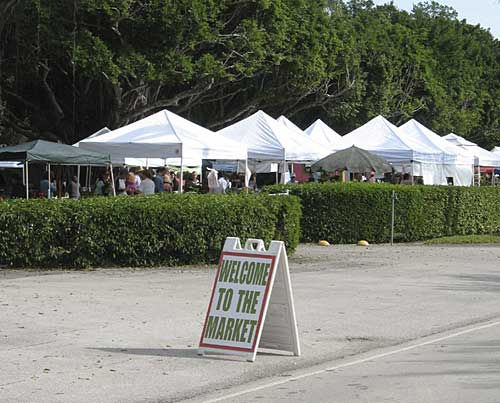
Suddenly it’s farmers market season again! A new market sprang up on Sunday morning in the Pinecrest Gardens parking lot. Formerly the South Florida Farmers Market, it has all your old favorite vendors and plus a few new ones. And it was mobbed! Despite a 9 a.m opening time, plenty of people pestered vendors at 8 a.m. (the old opening time) as they were setting up. Farmer Margie Pikarsky of Bee Heaven Farm emailed me, “Business was great. Best start day for a market. Pretty darn good, considering it was also a new location, and a month earlier!!!”
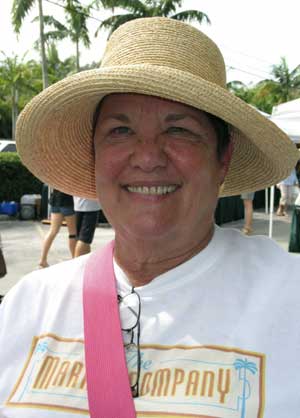
Claire Tomlin, The Market Company

The change in location was a long time coming. Germaine Butler, the founding president of the Pinecrest Garden Club, is delighted to have the Pinecrest Gardens Farmers Market at the garden. “I wanted a market for seven years,” she told me. “This is a community garden, and the market fits in here.” It took some persuading from Farmer Margie, Mitch Rabin of Living Colors Nursery, and Tim Rowan of The Lettuce Farm, to move the market to its new location. Claire Tomlin, who owns The Market Company which runs this market, is happy with the move. She said there’s plenty of room, plus it seemed a natural fit with the neighborhood. Compared to the Gardener’s location, the vibe is definitely more laid back, with people strolling up and down the long row of vendors. And there’s plenty of overflow parking along Killian Drive.

The large Redland Organics tent is located at the west end. If you’re in the CSA, and you want more of something in your share, you can find it at the market. If you’re not in the CSA, this is your chance to get the same things your friends are enjoying. You’ll also find goodies at RO tent that you won’t find in your box, such as smoked eggs, dried fruit, local raw honey, tomato plants, various tropical fruits from Possum Trot Nursery, and delicate oyster mushrooms (which debuted at Ramble) grown by Paradise Farms.

Fresh Local Organic at the Redland Organics tent

Redland Mediterranean Organics holds down the east end of the market. Stroll over to see Hani Khouri tending the falafel fryer, and get a taste of his goat cheese, hummus and tabouleh. Yeah, there’s another guy selling similar food, but it just doesn’t taste the same. And if you want pumpkin pie ice cream made with fresh goat milk, this is the only place you can find it.

And while you are there, stroll through the Pinecrest Gardens themselves. Admission is free, and docents from the garden club will give tours at 10:30 a.m. and 12:30 p.m. The garden club has big plans to put in a world-class kitchen and bring in world-class chefs to give cooking classes, according to Germaine Butler. Once an avid rose grower, she now plants arugula in the front yard, and has a philosophy of “sow it, grow it, serve it, eat it.” Sounds like a good match of garden and farmers indeed!
Read Full Post »

Go make your beds

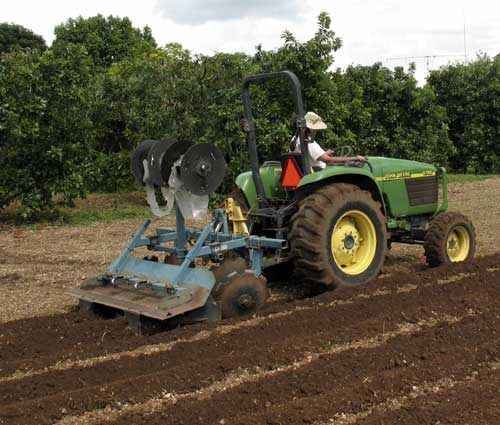
A lot of behind the scenes prep work goes on at Bee Heaven Farm before the first seeds are planted. The cover crop, which fixes nitrogen and other nutrients, has been mowed and tilled under to also add organic matter to the soil. The next step is to create rows of raised beds, where the vegetables will get planted.

Making beds

Making beds

The bedding attachment behind the tractor cuts into the soil and shapes it into a bed with channels on either side (where tractor tires pass). Native soil is not very deep in Redland. It averages about 1/4 inch over limestone rock. At Bee Heaven Farm — after rock-plowing, years of building up organic matter, and mounding up the beds — soil is maybe 4-6 inches deep, and very rocky. That’s it! That’s what your food grows in! The beds then need to be shaped and leveled by hand with a hoe. Rows of plants will then get planted by hand or with a seeder in each bed, either as transplanted starts or directly seeded. Tomatoes are planted in one row, beets in 4 rows, greens in 8 rows, or anything in between.

Bedding attachment

Bedding attachment in action

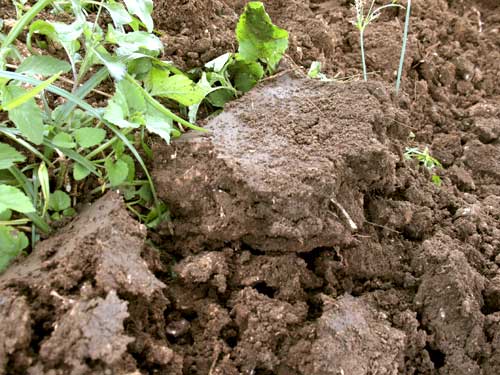
This past Saturday when I arrived, Farmer Margie was driving the tractor with the bedding attachment on the back, making passes up and down the main planting area. The bedding process wasn’t going very well. I saw one row wasn’t straight, kind of tapered into the next row. As she climbed down from the tractor, Margie explained that was where the tractor had actually slipped in the ground. The soil was wet from scattered rain showers blowing through because of a cold front. The wet soil was also getting compacting into clay-ey clumps, losing aeration and fluffiness that had been created by tilling. (For a detailed explanation of soil compaction and air spaces, read Margie’s post on tilth at Bee Heaven Farm’s Blog.)

Wet soil clumps

Wet soil clumps

Margie grumbled that she would have to wait until the weather cleared and the soil dried out, then till all over again to erase the curving beds of compacted soil, and attempt bedding again. Clearly every step of the growing process is affected by weather, in ways both subtle and obvious. Too much rain, not enough rain, too hot, too cold, too windy — the farmer is almost always at the mercy of the weather.

Read Full Post »

If you’re new to this area, you might be thinking ah, fall, time for harvest. Not! The growing seasons are upside down this far south. During the long, hot summer, most growers take a break. They start preparing the soil and planting in September and October. This time of year is their “spring.” The first crops are harvested around November, maybe earlier, depending on what you’re planting. So if you’ve had a garden when you lived in northern latitudes, and you want to have one here, you have to adjust for the location and climate and soil.

Farmer Margie was interviewed for a recently published article in the Fort Lauderdale Sun-Sentinel called How to plant a fall vegetable garden in South Florida. In it she discusses all-important soil preparation and how to grow heirloom tomatoes (one of her specialties). You can read the article online. (Hopefully they will keep it in the online archives for a while!)

Read Full Post »

Several months ago, I blogged about Jaideep Hardikar, a journalist from India who was here in the States on a fellowship. He wrote the article The Farmers Among Us that was published in the Sun-Sentinel. The original article profiled several growers who belong to Redland Organics, but is no longer available online. A shortened version was published on the front page of the Business section of the Miami Herald on Tuesday Oct. 13th. You can read it here.

According to the article,

Across the United States, consumers are increasingly buying directly from local farms through a model started decades ago in Switzerland and Japan now known as Community Supported Agriculture.

Nationwide, sales from farms directly to consumers — including CSA and farmers markets — jumped 49 percent from $812 million in 2002 to $1.2 billion in 2007, according to the most recent Department of Agriculture census. That’s twice as many sales as a decade earlier, the federal agency said.

Estimates of active CSA programs vary, but the 2007 U.S. census found more than 12,500 farms selling directly to consumers in every state. The National Center for Appropriate Technology, an agriculture think tank, estimates CSA programs supplied food to more than 270,000 households last year.

Farmer Margie told me that last season she had 440 CSA members, and has 465 members this season. She started Redland Organics CSA in 2002 with only 25 members. There are at least 100 on the waiting list. Turnover varies, maybe about 35%. Margie also mentioned that in January there will probably be a very limited number of trial shares available, and only to those folks already asking about them. She is pretty much at full capacity already. If you’re not a CSA member, but still want to get the same food, you can shop at the South Florida Farmers Market in Pinecrest.

Read Full Post »

The photographer and her work

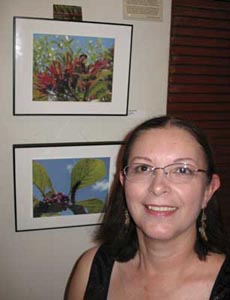
The photographer and her work. Photo by Margie Pikarsky.

As I entered the Miami Beach Botanical Gardens, the sweet, intoxicating scent of jasmine greeted me. Friends were waiting for me at the exhibit, and I was glad they came out to see the art and to show support. Farmer Margie and her husband Nick took turns taking pictures of me with my pictures, and it felt like paparazzi. Now I know what it’s like on the other side of the lens! Margie pointed out that the picture Firebush was hanging right below the sign that said FIRE extinguisher. Hmmm, seems like the people who were hanging the art have a sense of humor, I like that. Robert the Cantankerous Chef also came, and was discussing what kind of caterpillar that was. He thinks it’s a zebra Gulf Fritillary butterfly, and Margie thinks it might be a brown orange julia. [Both caterpillars are quite similar in appearance and both are natives, according to Margie, who looked these things up. Thanks for the fact checking!]

Claire Tomlin of The Market Company (whom I’ve met at the South Florida Farmers Market) provided veggie snacks, and Schnebleys brought a variety of fruit wines. I sampled the avocado wine, and it’s similar to pinot grigio with a whiff of avocado, and it’s actually pretty good. Heard the lychee wine (my favorite) ran out fairly quickly. Hung out till the very end with my friend photographer Mark Diamond, waiting to hear the announcements of the winning artists, including audience choice, but neither us of won anything. Thanks for your votes, it’s all good. I’m glad to be in the show, and hope that more shows are to come.

The pictures look a lot better in person, so if you haven’t seen them and you’re in the area, stop in and take a look for yourself. The show is up for only this week. I’m coming by on Saturday afternoon to pick them up — unless you want to take them home with you…? Let me know…

Botanist Steven Woodmansee wrote about the plants depicted in the art works. Here’s what he wrote about my pieces, which was posted on a card next to them.

1.  Beautyberry  – This photograph depicts one of our showier native flowering plants. American beautyberry (Callicarpa americana) is a member of the mint family (Lamiaceae), and its leaves are aromatic when crushed, although it is not recommended for culinary practices.

However, the clusters of purple fruit do attract birds, especially mockingbirds, who will defend “their” plant from other encroaching birds. It is native to upland habitats including pinelands and hammocks, and prefers full sun.  Branches may be clipped, and used in flower arrangements, as they last several days.  In cultivation, it is best to cutback the plant to one third its size at least once a year.  It is native throughout Florida and portions of the southeastern United States.

2.  Firebush – (Hamelia patens) is a member of the coffee plant family (Rubiaceae).  The showy tubular red flowers attract a plethora of butterflies and hummingbirds (and in this photo, a honey bee).  A favorite for the butterfly garden, firebush flowers year ’round, and grows well in partial shade.

Its fruits are devoured by birds.  It is recommended that for a bushy appearance and longevity, plants be cut back to one third its size at least once per year.  This species is a must for any Florida yard.  It is native across most of peninsular Florida where it can be found in swamps and hammocks.

Read Full Post »

« Newer Posts - Older Posts »