Feeds:
Posts
Comments

Posts Tagged ‘Slow Food Miami’

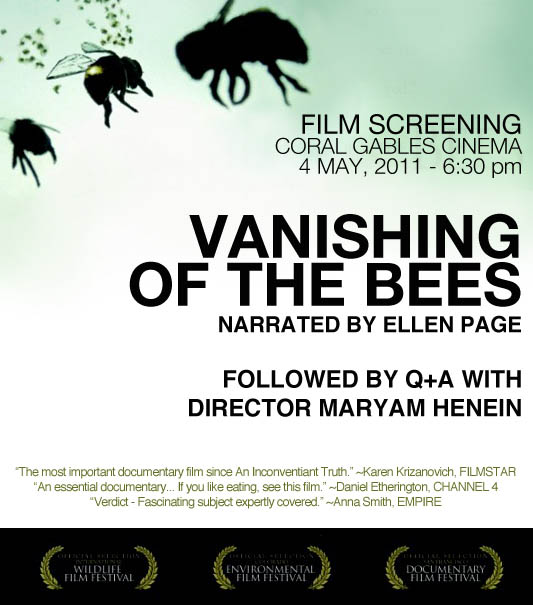
Don’t miss the only second South Florida screening of Vanishing of the Bees, a beautifully filmed, critically acclaimed documentary about Colony Collapse Disorder — the mysterious phenomena that has been killing entire hives of commercial honey bees around the world. (Correction: the documentary also screened on Earth Day as part of a fund raising film and food event. See the writeup in the New Times.)

The screening will be held at the new, state of the art Coral Gables Cinematheque, and is sponsored by Slow Food Miami. Before the screening, there will be complimentary champagne, and savory and sweet local snacks for purchase. Farmer Margie Pikarsky and her crew are bringing honey and flowers from Bee Heaven Farm.

This documentary is independently produced and was many years in the making. Film director Maryam Henein and beekeeper John Herring will answer questions after the screening. All the proceeds from this event go toward Slow Food Miami’s program which builds school and community-based gardens.

Come support the filmmaker, Slow Food and bees. Tickets are $14 each, and you can buy them online. Click on the “reserve your spot now” button to pay by credit card. Hurry, there’s only a few seats left. This screening is one night only.

Wednesday May 4, 2011
6:30 p.m. Complimentary champagne
7:00 p.m. Film screening
8:30 p.m. Q&A with film director Maryam Henein and John Herring, VP of the Broward Beekeepers Association

Location:

Coral Gables Cinematheque
260 Aragon Ave.
Coral Gables FL 33134
786-385-9689

Parking is available in the garage next door.

Read Full Post »

Pie…. ah, who doesn’t love pie. Fruit pie, custard pie, pie with whipped cream on top, pie with ice cream, pie with a light flaky crust. Pie! As much as I love eating pie, I haven’t had much luck making it. Have been thwarted by the most important step — making a crust that is light and flaky, not tough and rubbery.
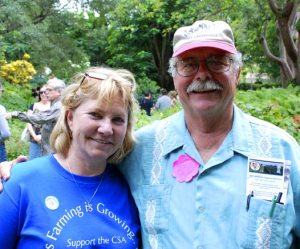
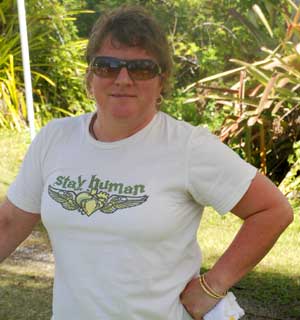
Growers Teena Borek and Robert Barnum

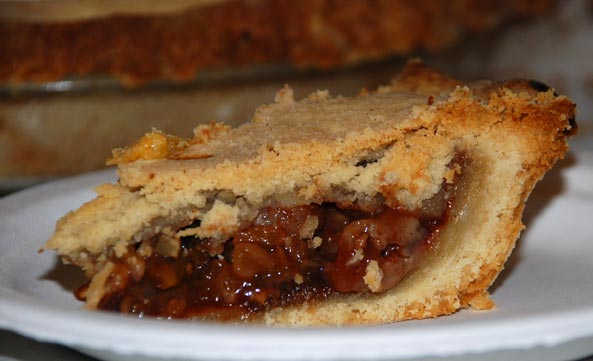
The Cantankerous Chef aka Robert Barnum spent his summer vacation patiently working on pie crust. He was passionately in pursuit of the perfect light, flaky crust to use in his tropical fruit pies. He told me that I could get a taste of that perfection in his homegrown longan-walnut-‘bola raisin pie at the Slow Food Miami “Pie on the Porch” competition this past Saturday.

It was a great afternoon to hang out on the wide wraparound porch at the historic Merrick House while sipping lemonade. Kids ran around on the lush green lawn under the shade of huge live oak trees. A vegetable garden had been set up on a side lawn. It was round, with coral rock borders, and looked very much like a pie cut into four slices. Boy Scouts from

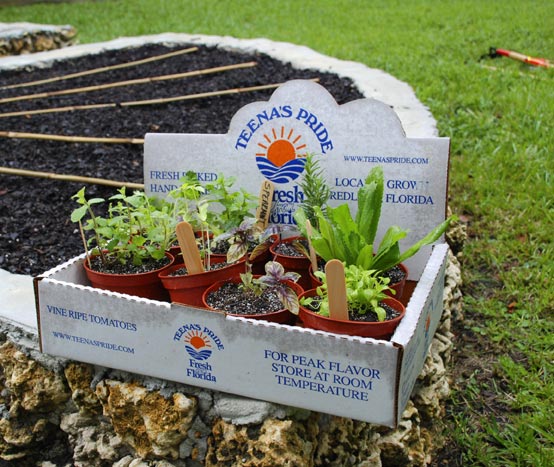
Little plants ready to grow.

Troop 4 tilled the soil, and starter plants provided by Teena’s Pride Farm were waiting to get planted into the beds. Slow Food Miami director Donna Reno explained this would be a historically accurate kitchen garden, growing foods much like the ones the Merrick family ate. The garden and pie competition are two of several events to  commemorate the 100th anniversary of the Merrick House.

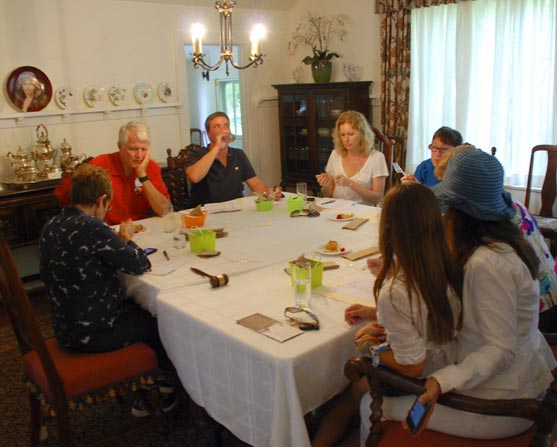
By the time I arrived, the porch was packed with eager, hungry people. Serving tables were set up, but where were the pies? They were inside the house getting judged. The seven judges aka the Supreme Court of Pie, led by Chief Justice of Pie Hedy Goldsmith herself, were ensconced in the dining room of the Merrick House. They were seated around a large table, armed with scorecards, plastic forks and glasses of water.
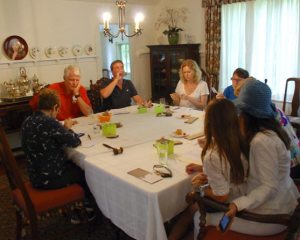
The Supreme Court of Pie

In the adjoining kitchen, 23 pies were arrayed on the counter. The pies were judged one by one. Three thin slices were cut and brought out to the table. The judges sampled and passed around the slices, discussed them briefly, and made their marks on score sheets. The judges evaluated pies on overall appearance, taste, overall impression, creativity, regional ingredients, and name. It was serious, intense work.
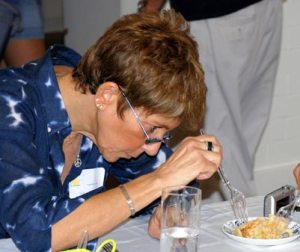
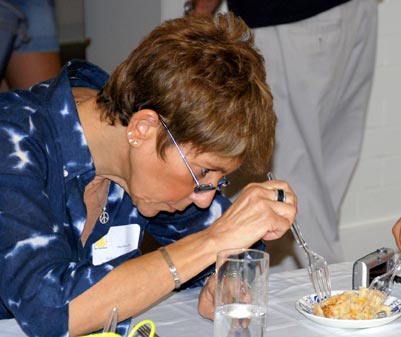
Pastry chef Hedy Goldsmith goes eyeball to eyeball with coconut pie.

According to the competition rules, “All pies must be made with a fruit or main ingredient that grows locally.” The pies had to be homemade, using home grown or local, and non-artificial ingredients. The pies had small cards describing what they were, but contestants were not identified.

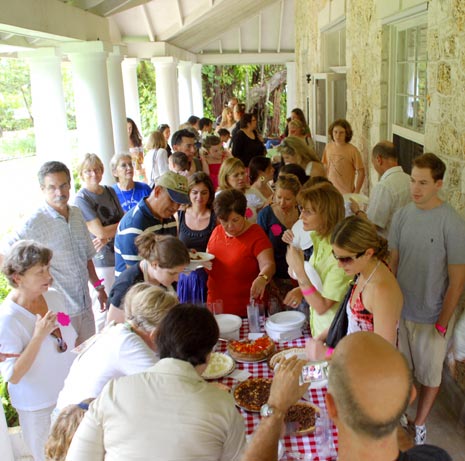
Once the pie was judged, a runner brought it out to the porch, where hungry guests were waiting for a taste. As a Slow Foodie began slicing and doling out pieces, people immediately mobbed the table. You’d think they hadn’t eaten pie in ages. “It’s a feeding frenzy out there,” the runner commented when she returned to the kitchen. I was intrigued by a green avocado pie and a salmon-colored mamey pie, but those vanished before I made it to the table.
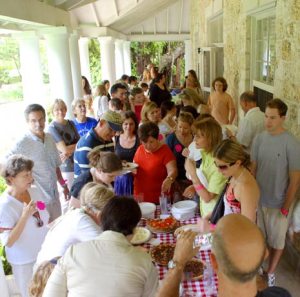
The first pies to emerge from judging got mobbed.

Tracked down Robert’s longan-walnut-‘bola raisin pie and dug in. It was a pie of complex flavors and unusual textures. Am not a fan of fresh longan, but baking mellowed and sweetened its flavor, and it tasted more like lychee. Encountered chewy bits of ‘bola raisins made from dried carambola, and crunchy bits of walnut. The texture reminded me of mincemeat pie, but count on Robert to push a recipe and turn the familiar into something different. As for the perfect crust, yes, it was light and crumbly, as promised. (If you want The Cantankerous Chef to make you a pie, and maybe dinner to go with it, give him a call at 305-235-1768.)

Most of the pies that I tasted (but I didn’t taste them all) followed the competition rule that the predominant ingredient must be local — mango, avocado, mamey, passion fruit, guava, coconut and longan to name the ones I saw. Some were nowhere near local — apple, apricot, pecan, chocolate — but they sneaked into the competition anyway.

The official winners were blueberry (could be local, blues grow in Florida), chocolate pecan (not local), and papaya (could be local). Details are posted on the Slow Food Miami web site.
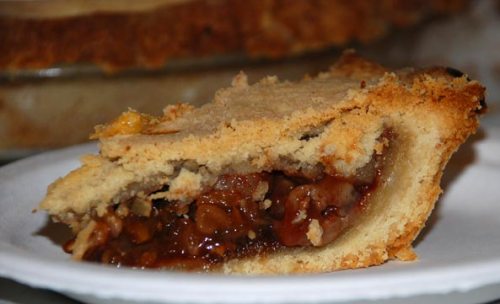
Robert Barnum's longan-walnut-bola raisin pie.

Robert’s longan-walnut-‘bola raisin pie won an Honorable Mention. His cantankerousness vanished for a few moments. “Yippee!” he cried out happily. “I’m in fourth place,” he kept telling me. Yes, indeed. Good to see his work receive public recognition on its merits alone. Good to see SFM inching closer to recognizing local food.

In the past, SFM was chided about using (or not using) local food at its locavore events. With this pie competition, the group came one step closer to walking the walk. If the Holy Grail of a locavore event is that the ingredients (all, most, or as much as reasonably possible) are sourced locally, this event came a bit closer. However, pies made from non-local ingredients (for example apple, chocolate, pecan, apricot) should have been kept out of competition.
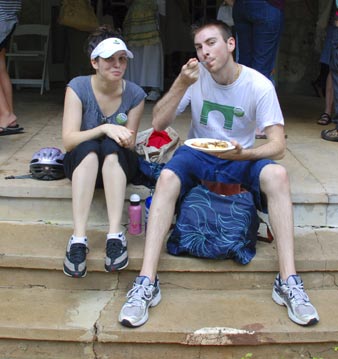
Foodies Naomi Ross and Brian Lemmerman enjoying pie bliss on the porch. They bicycled over from UM in the rain to taste something good to eat.

If you missed the pies, you can still visit Merrick House. It’s a lovely place, and one of the few structures that still remain from an earlier era. I’m glad I was able to visit it briefly, and want to come back another time to tour the house and grounds.

Merrick House
907 Coral Way
Coral Gables, FL 33134
305-460-5361, 305-460-5095

Kara Kautz, Historic Preservation Officer

Read Full Post »
Bikes resting after a tour of farm country.

On a sunny, breezy Saturday morning last week, over 80 cyclists converged on Bee Heaven Farm for the Slow Locavore Farm Lunch, organized by Slow Food Miami (SFM). The Farm Lunch combined a 7.5 mile bike ride along Redland back roads, with stops along the way at several farms, and ended with a gourmet lunch prepared by Chef Kris Wessel and Chef Kira Volz served at Bee Heaven.

Donna Reno

Donna Reno, the leader of the Miami convivium (as the SF chapters are called) said she came up with the idea after going on a similar farm tour bike ride in Italy about 20 years ago. Farmer Margie (who has served on the SFM Advisory Board for the past year or two) was an active collaborator and gave that memory legs. She picked the farms, plotted the route, made suggestions for sourcing local food, and provided her ample front yard for the event.

The cyclists visited four farms, beginning and ending at Bee Heaven, with stops and tours at Fancy Koi 2 fish farm, Going Bananas! nursery/grove, and Teena’s Pride farm, which is known for its large and lovely heirloom tomatoes. “It’s important to know your grower and visit the farm,” grower Teena Borek told me. These weren’t just pointless, picturesque visits but an opportunity for locavore cyclists to put their eats into a bigger context. The connection would have been stronger and easier to make had more local local foods from those farms been on the menu. But maybe I’m asking for too much? More on that later…

Chef Kira Volz, Creek 28

This bike ride/farm lunch was daring and unusual for SFM because it was held outdoors and was reasonably priced. Most of their activities are meals in upscale restaurants for hefty prices. It was good to see Slow Foodies get out from behind white linen tablecloths and ride around in fresh air and sunshine for a change. But wait! Most of the attendees were participants of spinning classes at Equinox gym, not just the usual Foodies. (Donna Reno explained that they got permission to hold an olive oil tasting at Equinox, using it “to reach out to the biking and fitness biking communities.”)

A few CSA members were also in the mix. Janet  and Larry Peterson said the ride was an great opportunity to visit farms that were “pretty impressive” that they otherwise wouldn’t be able to see. Janet explained she was inspired to seek out local food and joined the CSA after a group at her church, Riviera Presbyterian, read Barbara Kingsolver’s book, Animal, Vegetable, Miracle. As she looked around Bee Heaven, she said, “If this kind of farming could take hold, it would be a good local food source and would stop urban sprawl.”

Lining up for seconds (and thirds) at Chef Kira Volz’s tent.

The printed menu had a clear, comprehensive definition of locavore.

It is part of the concept of local purchasing and local economies, a preference to buy locally produced goods and services. Those who prefer to eat locally grown/produced food sometimes call themselves locavores or localvores.

So, let’s look at the food:

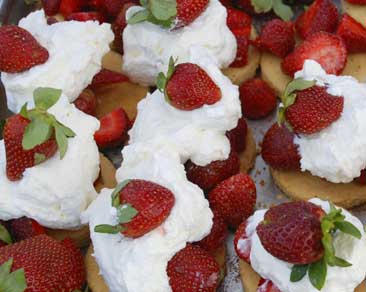
Key West Shrimp Fattoush (Kira Volz), Hand Rubbed BBQ Ribs & Herb Tossed Home Fries (Kris Wessel), Who Do You Do Voodoo Chicken (Kris Wessel), Andean Restorative Salad (Kira Volz), Aunt Rita’s Key Lime Pie (Kris Wessel’s aunt), Strawberry Shortcake Bar (The French Pastry Chef), Going Bananas Bread Pudding (Kira Volz) washed down with limeade (Robert is Here), water, beer and wine.

Yet not all the food on the menu was local. (Expected to see tilapia, since Fancy Koi 2 raises those fish.) When I asked Donna Reno about it, she did admit that “the freeze affected availability and we didn’t meet our goals 100 per cent in terms of local.” She pointed out that the tomatoes were from Teena’s, the shrimp was from Key West, and bananas in the bread pudding and strawberries were local. She even pointed out that the organic beer, Monk in the Trunk, was from Jupiter FL. (A closer reading of the fine print on its label revealed that it was actually brewed in South Carolina.)

Three of the four growers featured in the tour. L to R: Margie – Bee Heaven, Don – Going Bananas!, Sharon – Fancy Koi 2. Photo by Nick Pikarsky.

Wait a minute! Call it Locavore Lunch but only a smattering of ingredients is actually locally sourced? My head is spinning! A completely local meal is not that hard to do. It’s been done before. Last year’s End of Summer Brunch over at Robert Barnum’s Possum Trot was all local food and drink. And Farmer Margie held a Mothers Day Brunch last year that was completely locally sourced except for maybe salt and pepper.

Donna was pleased with the event. “We’ll do it again, maybe next spring,” she told me. Good idea! That’s plenty of time for SFM leadership to scope out farms and groves and farmers markets to see what’s growing — locally and in season — and create a menu from local food, rather than build a menu and then look for some local food to fit. I’m certain that Chef Kris Wessel and Chef Kira Volz could have come up with delicious, creative dishes based on an all-local, post-freeze list of ingredients, had they been given that challenge. It would be fantastic if the group held more events that celebrated local, regional and artisanal food, as per their own principles and mission statements.

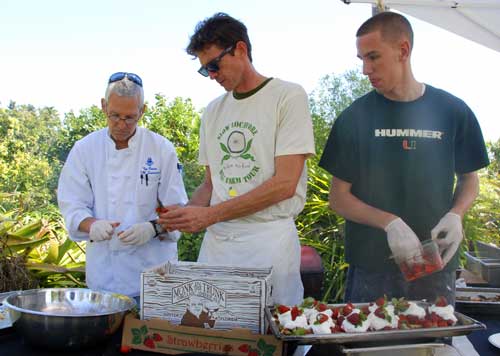
Chef Tim Rowan of Deering Bay stopped by to help out Chef Kris Wessel of Red Light. Filling in as his prep chef is his second cousin Mark Parkerson.

Locavore shouldn’t be just a foodie fad — it’s not about worshipping trendy ingredients or rock star chefs. The point is to connect the food on your plate with this place and these growers. They work very hard to feed us city folk, and have a tough time paying their bills. “The only way a small grower can survive is to sell directly to the public,” Teena Borek told me. Hopefully that connection or epiphany happened with participants on the bike ride. Our grandparents knew what food was about. It was so obvious to them but we’ve forgotten how. No farms, no food, no chefs, no locavores. It’s just that simple.

(For another take on the bike ride and lunch, check out this recent post on Mango & Lime.)

Strawberry shortcakes for dessert!

Read Full Post »

Join Slow Food Miami for breakfast at the Pinecrest Farmers Market, located at 11000 Red Road.

Sunday, December 13
9:30 AM – 11:00 AM

$8 for Slow Food Members; $10 for non-members
RSVP to Exileatmed@comcast.net

MENU:

Organic Egg Strata with Hani’s Goat Cheese and Fresh Herbs
Joanna’s Breads
Local Fruit Salad
Fresh Tomato with Organic Lucini Olive Oil and Aged Parmesan
Coffee

GUEST SPEAKERS:

Katie Edwards, Executive Director of the Dade County Farm Bureau
Holly Hickman, Congressional candidate and author

Breakfast produced by Slow Food Miami, The Market Company, JoAnna’s Marketplace and Redland Mediterranean Organics.

Shop for fresh produce and support our local farmers. REMEMBER “No Farms, No Food.”

Read Full Post »

« Newer Posts