Feeds:
Posts
Comments

Archive for the ‘farm’ Category

Gabriele Marewski of Paradise Farms Organic announces another season with a stellar line up of Miami’s best chefs! Prepare yourself for an incredible evening of rustic decadence as Dinner in Paradise takes you away to a lush and tropical setting.  Upon arrival, guests enjoy a welcome reception with delicious hor d’oeuvres, before heading off on a farm tour, conducted by Gabriele that encompasses this beautiful five acre organic paradise and its fruit trees, edible flowers, mushrooms, and fragrant herbs.  As the sun sets on the evening, the magic truly gets underway.

This year, Dinner in Paradise proceeds benefit the Urban Oasis Project, a not for profit organization, whose mission it is to make fresh local food available to every one. Paradise Farms’ Ready to Grow garden beds will be installed in Liberty City and homeless shelters that house children in Miami Dade County.

Dinners are scheduled from December through February and begin at 5 PM with a cocktail reception followed by a farm tour. Dinner begins at 6 PM. March & April dinners will begin at 7PM with the cocktail reception at 6PM. Each dinner, priced at $165.50 (tax and google fee included), features five courses made with local, organic products, paired with top quality wines. Schedule/Chefs subject to change. Please visit the Paradise Farms web site for updates and to make reservations.

Read Full Post »

Ten students from the Ecology Club at Miami Southridge Senior High School put in a day’s work at Bee Heaven Farm. This was not just any kind of work day but an Environmental Immersion Day, as part of the Fairchild Challenge, sponsored by Fairchild Tropical Botanic Garden.

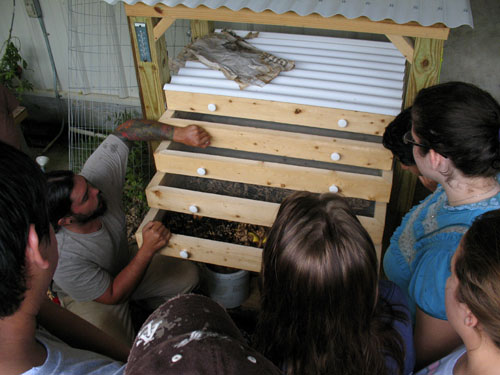
On Thursday, November 3rd, ten students, their Ecology Club advisor, and the Challenge coordinator arrived bright and early in the morning. Farmer Margie gave them a tour of the farm, along with a explanation of organic farming practices that she follows. The kids were introduced to the vermicomposting setup by intern Eric Morales, and learned how to grow worms to make worm castings and worm tea, which are then used as fertilizer.

Farm intern Eric Morales teaches the ins and outs of the Worm Manor.

But the must important part of the day lay ahead. The students’ mission was to get rid of invasive, non-native plant species that had taken root in a buffer section planted with native plants. On the non-native hit list were long pesky

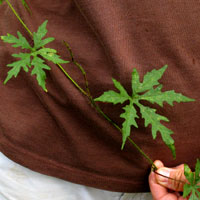
Non-native jasmine vine

vines of a sweet smelling but totally invasive variety of jasmine, a variety of morning glory, and wild petunia with purple flowers. Although these plants look pretty when they bloom, they can quickly overwhelm the natives by competing for light and space.

The non-natives had put down long runners that threaded through and on top of cabbage palm, coontie and and other native plants in the buffer area. Those vines are tough to remove. You can’t just grab and pull on it, and expect it to come up. You have to grab one end and start working your way back to the root, then dig a bit to pull it out, or the whole plant will grow back.

Non-native morning glory

Margie carefully pointed out the difference between the non-native jasmine leaves which had a pointed tip, and a very similar native plant which had smaller leaves with a rounded tip. An albizia, or woman’s tongue, tree was attacked by students with loppers and a pruning saw. They hacked it into chunks, loaded them into a wheelbarrow, and wheeled it to the compost heap. Part of a shrubby Brazilian pepper suffered a similar fate.

Farmer Margie shows how to attack Brazilian pepper.

The students were accompanied by the Ecology Club mentor, Jennifer DeHart, who teaches AP environmental science at Southridge. She picked students who were the most active in the club to participate in this day’s Challenge. Her ten

Non-native albizia or woman's tongue tree

students worked hard, sometimes in a drizzling rain, and cleared out a good bit of “bad” plants by the end of their day. Most importantly, they learned a bit more about plants, worms and organic farming — and what to do about a wasp sting.

Non-native wild petunias

Also on hand was Challenge coordinator Marion Litzinger, from Fairchild Tropical Botanic Garden. She explained that the Fairchild Challenge is a free school program to get kids involved in hands-on activities alongside scientists or growers. The goal is to reconnect kids with nature and the environment, Marion explained. Students win points based on doing different Challenges throughout the school year, and all the points add up to winning varying amounts of money for their school, as much as $1000, meant for improving the environmental situation at the school.

For more information about the Fairchild Challenge, contact Marion Litzinger at 305-667-1651 ext. 3356 or mlitzinger@fairchildgarden.org.

Read Full Post »

Packing avocados

Organic avocado grower Murry Bass of Wyndham Organics was packing avocados in the Bee Heaven Farm barn for most of the summer. His fruit was selling under the Uncle Matt’s brand at Whole Foods. Although Murray is done packing his avo’s, there are still some late varieties getting picked and coming to stores.

I made this little story to show you how the fruit gets from the tree to the store. Click on the image to see the full sized comic page. (I made the comic last summer, but the process is pretty much the same from year to year.)

Read Full Post »

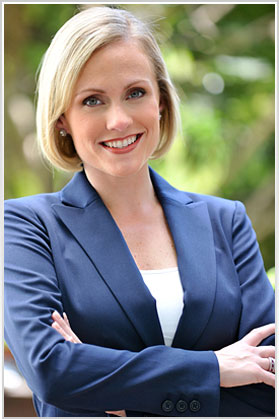
Katie Edwards

MW: How to keep the land in agriculture? The farmer thinks that the land was your bank, that’s your retirement fund.

KE: I’d rather see us focus, before we start looking out, start looking in and focus more on reinvestment. Even in the city of Homestead there are things that we can be doing for energized growth. I think, you take the lazy approach and say Ok you know what, I don’t like what I drew on that piece of paper, scratch, give me a new one. That’s the mentality. It’s so much easier.

MW: So you’re saying the urban sprawl is not economically viable any more?

KE: I don’t think it ever was. I don’t think it ever was. I don’t think it makes sense to build up out of there. I don’t think we should vilify farmers for the predicament that they’re in. I don’t think that they created it That’s the plot in life God gave them, is they’ve got land that has to be planted, and they’ve got to be able to take out money to sell their crops, to buy their seed, their inputs, their fuel at the beginning of the season, and what do they do, they go to the bank. Pre-NAFTA they were making money and they didn’t have these issues. And all of sudden, it’s like everything happened. We convert row crop land to nurseries, and we end up that there are 1200 nurseries in Miami-Dade County, that’s too many. And then what happens? We’ve got water restrictions and people aren’t buying plants. And then we have a recession and housing market, there’s nothing to landscape. People would rather pay off bills rather than landscape or re-sod their homes. Most of the nurseries are on small parcels. They can’t put a subdivision in there. So what do the growers do? They are abandoning, they’re walking away from their properties saying I can’t make it, sorry. That’s the problem. Drive around Redland and see how many nurseries there are with for sale signs up, vacant ground covering those lands there. They can’t afford to maintain them. That’s the problem I’ve encountered.

MW: How does Farm Bureau speak for the small guy? Or is Farm Bureau only for the big guys?

KE: I’ve got quite a lot of small growers [as members]. A lot of these guys are new farmers, some are generational growers, but some are completely new to the business. We’re just trying to find ways trying to make everyone happy, because in my industry the people that I represent are so diverse, ethnically, gender-wise, age, income and what they grow. You’re going to have some issues that collectively we all agree on, but everyone needs a different type of help and assistance. What my big farmers need help with are immigration issues, so most of their issues are federal. With the smaller farmers need mostly are county, they want help with their certificate of occupancy at farmers markets, they want help with ag assessment, they want help marketing, they want help making inroads talking with chefs.

MW: In other communities you have farmers communicating with chefs. Food writers are writing about eating local food. Would be great if more restaurants sourced locally.

KE: Absolutely! You help promote, you do incentives, you provide more awareness and recognition like for programs like Redland Raised. And the farmers have the chance to be entrepreneurs, to adapt and to be creative. Because if we’re going to be adaptive in the industry and keep looking for new and emerging markets, we can’t have the state, or most oftentimes the county saying, no you can’t do this. With the winery for example, I helped Peter Schnebly with the winery ordinance. Originally, that was illegal. And all the residents in the Redland were fighting against it saying it will be disruptive, it’s not going to do anything for us, and now they all love it. And that was the whole thing, trying to find a way to get creative. You have to have common sense. You have to give growers enough flexibility to be able to be entrepreneurs, to be creative and to stay in business.

MW: What issues come up at fundraisers?

KE: Each population has its issues. The issues in Sweetwater aren’t the same as the issues in Homestead or the Redland. And you talk and you learn. Part of what I do is try to bring people together, find commonalities, and then figure, where we can compromise and where can we get stuff done.

One of the biggest issues in West Kendall is dealing with the homeowners associations. With the huge rate of foreclosures and trying to strike a balance between the rights of the condo association, the rights of the homeowner, the rights of the bank that actually has title when someone has to walk away from the mortgage. How do you look at it as a human being, but what does the law say? You can’t keep asking private citizens to bear more of the brunt of the economic crisis when it comes to the HOAs and the foreclosures.

The other issue that’s important to me is property tax reform. It’s very expensive to be a homeowner in Miami-Dade County. When I began doing comparisons online, looking at the Miami-Dade Property Appraisers website, I saw the complete inequities in what we’re paying but we’re all sharing the same services. Let’s say I pay 2 thousand dollars a year in property taxes, my neighbor next door pays less because they bought their home in 1998, that to me is not fair. We’ve got to figure out something holistically that provides people an opportunity to share in government services that’s not based on some fictitious value, which is to me all these fair market values are, it’s just whatever the market is. I’m willing to put it out there and tell people we’ve got to have a serious conversation on how to fix this and make it at least equitable and fair for all of Floridians.

When I come back from Tallahassee I’m still going to go in to the Royal Palm Diner, and I’m still gonna have to face these people who are going to grill me and say, why did you sell out, why did you do this? I want to be able to still be Katie and still be a member of this community and have my name in good standing. I don’t understand how anybody could ever lose sight of the fact that they are going up there not for themselves but for other people. And these people, they’re giving you their vote, which is the most powerful thing they could ever give you. If someone says, I can’t give you a donation, I say that’s fine, what I really need is your vote. The money is great but it can only go so far, though. When people come to you and they say, when you get elected I want you to help me work on these projects, I’m like, absolutely. You have to give them an open door, you have to be accessible.

Read Full Post »
You haven’t heard much from me these last few months because I’ve been feeling de-pleated by condo board responsibilities. Small problems were looking big, and bigger problems looked overwhelming. Time to hit the reset button, so I headed down to Bee Heaven a couple weeks ago to get some much needed farm therapy.

Fall is planting time down in Redland. Summer is just too hot, too buggy and too rainy to grow much of anything. Planting starts in the fall near the start of the dry season, and harvest is in the spring. The growing seasons here are completely upside down compared to the temperate climate Up North.

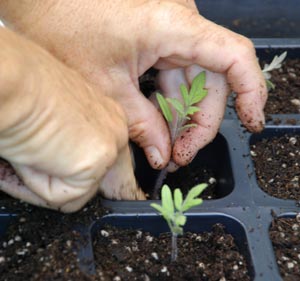
Jane transplanted starts into their first pot.

It was a sunny, breezy Saturday afternoon when I visited Bee Heaven. Margie and her manager Jane Cameron were puttering in the potting shed, transplanting starts, or baby vegetable plants, from the seed beds to small pots. A bit of soil went into the bottom of each pot. Then, one by one, Jane carefully lifted each start out of its bed and placed it into its new home. She set the plant down with one hand, put more soil around it with her other hand, and pressed the soil down gently. The work had a gentle rhythm. Repeat it a hundred more times or so, and that was the afternoon’s task.

Growers will tell you there’s something hopeful about working with baby plants. “It’s so exciting to see them grow from seed,” Jane said. “It’s empowering. It feels exciting to see the plant first poking out of the ground, to see the energy. You don’t get that with a plant already started that you buy from the store.”

You’re not thinking of bugs, or disease or freeze — although those risks are there, even at that stage. Some starts’ leaves had evidence of bugs munching along the edges. Another start revealed a small black caterpillar near its roots, as it was gently lifted out of the seed bed. The caterpillar would grow up to be a butterfly of some kind, Margie explained, but in the meantime, it was chomping on little roots. A note was made in the input log, and the plants and seed tray would be treated with BT for the caterpillars.

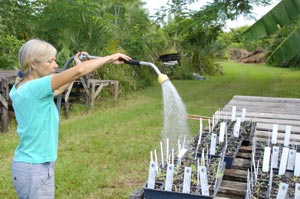
Jane watered the starts after transplanting.

Labels were placed into the pots, so you knew what kind of plant it was. Trays of pots were taken to an outside table made from old wooden pallets, where the starts soaked up sunshine and would grow and grow. Jane watered them lightly, holding the spray nozzle high above, so water fell gently like rain. Smaller starts were waiting on other outside tables nearby, still too young for transplant, maybe in a few more days. “They aren’t finished sprouting,” Margie said. When the little plants show four true leaves, then they are ready to pot up.

Most of the starts I saw that day were heirloom tomatoes with exotic names like Black From Tula, Red Calabash, and Zapotec Pleated. “ZAP-otec. That sounds like the name of a pharmaceutical,” Jane remarked. “Feeling de-pleated? Try Zapotec,” Margie chimed in. “It will pleat you back in no time!” Now there’s an idea — plant (and eat) heirloom tomatoes to be re-plete with energy.

Work done, I ambled around Bee Heaven to see how other things were going. Bright sunshine and clear blue sky were good medicine in itself, and soon I was feeling less de-pleated. A light breeze ruffled leaves, and mockingbirds twittered background music from a nearby big tree and from the hedges further over. Roosters living in nearby chicken tractors got a call and response chorus going. “Ur-ur-ER-ah,” one rooster called, and another responded an similar way, and another, and suddenly I was in the midst of poultry opera. “Here I am, how are you,” they seemed to be calling. “I am here,” I told them. (Yes, I talk to chickens.) I am here, I am fine, pleated and replete. Farm therapy works!

Read Full Post »

« Newer Posts - Older Posts »