Feeds:
Posts
Comments

Archive for the ‘farm’ Category

The Miami Herald has a nice long article about farmer Margie Pikarsky and the Redland Organics CSA. You can find it in today’s Tropical Life section.

Bee Heaven owner: Organic farming is good for the foodie — and the land

BY ANA VECIANA-SUAREZ
aveciana@MiamiHerald.com

On a muggy summer day, as bruised clouds gather overhead, Margie Pikarsky wends her way through her five-acre farm pointing proudly at strips of cultivated land and a growing compost pile. A blue jay swoops across the field, then another. In the distance a cardinal trills.

“I feel very connected to nature,” Pikarsky, 57, says, and then adds with a wry laugh. “I have this Mother Earth thing going.”

Indeed. Pikarsky has been running Bee Heaven, an organic farm in South Dade’s Redland area, since 1995, when pesticide-free farming was more a boutique niche than thriving business. She harvests honey, collects organic eggs and grows familiar fruits and vegetables as well as exotics — mostly Asian greens — that do well in South Florida soil.

She sells them at farmer’s markets and through Redland Organics, a community-supported agriculture (CSA) initiative that allows people to buy “shares” upfront in return for weekly selections of organic produce during the growing season.

Read more: http://www.miamiherald.com/2010/07/22/1740121/mother-earth.html

Read Full Post »

Summer has just begun and it’s already a scorcher! We’ve had above normal temperatures since April 26, according to the National Weather Service. Highs have been 90 degrees or above since May 30 (except for a slight dip to 88 on June 1). The heat index has been 100+ degrees most days. Last June was even hotter. Record temperatures were set on June 22, 2009 in Miami with a high of 98. Fort Lauderdale had a high of 100, tying an all time record. This summer feels hotter because temps have consistently been at 90 or above for 59 days and counting, while last summer temps were mostly in the high 80s with a few spikes in the 90s.

The last picture I took before getting chased off by a hot and cranky bee.

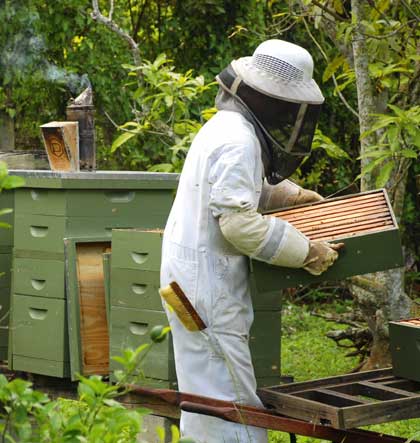
This crazy heat has an effect on livestock at Bee Heaven Farm. Chickens stand with their beaks open, panting, and hold their wings out a bit to their sides to try to cool off. Bees don’t like heat and get cranky. I passed by the hives when beekeeeper Miguel Bode was working with them a few weekends ago. One bee took offense to where I was standing, buzzed around my head, and chased me for a good distance. Lucky for me, I didn’t get stung but it felt close! Even the worms in the vermiculture bin have been suffering mightily. Instinctively they’ve dived down to the bottom of the bin, seeking cooler soil, but hit bottom instead. The Worm Guy (that’s what Margie calls him) advised chilling them down with frozen water bottles buried in the bin. Wigglers on the rocks, anyone?

I asked Farmer Margie what grows well in this kind of heat. “Weeds!” she exclaimed. Those weeds completely took over vegetable beds after Gleaning Day. Margie mowed them down, and now that she’s had two days without rain, she’s out on her tractor tilling the soil, preparing to plant cover crops.

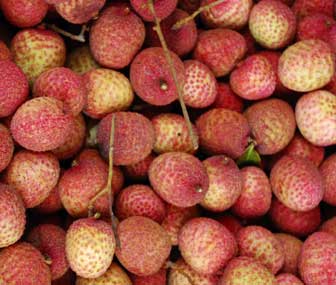
Some summer fruit is finally starting to get ready, but running a little behind schedule because of the freeze this winter. The extended period of super cold weather caused plants to go dormant for weeks. Lychees (Mauritus variety) are bearing late this year. Margie pointed out that last year, a bumper crop of lychees were harvested in late May. This year the harvest began in mid-June, and the quantity isn’t quite as much.

Mauritus lychees from last summer.

Another casualty of the cold are mango trees which were in bloom in January when the freeze hit. The long stretch of freezing temperatures damaged blossoms. Some fruit set and grew, but then aborted and fell off. I’ve seen trees that don’t have as much fruit, and if they do, they’re not as plentiful and not as big or developed.

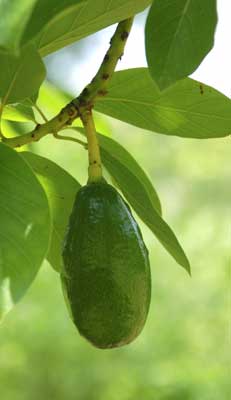
Half-grown Donnie avocado.

Avocado trees seemed to escape significant damage from the freeze in January. Branches are loaded with fruit several inches long, about the size of Haas avocados in the groceries. If you’re not familiar with Florida avocados, and you have a tree in your yard, don’t get confused and pick early! The varieties that grow here, especially the Donnies that Margie raises, get much much, much bigger than the Haas variety from California or Mexico. Last summer many Donnie avocados weighed in at 3 pounds apiece, and one giant weighed 4 pounds. Avocado picking will start in mid-July, also several weeks later than last summer.

Read Full Post »

glean to gather grain or other produce left by reapers; to pick up after a reaper; to strip (as a field) of the leavings of reapers.

Gleaning Day at Bee Heaven Farm is a laid back end-of-season tradition. CSA members are invited to bring a potluck dish, and rummage through vegetable beds and pick what’s left. About 80-100 people showed up last Sunday and many families brought their kids.
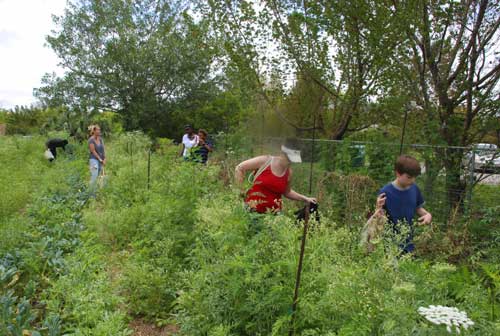
Waist high in weeds serching for morsels of food.

People started trickling in at 11:30 am. Those who had done this before knew the drill. They brought totes and snippers, and wore hats and sunblock. Instead of sitting down to eat first, they wasted no time in finding things to pick. It felt like an Easter egg hunt, only in this case you were looking for tomatoes and other comestibles.

Friends put me to work showing things to their grade school age boys. “Do you have carrots?” Mark asked. “Look, there’s some in this row,” I pointed out. He and Devin and I browsed down the row peering through weeds to wiggle carrots out of the ground. Getting fingers in the dirt was fun. Several sow bugs trundled out and the boys got animated. Forget playing video games. When was the last time you stuck your fingers in the dirt, tugged on fat orange roots, and communed with bugs? Heaven! Moments later we found ourselves over by the kohlrabi when the the horse snorted. Devin started. “What was that?” he asked. “Look at the other side of the fence,” I said. “It’s a horse, it’s a horse!” Mark exclaimed. You should have seen his eyes shine. I mean, it was a real, live horse!
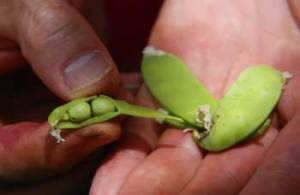
Like peas in a pod.

Grown up kids were also having adventures and making small discoveries. Over in the next vegetable bed, I showed Nathan how to hunt for snow pea pods hiding among withered vines. Some pods were bulgy, and sure enough, had small peas growing inside. “This tastes amazingly good,” Nathan said, munching on a raw pea. One row over were small bull’s blood beets, perfect for roasting whole. He could see round roots showing above the ground and it made sense to him what he was looking at. One good tug and a beet came up, dirt and and all. “It’s a beet!” he exclaimed (just like a kid). And thus a connection was made: here is a plant growing, part of a mass of undifferentiated greenness, but as you pick it, it changes to food. Magic!

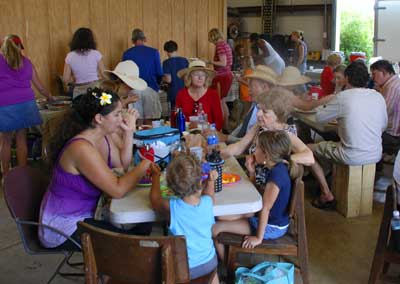
It was getting hot and I went back inside the barn, which was full of people eating and talking. The tables were loaded with lots of good food. A carrot and garbanzo salad seasoned with cumin was tasty, and I liked the Thai flavored mango salad. People ate almost all of the turnip slaw that I brought (recipe below). Managed to snag one of the last slices of Sylvia’s tart made with asian mixed greens, Hani’s goat cheese, and hard boiled eggs. She made her own crust and crimped the edge empanada style. You could taste the care that went into making it. The party was supposed to end at 2, but people were still hanging out when I left at 3. Once you get a taste of the farm, it’s hard to let go.

Everybody brought food, and it was all good.

Turnip Slaw

1/4 cup chopped red bell pepper
1/4 cup thinly sliced green onions
4 cups turnips
oil and vinegar
thyme (to taste)
salt and pepper

Peel and slice turnips, then cut into matchsticks. (Or, you can shred them in a food processor.) In a bowl, combine turnips with red peppers and green onions. Make a vinaigrette with your favorite oil and vinegar, including thyme, salt and pepper. Stir well. Refrigerate several hours for flavors to blend.

(Recipe originally from cooks.com, has been slightly modified.)

Read Full Post »
When cabbages fly

Last week, Farmer Margie told me that she was short-handed and needed volunteers to help pack shares. I offered to help, and rounded up my new buddy Nathan (who wants to be a tractor mechanic when he grows up), and he brought along his mother Tunie. Farm manager Muriel invited Christina, and we four volunteers joined the packing line in the barn at eight last Friday morning.

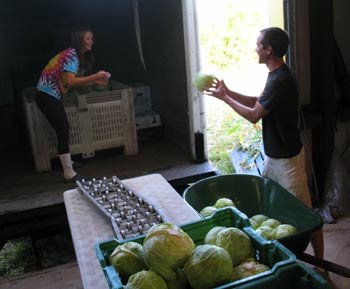
Kenna and Nathan make cabbages fly.

Before we could start packing the actual shares, the reefer truck had to be unloaded. It was full of vegetables from Worden Farm. The first challenge was a large bin full of cabbages, too heavy to lift fully loaded. Intern Kenna and Muriel climbed aboard and tossed cabbages fast and furious to Nathan and me. We caught and stacked them into wheelbarrows, which went to the head of the packing line.

Muriel determined which veggies went in which order on the line. The heaviest items get packed first and go in the bottom of the share box. The lightest things go on top, where they won’t get crushed. The actual packing went fast and easy. Margie and Christina packed cabbage and beets. Tunie added green beans and spring onions. I was next on the line. With my left hand, I reached for the box coming down the rollers and put in a bunch of kale. If the cabbage was big (and some were monstrously huge), I packed a smaller head of lettuce. If the cabbage was small, I put a bigger head. Then I pushed the box to Jesus on my right, who added mushrooms, closed the boxes and stacked them. Nathan loaded the boxes into the truck. Kenna was the runner, replenishing supplies of veggies and empty boxes.

Packing had a steady rhythm. Pull, pack, push. Pull, pack, push. When the full shares were done, the half shares were next. It seemed to go more slowly, but I think that’s because there are more half shares than full shares. Still, we were done by noon, and the truck was loaded with share boxes. Christina described the process as, “This is the place where the farm connects with the table, putting the vegetables in the box. Goodbye, vegetables! Hope you don’t wilt in the frig!”

Thanks to volunteers Nathan, Tunie and Christina for their hard work!

Read Full Post »

Paradise Farms introduces the first interactive “Learning Luncheon” featuring Private Chef Mary Siragusa.

Saturday, April 17th
11:00 am Arrival with sparkling organic juices, followed by farm tour
11:30 am – 12:30 pm Interactive food prep
12:30 pm – 2:00 pm Luncheon

3 courses with dessert @ $45 per person. Sign up at www.paradisefarms.net

Learn how to prepare delicious and healthy meals effortlessly while having a great time. Guests will have the opportunity to partake in the preparation of the meal. Chef Mary will explain the benefits of organic foods and show you how easy it is to incorporate organic juices and food into your lifestyle. You will be inspired by her fresh, wholesome approach!

Gabriele Marewski, owner of Paradise Farms, will lead a farm tour to collect the herbs and edible flowers for lunch with a discussion on how you can grow your own food.

Featured will be Carico International, a manufacturer of healthy lifestyle products including cookware which uses low heat and no oil.

MENU:

First course: Creamy cucumber soup
Second course: Baby Brassica greens with fennel, carrot and orange
Third course:
Grilled shrimp on top of orrecciette primavera
Dessert: vanilla coconut cake with a hint of lime accompanied with lime sorbet
Coffee and tea service.

Read Full Post »

« Newer Posts - Older Posts »