Feeds:
Posts
Comments

Archive for the ‘farm’ Category

Packing veggie shares

Ever wonder how the food in your CSA share box actually gets into the box? Or how many people it takes to do it? Many steps and many hands are involved. Here’s a picture of the packing line set up in the Bee Heaven Farm barn on Friday.

Q: How many people are packing shares? See the answer below. Click on picture for larger view.

First, the items are weighed, bunched or bagged and placed in the large plastic boxes or totes. Tables are set up in a long line, with rollers along one length and totes of veggies along the other. The person on one end — in the case of this picture, on the right — takes an empty box and puts a certain amount of some particular veggie into the share box, and slides it down the line to the next person, who puts their item/s in and slides the box, and so on. The last person — in this case, all the way on the left of this picture — closes the flaps and stacks the filled boxes. One person stacks the boxes inside the reefer truck. Another person is the designated runner, and scurries around supplying empty boxes to the first packer, and replenishes totes of produce from the cooler to the packing line.

A: If you said ten, you’re wrong. The correct answer is seven. From L to R: Kenna, Jamie, Lindsey, Margie, Andrew, Muriel. Jesus is inside the truck.

Read Full Post »

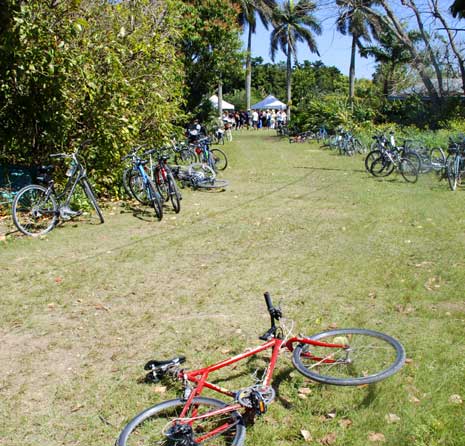
Bikes resting after a tour of farm country.
On a sunny, breezy Saturday morning last week, over 80 cyclists converged on Bee Heaven Farm for the Slow Locavore Farm Lunch, organized by Slow Food Miami (SFM). The Farm Lunch combined a 7.5 mile bike ride along Redland back roads, with stops along the way at several farms, and ended with a gourmet lunch prepared by Chef Kris Wessel and Chef Kira Volz served at Bee Heaven.
Donna Reno

Donna Reno, the leader of the Miami convivium (as the SF chapters are called) said she came up with the idea after going on a similar farm tour bike ride in Italy about 20 years ago. Farmer Margie (who has served on the SFM Advisory Board for the past year or two) was an active collaborator and gave that memory legs. She picked the farms, plotted the route, made suggestions for sourcing local food, and provided her ample front yard for the event.

The cyclists visited four farms, beginning and ending at Bee Heaven, with stops and tours at Fancy Koi 2 fish farm, Going Bananas! nursery/grove, and Teena’s Pride farm, which is known for its large and lovely heirloom tomatoes. “It’s important to know your grower and visit the farm,” grower Teena Borek told me. These weren’t just pointless, picturesque visits but an opportunity for locavore cyclists to put their eats into a bigger context. The connection would have been stronger and easier to make had more local local foods from those farms been on the menu. But maybe I’m asking for too much? More on that later…
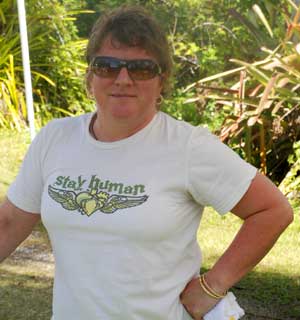
Chef Kira Volz, Creek 28

This bike ride/farm lunch was daring and unusual for SFM because it was held outdoors and was reasonably priced. Most of their activities are meals in upscale restaurants for hefty prices. It was good to see Slow Foodies get out from behind white linen tablecloths and ride around in fresh air and sunshine for a change. But wait! Most of the attendees were participants of spinning classes at Equinox gym, not just the usual Foodies. (Donna Reno explained that they got permission to hold an olive oil tasting at Equinox, using it “to reach out to the biking and fitness biking communities.”)

A few CSA members were also in the mix. Janet  and Larry Peterson said the ride was an great opportunity to visit farms that were “pretty impressive” that they otherwise wouldn’t be able to see. Janet explained she was inspired to seek out local food and joined the CSA after a group at her church, Riviera Presbyterian, read Barbara Kingsolver’s book, Animal, Vegetable, Miracle. As she looked around Bee Heaven, she said, “If this kind of farming could take hold, it would be a good local food source and would stop urban sprawl.”
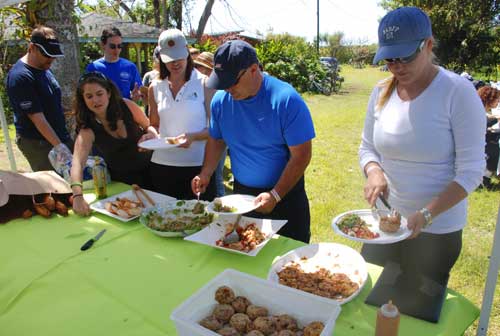
Lining up for seconds (and thirds) at Chef Kira Volz’s tent.

The printed menu had a clear, comprehensive definition of locavore.

It is part of the concept of local purchasing and local economies, a preference to buy locally produced goods and services. Those who prefer to eat locally grown/produced food sometimes call themselves locavores or localvores.

So, let’s look at the food:

Key West Shrimp Fattoush (Kira Volz), Hand Rubbed BBQ Ribs & Herb Tossed Home Fries (Kris Wessel), Who Do You Do Voodoo Chicken (Kris Wessel), Andean Restorative Salad (Kira Volz), Aunt Rita’s Key Lime Pie (Kris Wessel’s aunt), Strawberry Shortcake Bar (The French Pastry Chef), Going Bananas Bread Pudding (Kira Volz) washed down with limeade (Robert is Here), water, beer and wine.

Yet not all the food on the menu was local. (Expected to see tilapia, since Fancy Koi 2 raises those fish.) When I asked Donna Reno about it, she did admit that “the freeze affected availability and we didn’t meet our goals 100 per cent in terms of local.” She pointed out that the tomatoes were from Teena’s, the shrimp was from Key West, and bananas in the bread pudding and strawberries were local. She even pointed out that the organic beer, Monk in the Trunk, was from Jupiter FL. (A closer reading of the fine print on its label revealed that it was actually brewed in South Carolina.)
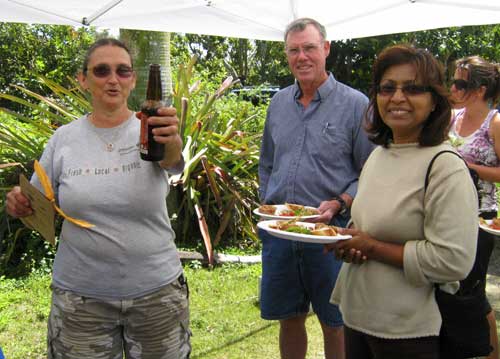
Three of the four growers featured in the tour. L to R: Margie – Bee Heaven, Don – Going Bananas!, Sharon – Fancy Koi 2. Photo by Nick Pikarsky.

Wait a minute! Call it Locavore Lunch but only a smattering of ingredients is actually locally sourced? My head is spinning! A completely local meal is not that hard to do. It’s been done before. Last year’s End of Summer Brunch over at Robert Barnum’s Possum Trot was all local food and drink. And Farmer Margie held a Mothers Day Brunch last year that was completely locally sourced except for maybe salt and pepper.

Donna was pleased with the event. “We’ll do it again, maybe next spring,” she told me. Good idea! That’s plenty of time for SFM leadership to scope out farms and groves and farmers markets to see what’s growing — locally and in season — and create a menu from local food, rather than build a menu and then look for some local food to fit. I’m certain that Chef Kris Wessel and Chef Kira Volz could have come up with delicious, creative dishes based on an all-local, post-freeze list of ingredients, had they been given that challenge. It would be fantastic if the group held more events that celebrated local, regional and artisanal food, as per their own principles and mission statements.

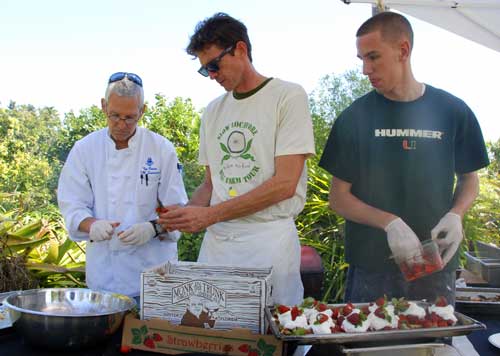
Chef Tim Rowan of Deering Bay stopped by to help out Chef Kris Wessel of Red Light. Filling in as his prep chef is his second cousin Mark Parkerson.

Locavore shouldn’t be just a foodie fad — it’s not about worshipping trendy ingredients or rock star chefs. The point is to connect the food on your plate with this place and these growers. They work very hard to feed us city folk, and have a tough time paying their bills. “The only way a small grower can survive is to sell directly to the public,” Teena Borek told me. Hopefully that connection or epiphany happened with participants on the bike ride. Our grandparents knew what food was about. It was so obvious to them but we’ve forgotten how. No farms, no food, no chefs, no locavores. It’s just that simple.

(For another take on the bike ride and lunch, check out this recent post on Mango & Lime.)
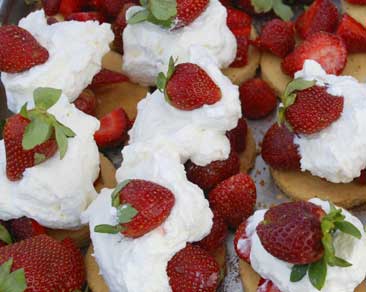
Strawberry shortcakes for dessert!

Read Full Post »

Avocado tree infected with laurel wilt. The fungus carried by the beetle causes entire branches to turn brown and die. Photo courtesy UF/IFAS.

If you have avocado trees growing in your yard, heads up! The feared redbay ambrosia beetle has surfaced in west Miami-Dade County, in Emerald Lakes. One beetle was caught in a trap on March 2. Scientists are testing the captured bug to see if it carries a fungus that kills avocado trees (and others in the bay family) by causing a fatal wilt. There was a scare last summer, but that proved to be a false alarm. This time it looks like the real threat has arrived.

Florida Dept. of Agriculture recommendations for homeowners:

The public can help prevent the spread of the redbay ambrosia beetle and laurel wilt disease by following these simple suggestions:

— Become familiar with the signs of laurel wilt disease and redbay ambrosia beetle and be on the lookout for evidence of the pest/disease on your trees. http://www.doacs.state.fl.us/pi/enpp/pathology/laurel_wilt_disease.html

— Use local firewood only. Do not transport firewood from other states because destructive pests and diseases, such as redbay ambrosia beetle and laurel wilt, can hitchhike into Florida on infested firewood. http://www.doacs.state.fl.us/pi/videos.html

— Do not transport host trees (redbay, swamp bay, avocado, sassafras, pondspice, pondberry and others in the Lauraceae family) unless purchased from a registered nursery.

— If your Lauraceae-family tree dies, use one of UF/IFAS’s recommended methods of disposal.

People who suspect their trees might be infected with laurel wilt or think they have found a redbay ambrosia beetle are urged to contact the DPI helpline at 1-888-397-1517.

People who would like to submit a plant or insect sample, visit this web site for sample submission instructions http://www.doacs.state.fl.us/pi/enpp/pathology/laurel_wilt_disease.html

Know your foe: redbay ambrosia beetle. Actual size is about half a grain of rice. Courtesy UF/IFAS.

Discovery of ambrosia beetle in Miami-Dade no cause for panic, scientists say

Last summer, there was a premature announcement of the presence of a tiny beetle that has the power to spread fungus that can severely damage avocado trees. That turned out to be an unfortunate mistake, triggering some growers to cut down and burn trees and apply pesticide.

This month, there’s no mistaking it: One redbay ambrosia beetle was found in a trap in west-central Miami-Dade County on March 2.

But scientists say a single beetle shouldn’t scare Miami-Dade growers — whose trees cover nearly 7,000 acres of South Florida — just yet.

“It’s not cause for panic, thank God,” said Jonathan Crane, a tropical-fruit plant specialist with the University of Florida’s Institute of Food and Agriculture Sciences in Homestead.

Read the rest of the article here.

Read Full Post »

Hope springs forth

The heirloom tomatoes available at market are winding down. They will be very scarce for weeks, assuming there won’t be patchy frost tonight, which still has potential to damage weakened plants.

Weeks later, you can still see signs of freeze damage at Bee Heaven Farm — and signs of recovery.

Tomatoes blooming after the freeze

The heirloom tomatoes vary in damage. Some varieties are all but destroyed by the freeze. The ones with blackened, shriveled leaves are not coming back. A few varieties are re-growing leaves and still have fruit ripening on the vines. And some look positively fluffy with their green leaves and are blooming again. The quantity and quality of the second bloom tomatoes remains to be seen. If they’re just as nice as the ones we’ve had so far, expect more heirloom tomatoes at market, just not right away, perhaps in a couple months. “Hope springs forth!” Margie said.

Purple Pod heirloom beans blooming after the freeze.

The heirloom beans have been all but decimated. One variety with purplish stems, known as Purple Pod, re-grew leaves and looks a lot better than a week or two after the freeze. It’s even putting out a few, shy blooms. The question is, will those blooms set and grow beans. And if they grow, how big and what shape are they going to be in? All of that is doubtful because they have a big problem with mildew. “The leaves are all frozen out and the plants are more vulnerable to everything,” Margie explained to me.

This is the lasting, almost hidden freeze damage that takes weeks to emerge. The Gold of Bacau beans aren’t coming back very well at all, and the few pods that have grown since the freeze are small and misshapen, nothing you would want to buy at the market or find in your CSA box.

Freeze damaged Gold of Bacau beans.

Read Full Post »

Join us Wednesday, February 24, 2010 for
A Possum Trot Experience! presented by Bee Heaven Farm

POTATO PANDEMONIUM

Native to the New World Tropics, potatoes are used around the world in many different cuisines. Experience the incredible variety of potatoes at this one-of-a-kind event.

MENU
Potato Vichyssoise Soup with Multicolored Chips
Potato Salad with Carambola Relish
Scallopes Potato with Betel Leaf
Individual Potato Souffles
Parsley Potatoes
Smoked Potato Medley
Meat ‘n Potatoes
Potato Pancakes Topped with Fruit & Cas/Passion Sauce

Your unconventional experience will include sampling from a selection of 35 years’ worth of home-made wines from tropical fruits grown on the farm.

Limited seating in quasi-formal setting in a rustic old Florida farmhouse.
$100 per person * 6:30 pm serving
Come early for an informal class on sustainable cooking techniques and unusual uses for local ingredients.

RSVP with advance payment required by Saturday, February 20th.
Cancellations accepted up to 48 hours prior to event.
No refunds for no-shows or late cancellations.

REGISTER NOW

Where:
Possum Trot Tropical Fruit Nursery
14955 SW 214th St
Miami, FL 33187-4602
305-235-1768

Read Full Post »

« Newer Posts - Older Posts »