Feeds:
Posts
Comments

Archive for the ‘farmer/grower’ Category

A lot was going on at the Fairchild Farm & Garden Festival. Here’s another post from the Festival, about growing your own oyster mushrooms.

On Saturday April 24th, Gabriele Marewski and Drake Kurlander of Paradise Farms were set up for a talk on her oyster mushroom operation. “Growing mushrooms is an art and a science,” Gabriele said as she introduced Drake, an FIU student with a passion for mushrooms. He works closely with Benjamin Masope, the mushroom expert from Ghana who is responsible for successfully starting Gabriele’s mushroom production. (You can read more about his story in the April issue of edible South Florida.) Here are my notes from Drake’s presentation.

Drake Kurlander

“Anyone can grow mushrooms once the process is understood,” Drake said. He went on to explain the life cycle of mushrooms. You start with spores, which germinate, grow in substrate and result in the fruit body, or edible part of the mushroom. Spores are in the air everywhere. Spores are both male and female, and once they germinate, they make a simple structure called hypha that replicates itself, combines, and creates a network called mycelium. This network colonizes, and two and a half to three months later, produces pin or baby mushrooms. From that stage, it takes only two to three days for a pin mushroom to grow to full size. A full grown fruit body (as the edible part of the mushroom is called) has a hollow structure full of spores, and it can reach out and put spores in the atmosphere. A fruit body will also grow by cloning. You can sever it and put it in substrate (special growing medium) and it will expand.

The production process on the farm follows a specific process. The growers start the spore culture in a petri dish. Next, they sterilize grain (they use organic chicken feed at Paradise) under high heat and crush it. The grain, or primary substrate, is inoculated with spores and incubated in jars. While it’s growing, Drake and Benjamin mix up the secondary substrate — a top secret formula! — and put it into bags. Those go in the pasteurizer which cooks the substrate at a high heat to kill any wild spores which might dominate the mushroom spores. The spawn is then inoculated into the sterilized substrate and left to grow in a chamber which circulates humidified air. “The challenge is to maintain sterility in the grow room,” Drake explained. “Air has fungi and contaminants floating in it.” Currently they are harvesting 200 to 300 pounds a week, and want to increase production to 800 pounds a week.

Oyster mushroom starter kits. Each bag of substrate is inoculated with mycelium. Just add water and light, and wait for signs of growth!

If you’re adventurous and want to grow your own oyster mushrooms, Gabriele has starter kits available. The kits consist of a large bag of secondary substrate inoculated with mycelium, and a larger bag with perlite. Drake explained the home growing process with the starter kits. Soak the perlite with water, strain, then set the bag of colonized material in it. The water provides humidity that the mycelium needs to grow and set fruit. “Open it up and air it out every day and mist with water. After a week or two, you will see the mushrooms start growing.” The best place to grow is on a windowsill or near a source of light. “The mycelium need light to trigger pin set,” Drake explained. He recommended that you harvest all the mushrooms at one time, or it will shut down growth and start to rot. Once picked, the fruit body growth will start again, and you can re-harvest several times. Click here for a copy of Paradise Farms’ mushroom growing instructions. (If you want to learn more, Drake recommended this book — The Mushroom Cultivator: A Practical Guide to Growing Mushrooms At Home by Paul Stamets.)

The starter kits are available for $40. Each bag or inoculated substrate will last for about four to six months of growing, and you can harvest six to twelve pounds of mushrooms from it. Gabriele pointed out this is a pretty good deal, since mushrooms retail for $10-12 per pound. You can order a mushroom growing kit from Paradise Farms, and pick it up from Benjamin where he works at the Crackerman booth at the Coconut Grove Farmers Market on Saturdays.

Paradise Farms
305.248.4181
Info(at)paradisefarms.net

Read Full Post »

If you have been reading the local food blogs, then you knew goatherd-cheesemaker-chef Hani Khouri’s kids started arriving in March. No, not his children home for spring break. His kids, as in baby goats.

These kids have been been the focus of a small media frenzy. They must be the most famous goats in the area. Hani is very excited about it. Celebrity kids, imagine that!

Laurie Jennings introduces The Goat Herder.

Most recently, Jonathan Vigliotti did a story on Hani’s transition from businessman to goatherd, which aired on Local 10 WPLG on May 11. If you missed it, the story and video are posted online here.

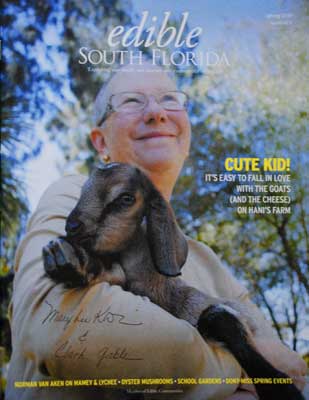
Mary Lee Khouri and Clark Gable

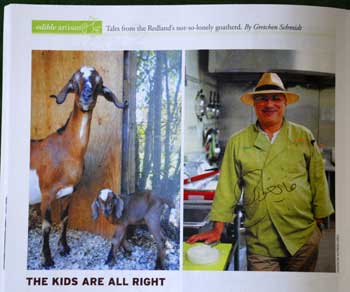
In their latest issue, Edible South Florida has a great cover picture of Hani’s wife Mary Lee, holding one of the kids, accompanying a nice article. The article is by Gretchen Schmidt and photos by Alfredo Añez. Look for the magazine this month at Whole Foods and other locations.

If you look carefully, Mary Lee and Hani autographed their pictures. Want my copy? Be the fifth (5th) person to comment on this post as to which is your favorite flavor of HANI’S ice cream and why, and the autographed magazine is yours! Only one comment per person allowed. Offer expires Thursday May 20 Saturday May 22 at midnight.

Back in March, two local food blogs have also posted about the goats. Genuine Kitchen featured the pregnant does, including the very huge Cleopatra.

Shortly after, Mango & Lime came out and took pictures of Cleo’s kids, including the very pregnant doe Maria. Paula’s post about the goats and Hani was featured as Blog Post of the Week on the South Florida Daily Blog.

The kids are growing up. They are cute and friendly, and better yet, they are weaned. That means that Hani is back in full production with goat cheese and goat milk ice cream, and it’s as good as you remember. You can get some from Hani’s Mediterranean Organics at the Pinecrest Gardens Green Market this Sunday. Yes, it’s still going strong through the end of this month.

5855 S.W. 111th Street, Pinecrest, 33156
Open Sundays, 9 a.m. to 2 p.m.

Hani signed his name in Arabic.

Read Full Post »

It was a great weekend for the Fairchild Farm & Garden Festival, sunny and warm but not yet excruciatingly hot. A lot was going on, and I was running from presentations in the Garden Room to various tents and back trying to keep up with interesting events.

Margie Pikarsky

On Saturday morning, I dropped in at the start of Farmer Margie Pikarsky’s presentation on preserving the harvest. As usual, she gave a well-researched lecture on different kinds of food preservation — freezing, fermentation, dehydration, brining, pickling, and canning. The handout was chock full of info, and if you didn’t make it to the lecture, you can download it here.

As for following recipes and instructions that one finds published in books and elsewhere, Margie cautioned that “all publications are geared for the temperate zone. You can’t listen to them. We have to modify. It’s warmer here and chemical reactions happen faster. You have to be aware of that. Sauerkraut can take two weeks instead of two months. There’s potential for vegetables to go bad in the heat when fermenting. Start with organic produce which has less mold and contaminants.” Margie recommended the book Wild Fermentation if you want more detailed instructions for pickling and fermenting.

Stopped by the Cooking Demo tent to say hi to Laura Lafata aka La Diva Cucina. She was getting ready to give a presentation on preparing radishes with vermouth. The radishes looked happy to be in her hands, and vermouth is an ingredient I hadn’t thought of using. (The recipe is at the bottom of this post.)

Laura Lafata aka La Diva Cucina

Talk about food makes me hungry, so I prowled around looking for something good to eat. Found Margie standing in line at the bright green Native Conch stand, and we got the last of the conch salad. Thanks to Jason for taking care of us!

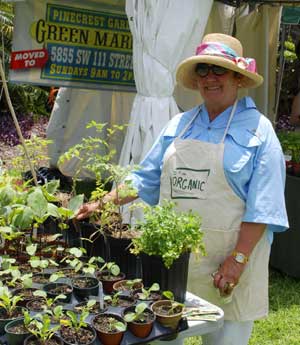
Claire Tomlin with potted herbs for sale.

Came across Claire Tomlin of The Market Company showing off her latest venture. She has ready-to-grow raised garden beds made of cedar that you can use in your yard. The beds come in a package that includes a cedar frame, soil blend, vegetable and herb starter plants, organic fertilizer and mulch. All you need to add is water and sunlight. It’s too late to plant almost all vegetables now (remember, we’re in the sub-tropical growing zone), but there’s more than enough time to get ready for fall planting. If you’re interested, contact Dylan Terry at dylanjterry(at)gmail.com or call 786-436-7703 for more information.

Pure beeswax candles available from Miguel Bode the beekeeper.

Said hi to Miguel Bode the beekeeper on the way out, and he revealed that he has the largest display of pure beeswax candles anywhere (well, at least at the festival). He uses 35 different molds to shape wax extracted from his hives.

My name was on the schedule for the food bloggers panel Saturday afternoon, but I couldn’t stay due to a schedule conflict. Thanks to Melissa Contreras and Annie Stamps of Fairchild for inviting me to participate in the Festival. You ladies rock!

Sauteed Radishes and Tops over Bow Tie Pasta with Apple Chicken Sausage

Serves four main dinners or six starter plates


Ingredients:

1 lb. box of bow tie pasta
1 bunch of radishes with tops attached
1 pkg. organic apple chicken sausage
dash white vermouth
good quality extra virgin olive oil
kosher salt and pepper

Method:

Put on pasta water to boil and once boiling, add a dash of salt. Cook pasta al dente in salted water for a minute or two less than suggested When pasta is cooked, drain into colander, saving 1/2 cup of pasta water. Set aside.

While pasta is cooking, fill sink with cool water. Chop radish tops and wash thoroughly in water, let green tops drain and then blot dry with paper towels. Wash radishes and thinly slice, set aside.

Heat large fry pan on stove and slice sausages into quarter inch slices. Add olive oil to pan and when heated, add sausages, lower heat to medium high and saute until brown on both sides, being careful not to burn. Put cooked sausage on plate, set aside.

Heat fry pan again and add more olive oil if needd. Once hot, add radishes, lightly salt and cook over medium heat until light brown on both sides. Turn up heat and add a dash of vermouth to deglaze pan, continue cooking radishes for another 30 seconds or until soft. Add to the plate of cooked sausage.

Heat fry pan and use more oil if necessary. Lightly saute greens until just wilted, add pasta to pan along with sausages and radishes and thoroughly combine all ingredients. Cook over medium high heat for another minute, adding a bit of pasta water to make a light sauce. Season with salt and freshly ground black pepper and serve immediately. Drizzle extra virgin olive oil over each serving.

Copyright (c) La Diva Cucina Inc.

Read Full Post »

Roots in the City Farmers Market in Overtown

Just west of new luxury high rises on Biscayne, a row of white tents sprang up on the corner of NW 2nd Ave. and 10 St., smack dab against a patch of young collard greens. Underneath the tents, farm fresh fruits and vegetables were arranged on tables. The newest farmers market was launched on Wednesday in Historic Overtown, one of the oldest and underserved neighborhoods in Miami. If people couldn’t come to market to get much needed produce, well, the market was going to come to them. There hasn’t been an actual farmers market in downtown for decades.

Locals checking out and buying from Redland Organics.

Two local growers were at the Roots in the City Farmers Market. Farmer Margie from Redland Organics put out a colorful display of radishes and white Asian salad turnips, carrots and celery, Asian greens, loquats, canistel and black sapote. Under the next tent, farmers Teena Borek and her son Michael from Teena’s Pride Farm brought tomatoes, red bell peppers, white eggplant that looked like bowling pins, and bunches of greens.

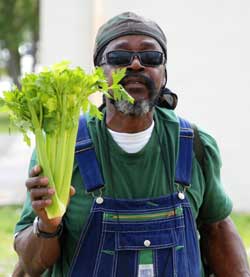
John Lealand Laundry likes celery.

The market was open from 1 to 4, and there was a fairly steady trickle of curious neighbors wandering over. A lot of looking, a bit of curious sniffing and tasting, but mostly people were excited that a farmers market suddenly appeared on their street. People bought a few things, choosing carefully. One resident told me that there are several groceries in the neighborhood, including a Winn Dixie on the other side of I-95, but produce is very expensive.

Market tokens

Some neighbors paid with cash and some were happy to find out they could use food stamps. That was the best part, the most amazing thing. The Roots market is set up to accept food stamps (also known as Supplemental Nutrition Assistance Program or SNAP). Even better, the Roots market has implemented a Double Value Coupon Program that would double the value of a person’s food stamp purchases. For example, if somebody bought five dollars worth of veggies, they would get that equal amount in tokens they can then use to buy more food at the market.

This bit of shopping ingenuity and the Roots market came about from the collaboration of many entities. The Wholesome Wave Foundation has set up similar “Nourishing Neighborhoods” programs at over 80 farmers markets around the country, and provided leadership, training and seed money. Health Services Coalition handled the actual SNAP transactions, acting as a go-between the farmers and the buyers, and is putting the word out in the community. Michael’s Genuine Food and Drink enlisted Margie and Teena, the first two local family farmers to participate, and helped with fundraising and promotions. And the Roots in the City community garden (which is raising nearby collards, and has two acres of garden in the immediate area) offered space for the market, and added its produce to sell.

People from HSC on hand to handle SNAP sales and manage tokens.

The Roots market will have a dedication ceremony in two weeks, on Wednesday April 7. Miami Mayor Tomas Regalado has been invited, and there will most likely be other dignitaries attending. The market will run for four weeks, with maybe an extension for four more, and is scheduled to resume in fall.

Listen to Low-cost produce comes to Miami’s Overtown, the WLRN report by Joshua Johnson, here. The Genuine Kitchen has posted the press release (with lots of good information) here. And Mango & Lime posted her report on the market opening here.

Miss Sarah tells it like it is to the media.

Read Full Post »

Chris and Eva Worden of Worden Farm in Punta Gorda were recently featured on NBC Nightly News.

Click here for the Nightly News archives page.

Then, go to March 2 and click on the link “Organic Farm Markets Draw Crowds.” The video will pop up in a separate window.

Read Full Post »

« Newer Posts - Older Posts »