Feeds:
Posts
Comments

Archive for the ‘farmer/grower’ Category

Farmer Margie was recently interviewed by Niala Boodhoo of WLRN/Miami Herald about the economic impact of last month’s freeze. Two reports originally aired on WLRN last week, and the second one is by reporter Christine DiMattei.

If you weren’t lucky enough to catch them on the radio, you can listen to and/or download them from the Miami Herald web site. Scroll down the page and look for these headlines:

02/20 FBR – South Dade farmers and the freeze

02/23 Two-week cold snap brings season of worry to local farmers

Read Full Post »

Steven Green, Green Groves

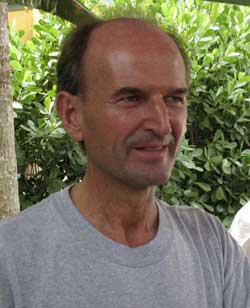
Meet Steven Green of Green Groves. His day job is professor of tropical biology, conservation and statistics at UM. He also has a two and a half acre grove of various fruit trees. The cute little clementines from a couple weeks ago were his. This week we have lemons from his grove. Steve doesn’t know the name of the variety but does know it was planted in 1938. He says their flavor is “much brighter and more flavorful,” than your average supermarket lemon, and the fruit has a moderate amount of seeds and thick skin.

Steven grows lemon, lime, carambola, calamondin, allspice, monstera, avocado, tangerine, 5 kinds of mango, and lychee. He has been growing fruit since he moved to Redland in 1978, when he bought a 2 1/2 acre avocado grove with trees planted originally in the 1930s. There are still a few of those left, including the lemons. In 1991 Steve planted lychees, but Hurricane Andrew knocked them all down the following year. Putting his scientific knowledge to good use, Steve replanted 125 lychee trees at what he calls the “optimal distance” for orb weaver spiders. They prefer a span of about 2 meters from branch edge to branch edge for their webs. Once the spiders made their webs and settled in, there have been no problems with caterpillar moths in the groves. Lychees have so few pests, Steve says, that he doesn’t used pesticides in his grove. He’s now in the process of getting the grove certified organic.

Lemon from Green Grove

When Steven has way too many lemons, he makes this North African lemon preserve:

Cut the lemon into quarters, bury in kosher salt, add chilis (optional).
Can take out spoonfuls of liquid to cook with.
Store salted lemons in frig.

Read Full Post »

Oyster mushrooms have been a welcome addition to the CSA shares so far twice this season. They are grown at Paradise Farm, and are for sale on Saturdays at the Paradise tent at the Coral Gables Farmers Market, and also on Sundays at the Redland Organics tent at the Pinecrest Gardens Farmers Market. The following article was published in the Miami Herald on Thursday. Nancy Ancrum did a great job, couldn’t do better myself. Enjoy!

Homestead farmer, African scientist realize mushroom dreams

BY NANCY ANCRUM
nancrum@MiamiHerald.com

It was an e-mail that just screamed to be spiked. It came from an African country; it mentioned something about a “lottery;” it hinted that there was a wonderful, enriching opportunity to be had.But Homestead farmer Gabriele Marewski didn’t delete the message. She read it. It wasn’t a scam; it was the world working in mysterious ways.

“Those scam e-mails go right into the spam box. But this one had that first sentence that was intriguing,” Marewski says. “It said, ‘I won the lottery to come to the United States.’ The other ones say, ‘You won the lottery, give us an account number.’ ”

She went from intrigued to hooked when she got to this line: “I can show you how to grow oyster mushrooms.”

“This was too bizarre; so bizarre I had to respond.”

Read the rest of the article here:
http://www.miamiherald.com/living/top-stories/story/1448132.html

Read Full Post »

Freeze’s toll

The Miami Herald
Posted on Sat, Jan. 16, 2010

Freeze takes huge toll on Florida agriculture

http://www.miamiherald.com/business/story/1428216.html

BY ELAINE WALKER
ewalker@MiamiHerald.com

Although the freezing weather is finally gone, consumers in South Florida and across the country will soon feel the impact at the grocery store.From green beans and yellow corn in Homestead to tomatoes in Immokalee, the freeze had a devastating effect on the vegetable industry. In some cases, entire fields were destroyed, with statewide losses expected to stretch into the hundreds of millions of dollars.

While some farmers have managed to salvage part of their crops and others are already replanting, supply is going to be a problem for at least a month or two, depending on the crop. That in turn translates into higher prices for consumers.

“Tomatoes that were trading for $14 for a 25-pound box, now they are up at $24 a box,” said Gene McAvoy, a vegetable expert with the University of Florida. “Consumers can probably expect to see prices go up about $1 a pound. But at a certain point, the consumer is going to balk and people will start to back away from certain items.”

The timing of the freeze couldn’t have been worse for Florida’s vegetable farmers, who were in the midst of the peak growing season. During the winter months, Florida growers are the largest U.S. supplier of vegetables.

Florida Agriculture and Consumer Services Commissioner Charles Bronson told state legislators earlier this week he believes that about 30 percent of the state’s agricultural crops were damaged or destroyed. With losses expected to reach into the hundreds of millions of dollars, that’s another blow to the state’s already fragile economy.

Florida growers typically generate about $8 billion a year in annual agricultural revenue, said Florida Agriculture spokesman Terence McElroy.

“The industry is going to be hit hard,” McElroy said, “but farmers are a pretty resilient group.”

In Miami-Dade County alone, the losses are estimated at just over $250 million, which is about 40 percent of the more than $600 million in revenue agriculture generates each year, said Charles LaPradd, agriculture manager for Miami-Dade County.

Hardest hit in Miami-Dade were the row crops like green beans, squash and corn, said Katie Edwards, executive director of the Dade County Farm Bureau. About 30 percent of the county’s tomato crop took a hit, Edwards said, but growers are still trying to assess the damage.

“We got some stuff that got hurt and some stuff that made it,” said Freddy Strano, a Homestead tomato grower, who estimates his losses could range between 20 percent and 50 percent of his 250 acres. “It’s hard to tell. Anything on the outside of the plant got exposed and is no good. We’re trying to salvage what we can.”

In the Immokalee area, which is one of the major areas for tomato production, produce losses are estimated at over $100 million, McAvoy said. Tomatoes in Immokalee were nearly wiped out for the winter season.

Bob Spencer of West Coast Tomato says about 95 percent of the tomatoes that he would be picking over the next 45 days in Immokalee are gone. He estimates he lost close to 250 acres of crops, worth hundreds of thousands of dollars.

“We haven’t experienced a freeze like this in 20 years,” Spencer said. “It reminds the ego what can happen. Farming is a tough sport. It’s not flag football. It’s tackle football.”

The last freeze of this magnitude Florida experienced was in 1989. But this recent cold spell potentially was more devastating for farmers because the freezing temperatures lingered for a week — 10 days in some places. Many crops can withstand one or two days of freezing temperatures, but with prolonged exposure there is no escape.

“Typically if you water the crops ahead of the cold period, it will help,” said John Alger of Alger Farms in South Miami-Dade. “A bulletproof vest works only to a certain size gun. If you keep getting shot in the same place, eventually it’s going to get through.”

Alger, who grows sweet corn and landscape trees, estimates he lost “way over a million” dollars from the freeze, which destroyed about 75 percent of his 1,250 acres of sweet corn.

“It’s not only the farmer, but everyone in related businesses from the truck drivers to the crop dusters, the harvesting crew and the packing houses are going to be impacted,” he said. “The multiplier effect on the economy is devastating.”

Florida tomato growers are already worrying about how to avoid panic over the tomato shortages and make the current supply last as long as possible until the spring crop is ready for harvest in late March.

“The tomatoes we have are going to be metered out to try to meet our customer demand,” said Reggie Brown, executive vice president of the Florida Tomato Growers Exchange.

“It’s going to be an opportunity for Mexico to make inroads, and that’s never a good thing.”

© 2010 Miami Herald Media Company. All Rights Reserved.
http://www.miamiherald.com

Read Full Post »

Bee Yard wanted

Beekeeper Miguel Bode

You might have seen beekeeper Miguel Bode selling honey and beeswax candles at fairs and festivals and markets all around town. If you bought wildflower, avocado or lychee/longan honey from him (or Farmer Margie), those are the products of his bees kept at Bee Heaven Farm, among other farm locations. I caught up with him at Ramble, and noticed he had a sign saying he was looking for a bee yard in suburban Miami. Your reward? All the honey you can eat — and an opportunity to do something to help honey bees survive.

“A bee yard is a place where bees can be put and survive,” Miguel explained. The ideal location is secluded or isolated, in an area where people will not go often. It would be a place where the bees won’t be disturbed or disturb anyone else, and preferably close to a fence. When choosing a spot, consider the other side of the fence, so that bees coming and going from their hives don’t disturb the neighbor having a barbecue, for example.

A row of bee hives at Bee Heaven Farm

Specifically, Miguel is looking for a space big enough for multiple hives, at least 15-20 at the most. The hives are boxes stacked in a row 2 feet wide by 12 feet long. He would like to set up 3 rows, with an 8 foot buffer in between. That translates to a patch of yard that would be 12 feet by 22 feet in size, not including any space immediately around the hives.

Currently Miguel is keeping most of his bees in agricultural areas. He explained that bees produce less in Redland that in the suburbs. In spring when avocado, lychee and longans bloom there’s plenty of food for the bees, but during the rest of the year there’s not as much variety. Miguel would like to move his bees to the Pinecrest or Old Cutler Road areas where the yards are large and there’s plenty of different things blooming year round. The typical yards in the city are too small for so many hives, though. Special landscaping is not that important. Bees will fly to wherever they find flowers. They usually range about one mile, and will go as far as three miles.

Bee yard wanted, sweet reward!

Pets and kids are usually not a problem, and will quickly learn not to bother. Generally, honey bees are not aggressive and will not willfully attack you. Just don’t go up to the hive and start hitting it, then they will get upset! Bees only sting as a last resort. Open pools (not screened in) are a red flag because bees are attracted to water to drink, and might frighten or sting people in or around the pool. Yes, bees drink water (I have seen a bee sipping water from a puddle), and during the dry months of March, April and May they need lots of water.

If you like bees and honey and think your back yard is the perfect spot, contact Miguel Bode at beemyhoneymiami(at)yahoo.com .

Read Full Post »

« Newer Posts - Older Posts »