Feeds:
Posts
Comments

Archive for the ‘food’ Category

Earth Learning is presenting a series of workshops and seminars that lead up to the Second Community Food Summit. These events will bring in recognized activists and skilled practitioners to work with our community leaders as well as engage public audiences.

The Path to the Summit will be organized around six perspectives : Healthy People, Resilient Communities, Justice and Fairness, Sustainable Ecosystems, Vibrant Farms, and Thriving Local Economies.

Thursday, September 29th
8:00 am to Noon: “Local Plus” Food Access for All (Healthy People)
1:00 – 4:00 pm: Enabling Local Food (Resilient Communities)
6:30 – 9:30 pm: Re-Setting the Table, Toward Food Justice (Justice and Fairness)

Friday, September 30th
8:00 am – Noon: Sustainable Agriculture for All (Justice and Fairness)
6:00 – 9:30 PM: Carbon Farming: An Appetizing Strategy for Ecosystem Restoration and Climate Change (Sustainable Ecosystems)

Saturday, October 1st
3:00 – 7:00 PM: The New Agrarians: Growing Food Everywhere (Vibrant Farms)
7:00 – 10:00 PM: Greenhorns Film Screening & Potluck

Sunday, October 2nd
9:00 AM – 3:00 PM: Regenerative Farm Tour
4:00 – 8:00 PM: Miami’s Local Food Scene: Dine-Around Midtown

Monday, October 3rd
8 am – Noon: Slow Money Workshop
1:00 – 4:00 PM: Leading the Transition to a Local Food Economy

For detailed information on the pre-Summit workshops, along with registration and locations, go to the Earth Learning web site.

Read Full Post »

Thighs and Pies

Slow Food Miami Annual Pie Contest

Saturday, September 10th at 12 noon

12:00 pm Enjoy a picnic lunch with Sustain Restaurant‘s famous fried chicken
Sides and sweets by Whole Foods Market

1:00 pm Pie winners announced
Followed by pie sale to benefit local school gardens

Tickets: $35 Adult — $15 Child (5-15) ages 5 and under free.
Purchase online here.

Judges:
Lee Brian Schrager
Founder of the South Beach Wine & Food Festival

Hedy Goldsmith
Executive pastry chef, Michael’s Genuine Food & Drink

Ariana Kumpis
President, Les Dames D’Escoffier Miami

Meet Your Farmers: Seriously Organic, Bee Heaven Farm, G.R.O.W.
Bring some cash to purchase fresh, local produce!

Entertainment: Matthew Sabatella and the Rambling String Band

Location:
The Barnacle Historic State Park
3485 Main Highway
Coconut Grove FL 33133

Sponsored by Whole Foods Market 

Read Full Post »

A two foot long jakfruit split open.

Last Saturday I shopped at two markets, one small and friendly, and one big and corporate. First, I stopped by to see what was new at the Upper Eastside Market, and it was loaded with good things to eat. Who says it’s too hot to grow anything here in the summer? Over at the Nature Boyz juice stand, Clive had a couple of good sized jakfruit available. They are starting to mature this time of year. Further down the row of tents, I found locally grown okra, collards, calabaza, lemongrass, fresh akee and annona fruit. You could get callaloo and plantains from Three Sisters Farm in Redland, sweet potatoes grown on a small farm in Kendall, and loads of starfruit from a garden just down the street in Miami Shores. The eggs were from hens kept somewhere in North Miami, shhhhh! They even had bags of white and brown organic rice grown and milled in Belle Glade. Almost everything at this market is local — sourced either from Miami-Dade County or somewhere in Florida.

Local avocados grown for Uncle Matt’s.

My next stop was Whole Foods in Aventura. I’d heard there was local fruit in the stores, and wanted to see for myself. I easily spotted a nice heap of shiny and fresh green avocados carrying the Uncle Matt’s brand, and grown locally by Murray Bass. Nearby were medium sized mamey from Health and Happiness Farm, but their pints of longans had sold out.

The fruits looked pretty good, but specialty items were another story. Packets of allspice leaves and berries from Bee Heaven Farm were starting to look a little brown. Bunches of wilting garlic chives, also from Bee Heaven, were piled in a shallow basket in an open cooler. They were starting to wilt, and looked in desperate need of a mister. One shelf up were boxes of extremely perishable edible flowers from Paradise Farms that looked flat, dried up and inedible.

Overall, I have to give Whole Foods credit for making a good effort to support local growers. They are doing an OK job of sourcing local fruits this summer. But, by the looks of things, their produce people could use training on how to handle delicate specialty items. And of course, there’s just no comparison to shopping at the neighborhood farmer’s market, which has plenty of extremely fresh, locally sourced items!

Read Full Post »

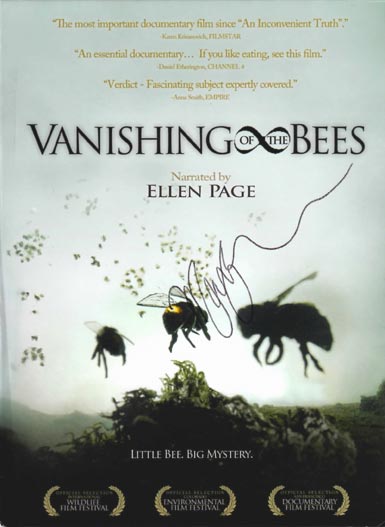
Vanishing of the Bees, an intriguing new documentary about Colony Collapse Disorder, is back in town for a FREE one-night screening.  

Date: Sunday August 21, 2011
Time: 6:30 pm to 8:30 pm
Location: Fairchild Tropical Botanic Garden
10901 Old Cutler Road
Coral Gables FL 33156

Back in May, Vanishing of the Bees showed for only one night at the new, state of the art Coral Gables Cinematheque. And it was a good turnout — over 200 people packed the auditorium. Proceeds from that screening went to support Slow Food Miami’s school garden program.

Beekeeper John Herring and filmmaker Maryam Henein at the May screening.

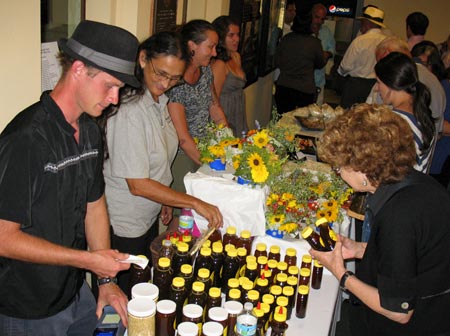
The filmmaker, Maryam Henein, was present to introduce her film and answered questions after the showing. She was accompanied by John Herring, a beekeeper from Broward County, who brought a sample hive and various tools of his trade, who also answered questions about bees. Farmer Margie Pikarsky and interns Mike and Sadie from Bee Heaven Farm came with many boxes of local honey and wildflower bouquets for sale.

Vanishing of the Bees is a real-life mystery story which begins with two commercial beekeepers, David Hackenberg and Dave Mendes, who tell similar stories of how one day they came to check on their hives and found them inexplicably empty. They realized their problem wasn’t only with their hives, or happening in Southwest Florida where they were located. It was a growing, serious problem in 35 states and also in Europe. Bees were either vanishing, or their immune systems were succumbing to all kinds of pathogens. Populations were dying faster than they could be replaced, and nobody knew why. The film goes on a journey that follows David and Dave as they try to solve their mystery, and in the process they discover how they can keep their bees healthy and productive, and their beekeeping businesses alive.

Through the course of researching and making her film, Maryam became a passionate and tireless activist for the honeybee. Her love and concern is clearly apparent in the film, which weaved a magic spell around the audience that night. As the story unfolded, people were pulled in; and at one scene in the middle, you could almost hear a pin drop as facts built up and pointed to the most likely causes of bee die-offs. The camerawork is amazing, bringing you very close to slow-motion bees in mid-flight, and editing and animation are superb.

Support the bees

The film does end on a hopeful note, that it’s not too late for ordinary people to save the honeybee. “Colony Collapse Disorder is a wake up call,” Maryam said after the screening. “There’s a big abyss between the people who know and the people who don’t know. Every one of you is a worker bee” to get out the word and take action.

She mentioned several ways you can help the bees and support your own good health. The easiest thing to do is buy organic produce and local honey. (You can find both at local farmers markets.) Organic farmers are not allowed to use systemic pesticides or other dangerous chemicals that can harm bees. Most organic farms tend to have a happy mix of several kinds of plants that support bees, and most farms keep hives and sell local honey. 

Mike and Margie from Bee Heaven Farm with honey and wildflower bouquets for sale at the screening.

Another simple thing you can do is avoid buying “honey-flavored” breads, cereals and other products. They are sweetened with honey blends imported from China. “Funny honey” is diluted with lactose syrup, high fructose corn syrup or other sweeteners. It is also tainted with strong antibiotics and lead residues. Corporate bakeries — and the film named General Mills and Pillsbury — buy imported honey because it is very cheap. (Real honey costs a lot more because U.S. beekeepers can’t produce enough to meet demand.) 

If you have the space, a fun thing you can do is plant a bee-friendly garden, with an assortment of plants that bloom throughout the year to attract pollinators. Choose low-maintenance native plants and wildflowers, keep fruit trees, or raise vegetables in your garden or in containers on your patio or balcony. Whatever you do, DO NOT use systemic pesticides! Those are the kind that are applied once a season or once a year as a soil drench, and “provide protection without spraying.” Plants suck those chemicals up through their roots, and all their cells and pollen itself become poisoned. Bees then gather tainted pollen, bring it back to their hive, and make themselves very sick from it, sick to the point of death. 

Support the film

Vanishing of the Bees is a completely independent production, and it took a long time and a lot of money to make it happen. From researching and writing the script to the final edit took about four years to make, and it cost half a million dollars. (Just the editing alone took a year and cost a good chunk of money.) Maryam raised funds a little bit at a time, from donations and sponsorships, and they went toward paying film expenses. When she wasn’t filming, she supported herself at times as a waitress, and admitted that for a while she was on food stamps and maxed out credit cards to survive. 

Maryam and her producers are making their money back with donations and DVD sales. Right now, they are running a promotion and selling the DVD on their web site for a reduced price of $14.99 for a personal viewing license. (They might also be selling the DVD at Sunday’s screening.) Maryam wants to get her DVD into schools. “Education is the beginning,” she said. “We are the generation waking up. The change is coming up in the generations behind us.” At the time of the May screening, she needed to raise about $12 thousand to develop a companion study guide. She is self-distributing her film, and is actively seeking venues for future screenings. The next Florida screening is in Tampa on August 29th.

Read Full Post »

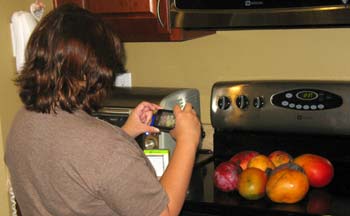
Kattia documents the arrival of Redland mangoes.

A person can move away from Miami but their craving for flavors of the place will stay for a long time. Case in point, friends Kattia and Chris moved away about 10 years ago, and live in tropical fruit exile all the way up in Sanford. If they want a fresh mango, they have to go to the store and settle for fruit imported from Mexico. They complained those out-of-season offshore mangoes just don’t have the flavor, juiciness and aroma of a home grown mango from Miami. And why should they? Imported fruit is picked half-ripe, then dunked in hot water to kill pathogens, which also kills taste.

I told my friends about the bumper crop we had this summer, and they asked when I was coming up. Right away, I replied, and loaded up my car with sacks of plump red and golden Kent mangoes from Paradise Farm, and headed north on I-95. About four hours later, I pulled into their driveway, and Kattia and I lugged eight pounds of mangoes and a box full of empty canning jars to her kitchen. 

“When life hands you mangos, make jam!” said Kattia with delight. (If this sounds like a familiar adventure, she and I made lychee freezer jam two summers ago.) The canning process she followed wasn’t all that difficult, even for a novice like me. “The trick to making cooked jam is to have everything ready and waiting to go,” she said. 

First, we made sure that everything we needed to use was clean and ready. Jars, rings and other utensils were run through the dishwasher beforehand. (If you don’t have a dishwasher, sterilize everything in a big pot of boiling water to kill any dangerous bacteria that can spoil food and make you sick.) 

As the dishwasher hummed, we peeled, seeded and chopped mangoes. Six cups of fruit were destined for jam, and went into a big pot to cook. (The rest of the fruit was stuffed into the freezer.) Lemon juice was added “to wake up the taste of mangoes,” and pectin was stirred in. “Pectin is what makes the jam set,” Kattia explained. “Pectin and lemon help mangoes give off juice.” She also added a bit of butter to reduce foaming as the mixture cooked.
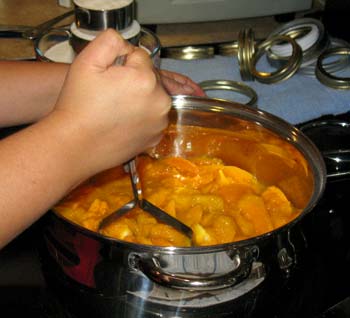
Mashing chopped mango as it cooks. Note 5 and a half cups of sugar, and rings in the background, ready to go.

Out came the potato masher, and the fruit was smashed into smaller pieces, to the texture of rough applesauce. Heat was raised to a rolling boil — when you stir, bubbles keep forming — and the fruit mixture was stirred constantly. Sugar was quickly added, and stirred until everything came back to a rolling boil for one more minute. (If you think five and a half cups is a horrifying amount of sugar, keep in mind that this is called a low-sugar recipe. A regular amount would be 10 cups.)

When the mango mixture got soupy and looked translucent, it was time to fill up jars. “It helps to lay out everything you need because assembly goes quickly,” Kattia said. She set a wide mouth funnel into a jar, and ladled mango mixture up to the very neck. Next, using a magnetic grabber, she fished a lid out from a small pot of simmering water, centered it on top of the jar, and screwed on a ring. The filled, sealed jar was then turned upside down on a towel on the counter.

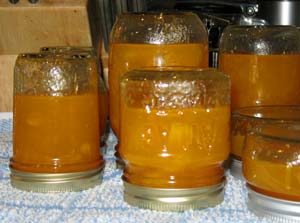
“With the inversion method of canning, the fruit goes to the top of the jar, and the air goes to the bottom of the jar,” Kattia explained. “When you flip it over, the air goes to the top, and creates a vacuum, and it seals the jar.”

Jam cooling upside down. When a jar is flipped over, the air inside will rise to the top and create a vacuum.

The jars stayed upside down until they were cool to the touch. This took about an hour or so. Then we turned them right side up and tested the seal. A properly sealed jar lid was hard, without any give. Two jars had lids that popped or flexed a little, and they went back upside down for about 15 minutes longer. (If that still didn’t do the trick, the jam would have to be eaten right away — what a tragedy! — or processed in a pot of boiling water for long term keeping.) The whole process took about two hours, including prep and filling jars.

Voila! We had jam! It wasn’t that difficult to make. The hardest part, and it’s not really that hard, is to track down canning supplies. Kattia bought jars, lids and canning paraphernalia at a nearby Super Wal-Mart. If your local store doesn’t carry what you need, you can find canning kits and jars online. Labels would be helpful if you’re making a batch to give away. 

When we were done, pretty golden jars of mango jam were lined up on Kattia’s counter. The sweet tropical taste of Miami’s summer had been captured to savor for later. (It’s not the same as having fresh mangoes, but the stash in the freezer comes close.) I drove back home with several jars, some to keep and some to share. My jar is meant for for medicinal purposes, as it were, for later in the year. A bit of sunshiney mango jam spread on buttered toast will chase away any gray winter blahs!

Kattia’s Mango Jam

6 cups mangoes, peeled, seeded, chopped
juice of 1 lemon
3 Tbps. low or no-sugar pectin
5 1/2 cups sugar
1 pat of butter

Peel, seed and chop mangoes. Put them into a large pot with lemon juice and mash with a potato masher. Stir in butter and pectin and keep stirring. Raise heat to a boil. Skim off any foam. Then quickly stir in the sugar a bit at a time until it dissolves. Keep stirring at a rolling boil for 1 minute longer. When the mixture looks transparent, it is ready to put into jars.

Ladle mango mixture into a jar up to its neck. Do not overfill, as you need an air space. Wipe off any spills and put on the lid and ring. Place jar upside down on towel to cool. Repeat with other jars until all your mixture is used up. Let jars cool to touch, then turn over and test seal. If the lid pops, flip it over to sit for a few more minutes, or refrigerate.

Read Full Post »

« Newer Posts - Older Posts »