Feeds:
Posts
Comments

Archive for the ‘food’ Category

Winter melon for summer

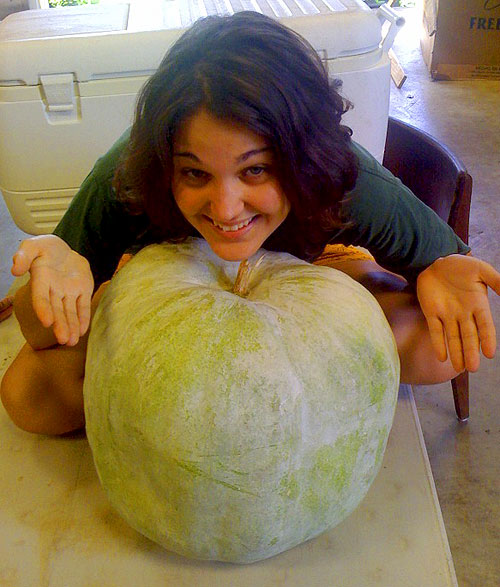
Rachel presents the winter melon. Photo by Daniel.

One of the more unusual offerings at the Bee Heaven Farm summer fruit sales has been winter melon, also known as wax gourd. It’s called that because of the white, waxy coating on its green skin. A few weeks ago, I rode up with Farmer Margie to fetch them from C&B Farms up in Clewiston. The growers boxed and shipped the giant melons to various northern cities that have large Asian populations.  I’m told the Chinese consider winter melon a cooling food, and that these melons grow much larger in China.

A slice of winter melon.

These melons are huge and heavy! The one in the picture weighed at least 20 pounds. There’s no way that you could sit down and eat the whole thing, nor would you want to. Usually you buy it by the chunk. The flavor is very mild and slightly sweet, similar to a honeydew, and the flesh is white. The melon is very juicy and releases a lot of clear liquid after you cut it. A slice doesn’t keep very long in the frig, maybe a couple days at most, and then it starts to get mushy in places. If you’re not going to use all of it, wrap peeled and seeded chunks in plastic and freeze.

Winter melon is best eaten cooked, not raw. Recipes abound on the Internet for winter melon soup, stir fry, drinks and even pickles. You can also freeze peeled and seeded chunks for later use. After sifting through all kinds of possibilities, I settled on making soup. I had all the ingredients on hand — homemade vegetable broth, a couple skinless chicken thighs, carrots, mushrooms, scallions, garlic and ginger. The melon chunks softened as they cooked and turned translucent. They took on the color and taste of the broth. I added salt and pepper, and finished with some toasted sesame oil for more flavor. The soup was good, but I can’t say for certain if it was cooling. It was hot soup, after all.

Chicken vegetable soup with chunks of winter melon and a drizzle of toasted sesame oil.

Maybe next time I’ll try making a simple drink to test the cooling properties of the melon. A drink recipe I found on asianhealthyrecipe.com calls for one pound of melon and 5-6 cups of water. These are the instructions: Cut the melon into chunks and cook it skin, seeds and all, until some liquid comes out of the melon. Then add water, bring to a boil. Remove from heat. Add honey to taste, and serve either hot or cold. The recipe didn’t say if you’re supposed to strain the chunks out, but if you did that, I suppose you could eat the melon in a separate dish, maybe mixed in with something else. (It is, after all, quite mild flavored.) The drink is supposed to be cooling — and slimming, if you leave out the honey.

Have you tried winter melon? What recipes do you have for it?

Read Full Post »

It’s never too hot to eat fruit in the summer, so head on over to the Fruit and Spice Park for their Redland Summer Fruit Festival this weekend. I don’t know about the other vendors, but Farmer Margie will be selling melons, melons, melons! She went to C&B Farms up by Clewiston and loaded up with end of season cantaloupes, cute “personal size” round watermelons, and giant winter melons that she’ll sell by the wedge. There will also be organic eggs, honey from the bees that live on the farm, fresh herbs and a few other interesting things.

The event looks like a whole lot of fun for the whole family. There’s balloon tossing for the kids, and fruit sampling for kids of all ages, a petting zoo, sack races, live bluegrass bands, along with ice cold fruit smoothies and chocolate-topped strawberries on the menu. Did I mention the pony rides? And melons, you can’t forget the melons!

Saturday June 19 and Sunday June 20
10 am to 5 pm

Admission: $8 per adult
Children under 12 admitted free
Come Rain Or Shine!

Fruit and Spice Park
24801 SW 187 Ave.
Redland FL 33031
305-247-5727

Read Full Post »

photo by Sara @ Culinerapy

Featuring local Redland ice cream specialists:

Gabrielle Berrier, Gaby’s Farm
Hani Khouri, Hani’s Mediterranean Organics
Robert Barnum, Possum Trot Tropical Fruit Nursery

When: Sunday, July 4th
11:30 am – 2:30 pm
Where: Bee Heaven Farm

Family fun! Sample ice cream and sorbet creations and tropical fruit pies from Redland farm producers. Vote for your favorite flavors during our ‘fun tasting’.

Stroll around the farm during this informal gathering. The kids (and adults, too) can check out the chickens, see how the avocados are growing, how the planting areas rest with the summer cover crops, and enjoy the birds, the bees and the butterflies.

Afterward, want to take your favorite flavors home? Bring cash and a cooler, with (preferably) dry ice, to keep your ice cream frozen solid.

BUY TICKETS FOR THE EVENT

http://www.brownpapertickets.com/event/115231

Adult (10+): $10
Child (4-9): $5
Child (0-3): free

Attendance limited – Advance purchase required by July 1

Sponsored by Whole Foods.

Read Full Post »

Seems like gourmet cheesemaker and Mediterranean chef Hani Khouri is all over the place these days. Busy man! Does he ever take a moment to just relax, chill out for a moment, stop and smell the… shisha? Sure he does!

There’s a groovy, laid-back event coming up soon at the Everglades Hostel way down in Florida City. Don’t groan, it’s worth the drive down. Where else would you get a chance to sprawl out on cushions and carpet in the hostel’s gazebo, smoke a hookah and get your hands and feet decorated with traditional henna designs?

And speaking of Hani, he’s bringing the vegetarian feast of: hommos asli (asli means authentic), baba ghanouj asli, tabbouleh asli, felafel asli, tahini sauce, traditional condiments, fresh baked pita bread and fresh goat milk ice cream in various tropical fruit flavors. If you miss buying his ice cream at the farmers market, here’s your chance to enjoy the treat in real Mediterranean style.

For more details and to purchase tickets, click here.

Henna Hookah and Hani
June 12 8 pm – 1 am
Everglades Hostel
20 SW 2 Avenue
Florida City, FL 33034

Call/text Kristin Jayd for more info 305-342-5844 or send her an email at kristinjayd(at)gmail.com .

Read Full Post »

A lot was going on at the Fairchild Farm & Garden Festival. Here’s another post from the Festival, about growing your own oyster mushrooms.

On Saturday April 24th, Gabriele Marewski and Drake Kurlander of Paradise Farms were set up for a talk on her oyster mushroom operation. “Growing mushrooms is an art and a science,” Gabriele said as she introduced Drake, an FIU student with a passion for mushrooms. He works closely with Benjamin Masope, the mushroom expert from Ghana who is responsible for successfully starting Gabriele’s mushroom production. (You can read more about his story in the April issue of edible South Florida.) Here are my notes from Drake’s presentation.

Drake Kurlander

“Anyone can grow mushrooms once the process is understood,” Drake said. He went on to explain the life cycle of mushrooms. You start with spores, which germinate, grow in substrate and result in the fruit body, or edible part of the mushroom. Spores are in the air everywhere. Spores are both male and female, and once they germinate, they make a simple structure called hypha that replicates itself, combines, and creates a network called mycelium. This network colonizes, and two and a half to three months later, produces pin or baby mushrooms. From that stage, it takes only two to three days for a pin mushroom to grow to full size. A full grown fruit body (as the edible part of the mushroom is called) has a hollow structure full of spores, and it can reach out and put spores in the atmosphere. A fruit body will also grow by cloning. You can sever it and put it in substrate (special growing medium) and it will expand.

The production process on the farm follows a specific process. The growers start the spore culture in a petri dish. Next, they sterilize grain (they use organic chicken feed at Paradise) under high heat and crush it. The grain, or primary substrate, is inoculated with spores and incubated in jars. While it’s growing, Drake and Benjamin mix up the secondary substrate — a top secret formula! — and put it into bags. Those go in the pasteurizer which cooks the substrate at a high heat to kill any wild spores which might dominate the mushroom spores. The spawn is then inoculated into the sterilized substrate and left to grow in a chamber which circulates humidified air. “The challenge is to maintain sterility in the grow room,” Drake explained. “Air has fungi and contaminants floating in it.” Currently they are harvesting 200 to 300 pounds a week, and want to increase production to 800 pounds a week.

Oyster mushroom starter kits. Each bag of substrate is inoculated with mycelium. Just add water and light, and wait for signs of growth!

If you’re adventurous and want to grow your own oyster mushrooms, Gabriele has starter kits available. The kits consist of a large bag of secondary substrate inoculated with mycelium, and a larger bag with perlite. Drake explained the home growing process with the starter kits. Soak the perlite with water, strain, then set the bag of colonized material in it. The water provides humidity that the mycelium needs to grow and set fruit. “Open it up and air it out every day and mist with water. After a week or two, you will see the mushrooms start growing.” The best place to grow is on a windowsill or near a source of light. “The mycelium need light to trigger pin set,” Drake explained. He recommended that you harvest all the mushrooms at one time, or it will shut down growth and start to rot. Once picked, the fruit body growth will start again, and you can re-harvest several times. Click here for a copy of Paradise Farms’ mushroom growing instructions. (If you want to learn more, Drake recommended this book — The Mushroom Cultivator: A Practical Guide to Growing Mushrooms At Home by Paul Stamets.)

The starter kits are available for $40. Each bag or inoculated substrate will last for about four to six months of growing, and you can harvest six to twelve pounds of mushrooms from it. Gabriele pointed out this is a pretty good deal, since mushrooms retail for $10-12 per pound. You can order a mushroom growing kit from Paradise Farms, and pick it up from Benjamin where he works at the Crackerman booth at the Coconut Grove Farmers Market on Saturdays.

Paradise Farms
305.248.4181
Info(at)paradisefarms.net

Read Full Post »

« Newer Posts - Older Posts »