Feeds:
Posts
Comments

Archive for the ‘fruits’ Category

Melon run

Farmer Margie, winter melons, and Mike Counts.

Last month I rode up with Farmer Margie to C&B Farms up near Clewiston to load up with fruit for the summer fruit sales. We came back packed to the rafters with melons. Loaded in the back were three boxes of cantaloupes (the last of the season this far south), and six big heavy boxes of some of the cutest round watermelons I ever saw. They are called “personal size” and it’s easy to see how one person could very easily gobble one up. And at the other end of the size scale, we snagged several ginormous winter melons that had originally been destined for Asian communities up north. Each one of the winter melons was about 20 pounds, but that is just a guesstimate.

The CSA got a lot of food from C&B Farms through the regular season. A quick look at the newsletters (you read and kept yours, didn’t you?) shows that we ate zucchini, celery, rosemary, strawberries, yellow squash, green beans and mint — to name a few things — grown there. Margie kept telling me that I ought to go up and visit C&B, so when she called me the other day about making the melon run, I jumped at the chance.
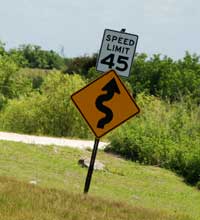
Snake Road wiggles like a snake.

We rode up up I-75 and headed west on a bright sunny morning with big puffy clouds in the sky. Margie spotted all kinds of things — an occasional bird perched in a dead maleleuca tree, big green shrubs studded with pale pink wild hibiscus native to the Everglades, and a golden brown snake rippling across the road. About an hour into the journey, we turned onto Snake Road (but didn’t see any snakes there). Swamp lilies grew in the canals on either side of the road as it turned and twisted past cow pastures dotted with cabbage palms and cypress domes. Swallow-tailed kites soared above. The sawgrass was in bloom, sending up long feathery clusters of small, reddish flowers. We passed through the bustling Big Cypress Seminole Indian Reservation, took a turn and found ourselves in the Devil’s Garden agricultural area.

C&B Farms in Clewiston

C&B Farms is sandwiched between Clewiston and the edge of the Everglades. According to owner Chuck Obern, the farm is 2500 acres in size, with 1500 acres that are tillable. Of that, 1000 acres are planted  conventionally and 500 acres are in organic production. Chuck offered us a quick tour of his farm, so Margie and I hopped into his truck and headed down a sandy road into the heart of the farm. One side of the farm is organic, and the other side is conventionally farmed. The two sides are separated by a large ditch and a row of of trees. Each side has separate farming equipment and packing lines, where the produce is rinsed and boxed, and there’s a separate organic section in the enormous cooler.
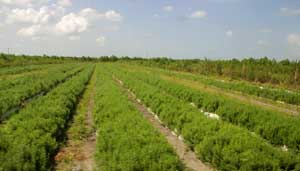
A 2-acre block of rosemary.

Mid-June is pretty much the end of the season and there wasn’t that much growing at C&B. It’s already too hot. We passed by two-acre blocks or fields of herbs — dill that had already bolted, marjoram, knee high sage, bushy rosemary, tarragon, oregano, spearmint, and parsley. We passed by long brown piles of compost, which is used mostly for water and nutrient retention, or as a soil conditioner. The soil is light gray and sandy, very sandy, and it’s amazing they can get so much to grow in it. We passed by blocks of cantaloupe, personal sized watermelons, and butternut squash.

Pumping station for drip irrigation. Barrels hold liquid fertilizer.

Crops are irrigated two different ways. There’s an automated double drip irrigation system (double meaning two lines of drip tape per planting row). Water is pumped from a ditch or a well, and liquid fertilizer is mixed in. A computerized system controls how much water is sent where and when. There’s also the seep irrigation system in which water is pumped into or out of the ditches to raise or lower the water table under the fields. The water seeps into the soil from underneath, rather than drip down from the top. Seep irrigation water is reused or recirculated several times before it is sent to a retention area. Excess water is treated to remove phosphorus before it is released back into a canal bordering the Everglades ecosystem.

During peak season, 500 workers are in the fields picking and packing. But at the end of the season, with a lot less growing, there are only about 100 workers. Fields were dotted with trailer-mounted portapotties complete with a handwashing and sanitizing station, as required by recent federal food safety laws. These regulations also require that workers can’t wear jewelry or bring outside food or drink into the fields.

The federal food safety act is actually many sets of guidelines that came about after the e. coli incident with contaminated jalapenos from Mexico a few years ago. Since then, domestic growers have to comply with stricter standards of produce handling cleanliness. To check compliance, a major food safety certifier comes once a year to check procedures, equipment, and records over a period of three days.
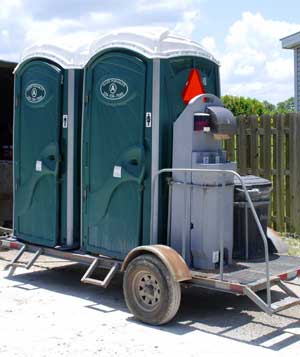
Mobile portapotties, with handwashing station, that are taken out to the fields.

Surprisingly, Central and South American growers do not have to comply with the same strict federal food safety laws as domestic growers. The vast majority of imported produce is not inspected. At most only one to two per cent (maybe even less) of the food coming in is checked for the same standards of cleanliness and safety, and pesticide residues. “There’s no traceability, no accountability,” Chuck complained. “And no guidelines. It’s not a level playing field.” Imported or “offshore” produce is priced less than domestically grown produce, and American farmers find it hard to compete. Their costs have gone up due to extra work and expenses meeting the new guidelines.

So what should a conscientious food shopper do? “Vote with your dollars,” said Mike Counts, the C&B sales manager. “Your dollar ultimately makes the statement. If enough people do it, they will change.” That said, we finished loading up and headed back out on the highway. One hundred miles later we were back at Bee Heaven, unloading fresh melons that had been picked just a few days before. Maybe it costs a little more to buy local and organic, but as you sink your teeth into those juicy fruits, you’ll have the satisfaction of knowing that you’re keeping a couple of local farmers in business.
Read Full Post »

Local fruit at Whole Foods

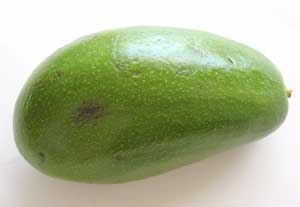
Donnie avocado

Farmer Margie just got back from dropping off 30 bushels of her certified organic Donnie avocados at the area Whole Foods warehouse. Look for her fruit in South Florida stores starting this Thursday. If you don’t see them, ask the produce manager to get them for you.

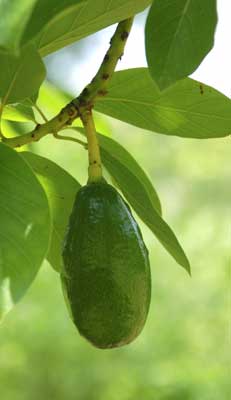
Here’s a picture of a Donnie that I got at last Saturday’s fruit sale. I can hardly wait to sink my teeth into it! These are mild and creamy and I can only eat half at a time. This particular fruit weighs one and a half pounds, but by the end of the season, they will grow to 3 to 4 pounds!

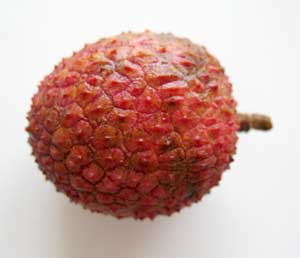
Mario's lychee

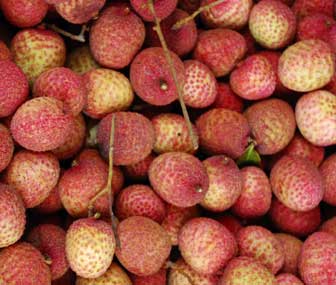
Margie also dropped off certified organic lychees that are Certified Naturally Grown by Mario Yanez, which will also be in Whole Foods this week. His lychees are plump and sweet and juicy. It’s getting toward the end of lychee season, so get them while you can because there aren’t going to be any more.

Read Full Post »

Summer has just begun and it’s already a scorcher! We’ve had above normal temperatures since April 26, according to the National Weather Service. Highs have been 90 degrees or above since May 30 (except for a slight dip to 88 on June 1). The heat index has been 100+ degrees most days. Last June was even hotter. Record temperatures were set on June 22, 2009 in Miami with a high of 98. Fort Lauderdale had a high of 100, tying an all time record. This summer feels hotter because temps have consistently been at 90 or above for 59 days and counting, while last summer temps were mostly in the high 80s with a few spikes in the 90s.

The last picture I took before getting chased off by a hot and cranky bee.

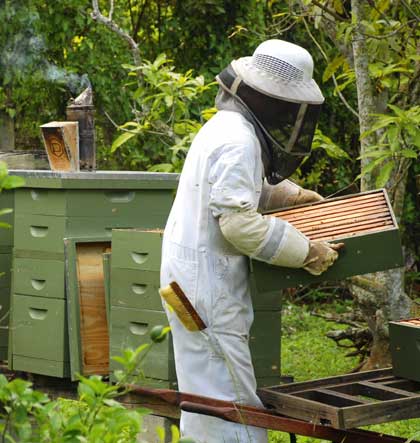
This crazy heat has an effect on livestock at Bee Heaven Farm. Chickens stand with their beaks open, panting, and hold their wings out a bit to their sides to try to cool off. Bees don’t like heat and get cranky. I passed by the hives when beekeeeper Miguel Bode was working with them a few weekends ago. One bee took offense to where I was standing, buzzed around my head, and chased me for a good distance. Lucky for me, I didn’t get stung but it felt close! Even the worms in the vermiculture bin have been suffering mightily. Instinctively they’ve dived down to the bottom of the bin, seeking cooler soil, but hit bottom instead. The Worm Guy (that’s what Margie calls him) advised chilling them down with frozen water bottles buried in the bin. Wigglers on the rocks, anyone?

I asked Farmer Margie what grows well in this kind of heat. “Weeds!” she exclaimed. Those weeds completely took over vegetable beds after Gleaning Day. Margie mowed them down, and now that she’s had two days without rain, she’s out on her tractor tilling the soil, preparing to plant cover crops.

Some summer fruit is finally starting to get ready, but running a little behind schedule because of the freeze this winter. The extended period of super cold weather caused plants to go dormant for weeks. Lychees (Mauritus variety) are bearing late this year. Margie pointed out that last year, a bumper crop of lychees were harvested in late May. This year the harvest began in mid-June, and the quantity isn’t quite as much.

Mauritus lychees from last summer.

Another casualty of the cold are mango trees which were in bloom in January when the freeze hit. The long stretch of freezing temperatures damaged blossoms. Some fruit set and grew, but then aborted and fell off. I’ve seen trees that don’t have as much fruit, and if they do, they’re not as plentiful and not as big or developed.

Half-grown Donnie avocado.

Avocado trees seemed to escape significant damage from the freeze in January. Branches are loaded with fruit several inches long, about the size of Haas avocados in the groceries. If you’re not familiar with Florida avocados, and you have a tree in your yard, don’t get confused and pick early! The varieties that grow here, especially the Donnies that Margie raises, get much much, much bigger than the Haas variety from California or Mexico. Last summer many Donnie avocados weighed in at 3 pounds apiece, and one giant weighed 4 pounds. Avocado picking will start in mid-July, also several weeks later than last summer.

Read Full Post »

Hope springs forth

The heirloom tomatoes available at market are winding down. They will be very scarce for weeks, assuming there won’t be patchy frost tonight, which still has potential to damage weakened plants.

Weeks later, you can still see signs of freeze damage at Bee Heaven Farm — and signs of recovery.

Tomatoes blooming after the freeze

The heirloom tomatoes vary in damage. Some varieties are all but destroyed by the freeze. The ones with blackened, shriveled leaves are not coming back. A few varieties are re-growing leaves and still have fruit ripening on the vines. And some look positively fluffy with their green leaves and are blooming again. The quantity and quality of the second bloom tomatoes remains to be seen. If they’re just as nice as the ones we’ve had so far, expect more heirloom tomatoes at market, just not right away, perhaps in a couple months. “Hope springs forth!” Margie said.

Purple Pod heirloom beans blooming after the freeze.

The heirloom beans have been all but decimated. One variety with purplish stems, known as Purple Pod, re-grew leaves and looks a lot better than a week or two after the freeze. It’s even putting out a few, shy blooms. The question is, will those blooms set and grow beans. And if they grow, how big and what shape are they going to be in? All of that is doubtful because they have a big problem with mildew. “The leaves are all frozen out and the plants are more vulnerable to everything,” Margie explained to me.

This is the lasting, almost hidden freeze damage that takes weeks to emerge. The Gold of Bacau beans aren’t coming back very well at all, and the few pods that have grown since the freeze are small and misshapen, nothing you would want to buy at the market or find in your CSA box.

Freeze damaged Gold of Bacau beans.

Read Full Post »

Steven Green, Green Groves

Meet Steven Green of Green Groves. His day job is professor of tropical biology, conservation and statistics at UM. He also has a two and a half acre grove of various fruit trees. The cute little clementines from a couple weeks ago were his. This week we have lemons from his grove. Steve doesn’t know the name of the variety but does know it was planted in 1938. He says their flavor is “much brighter and more flavorful,” than your average supermarket lemon, and the fruit has a moderate amount of seeds and thick skin.

Steven grows lemon, lime, carambola, calamondin, allspice, monstera, avocado, tangerine, 5 kinds of mango, and lychee. He has been growing fruit since he moved to Redland in 1978, when he bought a 2 1/2 acre avocado grove with trees planted originally in the 1930s. There are still a few of those left, including the lemons. In 1991 Steve planted lychees, but Hurricane Andrew knocked them all down the following year. Putting his scientific knowledge to good use, Steve replanted 125 lychee trees at what he calls the “optimal distance” for orb weaver spiders. They prefer a span of about 2 meters from branch edge to branch edge for their webs. Once the spiders made their webs and settled in, there have been no problems with caterpillar moths in the groves. Lychees have so few pests, Steve says, that he doesn’t used pesticides in his grove. He’s now in the process of getting the grove certified organic.

Lemon from Green Grove

When Steven has way too many lemons, he makes this North African lemon preserve:

Cut the lemon into quarters, bury in kosher salt, add chilis (optional).
Can take out spoonfuls of liquid to cook with.
Store salted lemons in frig.

Read Full Post »

« Newer Posts - Older Posts »