Feeds:
Posts
Comments

Archive for the ‘fruits’ Category

Monstrous mango

Ginormous mango — look closely at the scale to see how much it weighs.

Nothing says summer in Miami like eating one or two (or three) mangoes a day. And with massive quantities of mangoes available everywhere, that’s easy to do. Home grown or roadside mangoes just don’t compare to half ripe, faintly flavored fruit coming in from Mexico. Just do yourself a favor and don’t even look at those when you are surrounded by local abundance.

Bet you can’t eat but one of these monstrous mangoes! It came from Possum Trot Tropical Fruit Nursery, where Robert Barnum must be feeding it some amazing compost to grow that big. Can its extreme size be attributed to global warming? Look closely at the dial on the scale. It weighs over four pounds! Bet you can’t eat two!

Read Full Post »

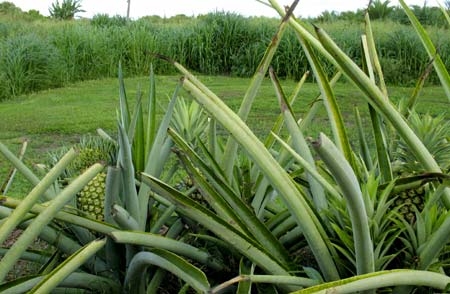
Tim’s pineapple patch. Lettuce and cabbage planting area is in the background, now overgrown with weeds.

Tim Rowan is a hard working farmer. In the winter he grows certified organic lettuces and cabbages. And in the summer, when it’s so hot that some farmers take a break, Tim is still growing things. His latest hobby, as he calls it, is raising pineapples. He has a test patch with over 70 pineapple plants in various stages of maturity. (Most started from tops salvaged from his kitchen where he is a chef at Deering Bay Yacht and County Club. He also grew several pineapples at his vegetable garden there.) Some plants on his farm are already bearing fruit. I asked Tim to save me a pineapple, and recently he let me know mine was ready, come and get it.

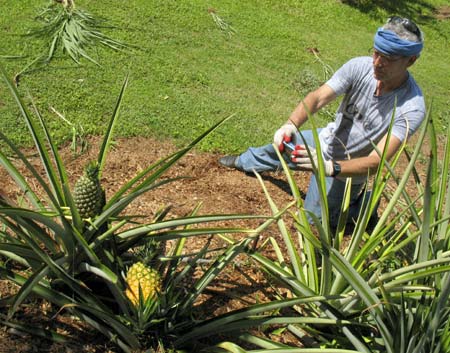
Tim Rowan photographs the pineapple before it gets picked.

And there it was, in all its glory — a very large pineapple perched on a short stalk sprouting from the center of of a spray of long, narrow, sharp toothed leaves. (If you’ve never seen a pineapple plant, it looks like a bromeliad.) The fruit was fully mature and golden yellow in color. It had a distinctive top — not one leafy crown, but at least six or eight all in a row. It looked like the pineapple was sporting a mohawk. Both Tim and I took pictures from various angles while it was still on the plant. If a pineapple could have charisma, this one did. Check out Tim’s blog post about his adventures growing pineapples.

Pineapple sporting a mohawk top.

Tim had left the fruit growing on the plant so I could pick it myself. “Hold it with both hands, give it a little twist and snap it off,” he said. I did, and it came off easily in my hands. I was impressed by how heavy and substantial it was. Turns out it weighed five pounds.

Several large suckers or shoots were growing from the base of the plant. They looked like overgrown pineapple tops. Tim broke one off carefully, and at its base were strands of white roots, ready to plant. This sucker would grow into a new plant which would bear fruit in one year. Tim removed other suckers and planted them too. “From one plant you can get as many as eight new plants,” he said as he set them into the ground. You can also plant pineapple tops, but it takes two years to flower and another six months for the fruit to mature.

Picking pineapples, location not specified. Florida Photographic Collection.

Pineapples are not unusual for South Florida. Settlers started growing pines, as they were called, in 1860 at Plantation Key. From the late 1880s to the early 1900s, pineapple was a popular crop, and almost everybody had a patch. Plantations stretched from Plantation Key to the south, to Elliott’s Key (as it was spelled then), north to Lemon City settlement, up the coast to Yamato (west of Boca Raton) which was farmed by Japanese, and as far north as Indian River. The fruit was shipped by schooner and then rail to northern cities. Competition from Cuba and Hawaii, diseases, bugs, and freezes eventually wiped out the industry by the time of WWI.

Boxing pineapples for shipping. Florida Photographic Collection.

In more recent times, “A guy tried producing specialty pineapple in the mid-late 1990’s on the S.W. corner of Naranja Road and Quail Roost,” county agriculture manager Charles LaPradd told me in an email. “They were the small super sweet golden ones that sell for a fairly high price, so he thought he could compete against the imported ones. He couldn’t and went out of business.” These days, almost all the pineapple in stores is grown offshore. Costa Rica is the top supplier for pineapples for the United States.

Shipping pineapples by boat. Florida Photographic Collection.

Pineapple may not be grown on a large scale in Redland anymore, but many people grow a few plants in their own gardens. They are easy to grow, like full sun, and because the plant has a shallow root system, doesn’t mind growing in a container.

Besides planting the top, save the peel of a homegrown or organic pineapple and use it to make a pineapple flavored vinegar. Here’s the recipe from Wild Fermentation by Sandor Ellix Katz. Use it to make salad dressing, put it on avocado, stir into salsa, or wherever you need a sweet-sour tang.

Mexican Pineapple Vinegar

1/4 cup sugar
peel of 1 pineapple (organic or home grown)
1 quart (4 cups) water
cheesecloth (or coffee filter)
glass jar

1. In a jar or bowl, dissolve the sugar in 1 quart of water. Coarsely chop and add the pineapple peel. Cover with cheesecloth (or coffee filter) to keep flies out, and leave to ferment at room temperature.

2. When you notice the liquid darkening, after about 1 week, strain out the pineapple peels and discard.

3. Ferment the liquid 2 to 3 weeks more, stirring or agitating periodically, and your pineapple vinegar is ready. Keep in refrigerator.

Read Full Post »

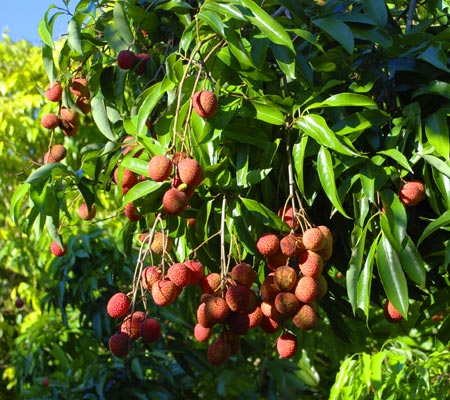
Organic lychees ripening in the morning sun.

The lychees in this week’s summer fruit offering come from Green Groves, not too far from Bee Heaven Farm. Steven Green, the grower, invited me to see how lychees get picked. He had an order from Whole Foods, and hired a picking crew to help. If you were in Whole Foods last weekend or this weekend and saw pint containers of organic lychees for sale, those were the ones!

Up in the cherry picker, Gonzalo picks lychees.

Picking work starts early. Golden morning sunlight was just breaking over the tops of trees from the grove across the road. The air was cool and full of sounds of birds. Dew was still clinging to weeds under the lychee trees. Ripening fruit hung in heavy clusters on the trees. At 7 am, the crew was already getting started. They had dropped off their cherry picker the day before. It was a simple contraption — an engine on three wheels, with a boom arm and bucket. Gonzalo, one of the workers, stood in the bucket and manipulated the controls to raise the boom and drive the picker to a different spot. When I arrived, he was already at tree top level gathering fruit.

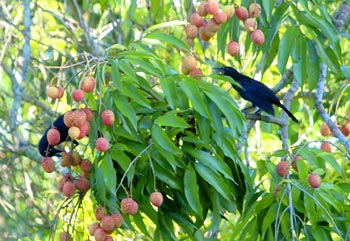
Gonzalo held a pair of heavy duty clippers in one hand, and reached with his other hand to grab clusters of lychees called panicles. He snipped the panicle and placed it into one of the bins fastened to the sides of the bucket. He started with the first tree by the gate, and worked from top down. Then he moved to the other side of the tree, gracefully maneuvering the picker, and again clipped fruit from the top down. “Usually the whole tree ripens at the same time. The lower branches ripen before the upper. And the top gets eaten by grackles,” Steven said with a laugh. “I have enough to share.” He has 125 trees planted on two acres, and has been growing lychees since 1992, and avocados for 15 years before then.
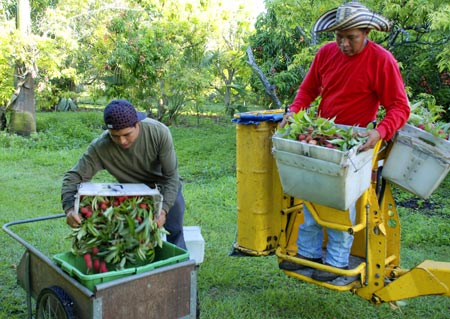
Hidalgo loads fruit that Gonzalo gathered.

The rising morning sun shone on Gonzalo’s face as he worked silently and quickly. Bins filled up with lychees. The picker’s gasoline engine clattered, and grackles screeched from a nearby tree. He lowered the bucket and Hidalgo came with a gardener’s cart and dumped lychees into it. When the cart was full, he walked back with the cart to the improvised packing house. A long table had been set in the carport of Steven’s house. Hidalgo dumped lychees onto the table. It had a raised lip along the edges, to keep precious fruit from rolling away.
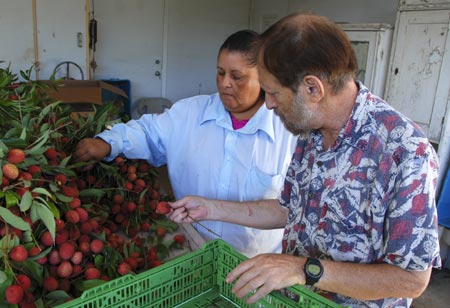
Steven shows Leticia the acceptabe size for coffee spots.

Leticia, the owner of the picking company, stood at the table and checked each individual fruit. She has been packing fruit for 25 years and has a keen eye for the perfect ones. “This crew knows ripeness,” Steven said. They have worked for him for many years. Steven reviewed with Leticia how he preferred to grade the fruit. The perfect ones went into a green bin. The less than perfect ones, called number twos, were tossed into a box. A number two lychee was one that had a brown blemish called a coffee spot. Steven explained the coffee spots were harmless and didn’t affect flavor or quality of the fruit. Spots the size of a pencil eraser were ok, but bigger ones were not. Spotted number twos are still good to eat, but in this case would get sold to make wine or ice cream. Steven pointed out, “Buyers of number twos are price sensitive and understand that the blemishes have no effect on fruit quality except for appearance.”

The sweet perfume of ripe lychees filled the air. Steven showed me the difference between a perfectly ripe lychee and one that wasn’t quite there. The not as ripe fruit’s skin had little spines or bumps. A ripe fruit’s bumps flattened out. Steven explained that as it ripened, the lychee grew more plump and rounded, which stretched its skin and flattened out the bumps.
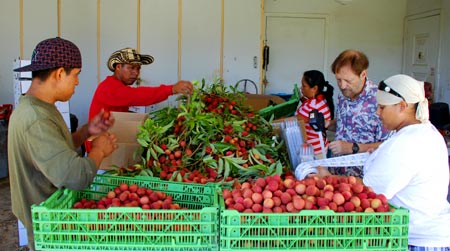
Hidalgo, Gonzalo, Betty, Steven and Shelly grading and packing fruit.

Picking is all a matter of timing. Pick too early and the lychees are a little sour. (I happened to eat some of those a couple weeks ago.) Wait a little for the fruit to ripen more and it gets sweeter and tastes like lychee. “If you wait too long to pick, overripe fruit tastes like sugar water and you lose the lychee flavor,” Steven explained. Picking also has to do with market timing and getting a good price. The first local lychees to hit the local market got top dollar, getting $46 for 10 pounds wholesale. When Mexican lychees came in last Monday, May 30th, the prices crashed down to $25 and are now tumbling even lower. (These are prices for conventionally grown fruit. Organic lychees can fetch considerably more.)

Steven grumbled that NAFTA is the reason for the drop. “In Mexico, growing is much less expensive, and the quality is less, not anywhere as good as locally grown. They pick earlier because they need the extra time in shipping.” NAFTA gives offshore fruit — as growers call imports — another unfair advantage. “Mexican lychees may have prohibited pesticide residues, or have been treated with sulfites to preserve their color. USDA doesn’t have the manpower or resource to inspect all the fruit coming in. Also the retailer is supposed to mark COOL (Country of Origin Label) but there’s almost no enforcement against retailers that don’t. For organic fruit, that’s no problem, because origin is part of the certification.”
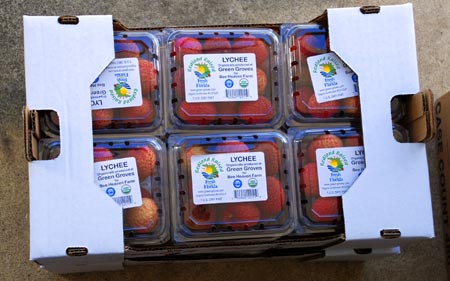
A case of organic lychees destined for Whole Foods.

Steven showed me the label that went on each pint clamshell and cardboard case. Among other information, the label had the “Redland Raised Fresh From Florida” logo and the grove’s organic certification number. Shelly stuck labels onto pint sized plastic clamshell containers, then filled one container at a time with number one lychees, and packed 12 to a case. Steven put labels on the cases. The crew would pick and pack fruit for a few more hours. A driver was coming later that afternoon to pick up their order of 40 cases. Steve’s lychees would be in local stores for the weekend selling for $6.99 a pint.

Look carefully and you’ll see a pair of common grackles feasting on fruit.

On my way back into town, I passed by a woman selling lychees by the side of Krome Avenue. It was completely the opposite of a supermarket — a tent, a bin full of lychees, and an ancient looking scale. Three cars had pulled to the side of the road and people were handing her cash for pounds of sweet fruit. Hand lettered signs nearby said LEECHEES $2.00. For that price, most likely the lychees were grown locally and were not organic. I was reminded of something I heard a farmer once tell me: “Growers are price takers, not price makers.” On that sunny Thursday morning deep in the heart of Redland, two kinds of lychees were being sold, and two kinds of prices were being made.

Read Full Post »

     The CSA’s been finished for a few weeks, and I don’t know about you, but I’ve been craving those veggies and salads! The fruitful bounty of summer helps compensate – I get so distracted with the juicy tropical fruits, and soon the avocados, that I almost forget what I’ll be missing until the fall. Another windfall of summer is that there’s EGGS available! We’ve been eating them in omelets, quiches, sandwiches…finally, getting our fill.

     Bee Heaven Farm has officially started the summer season offerings, coinciding with the first lychees and mangoes. The new on-line web store will let you order until Thursday June 8th at 3pm for Friday’s harvest. You’ll be able to choose from 2 places to pick up your order on Saturday- the farm, or Joanna’s Marketplace in Dadeland. There’s a pretty good assortment of goodies, including Rachel’s Eggs (certified organic), Tilapia, Hani’s cheese, hommos, baba ghanoush and tabbouleh. You’ll also find local raw honey, callaloo, herbs , carrots, parsnips, Black Spanish radishes (spicy!), and other yummy things. Fruits include several varieties of mangoes, mamey sapote, white sapote, two kinds of lychees, and a great deal on a 10-pound box of certified organic lychees from BHF’s Green Groves – plenty to indulge, share, freeze, make lychee syrup (pancakes!), and even wine. According to Kathy, longtime CSA member and home vintner, you need about 5 pounds of lychees per gallon of wine.

    The link to the store is not published on the website, but you can get to it from here: www.redlandorganics.com/BHFwebStore.htm When you place your first order, you’ll need to set up an account (no charge), then you can order every time there’s an offering. The summer web store will only be ‘open’ on weeks when we have something to sell. We might not have something every week, but when we do, the store will be open from Tuesday morning through Thursday 3pm.

     So, locavores, go get some goodies before the store closes!

Read Full Post »

The dinner table is perhaps the most powerful and delicious place to plant the seeds of change; the return to simple truths, change, and wisdom all go hand in hand. Our first step toward change can be to pause when we take our first bite and think about our connections with food. Aha! Understanding this connection is the essence of the Earth Dinner.
– Theresa Marquez, founder of Earth Dinner

Earth Dinner is a new holiday tradition meant to celebrate Earth Day. It was started four seven years ago by Organic Valley and Chefs Collaborative as a way to gather friends and loved ones around the table for a fresh, seasonal meal made of local ingredients. The focus of the Dinner is to have a meaningful conversation about the food — where it came from, how it was grown or harvested, and who grew it. So it was only natural that farmer Margie Pikarsky and grower/chef Robert Barnum would organize their own Earth Dinner,  held the weekend after Earth Day.

Earth Dinner at Possum Trot Tropical Fruit Nursery.

Call it extreme locavore. The challenge was to source all ingredients — except for flour and olive oil — from what was available locally. And so the hunting and foraging began. Chef Michael Schwartz  donated wild boar he had hunted himself together with local fisherman George Figueroa of Trigger Seafood, who donated cobia. Hani Khouri provided cheese and milk from his goats. Large beautiful heirloom tomatoes came from grower Teena Borek. Callaloo came from Three Sisters Farm, and a variety of herbs and vegetables from Bee Heaven Farm. Winemaker Peter Schnebly donated two kinds of local fruit wine. And a plethora of fruit came from Robert’s own grove.

At the wood smoker, Weber bastes wild boar and Sadie checks multi-color potatoes.

Margie and her crew volunteered to help clean and cook, and Robert’s friends pitched in. Preparations took days and went up to the last minute. When I arrived an hour before dinner, a plume of blue smoke chugged from the wood smoker outside the house, as wild boar and multi-color potatoes cooked inside. Both kitchens were humming with activity as helpers chopped, stirred, snipped and tossed. In the dining room, two long tables were covered with white linen and glittered with fine china, glassware and silver. Centerpieces of mixed flowers — food for local bees — from Bee Heaven Farm graced the tables. Glass goblets were stocked with braided breadsticks that had been baked in the wood oven and looked like branches plucked from the grove. Even the sea salt was local, produced by a small company in the Florida Keys.

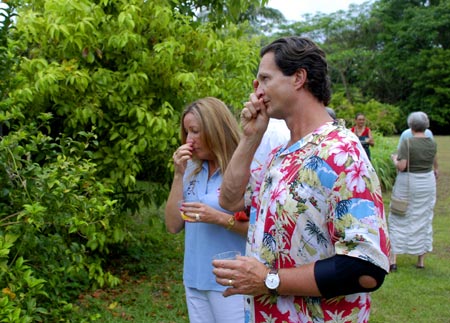
Donna and James Patrick smell crushed bay rum leaves.

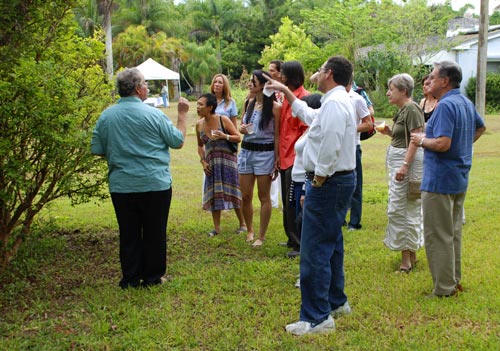
While there was still daylight before dinner, Robert offered guests a short tour of his 40 acre property. Everything he grows is useful in some way. He pointed out bay rum, lemon bay and citronella outside the house, and invited guests to crush leaves and smell different scents. Jaboticaba was nearby, with small, unripe berries growing on its trunk. It bears fruit three or four times a year. Robert harvests the berries for wine, of which we got a taste later in the dinner. Guests strolled through the grove and saw macadamia, mango, and lychee trees (to name just a few of the edibles that I recognized).

<< to be continued >>

Robert Barnum holds up a jaboticaba fruit.


Read Full Post »

« Newer Posts - Older Posts »