Feeds:
Posts
Comments

Archive for the ‘location’ Category

The two best farmers markets on the weekend — and you can feel free to debate this with me — are the Pinecrest Gardens Green Market on Sundays from 9 am to 2 pm, and the Coral Gables Farmers Market on Saturdays from 8 am to 1 pm.

Coral Gables Farmers Market
405 Biltmore Way
(in front of City Hall, at Biltmore Way and LeJeune Ave.)

Hurry over to the Gables Market because this Saturday March 27 is the last day. Several members of Redland Organics are selling their wares there.

Jad, Jessie, Leah and Mary Lee at Hani's Mediterranean Organics

One recent weekend I stopped by to chat with the crew at Hani’s Mediterranean Organics. Everybody who walked up to the tent asked if cheese was available. “The goat cheese is in limited production and sells out fast. You got to get here early,” Hani’s wife Mary Lee patiently explained. She offered mussels cooked in white wine sauce with garlic, or maybe some lupini beans to snack on. Their son Jad was making falafel, and volunteers Jessie and Leah from Ohio State University helped out. (Hani is also at the Pinecrest Market.)

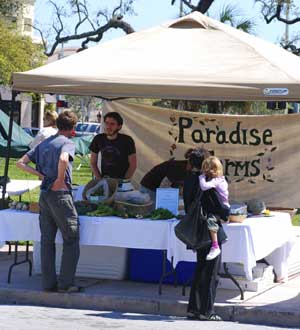
Paradise Farms, the only certified organic farmer at Gables market.

Across the street you’ll find Paradise Farms selling various fruits, vegetables and herbs. Paradise is certified organic, unlike other growers at the market. You have to get there early for their famous oyster mushrooms. The recent cool, dry weather slowed down mushroom growth, so there have been some weeks where they have been in short supply. (Paradise is not at Pinecrest Market, but you might find the mushrooms at Redland Organics.)

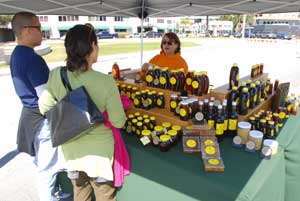
You’ll find Miguel Bode selling honey and pollen at his tent set up at the end of Biltmore Way right by LeJeune. Miguel’s wife was there last Saturday while Miguel was down in Redland checking his hives. He keeps bees at Bee Heaven Farm and at Paradise Farms. His wildflower honey is my favorite, and is a real taste of the local area.

Miguel Bode's local honey and bee pollen

Pinecrest Gardens Green Market
5855 S.W. 111th Street
(in parking lot in front of Pinecrest Gardens)

If you want Miguel’s honey but missed the Gables Market, you can also find it here, sold by Redland Organics. Everything is local, either grown on Bee Heaven Farm or sourced from organic growers within 150 miles of Miami. No telling what interesting things you’ll discover under the sprawling tent. In addition to honey, you can find certified organic fruits, vegetables and herbs, along with bunches of flowers and dried fruits, and Paradise Farms oyster mushrooms (subject to availability).

Word up to CSA members — the produce in your Saturday box is also available at market, so if you want more of something but didn’t find it in the extras box, go to Pinecrest. You can also find things at market which never make it into your CSA box, particularly fruit and herbs. On one recent Sunday, I saw rangpur limes, which look like small oranges but are not quite as tart as the familiar green limes.

The Pinecrest Market will run through April.

An assortment of familiar and unusual fruit at Redland Organics.

Read Full Post »

Avocado tree infected with laurel wilt. The fungus carried by the beetle causes entire branches to turn brown and die. Photo courtesy UF/IFAS.

If you have avocado trees growing in your yard, heads up! The feared redbay ambrosia beetle has surfaced in west Miami-Dade County, in Emerald Lakes. One beetle was caught in a trap on March 2. Scientists are testing the captured bug to see if it carries a fungus that kills avocado trees (and others in the bay family) by causing a fatal wilt. There was a scare last summer, but that proved to be a false alarm. This time it looks like the real threat has arrived.

Florida Dept. of Agriculture recommendations for homeowners:

The public can help prevent the spread of the redbay ambrosia beetle and laurel wilt disease by following these simple suggestions:

— Become familiar with the signs of laurel wilt disease and redbay ambrosia beetle and be on the lookout for evidence of the pest/disease on your trees. http://www.doacs.state.fl.us/pi/enpp/pathology/laurel_wilt_disease.html

— Use local firewood only. Do not transport firewood from other states because destructive pests and diseases, such as redbay ambrosia beetle and laurel wilt, can hitchhike into Florida on infested firewood. http://www.doacs.state.fl.us/pi/videos.html

— Do not transport host trees (redbay, swamp bay, avocado, sassafras, pondspice, pondberry and others in the Lauraceae family) unless purchased from a registered nursery.

— If your Lauraceae-family tree dies, use one of UF/IFAS’s recommended methods of disposal.

People who suspect their trees might be infected with laurel wilt or think they have found a redbay ambrosia beetle are urged to contact the DPI helpline at 1-888-397-1517.

People who would like to submit a plant or insect sample, visit this web site for sample submission instructions http://www.doacs.state.fl.us/pi/enpp/pathology/laurel_wilt_disease.html

Know your foe: redbay ambrosia beetle. Actual size is about half a grain of rice. Courtesy UF/IFAS.

Discovery of ambrosia beetle in Miami-Dade no cause for panic, scientists say

Last summer, there was a premature announcement of the presence of a tiny beetle that has the power to spread fungus that can severely damage avocado trees. That turned out to be an unfortunate mistake, triggering some growers to cut down and burn trees and apply pesticide.

This month, there’s no mistaking it: One redbay ambrosia beetle was found in a trap in west-central Miami-Dade County on March 2.

But scientists say a single beetle shouldn’t scare Miami-Dade growers — whose trees cover nearly 7,000 acres of South Florida — just yet.

“It’s not cause for panic, thank God,” said Jonathan Crane, a tropical-fruit plant specialist with the University of Florida’s Institute of Food and Agriculture Sciences in Homestead.

Read the rest of the article here.

Read Full Post »

Fan mail

It’s not every day that I get a thank you note from those in the higher echelons. Back in December, this note appeared in my inbox.

Dear Ms. Wertalka:

I wanted to compliment you on your blog, Redland Rambles. It’s a great vehicle for promoting local agriculture as well as putting a face and story behind those who grow our food and plants.

Keep up the great work!

Warm regards,
Katie Edwards

Katie A. Edwards
Candidate, State Representative, District 119
P.O. Box 900398
Homestead, FL 33090
Phone: (786) 266-8010
E-Mail: Katie@Elect-Edwards.com
www.Elect-Edwards.com

Paid political advertisement paid for and approved by Katie A. Edwards, Democrat, for State Representative, District 119.

I met Katie briefly this summer at the laurel wilt workshop, held at the UF/IFAS Extension offices. She’s currently the Executive Director of the Dade County Farm Bureau. Now she has set her sights on a higher goal, State Representative for District 119, which includes Redland, sprawls east to Pinecrest, and winds north through West Kendall and into Sweetwater.

On her campaign web site, Katie says that South Dade needs a strong voice in state government. “Protection of South Dade’s unique ecological resources is a priority if we are going to achieve a quality of life that is environmentally sustainable and socially responsible.” She’s the only candidate in that district who speaks for the growers in Redland. I may be wrong, but at first glance, her opposition doesn’t seem aware that they even have the county’s prime agricultural land in their district. As much as I didn’t want to get political when I first started this blog, maybe now it’s time to start having conversations with the people who want to make decisions for my farmer friends in Redland. Stay tuned…

Read Full Post »

Record-breaking cold temperatures rolled in, and a freeze warning was issued for several nights in a row this week. The farmers in Redland scrambled to protect their crops from the freezing cold, but generally fared well. CSA growers located further north — Worden Farms in Punta Gorda, and C&B Farms in Clewiston — got frost damage on Tuesday night. They’re still evaluating how much damage they got, and if any crops were lost.

As a result, there may be less in the share box this Saturday and maybe for the next week or so. Freeze damage is one reason, and less veggies growing is another. “Plants don’t like to grow when it’s cold. They like to go dormant,” grower Dan Howard explained to me. If there’s a killer frost and lettuce (for example) is burned by cold, that’s it, there’s no more local lettuce to eat until it’s replanted and harvested again. Remember, as CSA members, you agreed to share the same risks as the growers! No faking it with lettuce from Belize or somewhere… not in this CSA! (Also, because vegetables were damaged by the cold, or were not ready to pick, there will be less in the stores and the prices will go up.)

Reemay, or floating row cover, protects delicate greens and pole beans against freeze damage.

Margie Pikarsky at Bee Heaven Farm protected delicate basil, heirloom tomatoes, and pole beans with large sheets of Reemay, or floating row cover. It’s a spun polyester fabric that is used to cover plants, much like a blanket. The row cover acts like a blanket to hold in the heat and keep plants warm. Margie added she’s not watering as much, because that runs the risk of plants mildewing, or hot condensation cooking entire plants. Her crops have been covered since the first freeze warnings on Saturday, and the Reemay will stay up until the cold blast forecast for this coming weekend.

On Wednesday afternoon, Dan Howard of Homestead Organics, was cautiously optimistic. “Tuesday night it went down to 33, 34 degrees, but not a killer freeze,” he told me. He had prepared his bean fields by watering them quite extensively during the day on Tuesday. (It’s just too much acreage to use row cover.) Dan explained that his crews “soaked the ground down real good. Water insulates the ground to keep it from getting colder. Well water is 75 degrees, the same temperature year round. Dry ground gets colder than wet ground.” He explained that ground temperature is the most important for the plants, keeps the roots from freezing.

If the temperature gets below 32 for any length of time, plants will become permanently damaged from the cold. “Anything below 32 is bad, and at temps of 28, 29 degrees, it’s a total loss,” Dan explained. Monday night wasn’t that severe because there was a blanket of cloud cover, which acted as insulation and kept the temperatures from dropping too low. Tuesday night the sky was clear and temperatures dropped — but it was windy, and that made a difference. The moving air keeps ice from forming on the leaves. “If there’s no wind and clear sky, you get frost,” Dan said. And frost is what kills plants. It coats the leaves and burns them much like frostbite. Leaves turn black and wilted from the damage and the plant will die. Farmers can knock ice off the plants by spraying fields with water in the middle of the night, Dan explained. That’s why they’re up all night, watching the temps, checking the plants watering in the fields and groves.

In a similar vein, Robert Barnum of Possum Trot Nursery watered his tropical fruit grove on Tuesday night. He has giant pumps to draw well water, and tree-high sprinklers dotted through his grove. Tuesday night temps dropped to 36, and Robert was up at midnight and again at 3 am watering and checking on his trees. He explained that water gives off heat as it freezes, 353 kilocalories per gram of water to be exact, and that bit of heating warms the plants. Once the water on the plant freezes, it keeps the temperature constant at 32 degrees even if air temperatures drop below that, because a heavy coat of ice acts as insulation. But you have to keep watering, he insisted, to keep that small but important heating process going.

By Wednesday night Robert was less optimistic than Dan, and said the thermometer already read 39 degrees at 9 pm. The sky was clear and the winds were dying down. It looked like there would be a killer frost that night. Margie said the temperature dropped hard and fast — and then something unexpected happened. Some light cloud cover rolled in, and those clouds were enough to act like a blanket keeping heat from radiating away from the ground at night. Temps hovered around freezing, then came back up a bit. “I never saw anything like that,” Margie told me. But the main reason why the anticipated killer frost didn’t happen, according to Jonathan Crane at TREC: when the temperature fell to 35 it also reached the dew point. When the temperature meets the dew point, heat is released and the temperature rises, and that is what happened on Wednesday night. (There might have also been a bit of ground fog.) End result, no freeze, and crops were spared — this time. A more severe blast of cold air is forecast for the weekend, and growers (especially to the north of us) are bracing themselves.

To learn more about how frost forms and dew point, take a look at this web page.

Read Full Post »

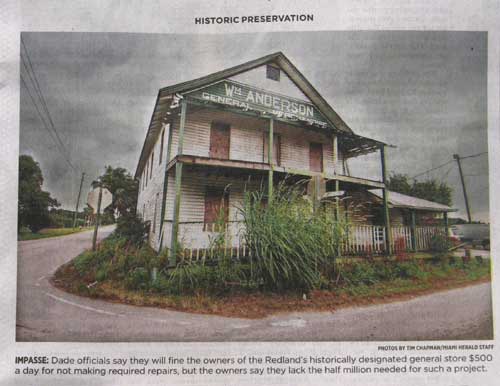
Anderson’s Corner doesn’t look like it will last much longer. It’s depressing to drive by there and see it all ramshackle and rickety, instead of restored and vibrant. I doubt if the current owners, who are struggling with upkeep, will be able to hold on much longer if they are going to get fined $500 a day. This might be the tipping point. Anybody out there with deep pockets who would like to help save this property?

The word was that the new bed and breakfast ordinance, which was drafted this summer with input from area growers, has gone to the county commission for a vote — but it has been pushed back and pushed back on the calendar. No telling when it will come up for a vote. It was supposed to in October, then in November. A yes from the commission will allow growers to add commercial kitchens and farm stands, and to legally to make and sell value-added agricultural products — jams, cheese, dried fruit, pickles and the like — in addition to the bed and breakfast provision. This new ordinance will essentially promote agritourism, which will allow the farmers to stay in business.

Anderson’s Corner, as photographed by Tim Chapman of the Miami Herald.

Redland’s Anderson’s Corner store at center of historic preservation battle

Miami-Dade officials have cracked down on the owners of the vacant, 100-year-old Anderson’s Corner general store in the Redland to prevent `demolition by neglect.’

BY ANDRES VIGLUCCI
aviglucci@MiamiHerald.com

The Anderson’s Corner general store, a modest, two-story wood-frame building on a corner in the rural Redland, doesn’t look like much. The white paint is peeling, porches sag, shattered windows are boarded up, and the Dade County pine siding is badly splintered where a hit-and-run motorist took out a chunk of wall last month.Yet the long-vacant country store, built around 1911 by a Redland pioneer, is one of Miami-Dade’s oldest and most resonant buildings — and also one of its most endangered.

And now it’s a test case in a county effort to boost enforcement of an ordinance meant to save historically designated buildings from what is happening to Anderson’s Corner, a phenomenon commonly described by preservationists as “demolition by neglect.”

“It’s sad to see these things happening, especially to a building that important,” said Kathleen Kauffman, Miami-Dade’s historic preservation officer. “And we don’t have that many wood-frame buildings left, period.”

Kauffman has cited the property’s longtime owners, Brian Simmons and his wife, Jessica Olsen, for failure to maintain a designated historic building. If the owners don’t make repairs sufficient to halt its deterioration, they will be fined $500 a day until the deficiencies are corrected.

Recently, the owners organized a cleanup, removing accumulated trash from the property and resealing boarded-up windows that had been forced open.

But Simmons said that he and his wife, small local farmers, lack the resources to do extensive repairs. They had planned a full renovation when they purchased it in 1997 but were unable to secure financing, he said. They have since had constant trouble keeping up with maintenance because vandals or homeless people regularly break in and damage the old building, Simmons said.

“It’s a money pit,” he said. “If I had the money, that place would be shining. It’s a piece of history, I know that. It makes us sick to know the condition it’s in. But my resources are tight.”

Subrata Basu, Miami-Dade’s assistant planning and zoning director, said he sympathizes with the owners’ difficulties but noted that they knew they were purchasing a protected building 12 years ago.

“It’s the owners’ responsibility to maintain the property — not just a historic property, but any property,” Basu said. “But it becomes a different issue when it’s a historic building.”

CITATION TRIGGER

County ordinances bar demolition or exterior alterations of buildings designated as historic. To address cases where owners allow historic buildings to slide into ruin — either deliberately or because of inability to properly maintain them — the ordinance gives the preservation officer the power to levy the $500-a-day fine.

But the ordinance had not been enforced, in part because the small office of three people lacked the resources to do so, Kauffman and Basu said. When the planning and zoning department last year absorbed the office, formerly housed at the county’s cultural affairs department, Basu had zoning inspectors undergo training to enforce the rules.

Complaints from neighbors over the worsening condition of Anderson’s Corner triggered the citation, the first under the new policy.

“I really resent that place falling apart,” said Peter Hoffman, one of the complainants, who lives catty-cornered from the old country store in an even older wood-frame building — the area’s original two-story 1904 schoolhouse, which is immaculately maintained.

“Locals and tourists knock the windows out,” he said. “They just kick those things out and they go in the building. It’s falling apart. The front porch is going to be in the street before the summer. And I’m worried about someone starting a fire.”

ABOUT ITS HISTORY

The store was the center of a settlement built by the first pioneers to claim homesteads in what was then, at the turn of the last century, a hardscrabble wilderness. Built by William Anderson, who worked for railroad magnate Henry Flagler, it provided living quarters for his family and served as a general store for what became a thriving farming community.

Editor and historian Howard Kleinberg called it “South Dade’s historic centerpiece.”

Designated a historic building by the county in 1981, Anderson’s Corner is part of a larger district made up of other surviving structures from the period, including the old schoolhouse. Anderson’s Corner is also on the National Register of Historic Places.

In the early 1990s, tropical fruit grower Joan Green and chef Mario Martinez transformed the old general store into a well-reviewed gourmet restaurant that used local produce in its dishes. It was just starting to gain popularity when Hurricane Andrew in 1992 took the building’s roof off and knocked the second story askew, putting an end to Anderson’s Corner’s brief-lived second incarnation.

The building has been vacant ever since.

Armed with $750,000 in grants, Green and Martinez gutted the building and began what was meant to be a complete restoration. Steel columns were installed to support the structure and a new roof put on. But the two had a falling-out amid what Green says were endless bureaucratic obstacles and financial disagreements.

The county pulled a $250,000 grant and, after lengthy litigation, the partners ended their involvement by selling to Simmons and Olsen, Green said, calling it “one of the greatest disappointments I have had in my life.”

“They had some idea about what they wanted to do there, but quite frankly it didn’t make any sense, economic or otherwise,” Green said in an e-mail from the Caribbean, where she now lives aboard a catamaran. “I have felt like crying every time I drive by the property because I have observed it deteriorating. I feel sad about all of the public money that went into the project that came to nothing.”

Dade Heritage Trust, a preservation group that loaned Green and Martinez money for the renovation, “never got a penny back,” said executive director Becky Roper Matkov.

“So much effort went into that, it’s such a shame,” Matkov said.

Simmons said he and his wife still dream about reopening Anderson’s Corner, but they were never able to secure financing for what he estimates would be a $500,000 restoration job. The couple, who live on a farm down the road, also had triplets since buying the historic property, limiting their time to focus on restoration or maintenance of the building.

Simmons said he would sell the property, but his wife, who grew up in South Miami-Dade, won’t hear of it.

“I had some great offers, but my wife said no,” Simmons said. “I would sell it today.”

BEHIND THE NEGLECT

Meanwhile, the building continues to deteriorate. Customers from a cantina next door litter the property with beer cans and bottles, Simmons complains. He believes cantina customers are responsible for some of the vandalism.

The cantina owner, for his part, says he believes the historic building is an eyesore and would like to see it gone.

“It has no value,” said the owner, Edelmiro Iglesias. “It has no floor and holes everywhere. It’s just going to fall down by itself.”

At least one neighbor thinks the vandalism may be deliberate, noting the historic property is one of a fewin the Redland with commercial zoning — thus potentially a target for someone hoping to cash in by building new retail.

“Piece by piece, it has been disappearing. Every day a piece goes missing. Almost as if it was being dismantled,” said John Green (no relation to the former owner), who has a small farm nearby. “It’s almost a sin to see this old edifice taken apart.”

Basu, the county planning official, said he believes there’s hope for saving Anderson’s Corner, which he believes would make a “wonderful” bed and breakfast. His agency is now drafting an ordinance to permit such lodging in the Redland.

But he concedes that the case underscores the difficulty in enforcing preservation laws. He hopes enforcement will stave off the building’s deterioration by ensuring that it is secured and, if necessary, shored up. But forcing actual renovation is well beyond the scope of the ordinance, and he acknowledges that the fine amount is “weak.”

“If someone is not cooperating, it can become a nightmare,” Basu said. “You can force them to do something immediate, but if they’re not into it, you eventually go back to where you started.”

© 2009 Miami Herald Media Company. All Rights Reserved.

Read Full Post »

« Newer Posts - Older Posts »