Feeds:
Posts
Comments

Archive for the ‘location’ Category

This summer, there was great concern among commercial avocado growers in Redland (including Bee Heaven Farm) about the apparent discovery of the redbay ambrosia beetle, which rapidly kills avocado trees, and has been located in North and Central Florida. At least one tree in Redland was suspected of infestation and was burned. UF/IFAS held a workshop (which was blogged) giving information about the beetle and laurel wilt, the lethal fungal infection that it causes.

If you have avocado trees on your property in town, don’t think you’re immune. Learn what the signs are and watch your trees carefully. There’s good information at Save The Guac and the UF/IFAS sites.

Farmer Margie told me in summer that she will take a wait and see attitiude with her grove. Both she and Gabriele Marewski of Paradise Farms (who also raises avocados) are cautiously optimistic that a healthy, unstressed tree may not get infested and die. So far so good, fingers crossed.

Here’s a good follow-up article about the situation, published in the Miami Herald on Dec 26th.

Avocado growers fear spread of Asian redbay ambrosia beetle

After enjoying a season of near record-high avocado prices, farmers of Florida’s second-largest tropical fruit crop are now worried about a potentially deadly invasive pest.

http://www.miamiherald.com/457/story/1398662.html

BY NIALA BOODHOO
nboodhoo@MiamiHerald.com

This year’s avocado season is making farmers happy: The 920,000-bushel crop, grown mostly in southern Miami-Dade County, is fetching prices that are almost 50 percent better than a few years ago. But as the season comes to a close, those in the Florida avocado industry are casting a wary eye to Martin County, where the redbay ambrosia beetle continues its march southward.

Growers, scientists, and the local, state and federal governments are in a race against the beetle as it makes its way south to the $30 million avocado industry.

The beetle, believed to be a native of Asia, is described by scientists as smaller than Lincoln’s nose on the penny. But it carries a fungus that has proved lethal to many trees in the laurel family, including redbays and avocados, from the Carolinas through Georgia, and now Florida. There is no method to cure the disease.

After citrus, avocados are Florida’s largest tropical-fruit industry. This year’s crop was more than 50 million pounds, virtually all of that grown on 7,500 acres in Miami-Dade.

“The avocado industry is very concentrated in one area,” said Craig Wheeling, president of Brooks Tropical in Homestead, one of the largest growers, packers and shippers of Florida avocados. “It’s kind of an all-or-nothing fight down here.”

Wheeling said his best avocados were getting about $16 a bushel — 45 percent better than the $11-a-bushel prices three years ago. He attributed the higher prices to not just a smaller crop, but to growing demand for Florida avocados. And he said that’s what makes it even more crucial that scientists find a way to combat the beetle and the fungus-causing disease it carries.

Females carry the fungus spores in a special pouch within their mouths. When the insects bore into a healthy tree to check if it would be suitable for nesting, the tree is inoculated with fungi that cause a disease called laurel wilt. As it spreads, the tree’s water system is disrupted, causing the leaves to wilt so quickly they don’t even fall off.

The larvae and adult females feed off the fungus — essentially, the beetle carries its farming system with it, said Jonathan Crane, a tropical-fruit plant specialist with the University of Florida’s Institute of Food and Agriculture Sciences in Homestead.

There are dozens of varieties of beetles that have a symbiotic relationship with a fungus it carries. The one beetle/fungus combination that has proved deadly to the redbay and Florida avocado tree is a specific variety with the scientific name raffaelea lauricola. It was first detected in Georgia in 2002.

It took a few years to spread through Georgia and was first found in Florida’s northern counties in 2005. On its own, the beetle can fly about 20 miles.

It has spread exponentially quicker the past two years to Central Florida, experts believe, because diseased trees have been cut down for firewood and brought south.

In late July, the local industry panicked after the state issued a press release saying a confirmed case of the beetle had been found in a Homestead grove.

Growers, including Brooks, spent hundreds of thousands of dollars to cut down and burn trees that looked weak or infected, and to spray groves with extra pesticides.

That initial test proved to be a false positive because the science behind tracking and typing the fungus is just developing, said University of Florida forest pathologist Jason Smith. The beetle and fungus have never been studied in Asia, where it is believed to come from, because trees there haven’t died.

“Nobody had ever looked at this,” Smith said.

It took weeks to confirm that the disease hadn’t reached Miami-Dade. Even so, the industry remains on guard.

“It’s still a threat,” said Miami-Dade County’s agricultural manager Charles LaPradd. “What I would love to say is that it will never get down here, but that’s fantasyland.”

Local growers say what happened this summer was a test.

The summer scare caused growers to start regular meetings with local, state and federal agriculture officials and scientists, who said they are close to a method that would confirm the disease in a day or so.

Most of the research is being spearheaded by the University of Florida, which received a $1.2 million USDA grant to find a way to beat the beetle.

One possible method might involve sterilizing the large equipment that is used within groves to prune trees, Smith said. Others are looking at the natural resistance that has been found in Asia and among some local varieties of trees. Additional research is going into fungicides that need to receive federal approval before being used.

In the meantime, the state agriculture department has also started a marketing campaign based on one of the fruit’s most popular uses, guacamole, at www.savetheguac.com. It’s designed to help educate the public about moving firewood and how to spot diseased trees.

“There are tens of thousands of backyard avocado trees in South Florida,” said state agriculture spokesman Mark Fagan.

“We can’t go into every backyard and inspect every avocado tree — we need the public’s help.”

© 2009 Miami Herald Media Company. All Rights Reserved. http://www.miamiherald.com
Read Full Post »

Bee Yard wanted

Beekeeper Miguel Bode

You might have seen beekeeper Miguel Bode selling honey and beeswax candles at fairs and festivals and markets all around town. If you bought wildflower, avocado or lychee/longan honey from him (or Farmer Margie), those are the products of his bees kept at Bee Heaven Farm, among other farm locations. I caught up with him at Ramble, and noticed he had a sign saying he was looking for a bee yard in suburban Miami. Your reward? All the honey you can eat — and an opportunity to do something to help honey bees survive.

“A bee yard is a place where bees can be put and survive,” Miguel explained. The ideal location is secluded or isolated, in an area where people will not go often. It would be a place where the bees won’t be disturbed or disturb anyone else, and preferably close to a fence. When choosing a spot, consider the other side of the fence, so that bees coming and going from their hives don’t disturb the neighbor having a barbecue, for example.

A row of bee hives at Bee Heaven Farm

Specifically, Miguel is looking for a space big enough for multiple hives, at least 15-20 at the most. The hives are boxes stacked in a row 2 feet wide by 12 feet long. He would like to set up 3 rows, with an 8 foot buffer in between. That translates to a patch of yard that would be 12 feet by 22 feet in size, not including any space immediately around the hives.

Currently Miguel is keeping most of his bees in agricultural areas. He explained that bees produce less in Redland that in the suburbs. In spring when avocado, lychee and longans bloom there’s plenty of food for the bees, but during the rest of the year there’s not as much variety. Miguel would like to move his bees to the Pinecrest or Old Cutler Road areas where the yards are large and there’s plenty of different things blooming year round. The typical yards in the city are too small for so many hives, though. Special landscaping is not that important. Bees will fly to wherever they find flowers. They usually range about one mile, and will go as far as three miles.

Bee yard wanted, sweet reward!

Pets and kids are usually not a problem, and will quickly learn not to bother. Generally, honey bees are not aggressive and will not willfully attack you. Just don’t go up to the hive and start hitting it, then they will get upset! Bees only sting as a last resort. Open pools (not screened in) are a red flag because bees are attracted to water to drink, and might frighten or sting people in or around the pool. Yes, bees drink water (I have seen a bee sipping water from a puddle), and during the dry months of March, April and May they need lots of water.

If you like bees and honey and think your back yard is the perfect spot, contact Miguel Bode at beemyhoneymiami(at)yahoo.com .

Read Full Post »

text by Art Friedrich, urban farmer, member of Urban Oasis Project
photos by Antonio Guadamuz, member of Urban Oasis Project

Saturday, Nov 28, 2009

Art Friedrich and partner Luigi (in flannel) touring ECHO

Getting out beyond SE FL to see what other things are happening in organic and sustainable agriculture in Florida, 16 folks headed out to ECHO (Educational Concerns for Hunger Organization) Global Farm and Worden’s Organic Farm in N. Ft. Myers and Punta Gorda, respectively. The group consisted of a number of the workers and WWOOF’ers from Bee Heaven Farm, as well as the big brain behind it all, Farmer Margie. Joining them were a number of local food enthusiasts from Urban Oasis Project and some of the new batch of Master Gardener Interns. [Note: Margie organizes a trip to ECHO and Worden every year during the Thanksgiving weekend, for the purpose of enlightening her farm interns and volunteers, and others who want to make the trip.]

Our first stop was the ECHO Global Farm, a christian based project started over 25 years ago to combat the problem of world hunger, primarily in the tropical zone, using the most concrete and long-lasting ways. Tours are available daily, and are well worth the $8. The tour consists of two hours of seeing and hearing about numerous fascinating plants, and methods of growing highly nutritious foods using unconventional and conventional methods that require little monetary outlay. There are six different recreated environments, such as a rainforest, an arid area, a monsoon climate (like we have, with 6 months dry and 6 months really wet), and the fascinating urban garden section.

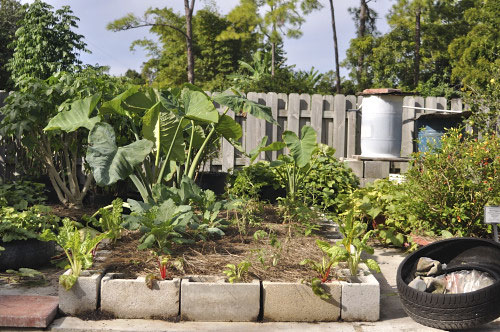
Container gardening taken to a new level.

The urban garden section showed some great examples of reusing trash, such as old tires, to create containers. Also fascinating was the wicking gardens that are mostly made up of a carpet with a little bit of soil in top and some gravel or even cans wrapped in socks for the plants to have structure to grow on. You fill a closed bucket with a hole in the bottom with water, stick it on an edge of the carpet, and let the garden suck the moisture out as it needs it! This is a great way to use a minimum of water and soil. While some of us had questions about the safety of carpet material, other types of substrate could be developed. Probably any old canvas or woven mat material would do. They try laying the carpet out in the natural UV rays of the sun to break down harmful chemicals.

I also enjoyed the mention of their research using human urine as fertilizer — it is packed full of good nutrients and is sterile! In some countries, this has been government sanctioned for a while, such as in Sweden, where some housing developments have been built with urine diverting toilets that drain to some big tanks. When the farmers need fertilizer, they just pull up, pump some of the liquid gold out, and spray it right on their fields! The savings in water and fertilizer are stellar, and it is only cultural taboo that makes the subject so difficult.

Urban homesteading at its finest!

The Moringa tree is a favorite plant there. They call it the Miracle Tree. One can eat almost any part of it, and it is incredibly dense with nutritive value, and the tree grows in almost any condition. I’ve started my own little plantation at my house in S. Miami.

Rustic raised bed

ECHO is also a seed bank, and they send seeds all over the world to see what works, with attention to both the physical and the cultural aspects. This aspect impresses me. It is applied science that recognizes humanity’s needs as a driving force in experimentation. And the needs of the global poor are great, but with sensitivity and ingenuity, the poor can be given the tools they need to improve their own lives in a sustainable and self-empowering way. ECHO taps into their own knowledge and traditions and offers a broader knowledge base for them to work with.

Endless fields at Worden Farm

The second half of our day was visiting Worden Farm in Punta Gorda. The farm is a brilliant example of hard work and smart planning to generate massive amounts of organic vegetables, sold all along the Gulf Coast. The farm is 55 acres, with about 35 in production, and is only six years old. The soil is almost pure sand, so lots of chicken manure is used as their fertilizer, as well as cover crops to slowly improve the quality. Long rows of raised beds made with plastic sheeting make upkeep relatively easy, and the veggies all looked absolutely flawless.

Drip irrigation system at Worden Farm

The plastic sheeting with drip tape irrigation underneath also helps limit water use, as well as the extra work of short watering cycles very frequently. Extra work to reduce the negative environmental impacts of the farm is a tradeoff they are happy to make. Those plastic sheets at the end of the season don’t hit a trash pile. They go to an agricultural plastics recycler.

Touring Worden Farm by electric cart. L-R: Wwoofer, Eva Worden, Cesar Contreras, Margie Pikarsky (back turned), Melissa Contreras

Farm Ferrari

Cow at Worden Farm

Read Full Post »

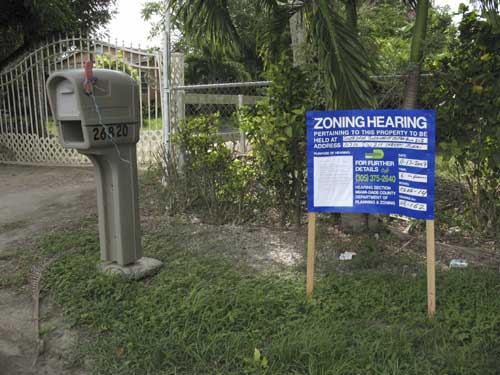
26820 SW 187 Ave.

Last Tuesday an overflow crowd packed the Community Zoning Appeals Board room and spilled into the hall for Mr. Bernardo Campuzano’s zoning hearing regarding his request to build a private soccer club on 9.2 acres of former plant nursery. On one side of the room sat Mr. C and his supporters, including about two dozen kids. On the other side was the opposition, consisting mostly of aggravated neighbors.

Mr. C’s attorney spoke first. He explained that Mr. C is a soccer instructor who has established many soccer clubs. As for concerns about the soccer stadium, the lighting would be what you find in a parking lot, preventing overspill, not tall stadium lights. They will work to preserve the agricultural character of the property — to a loud chuckle from the side with the neighbors — with a landscaping buffer. The attorney claimed the private soccer club is compatible with agricultural activity and consistent with the CDMP (Comprehensive Development Master Plan), and that private recreational facilities are one of the approved uses outside the UDB (Urban Development Boundary). And, he claimed that the stadium would address unmet recreational needs of the agricultural community. Also speaking in favor of the stadium was his law partner, who echoed that they support the rural residential community. Four other people came up to the podium and spoke simply and briefly in support of the soccer club, generally agreeing that sports are good for kids and keeps them out of trouble, and claiming the stadium is a good investment and a good project. Even Mr. C stood up and said that he will create a soccer academy for kids, and doesn’t see anything like that in the area.

Then came the neighbors’ turn to voice their objections. Almost the entire right side of the room stood when asked if they wanted to speak against the project, but the number was limited to six, same as those in favor. First up was a woman who expressed concern about sewage and groundwater contamination of locally grown produce, and also stated that the stadium belongs in an existing park. Next, a grower said the stadium is completely inappropriate use of agricultural land, that the noise coming from the property has been disruptive, that lights at night disturb plant growth, and that the stadium would not serve her agricultural operation or any of her workers in any way. Next, a man who raises exotic birds was impassioned in his complaint against the constant noise and smoke from illegal burns. He claims the lights and noise have been disruptive to his birds’ breeding cycle this past year, and production has dropped.

Then a woman who had been a professional soccer coach and referee expressed concerns about rowdy fans and the potential for violence. One long-time resident worried about groundwater contamination from vehicle leaks in the proposed unpaved parking lot, pointed out insufficient well and sewage capacity and restroom facilities, and doubted if Mr. C would really provide bottled water as required by the EQCB (Environmental Quality Control Board). The last person allowed to speak was another long-time resident, who explained that he had sponsored a successful soccer club and suggested that Mr. C do something similar instead of building a soccer facility.

Mr. C’s attorney was allowed a rebuttal to the neighbors’ statements. Regarding the sewage and contamination concerns, he said that EQCB and DERM (Dept. of Environmental Resource Management) imposed several restrictions, and that DERM did approve use. He repeated their intent is to preserve the character of the property while providing a service, and to create the least impact possible on the property. He also repeated that recreational facilities are approved use outside the UDB.

One by one the zoning council members voiced their opinions. The council chair agreed with the water and sewage issues, explaining the Mr. C’s property is two miles from the nearest sewer line and impossible to hook up. The vice chair stated he didn’t think this is the right location for a soccer stadium. The next council member put it simply, “I’m a country boy. I grew up in the Redlands. I don’t like it.” And the last council member also agreed the soccer stadium is not compatible with the agricultural area, and that soccer players belong at school or at a park. The chairman moved to deny in its entirety with prejudice, and the vice chair seconded. The council’s vote was unanimous 4-0 to deny with prejudice. Applause broke out from the opposition side of the room. Mr C and his family and supporters quickly slipped out the door, while those against the stadium chatted in small groups, voicing their concerns or savoring their victory. One person remarked this was the first time she saw all her neighbors together at the same time. This situation had brought the community together.

So what will Mr. C do next? Nobody knows, and I didn’t have a chance to ask him after the hearing. The message he got was loud and clear. After all his expense and trouble to arrange for a zoning hearing, his plan was shot down, and the neighbors are determined and united against ongoing noisy night activities. The only choices Mr. C has left are to stop the soccer games, or sell the property and play somewhere else. Or, he could build a McMansion and sell it. Or, he could revive the previous agricultural use of the property. Imagine, growing plants quietly, in the dark, without an increase in sewage or traffic. What an idea!

Read Full Post »

I think some of my friends envy my visits to Redland. “Ahhh, farm country,” they sigh with nostalgia. “Take me with you the next time you go.” OK, I agree, then warn it’s not the way they remember it from, say, 20 years ago. Some landmarks, like Robert Is Here, are still thriving. Anderson’s Corners? Closed and falling down from neglect. U-pick stands? Almost all gone. Fields and fields of beans and tomatoes and potatoes? Most of them filled up with McMansions and occasionally entire neighborhoods. And now a soccer stadium is going to go up. Stadium??? In the countryside? Indeed, it may be coming soon. Practically a done deal. Just the road across from a bean field, sandwiched in between two farms. Did you say soccer stadium??!!

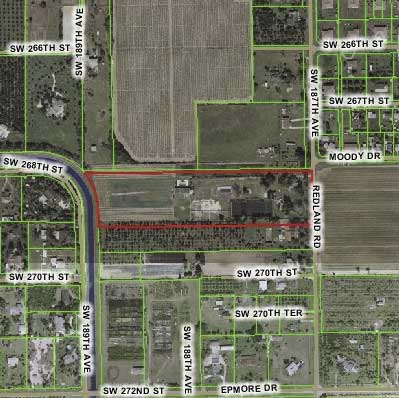
A gentleman named Bernardo Capuzano and his wife Maria bought 10 acres on Redland Road in 2006. The property was a plant nursery, but apparently that hasn’t been the main use this past year. Mr. C likes soccer, loves it so much that he hosts soccer games on his 10 acres. Neighbors have been hearing cheers and shouts from games, and the situation must have gotten unbearable because Team Metro came out a few times to inspect things. Two cases were opened based on anonymous complaints about “operating a soccer field without prior public hearing” and “construction without permits.” As for the construction, Team Metro found no violations, and that case was closed. (The county building department did find several violations.) But the soccer field case “remains open pending public hearing.” (Click here for a link to public documents on file regarding this case.)

Campuzano-property

site of proposed private soccer club

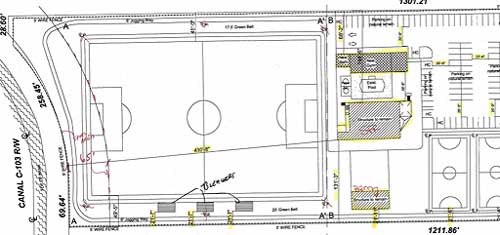
Instead of packing up soccer equipment, tilling the soccer field and planting beans and squash, Mr. C apparently decided to legitimize and push for a real soccer stadium. In fact, something even better than that! He wants to build a private recreational facility that includes one full-size soccer field with bleachers that seat 240 fans, three mini practice fields, plus buildings that house a gym, pool, stables and bathroom facilities. The grounds would also include a jogging path, plenty of parking and — get this — outdoor lighting. Can’t blame a man for having a dream, can you?

Only this is not going to be built in the city of Homestead, close to people who would enjoy such an amenity. This would be built on agricultural property surrounded by more agricultural property. We’re not talking about a proposed modest McMansion sporting 8 bedrooms and a stable (which, though still not the best use of farmland, is reasonably passive and low-impact). This would be a fairly active and noisy use of the property. The request for outdoor lighting indicates there would be games night and day. The bleachers that seat 240 people and accompanying number of parking spaces would imply there would be a significant increase in traffic.

site-plan-web

Portion of the site plan for soccer club

The soccer club application has quietly zoomed though county channels gathering approvals from various departments. For example, in its infinite wisdom, the county EQCS (Environmental Quality Control Board) has decided to grant their zoning variance regarding water and sewage. Currently, the property has a well for drinking water, and a septic tank for sewage — sized for an average single family home, not 200+ people! Neither well or septic are designed to take the load of many people attending soccer games.

[Note: To download the EQCS document, go to the county web page, click on Search Official Records (link is on the left hand side in a light blue box), and search for document # 2009 R 613934 or the name Campuzano, Bernardo and the recording date of 08/25/2009. You can also download it here.]

Until the property can get water and sewer hookups from distant lines (which might never happen, since we are talking about farmland, not a property within city limits), EQCS has set the condition that Mr. C must serve bottled water at the soccer club. Until water and sewer line hookups, Mr. C could possibly get by with port-a-potties, but that’s not the best solution either. (Do you know what happens when a chemical toilet is not emptied or maintained regularly? It’s nasty!)

What makes this whole situation so dicey is the property fronts on canal C-103. If untreated sewage leaks into the canal and groundwater, it could very well contaminate your food. Downstream lie fields of green beans and yellow squash, farmed by a grower who provides for our CSA. He pumps irrigation water from a well on his field — and if that groundwater gets contaminated from soccer field sewage, our food gets contaminated. Remember the e.coli and spinach scare from a few years ago? Conceivably we could have our own similar disaster in the making.

Also, this bit of new development will make another hole in the fabric of the agricultural community in Redland. Yes, the UDB (Urban Development Boundary) is keeping mass development at bay, but one by one agricultural properties in Miami-Dade County are sold and converted to non-agricultural use. Today a soccer field, tomorrow a shopping plaza. (Look north to Broward County to see what the future will bring.)

So which will it be — beans or soccer? Are you upset yet? Go to the zoning hearing and be the voice for locavores and farmers alike. Sometimes eating local is a political act.

Hearing number: 08-162
Applicant name: Bernardo and Maria Campuzano
Location: 26820 SW 187 Ave.

Community Zoning Appeals Board 14
Tuesday, Nov. 17, 2009 at 6 pm

South Dade Government Center
10710 SW 211 St
Cutler Bay, FL 33189

http://www.miamidade.gov/communitycouncils/cc14_agendas.asp

zoning-notice

Zoning notice for 26820 SW 187 Ave.

Read Full Post »

« Newer Posts - Older Posts »