Feeds:
Posts
Comments

Archive for the ‘location’ Category

Florida avocados

Florida avocados

Take a good look at this season’s avocados, and savor the flavor. This season might be the last time you’ll see and taste Florida avocados, if the laurel wilt disease gets out of control in Miami-Dade County. It’s caused by the tiny redbay ambrosia beetle that carries a fungus which kills avocado trees fairly quickly. In Brevard County, where there are mostly neighborhood avocado trees, UF/IFAS researchers spotted the disease in October 2008, and by May 2009 the same trees were dead.

Last week the rumors were flying among growers that laurel wilt was spotted in a Miami-Dade grove. This Wednesday night it was confirmed by UF/IFAS scientists at an emergency meeting held at the Miami-Dade County Extension Service office. Over 120 concerned avocado growers packed into the meeting room to hear the grim news. This tiny beetle presents an enormous threat to their livelihood.

One tree suspected of laurel wilt came back positive for the disease using DNA testing, and four additional samples had been taken from three other groves for testing. This is the first time the fungus has been spotted in a commercial grove in Miami-Dade County, and it could severely harm a $12.7 million industry.

There are 892 growers and 6773 acres of avocado groves in the county, according to the USDA’s 2007 survey. If the disease cuts Florida’s commercial avocado crop in half, which could happen, it could cost the state $27 million in total economic impact and enough lost worker hours to equal 275 full-time jobs, according to UF/IFAS.

Plant inspectors and insect trappers from the Florida Dept. of Agriculture are surveying the ag production area from Goulds south — 140 commercial groves numbering 7000 acres, according to their calculations. They’re also setting sentinel traps to track the beetle, similar to what’s being done with fruit flies. Their survey should be 70-80 percent complete by this Friday Aug. 7. At the time of the meeting, they have not yet found signs of the beetle or laurel wilt.

If you’re a homeowner and you have an avocado tree in your yard, check it often for signs of beetle infestation or laurel wilt. If you see anything suspicious, call the Division of Plant Industry at 305-252-4360 or 888-397-1517 and an inspector will come take a sample for DNA testing. If the sample comes back positive, you’ll be instructed on how to treat or properly dispose of your tree. Do NOT cut it down and throw it on the street for pickup, because that could help spread the beetle and its fungal infection to other trees in the neighborhood.

State representatives Ileana Ros-Lehtinen and Mario Diaz-Balart were instrumental in pushing the USDA to give UF a $1.9 million grant to find a way to mitigate and manage laurel wilt. Other local politicians who are actively involved are County Mayor Carlos Alvarez and County Commissioner Katy Sorensen.

On the other hand, Mayor Carlos Alvarez recently drafted a new county budget that slashed Extension office funding to almost zero. The office also relies on matching funds from UF/IFAS to educate and support growers and homeowners about plant diseases and various agricultural issues. This drastic cut couldn’t come at a worse time. County commissioners are meeting on Sept. 3 and 17 (after their August vacation) to vote on the new budget. Please take the time to call or email your county commissioner and tell them not to cut funds for Extension and local growers! For locavores, doing that’s a no-brainer, right??

Miami-Dade County Mayor Carlos Alvarez http://www.miamidade.gov/mayor/
Miami-Dade County Commissioners http://www.miamidade.gov/commiss/
Representative Ileana Ros-Lehtinen http://ros-lehtinen.house.gov/
Representative Mario Diaz-Balart http://mariodiazbalart.house.gov/index.html

More info on redbay ambrosia beetle
http://www.doacs.state.fl.us/pi/enpp/ento/x.glabratus.html

More info on laurel wilt
http://trec.ifas.ufl.edu/RAB-LW/
http://www.doacs.state.fl.us/pi/enpp/pathology/laurel_wilt_disease.html

Miami-Dade County Extension Service http://miami-dade.ifas.ufl.edu
Miami-Dade DERM http://www.miamidade.gov/derm/
UF/IFAS Tropical Research & Education Center http://trec.ifas.ufl.edu/
Fla. Dept. of Agriculture and Consumer Services http://www.doacs.state.fl.us
Read Full Post »

Roadtrip!

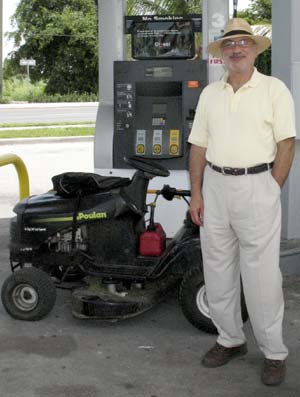
Hani's new ride

Rode up to the Small Farms Conference with Margie and Nick from Bee Heaven, Gabriele from Paradise and Hani of Redland Mediterranean. We gathered in Redland in the late morning and took a leisurely drive up US 27 to Kissimmee.

Traveling with growers is a bit different than traveling with regular city folk. For one, they laugh at things

Queso Balnco at Guines Ranch

Queso Blanco at Guines Ranch

that city folk would find ordinary or ignore. At the first stop, The Southern Belle Truck Stop in South Bay, Hani admired a rider mower at the pump. Looks like the owner just rolled right up to get gas. Didn’t know you could take those things on the road.

Next, farmers know where to get good eats off the beaten track. Further down 27, Margie pulled in at Guines Ranch for homemade queso blanco made from cow’s milk. There were herds of cows and goats in the front fields. (They do sell goats for meat, in case you’re interested.) The queso was mild and squeaked a little when I chewed it. Was a good snack along with organic (not local) cherries and organic (not local) dried goldenberries. Local eats 1, not local 2. Could do better, I guess.

Spotted a sign in Avon Park that said it was in South Florida, which started a discussion of how far north is South Florida, and where the line (or fuzzy boundary) is drawn. What is the criteria that determines where northern South turns into southern Central Florida. Is it climate, geography, distance? (If anybody knows, please let me know.) And, if it’s grown in Avon Park, then is it local to Miami? They’re both in South Florida! The word local — along with the words organic and natural — seems to have its definition stretched and pummeled into meaning something different than your county or immediate neighborhood.

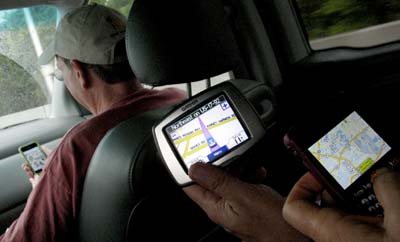
Navigating with an iPhone, GPS and Blackberry

Third, farmers know how to find their way even if it’s off the beaten track. Later in the afternoon came the navigational challenge to cut over from 27 and the Osceola Heritage Park on Route 192 in Kissimmee. It took an iPhone, Garmin and Blackberry (plus an old fashioned paper map) to figure out the route. After much discussion, we arrived at the Park and checked in at the conference. Lots of interesting sessions Saturday and Sunday. More to follow…

Read Full Post »

The Urban Oasis Project is an all-volunteer organization dedicated to building food gardens in the city. Think fruits and vegetables growing in a garden in your backyard. Bananas, okra, melons, herbs, mmmm. Urban Oasis Project is the brainchild of CSA member Melissa Contreras, who together with Art Friedrich, host monthly meetings and potlucks. The next one is right around the corner, this Saturday August 1 at 4 pm in North Dade.

Art emailed details: Yvrose Valdez, has offered to host the next garden potluck at her house!  She is a Master Gardener, and I think she’s growing more than all of the community gardens combined on her modest house-lot! You don’t want to miss it!

We will begin to gather around 4PM on Aug 1st, with garden tours at 4:30 and 5PM.

At 5:30 we’ll have a quick more formal meeting to talk about the future of Urban Oasis Project, formalize some by-laws, vote in officers, and sign papers for incorporation, and officially birth the Urban Oasis Project (in the eyes of the state).

Around 6:15 we’ll kick off the potluck and feast upon the delicious wonders. Please bring a dish of some sort, or a dessert. If it’s homegrown, that’s great, but it doesn’t have to be – we know many of you are beginners and that this is a more sparse time in the harvest season for all of us.

Everyone is welcome to bring seeds and plants to trade or share with each as well!

Yvrose lives near 108th St. and NE 2nd Ave., so this will be more convenient for all of you living north of Miami.  You must RSVP for the actual address!

Send your RSVP to Art theedibleyardmiami(at)gmail.com or Melissa admin(at)urbanoasisproject.org .

Read Full Post »

State 1, Lowes 0

What happens here in Miami-Dade County could set precedents for other counties regarding sprawl. Why don’t developers reconsider urban infill?

Florida Cabinet thwarts plan to alter Miami-Dade development boundary
The state Cabinet overruled Miami-Dade County and stopped an attempt to move the county’s western development line.
http://www.miamiherald.com/news/southflorida/story/1161697.html

Read Full Post »

Urban sprawl and farms

Urban sprawl is a hot button issue is South Miami-Dade County. Depending on whom you speak to, they’re either strongly for it or against it. The UDB, or Urban Development Boundary, is a line drawn in Miami-Dade’s master plan that separates agriculture from suburbia. Periodically and frequently, developers petition the county and state to move the line to accommodate new development. Sometimes the line moves, sometimes it doesn’t. This dance has been going on for years. Why is the UDB important? Because it allows space for agriculture, and provides a buffer between the city and the Everglades, an important source of our drinking water. Look at Broward County. They don’t have a UDB — and count how many farms, groves and ranches remain.

Recent editorial in The Miami Herald (7/24/09):
Hold the line on development

http://www.miamiherald.com/opinion/editorials/story/1155156.html

Recent related article in the Miami Herald (6/29/09):
Infill development will help hold line

http://www.miamiherald.com/business/story/1116072.html

Read Full Post »

« Newer Posts - Older Posts »