Feeds:
Posts
Comments

Archive for the ‘market’ Category


MargieEG

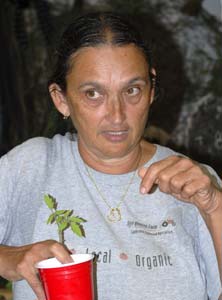
Margie tells all about heirloom tomatoes

notes from presentation by Margie Pikarsky given at Edible Gardens Festival

Heirlooms are varieties handed down from generation to generation of saving seeds. Heirlooms are open pollinated and stabilized cross. Hybrids are cross bred, so planting seeds may result in plants that look like parents and everything in between. With heirlooms, you get the same tomato every time, but with small variables. When you’re selecting generations, you end up with your own variety but adapted to where you are living. Heirlooms are hand me downs valued and treasured for flavor. Hundreds of varieties evolved this way. Some tomato varieties are documented back to the 1800s, brought here by families, or attained classic status. Most open pollinated tomatoes are indeterminate, which means there is no determined end to growth. The plant keeps going until something stops it. In this area, it’s a combination of heat, bugs and humidity.

Varieties. The closer to the wild types the better they do in the tropics. Tomatoes are said to have originated in Chiapas Mexico. They are small cherry types or tiny currant types. Really have to baby the big ones, beefsteak don’t have good pest resistance, have problems with birds and worms. The plant puts out a lot of energy to make 5 large fruit.

Everglades tomato is a small red cherry variety that was grown by Indians and pioneers. Can still find some, need to ask around. Very similar to Matt’s Wild Cherry, which is much like the wild tomato from Chiapas. Indians probably brought the same tomato, they are almost identical. Green tomatoes that grow well here – Green zebra, lime green salad (short plant), green grape, green gage (yellow outside, green seeds inside), Aunt Ruby’s German Green has had mixed results.

Seeds. Get seeds from Seeds of Change, TomatoFest, Seed Savers Exchange (also seed bank for members), Johnny’s Selected Seeds, Southern Exposure Seed Exchange (has varieties that are good for here).

startsEG

Black zebra starts

Seeds or starts. Big box stores grow starts from a handful of hybrids that aren’t ideal for here, and may not do well here. Many heirlooms don’t have any real disease or pest resistance. When adapting to this area, save seeds from the plants that show the most resistance, and grow that variety for 3-4 years to decide keepers. It’s the weather, not the tomato. If it dies during the first year, try it MORE than one year before you decide a variety is a keeper, because growing conditions are often very different from one year to the
next.

Planting and Growing. Grow organic, that means no synthetic fertilizers or chemicals for pest control. Organic on the label doesn’t always mean that it’s acceptable for production. Look for OMRI (Organic Materials Research Institute) paid seal of approval, or NOP (National Organic Program) approval. That indicates that only natural things were used. Same with fertilizers and pest controls. Don’t confuse organic with safe. Read the caution label before applying it.

Can grow in ground or in a pot. In a pot, if the soil is moist to the touch, it’s NOT time to water yet! Pot is easy to mismanage. Tomatoes like to be even when getting water, and a little on the dry side. Better to grow in ground, in raised bed. In most parts of this area, soil is only 1/4 inch deep over solid rock, and needs to be amended with compost, cover crops, and mulch. Put compost onto the bed, let it sit, then turn it over before planting. If growing in pots, use any good potting soil.

When planting from seeds, plant twice the depth of the diameter of the seed. Will come up fast in 2 or 3 days. Can plant directly into the soil or into pots to make starts. Transplant start and plant deeper up to the first leaves. Plant will grow new roots and will be stronger. If the soil is shallow, plant the start sideways. Don’t overwater or the plant will get spoiled and expect a lot of water all the time and that will cause problems. The soil should be moist to touch. Tomatoes prefer to be on the dry side. Will start bearing in 2 months. Some early ones bear in Dec. By April leaves are dying from the bottom up, still producing on top, could go into May.
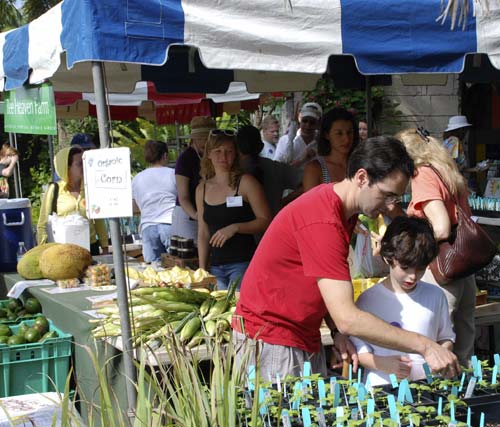
startsEG2

Learning about tomato plants

Tomatoes grow tall, need trellis support, at least five feet high, and plants grow over and off to the sides. Trellis – use square mesh wire 4×6 or 2×6, hold in place with rebar staked into the ground. Or make a big circle with compost on the inside and plants outside. To pinch side shoots or not — choice of more tomatoes only smaller, or less tomatoes and bigger. Prefer more fruit over bigger. Tied with jute rope or string (natural material) or weave stems through square 2×6 or 4×6 wire mesh as they grow.

Water from underneath, use drip tape on a timer so you don’t have to think about it. Watering overhead can help spread diseases. Wait to pick until after the dew dries, so as to not transfer disease. Pick just as fruit start to ripen, just start turning red and yellow, let them finish ripening on the table. Never refrigerate tomatoes, please! Tropical fruit lose flavor when refrigerated, and tomato is a tropical fruit.

For frost, cover with sheet if a few plants. User Reemay spun polyester material to cover rows. Provides minimal protection, need to attach somehow so it doesn’t blow away. (Plastic will burn plants, so do not use.) Remove after frost has gone. Can find in garden supply stores locally or online. It’s also known as spun polyester floating row cover.
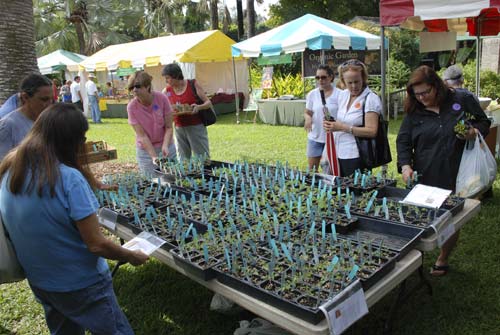
startsEG3

Picking out an assortment of tomato starts

Pest control. Use BT Bacillus Thuringensis for caterpillars. BT is a natural bacteria that makes the caterpillars sick so they stop eating and die, harmless for us. Can hand pick caterpillars if you just have a few plants. Organocide is a combination of sesame and fish oils, use it sparingly. Organocide will help with some diseases. Can do nothing about viruses – plants may or may not die right away. Some are tolerant of viruses, and will still bear tomatoes. To prevent mildew and mold, space plants 2-3 feet apart with good ventilation. Choose seeds that are disease resistant, especially those that resist mosaic virus. Margie doesn’t sterilize soil but other growers do. Nematodes, also known as root knot, are microorganisms that slowly damage plant roots. Start with sterile soil in pot. Use a special kind of marigolds known as nematocidal marigolds grown from seed, grow them intermingled with the tomatoes. Nematocidal marigolds are available from Seeds of Change.

To kill nematodes, solarize the soil with black plastic sheeting for 6-8 weeks before planting. If you use clear plastic, weed seeds will germinate because of the light. The heat kills all microorganisms. Sugar solution will work. Methyl bromide is used by commercial growers but it is very carcinogenic, and is getting phased out. The more organic matter in the soil, the better the plants can defend against nematodes, because there are more beneficial organisms in the soil. If you grow tomatoes in one place last season, grow them in a different spot (crop rotation). Don’t grow tomatoes in the place year after year. Rotate around different plant families each year.  For example, alternate legume-brassica-tomato. Don’t build up disease or pest problems.

Iguanas – build a giant cage around tomatoes to keep iguanas out. Don’t use chicken wire, they will flatten. Bird netting works while plants are young. Electrified fence?

Cover crop. Sunn hemp or mustard greens are good to suppress nematodes, let them go to seed and till under. Mustard has a lot of pest control properties, used to be more popular in the past. Mustards get large and start crowding tomatoes, have to keep picking.

Saving seeds. When harvesting, save the really nice ones before the end of the season. Squeeze out the seeds and dry them on wax paper, not paper towel. Seeds have a gel coating and to remove, soak them in a cup of water. When you start getting scum on top, pour through colander and rinse. If the gel coating is still on, put back in water and watch for a day or two, then strain again. The gel coating inhibits germination. Strain, rinse and dry on more wax paper. Wait until seeds are DRY. Humidity is the enemy, seeds will sprout and that’s no good. Use paper envelopes to store seeds, not plastic because it will trap moisture. Keep in air conditioning, or in jar with packet of desiccant.
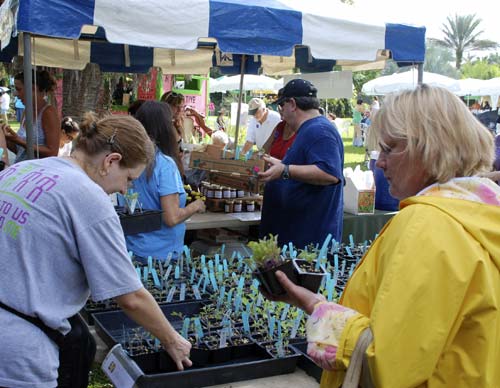
startsEG4

Choosing tomato plants at the Edible Garden Festival
Read Full Post »

If you want to get heirloom tomato plants for your own garden, but didn’t make it to the Edible Garden Festival, you have another chance. Bee Heaven Farm will be at The Great Green Family Festival at the Fruit and Spice Park this coming weekend, Nov. 15-16. Farmer Margie will be selling more tomato starts (baby plants, seedlings) along with eggs, honey, lemongrass and who knows what else.

Late breaking news: here’s a list of the heirloom tomato varieties that will be available — Sun Gold, Jaune Flamme, Green Grape, Black Prince, Lollipop, Matt’s Wild Cherry, Black From Tula, Brown Berry, Brandywine OTV, and Homestead 24. Slow Food Ark of Taste varieties:  Cherokee Purple, Red Fig, Sheboygan, and Sudduth Strain Brandywine.

Also available, vegetable and herb starts:  Fordhook Chard, Genovese Basil, Mrs. Burn’s Lemon Basil, Thai Basil, Russian Red Kale, Lacinato (Dinosaur) Kale,  Garlic Chives, and Lemongrass.

According to the Redland Evening Herb Society’s web page, “The purpose of this event is to raise awareness of simple, green-living practices, products and services that local families can put into use in their homes and community.” (For some reason I was thinking of the Jolly Green Giant with his kids in tow… silly me… )

The Great Green Family Festival
November 14 & 15 from 10 am to 5 pm
Admission: $8 (Children under 11 are free)

Fruit and Spice Park
24801 S.W. 187th Avenue
Homestead, Florida 33031
305-247-5727

Read Full Post »

Redland Raised, Fresh From FloridaRedland Raised launch event:
Thursday Oct. 29th, 10- 11 am
Publix at Tropicaire Shopping Center
7805 SW 40th Street, Miami

Starting this week, you won’t have to go too far to find locally grown produce. Redland Raised branded green beans, yellow squash, zucchini, boniato, okra and avocados will be available at all 1000 Publix stores in the state, during the local growing season which runs from November through April.

Miami-Dade County, Publix and the Florida Department of Agriculture and Consumer Services Fresh From Florida program teamed up to promote a “buy local” program throughout the county and state.

Charles LaPradd, Miami-Dade’s agriculture manager, was quoted as saying, “We were looking for a way to just make our local produce down here known a little bit better,” LaPradd said. “When you go local, you go green.”

Needless to say, larger local growers are delighted with this huge new market for their produce. Publix says the Redland Raised will help them keep transportation costs down, which should result in lower prices for customers, and a smaller carbon footprint.

Miami-Dade County’s agriculture industry is number two in the state (after Palm Beach County) and 18th in the country, generating an estimated $2.7 billion for the local economy.

On the Miami-Dade County web site, on the Office of the County Mayor’s page:

Buy Local, Redland Raised available at Publix

For South Floridians who want to buy local… the shopping experience is about to get even better. Thanks to a partnership with Publix Super Markets, more than 1,000 Publix stores will soon feature locally-grown fresh produce. The produce will be dubbed Redland Raised.

Along with ”organic”, ”buy-one-get-one-free”, and ”on sale” – Redland Raised can be the new buzz word in grocery store shopping. While Publix has always supported our local agriculture industry – shoppers who walk the produce aisle can now look for special labeling and displays that show when green beans, zucchini, avocados and more come from our very own backyard.

Redland Raised is a way to educate and encourage our residents to invest in local produce and in turn, stimulate our local economy. Miami-Dade County’s agriculture industry is number 2 in the state and number 18 in the country, generating an estimated $2.7 billion for our local economy.

I would like to thank Publix Super Markets for making it possible to promote our local brand, and for their continued investment in our community.

Enjoy Redland Raised!

Sincerely,
Mayor Carlos Alvarez

Read Full Post »

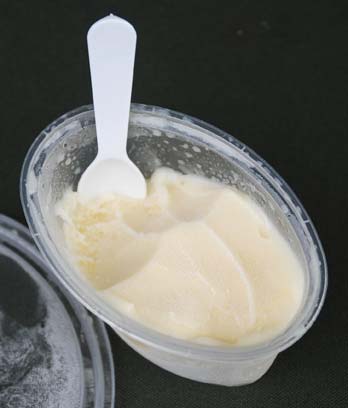
Arazá! What a wonderful name! Too bad the fruit is so tart…. But Farmer Margie told me that Hani Khouri of Redland Mediterranean Organics was going to make ice cream with it. Robert Barnum confirmed he had sold some fruit. Hot on the trail, I spoke with Hani and he promised that arazá ice cream would be available at the Edible Garden Festival at Fairchild Tropical Botanic Garden.

Arazá ice cream

Arazá ice cream

So I braved sporadic rain showers on Saturday, sidled up to Hani’s tent and asked, “Got arazá?” Yes, he said, and his son Jad handed me a container from the cooler. The only ingredients are arazá, agave nectar, and fresh goat milk. The ice cream is pale yellow in color, sweet and tart at the same time, with a “yogurt-like flavor in the back as a finish,” as Hani described. From the first spoonful I was in a swoon, lost in the blend of sweet-tart-tangy flavors and the smooth, creamy texture. Almost forgot to photograph it, that’s why there’s some missing in the picture. It’s now my new favorite flavor. Sorry, mango-orchid. Sorry, papaya.

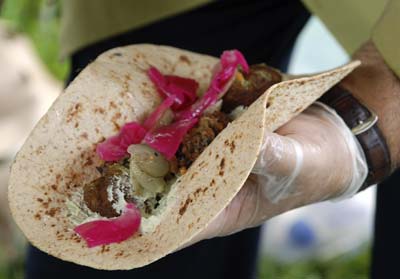
Hani started heating organic safflower oil in the big fry pan to make falafel, and I realized that a) I hadn’t had lunch and b) I hadn’t eaten his falafel in ages. Time to remedy that.

First came the flatbread, smeared with a dab of tahini sauce green with mint. Then three golden nuggets of falafel were topped with amba, fermented pickled green mango flavored with fenugreek and mustard seeds. “It’s spicy,” Hani warned, adding a small amount. (He claims that Farmers Margie and Gabriele are addicted to his amba.) I like how it added an exotic bite. Then came pickled turnips (bright pink from beets), thinly sliced cucumber and chopped tomato. Uniquely flavorful, this style of falafel is lighter than what I’ve tried elsewhere, and was told those particular toppings are quite popular in Israel.

Making falafel

Assembling falafel with pickled turnips

Redland Mediterranean Organics has teamed up with Sous Chef 2 Go and is sharing a tent at the Jackson Memorial Hospital farmers market. It happens on Thursdays in front of the Alamo building. Go look for their tent at lunchtime. The arazá ice cream is waiting to meet your taste buds. Also new on the menu is chicken roll — chicken seasoned with sumac (which gives it a cinnamon-like taste), rolled in dough and baked. And don’t forget the goat cheese!

[Note: Hani Khouri called me on Nov. 11 to tell me that he’s no longer selling at this market due to a sharp increase in vendor fees. He and Sous Chef 2 Go are partnering in a new lunch menu at the shop in Kendall. Look for my review coming soon.]

The Jackson Memorial Foundation Green Market @ Alamo Park
1611 NW 12th Ave., Miami
Inside the JMH Campus
Open Thursdays from 9 a.m. to 4 p.m.

Read Full Post »

Several months ago, I blogged about Jaideep Hardikar, a journalist from India who was here in the States on a fellowship. He wrote the article The Farmers Among Us that was published in the Sun-Sentinel. The original article profiled several growers who belong to Redland Organics, but is no longer available online. A shortened version was published on the front page of the Business section of the Miami Herald on Tuesday Oct. 13th. You can read it here.

According to the article,

Across the United States, consumers are increasingly buying directly from local farms through a model started decades ago in Switzerland and Japan now known as Community Supported Agriculture.

Nationwide, sales from farms directly to consumers — including CSA and farmers markets — jumped 49 percent from $812 million in 2002 to $1.2 billion in 2007, according to the most recent Department of Agriculture census. That’s twice as many sales as a decade earlier, the federal agency said.

Estimates of active CSA programs vary, but the 2007 U.S. census found more than 12,500 farms selling directly to consumers in every state. The National Center for Appropriate Technology, an agriculture think tank, estimates CSA programs supplied food to more than 270,000 households last year.

Farmer Margie told me that last season she had 440 CSA members, and has 465 members this season. She started Redland Organics CSA in 2002 with only 25 members. There are at least 100 on the waiting list. Turnover varies, maybe about 35%. Margie also mentioned that in January there will probably be a very limited number of trial shares available, and only to those folks already asking about them. She is pretty much at full capacity already. If you’re not a CSA member, but still want to get the same food, you can shop at the South Florida Farmers Market in Pinecrest.

Read Full Post »

« Newer Posts - Older Posts »