Feeds:
Posts
Comments

Archive for the ‘market’ Category

Dr. Marvin Dunn tells it like it is, while Local 10’s Todd Tongen looks on.

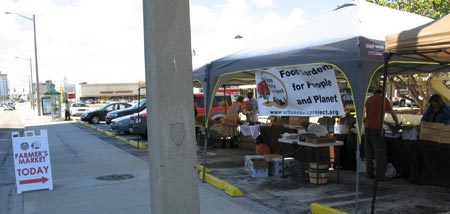
This Wednesday things were definitely not business as usual at the Roots in the City Farmers Market in Overtown. All the vendors were gone — no Nature Boyz, no Redland Organics, no Hani’s goat cheese. Members of the media, including three TV stations and four bloggers, were interviewing curious neighbors, and protesters with signs milled around. Only one tent belonging to RITC was up at noon, and market manager Maggi Pons was stacking collards, yellow squash, scallions and other produce as if it were a normal day at the market. Only she wasn’t selling — she was giving it all away because the market couldn’t sell anything.
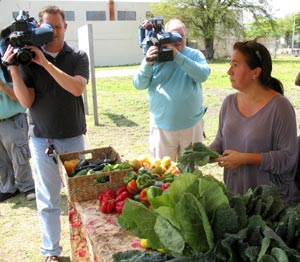
Maggi Pons, RITC market manager, and the media.

Last week the owner of the land that the market sits on had been served with a notice of violation. The South Florida Smart Growth Land Trust was cited by the City of Miami for “illegal sale of fruits and merchandise from open stands and vacant lots” and “failure to obtain a Class I special permit.” The market is allegedly illegal, and the media reported last week that it would be shut down. “It’s not just the wrong permit,” Maggi Pons fumed. “It’s a lot more complicated than that. The city doesn’t have a permit for a fresh produce market, so we have to take out a special events permit, good for only two times a year.”

Mayor Tomas Regalado sent two spokesmen to try to smooth the waters and clarify the situation. Alan Morley insisted that the mayor “loves the market.” He explained the city only wants the market to get the proper permits and licensing, not shut it down, and they have until the weekend to comply. “Certain criteria have to be met. They didn’t go through the right permit process,” he stressed.
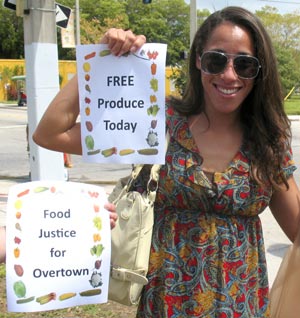
Asha Loring came to shop and joined the protest.

According to Pat Santangelo, the other spokesman, it’s all a big misunderstanding. “We have a lot of unnecessary paranoia,” he said. “If you’re going to run the market as a business, you need to comply with certain things.” He pointed out that the market required an annual certificate of use permit, a Class I permit, and a business tax receipt, and fees would be waived or reduced. When I asked Santangelo if the Class I permit was the two-times-a-year special events permit that market leaders were distressed about, he explained that it was an “unlimited” permit. (He said it was an “annual” permit, as quoted by Local 10 News.)

Yet market founder Dr. Marvin Dunn claimed he repeatedly called the city about the violation and didn’t get an answer. It got him hot under the collar, so he rounded up protesters and alerted the media. He said he got the certificate of use since the very beginning. The only solution he saw is to request a resolution from the city commission to allow his market to operate for six months at a time. But even that is politically uncertain, and as Dunn put it, “Who can run a market on a whim?”

Not all the vendors were happy about a day off. Instead of selling produce on Wednesday, Farmer Margie Pikarsky of Bee Heaven Farm stayed home. “Since we won’t be there, we won’t be bringing fresh, local, organic veggies to the underserved, food desert neighborhood. And, we won’t be employing the local resident that helps us with the setup and breakdown each week. How does that help anyone??” she said.

Neighbor James Branson is thankful for the food.

Wednesday’s free food giveaway was a big hit with the neighbors. Three women staggered away with four grocery bags brimming with collards and other produce. Area resident James Branson was delirious about his full shopping bag. “God is good,” he exclaimed, pointing to the sky. “Give thanks for the food on the table!” Neighbors who came late were disappointed. By 1:20 p.m. the RITC tables were completely empty of produce and the tent came down.

Giving food away may work in the short term, but in the long term it’s not a solution to either the problem of permits and codes — or developing a local food economy. It appears the City of Miami doesn’t have an ordinance that specifically applies to farmers markets. Spokesman Santangelo called the situation with RITC “a good learning process” for market people to learn how to comply with existing regulations. Yet he gave no answer when asked how the city can help this market (or others) navigate the permitting process smoothly and quickly.

Fresh veggies up for grabs.

The local food movement is growing, but it’s a slow and painful process. For every step forward, it appears there are two steps back. Farmers markets are the best way for small local growers to find buyers, and for buyers to find fresh, local produce at a fair price, especially in underserved neighborhoods. Instead of trying to shoehorn market compliance into codes that were written to address different situations that don’t quite fit, perhaps a new ordinance needs to be passed to support markets and allow the local food scene to flourish. (While Miami takes a tough stance on code enforcement, South Miami willingly embraces its new grower supported market.) Whichever the city, the most important thing is to get fresh food into the hands of people who need it most and have grown to count on it.

In the Media:

Read about the protest at CBS 4, Local 10 and the Miami Herald here and here. Mango & Lime has a thoughtful post and an update about zoning and permits (at the bottom of the page). Read Dr. Marvin Dunn’s letter to the editor in the Miami Herald. Read Commissioner Richard Dunn’s letter to the editor here. Read about Dr. Dunn’s “Food Justice for Overtown” protest here. Read about Marvin Dunn’s negotiations with the Overtown CRA officials here.


RITC Farmers Market got media attention.

Read Full Post »

Tomato madness

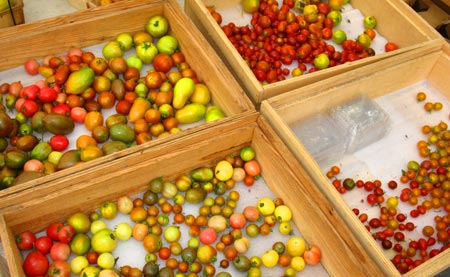
Come early for the best selection. By noon, the supply of small tomatoes dwindles considerably.

The heirloom tomato season is in full swing! It was off to a late start compared to last year because of cold weather we had back in December. You may remember that some varieties died from freezing cold temperatures. Those that survived were dormant for a while, just hanging out, getting their energy back. Now comes the explosion of tomatoes unlike anything you will find at most stores. Farmer Margie calls it madness and it is best kind, a wild madness of colors, shapes, textures and flavors — especially the flavors!

Tomatoes tomatoes tomatoes!

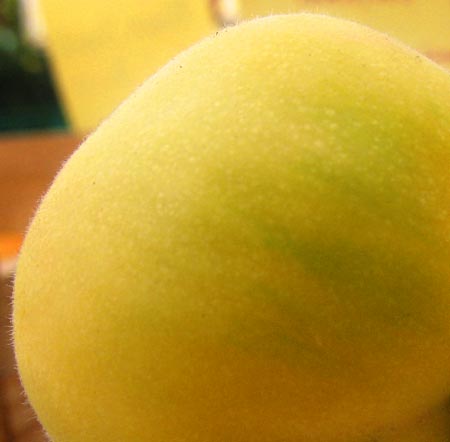
Heirloom tomatoes are the jewels of the vegetable kingdom. They come in all different colors — yellow, orange, rose, pink, red and black, which really are deep red veering into shades of brown and purple. Green tomatoes are a bit tricky. They stay green (with either a pale blush or golden hue) when they are ripe, and have a bit of lemony tartness along with their tomato flavor. If you look carefully, some red ones have golden flecks and others have stripes. Yellows and oranges are sweeter, less acidic. A new discovery this year is garden peach — a yellow tomato that is fuzzy like a peach, thus the name.

Look carefully — can you see the fuzz? Yes, it’s a tomato called Garden Peach.

Margie is raising about 60 varieties this year and I’ve learned some of them by name. The ones I recognize are: cherokee purple, green zebra, Matt’s wild cherry (great for snacking), the pleated and ruffly Costoluto Genovese, sun gold, lemon drop, brown berry  and black cherry (almost identical), red zebra, zapotec pleated, and podland pink.

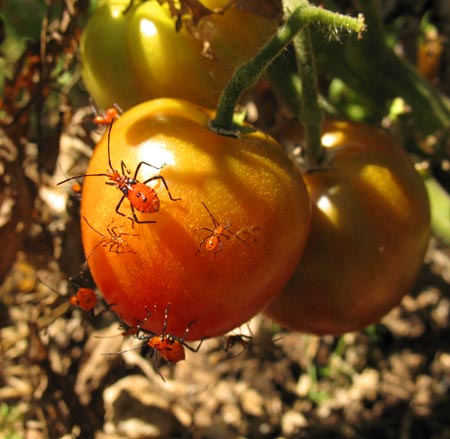
Marauders in the vines.

You can save the seeds from your favorite kinds, plant them next season and grow the exact same thing you ate. That’s because heirloom vegetables are open pollinated, meaning they keep their traits from one generation to the next, unlike hybrids. Farmers and gardeners saved seeds of the varieties they liked over the generations. Just think, people grew and ate hundreds of different kinds of tomatoes, not three or four kinds we find in stores today. Each heirloom tomato variety is unique and valued for its ability to fight off disease and insects, or adapt to growing conditions, and of course, have an excellent flavor.

I’m partial to Matt’s wild cherry, lemon drop, brown berry, sun gold and green zebra. Which varieties are your favorites?

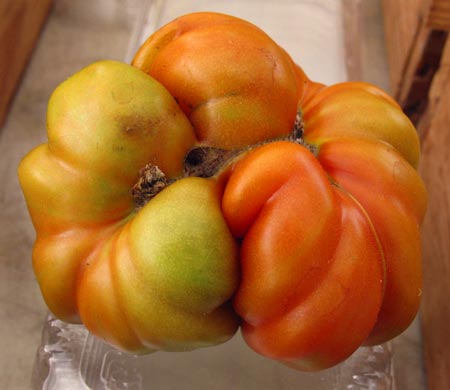
You’re not going to find something like this at the supermarket!

Read Full Post »

Upper East Side Farmers Market is located on the north west corner of Biscayne Boulevard and 79 St.

The newest grower-supported farmers market has opened at the Biscayne Plaza shopping center in northeast Miami. The Upper East Side Farmers Market is managed by Melissa Contreras and the Urban Oasis Project, a local non-profit which is also involved with the Liberty City Farmers Market.

Red leaf butterhead lettuce

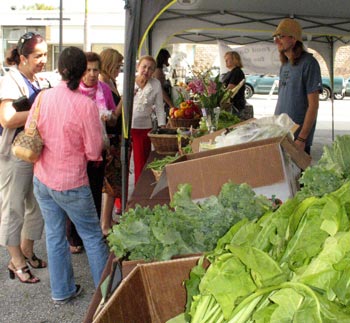
The market is small (only four tents) but carries a wide assortment of seasonal fruits and vegetables. All the food is locally grown (within 150 miles of Miami) from several farms and market gardens, and most of it is organic. The selection changes from one week to the next, and some things sell out quickly — so come early for arugula and callaloo. (Those sold out early two weeks in a row.) Some of the produce available last Saturday was sweet starfruit, stubby forked carrots, beautiful red leaf butterhead lettuce that looked airbrushed, bunches of dill and parsley, massive purple-top turnips, kale, and black sapote, just to mention a few things.

In addition to fresh produce, the market offers a wide selection of prepared foods, which also vary from one week to the next. Art Friedrich, co-founder of Urban Oasis, brought quart jars of brine-cured sauerkraut, and zucchini bread to die for. Oval loaves of artisanal bread lay in a basket next to local wildflower honey and Hani’s Organics baba ghanoush. On the next Saturday, bagged worm castings and bottles of worm tea (natural fertilizer) were available from Fertile Earth Foundation. The most surprising discovery was one-pound bags of rice, both white and brown, organically grown in Florida (in rotation with sugar cane) south of Lake Okeechobee.

Friends hanging out at the market.

I visited the market on the first two Saturdays it was open, and each time it was busy with a steady stream of customers. Melissa Contreras, co-founder of Urban Oasis, guess-timated that they had at least 100 shoppers on the first Saturday. Prices at this new market are a bit lower than what you might expect to see at a farmers market, plus they accept food stamps and match EBT purchases up to $10.

“The point of this market is to bring the communities together,” said Kelliann McDonald, spokesperson for Terranova, the center’s developer. She pointed out that the location is right between an upscale neighborhood and a poorer one. She envisions the market becoming common ground for both groups.

For several hours on Saturday, people shopped, tasted fruit, hung out for a little bit and told stories at this brave new market. Whether it will become a community hub remains to be seen, but one can only hope the people in the area, both rich and poor, will embrace the farmers and their bounty.

Look for the Upper East Side Farmers Market in front of Payless at Biscayne Plaza Shopping Center, located on the northwest corner of Biscayne Blvd. and 79 St. in Miami. Open on Saturdays from 9 am to 2 pm until May 28, 2011.

Read Full Post »

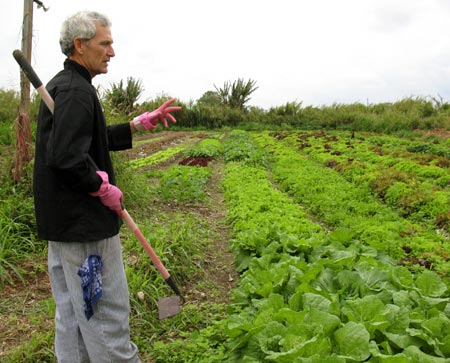
Lettuce Farmer Tim Rowan at the Pinecrest Gardens Green Market.

While most of us are still asleep, farmer Tim Rowan gets up on market days in the middle of the night, turns on the floodlight in his 3/4 acre field, and starts harvesting lettuce and cabbage by 4:30 a.m. The greens are only a few hours old by the time market opens. “That to me is creative,” Tim said. “Growing lettuce is creative. Getting it to customers within hours is creative. Anybody can load it in a box and ship it in. What I have growing that day is what I have at market.”

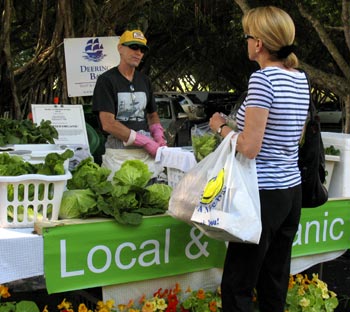
By 8 a.m. on a recent Sunday morning, Tim was set up underneath a large banyan tree at the Pinecrest Gardens Green Market. A poster size copy of his organic certification hung from the tree, and a big green and white Local & Organic sign was at the front of the table. It was heaped with cabbages and lettuces grown at The Lettuce Farm, Tim’s small certified organic farm located deep in Redland.

Last Sunday, a steady stream of customers and friends appeared at Tim’s table, and he greeted each person, remembering quite a few regulars by name. (He has been selling at this particular market since it started in 1996 in front of Gardner’s Market.) He chatted with them about their kids and families as he briskly bagged up their purchases of salad mix, butterhead lettuce, tatsoi, formosa cabbage and bok choy. A man came up asking for arugula. “All sold out,” Tim told him. “Come early for selection, come late for bargains.” The arugula was gone by 10 am, and almost everything else was gone an hour before the market closed.

Farmer Tim getting ready to weed his lettuce field.

Before farming, Tim was a chef at Mark’s Place. “Inspiration struck” when he saw all kinds of tropical fruit that came in to the kitchen from Ellenby Groves. His first taste of acidity of a Green Zebra heirloom tomato from Teena’s Pride made him realize that “this is real, fresh food. Growing heirloom tomatoes is something real,” he said. So he planted a backyard garden in 1990, expanded to growing heirloom tomatoes on a Kendall farm in 1992, and hasn’t stopped farming. “I saw the restaurant business as a dead end, and thought this was a way out,” he said.

But Tim is still a chef, working 50 to 55 hours a week at Deering Bay Yacht and Country Club. And he is still farming on a small scale. He bought his current place about seven years ago, and switched to growing several varieties of lettuces and cabbages that don’t require as much work to spray and fertilize. He plants late to avoid bugs. “Caterpillars are the biggest problem,” he explained. The greens are fairly sturdy and didn’t seem to be harmed too much by the recent cold. “Everything had a white coating of frost. I still don’t understand how this stuff can freeze for 12 hours and survive,” Tim said with amazement.

Farmer Tim and a very large cabbage.

His farm finally got certified by QCS (the Florida organic certifier) in 2003, a fact which Tim is proud of. “I got tired of explaining that I don’t spray. Having the certification makes a big difference,” he said. As an organic grower, Tim doesn’t use fertilizer, and instead relies on lots of compost to build up the marl soil of his farm.

Tim got into farming 15 years ago thinking he would stop being a chef, but he still has one foot in the kitchen. Instead, farming is what gives his life balance, feeds his soul and keeps him strong. “The farming part turns work more into a virtue,” he said at the end of a long day. “I go out in the morning and enjoy every part of it. It makes you feel great. There’s no drug that can give you the buzz like that. Clean living is good for your body, and mentally too. The older I get the easier it is to work. You realize how grateful you are to work and reap the benefits.”

Find The Lettuce Farm at these farmers markets: Pinecrest Gardens on Sunday, Key Biscayne on Saturday and Jackson Memorial on Thursday. His lettuces are also available at Norman Brothers Market in Kendall.

Follow The Lettuce Farm on Facebook

Read Full Post »

The Liberty City farmers’ market has a new home from now though April 2011!

Still every Thursday from noon to 6pm, about 10 blocks west of original location, new address is:

African Heritage Cultural Arts Center
6161 NW 22nd Ave
Miami, Florida 33142
305-638-6771

Additional info at www.urbanoasisproject.org

Please come visit this local grower-supported market, which still has some of the best local, mostly organic, affordable produce in town for everyone!

It serves the under-served, and doubles EBT (food stamp) money up to $10 per visit. Credit and debit accepted!

This location is in a beautiful park, highly visible at the intersection of two main roads, is fenced in, has ample parking and bathrooms, and has children’s programs and after-school care. It is owned by the county, and has been a hub of African heritage culture and arts events for years.

Read Full Post »

« Newer Posts - Older Posts »