Feeds:
Posts
Comments

Archive for the ‘people’ Category

Hey there Redland Ramblers! This is guest blogger Melissa Contreras, founder of Urban Oasis Project. Last night, a group of Redland and Miami farmers and I returned home after a weekend at the 2nd Small Farms/Alternative Enterprises Conference in Kissimmee.  I have always been a farmer wannabe, and as such, I grow food for my family, my pet bunnies,  and a few friends on my 1/4 acre “urban homestead” in Kendall.  I was happy to learn at the conference that this small scale of growing is now being officially considered as part of our local food system, as it should be! The University of Florida/IFAS Extension isn’t just for big farmers and agribusiness, we little people count too!

Cast of characters on this road trip included Bee Heaven Farmer Margie, husband Nick, their new farm manager Jane;  Muriel of Little River Market Garden, Mario of Guara Ki Farm, and me.  Meeting up at Bee Heaven Farm, we shared a ride in Margie’s van, and took the scenic route around the shores of Lake Okeechobee on US 27. It was beautiful! Cows and egrets mingled in green pastures, Nick spotted a sandhill crane, and tri-color herons searched for underwater snacks near the water’s edge. Along the way, through what was once a river of grass, we saw fields of sugarcane (some organic), and picturesque views which reminded me that while South Florida is often thought of as a metropolitan built environment,  it still belongs to Mother Nature, though altered. Hopefully Everglades restoration will return the river of grass to its rightful owner.

After 4 hours on the road, we arrived  and checked into our hotel, the posh and sophisticated Super 8. Hey, we’re on a budget, OK?  I shared a suite with Margie, Nick, and Jane.  After repeated promises to Jane that I would not confuse her with my husband in the middle of the night, she decided to sleep on the couch.  But, I digress.  We had a nice lunch in restored historic downtown Kissimmee, an old cowboy town with a lovely lakefront, unique and colorful wooden homes with gingerbread mill work, unusual eateries and watering holes like ” The Wicked Stepsister,” a nice antique shop,  and so much more. Next time you’re in the neighborhood, take a break from the Orlando area tourist traps and visit this authentic town.

After lunch, we proceeded to the Osceola Heritage Center, site of the next day’s convention, for meetings of the Greater Everglades Foodshed Alliance, the Florida Food Policy Council, and a pre-conference pow-wow with Extension agents from all over Florida. The Greater Everglades Foodshed Alliance meeting was a recap of the Food Summit for interested parties.  The Florida Food Policy Council will “bring together stakeholders from diverse food-related sectors to examine how the food system is operating and to develop recommendations on how to improve it. FPCs may take many forms, but are typically either commissioned by state or local government, or predominately a grassroots effort. Food policy councils have been successful at educating officials and the public, shaping public policy, improving coordination between existing programs, and starting new programs.” (definition from foodsecurity.org). We are forming a soon-to-be Miami food policy council. (Contact Mario if you have a stake in our local food system and want to participate in this new effort.)

Those who attended the informal Friday meetings were also invited to sit in on the pre-conference event for UF/IFAS Extension agents, in which  Dr. Danielle Treadwell, Dr. Mickey Swisher, and Sarasota Extension’s new Director and doctoral candidate Evangeline “Van” Linkous  talked about our changing food system from their different points of view and varying expertise.  Dr. Treadwell champions UF research in organic and sustainable farming, and feels that “educating consumers is an important part of what we do.”  Dr. Swisher said she was surprised to discover the “30 mile problem” in which  “disadvantaged communities in Florida’s urban areas often live 30-40 miles from areas where fresh produce is grown.”  Van’s background is in planning and she was a member of the Delaware Valley Regional Planning Council before coming back to Florida from Philadelphia and the University of Pennsylvania. She feels that much urban zoning could be converted to mixed-use, which could mean urban farms and farm stands could be located within high-density urban populations, giving urbanites more access to local, fresh food. A kindred spirit! We are quite lucky to have these three women in Extension.

So, if you’re catching on to a theme here, the conference tagline was “Sustaining Small Farms…Strengthening Florida’s Communities.”  There was much excitement among attendees on that Friday before the conference, seeing our major research institutions catching onto interests of so many people in local food,  and food justice as a paradigm shift from our current system. Further illustrating this point is the choice of keynote speaker for the conference: my personal hero, Will Allen, founder of  Growing Power, Inc.

I will write more about Saturday of the conference in the next post:  keynote speaker Will Allen, the three Florida Innovative Farmer Award winners, conference workshops, amazing local foods lunch and more! Come back  for more, including pictures!

Read Full Post »

Cover crops growing at Little River Market Garden.

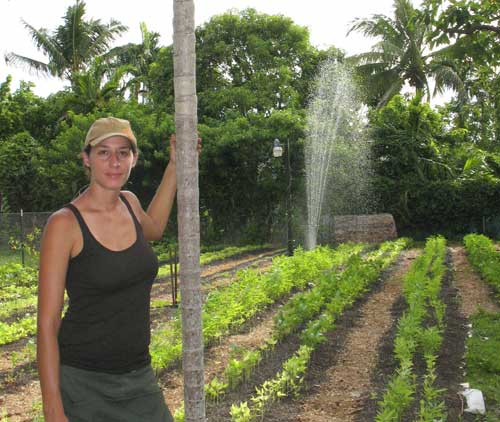
Tucked away in an obscure corner of northeast Miami, a new vegetable garden is starting to take shape in what was an empty city lot. Long straight rows of cover crops — Sunn hemp, cow peas and velvet bean — raise their young leaves to the late afternoon sun. In between rows of cover crop, peanuts are just starting to show pretty little yellow flowers. Loofa vines race to the top of the chain link fence at the front of the property, and a row of cassava flourishes alongside a stepping stone path. Over on one side is a trellis for a muscadine grapevine already forming a miniature cluster of fruit, and sweet potatoes grow beneath. Sage and other herbs are planted in a well-mulched S-shaped bed edged by palm tree logs. In the shade of an ancient mango tree loaded with fruit, a teepee shaped chicken coop holds several brown hens.

Welcome to the Little River Market Garden. This is the handiwork of Muriel Olivares, last year’s farm manager at Bee Heaven Farm. She created this garden from scratch a mere six weeks ago, planting on land leased from friends. Only grass and several trees were growing in what was once part of a citrus grove many decades ago. Now, weathered cardboard peeks out from the edges of some vegetable rows, and Muriel explained that it was set down right over the grass, with compost piled on top. The cardboard is already breaking down, and vegetable roots will easily push through it. In between planted rows, mulch neatly covers grass. The cover crops will get cut down and as they decompose, will add more nutrients to the compost.

This technique of piling on compost and mulch is called no-till because the soil is not tilled or disturbed by a tractor. Tilth builds up naturally without getting disrupted by tilling, and weeds are less likely to grow because they are smothered by compost and mulch. “No-till improves the soil by building soil structure and adding nutrients with compost,” Muriel explained. “It’s a very old technique. No matter the scale of farming, the concept is the same — never disturb the soil and always keep it covered.”

Muriel Olivares

The Garden will provide food for 11 people who have already signed up for CSA shares and flower shares. She says she might be able to squeeze in a couple more members, so if you’re interested, let her know. Her season runs for 21 weeks from November to April. Muriel wants to sell extra veggies and cut flowers at farmers markets, and is already inquiring about getting in to a few in the area. Check out her blog, Little River Market Garden, for news about the garden and updates about markets (once the season starts).

Muriel is confident that her crops and market garden will flourish. She took what she learned working as an intern for a season at a no-till organic farm in upstate New York, and combined that with skills learned at Bee Heaven helping run the CSA and selling at farmers market. Now she is is gambling that she can make a living as a market gardener. “This is my full time job, eight hours a day.” She doesn’t have a “day job” to tide her over. This is it!

So why do this crazy, risky thing? “I really like to be outdoors,” Muriel explained, “and to do what I want to do.” She paused and thought for a moment. “It sounds really weird but I have this connection to plants. I’m absorbed by them. I’m interested in them. Working with plants gives me mental energy.” She chose the urban location because she likes the city and found Redland too isolated. “This is a nice, happy medium. It’s very peaceful, but you’re in the city.” Here she is close to home, her friends, and her customers. When market season starts in winter, look for Little River and say hi to Muriel, the new generation of urban farmer.

Little River Market Garden
8290 NE 4th Ave.
Miami, FL 33138

mail@littlerivercsa.com

Read Full Post »

Speaking of Gleaning Day, guests had an additional treat in store. Over at a table to one side of the barn, CSA member Lolyklara Palmahuergo set up samples of her lacto-fermented foods. They were all made following recipes from the cookbook Nourishing Traditions, written by Sally Fallon. It is chock full of ways to preserve all kinds of foods using natural fermentation, based on principles of the Weston A. Price Foundation.

I sampled a bok choy salsa which was packed with flavor, tangy pickled cucumbers, a zippy kimchi and milder pickled okra. There were pickled green beans, sweet potato, malanga, and sauerkraut. The foods were lacto-fermented, not made with vinegar or brine. She also makes two kinds of kombucha, chicken liver pate and pesto. All of the vegetables are organic.

Sample platter of pickled foods, sauerkraut on far left, beets in the middle, green beans bottom left, and a few things I didn't taste.

Lacto-fermented foods are made by using whey and sea salt. The whey is a by-product from making yogurt from raw milk, which is obtained from “free pastured animals from North Florida,” Lolyklara explained. She uses different cultures to also make pima milk, kefir, and buttermilk.

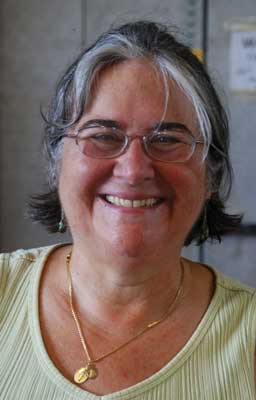
Lolyklara Palmahuergo

Eating fermented foods really helped Lolyklara overcome problems with fatigue. She had been exhausted the last few years, so she started reading a lot, trying to find solutions. “I’m a biologist originally and and this made sense,” she said, holding up her well-used copy of Nourishing Traditions. Not only does Lolyklara feel better, as an added bonus, her skin became clear and soft. Excitement about her recovery and a love of cooking propelled her to start making extra pickles to sell. “It’s about feeling useful and working, which I haven’t felt in the last four years since I got laid off from teaching German,” she explained.

All of the above mentioned fermented foods are available for purchase. Email Lolyklara at lolyklara(at)gmail.com to get on her mailing list or call 305-720-7766 to request a product price list and information on how to order. In addition, she is a healer working toward getting certified in the Healing Touch Program, and is looking for volunteers who would like free healings.

Read Full Post »

When cabbages fly

Last week, Farmer Margie told me that she was short-handed and needed volunteers to help pack shares. I offered to help, and rounded up my new buddy Nathan (who wants to be a tractor mechanic when he grows up), and he brought along his mother Tunie. Farm manager Muriel invited Christina, and we four volunteers joined the packing line in the barn at eight last Friday morning.

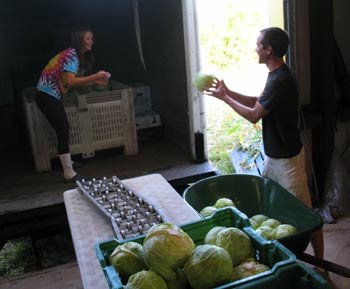
Kenna and Nathan make cabbages fly.

Before we could start packing the actual shares, the reefer truck had to be unloaded. It was full of vegetables from Worden Farm. The first challenge was a large bin full of cabbages, too heavy to lift fully loaded. Intern Kenna and Muriel climbed aboard and tossed cabbages fast and furious to Nathan and me. We caught and stacked them into wheelbarrows, which went to the head of the packing line.

Muriel determined which veggies went in which order on the line. The heaviest items get packed first and go in the bottom of the share box. The lightest things go on top, where they won’t get crushed. The actual packing went fast and easy. Margie and Christina packed cabbage and beets. Tunie added green beans and spring onions. I was next on the line. With my left hand, I reached for the box coming down the rollers and put in a bunch of kale. If the cabbage was big (and some were monstrously huge), I packed a smaller head of lettuce. If the cabbage was small, I put a bigger head. Then I pushed the box to Jesus on my right, who added mushrooms, closed the boxes and stacked them. Nathan loaded the boxes into the truck. Kenna was the runner, replenishing supplies of veggies and empty boxes.

Packing had a steady rhythm. Pull, pack, push. Pull, pack, push. When the full shares were done, the half shares were next. It seemed to go more slowly, but I think that’s because there are more half shares than full shares. Still, we were done by noon, and the truck was loaded with share boxes. Christina described the process as, “This is the place where the farm connects with the table, putting the vegetables in the box. Goodbye, vegetables! Hope you don’t wilt in the frig!”

Thanks to volunteers Nathan, Tunie and Christina for their hard work!

Read Full Post »

The end of an era?

Katy Sorenson has long been a friend to the farmers. She is best known for fighting attempts to move the Urban Development Boundary (UDB) which has restrained urban sprawl; for promoting zoning changes that would allow struggling family farmers to have alternative streams of agriculture-related income; and for promoting agri-tourism. Without her on the Commission, some farmers I’ve talked to fear their voices will no longer be heard, and the last remaining farm land will be devoured by waiting developers. Is this the end of an era, or will somebody as strong stand up and take Katy’s place?

Read the official announcement on the District 8 site, where you can also download her statement.

Read the Miami Herald article published on Friday, Feb. 5, 2010:

Miami-Dade Commissioner Katy Sorenson won’t seek 5th term

Miami-Dade Commissioner Katy Sorenson won’t seek a fifth term, closing a noteworthy career and opening the door for a new commissioner for South Miami-Dade.

BY MATTHEW HAGGMAN
mhaggman@MiamiHerald.com

Miami-Dade Commissioner Katy Sorenson will not seek reelection this fall, ending a 16-year run on the county board distinguished by her advocacy for the environment and social equality.

The commissioner announced plans to collaborate with the University of Miami to develop a leadership initiative on public service for people aspiring to run for local and state elected office. The effort, she said, will have the backing of the Knight Foundation and Dade Community Foundation.

Read more here:

http://www.miamiherald.com/news/miami-dade/story/1463960.html

Read Full Post »

« Newer Posts - Older Posts »