Feeds:
Posts
Comments

Archive for the ‘people’ Category

text by Art Friedrich, urban farmer, member of Urban Oasis Project
photos by Antonio Guadamuz, member of Urban Oasis Project

Saturday, Nov 28, 2009

Art Friedrich and partner Luigi (in flannel) touring ECHO

Getting out beyond SE FL to see what other things are happening in organic and sustainable agriculture in Florida, 16 folks headed out to ECHO (Educational Concerns for Hunger Organization) Global Farm and Worden’s Organic Farm in N. Ft. Myers and Punta Gorda, respectively. The group consisted of a number of the workers and WWOOF’ers from Bee Heaven Farm, as well as the big brain behind it all, Farmer Margie. Joining them were a number of local food enthusiasts from Urban Oasis Project and some of the new batch of Master Gardener Interns. [Note: Margie organizes a trip to ECHO and Worden every year during the Thanksgiving weekend, for the purpose of enlightening her farm interns and volunteers, and others who want to make the trip.]

Our first stop was the ECHO Global Farm, a christian based project started over 25 years ago to combat the problem of world hunger, primarily in the tropical zone, using the most concrete and long-lasting ways. Tours are available daily, and are well worth the $8. The tour consists of two hours of seeing and hearing about numerous fascinating plants, and methods of growing highly nutritious foods using unconventional and conventional methods that require little monetary outlay. There are six different recreated environments, such as a rainforest, an arid area, a monsoon climate (like we have, with 6 months dry and 6 months really wet), and the fascinating urban garden section.

Container gardening taken to a new level.

The urban garden section showed some great examples of reusing trash, such as old tires, to create containers. Also fascinating was the wicking gardens that are mostly made up of a carpet with a little bit of soil in top and some gravel or even cans wrapped in socks for the plants to have structure to grow on. You fill a closed bucket with a hole in the bottom with water, stick it on an edge of the carpet, and let the garden suck the moisture out as it needs it! This is a great way to use a minimum of water and soil. While some of us had questions about the safety of carpet material, other types of substrate could be developed. Probably any old canvas or woven mat material would do. They try laying the carpet out in the natural UV rays of the sun to break down harmful chemicals.

I also enjoyed the mention of their research using human urine as fertilizer — it is packed full of good nutrients and is sterile! In some countries, this has been government sanctioned for a while, such as in Sweden, where some housing developments have been built with urine diverting toilets that drain to some big tanks. When the farmers need fertilizer, they just pull up, pump some of the liquid gold out, and spray it right on their fields! The savings in water and fertilizer are stellar, and it is only cultural taboo that makes the subject so difficult.
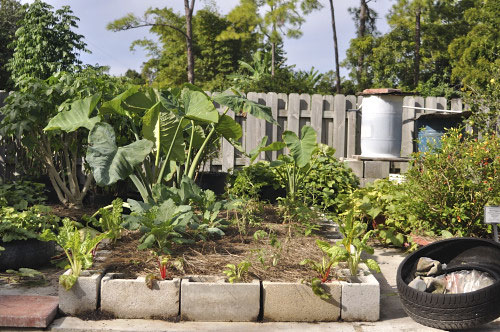
Urban homesteading at its finest!

The Moringa tree is a favorite plant there. They call it the Miracle Tree. One can eat almost any part of it, and it is incredibly dense with nutritive value, and the tree grows in almost any condition. I’ve started my own little plantation at my house in S. Miami.

Rustic raised bed

ECHO is also a seed bank, and they send seeds all over the world to see what works, with attention to both the physical and the cultural aspects. This aspect impresses me. It is applied science that recognizes humanity’s needs as a driving force in experimentation. And the needs of the global poor are great, but with sensitivity and ingenuity, the poor can be given the tools they need to improve their own lives in a sustainable and self-empowering way. ECHO taps into their own knowledge and traditions and offers a broader knowledge base for them to work with.

Endless fields at Worden Farm

The second half of our day was visiting Worden Farm in Punta Gorda. The farm is a brilliant example of hard work and smart planning to generate massive amounts of organic vegetables, sold all along the Gulf Coast. The farm is 55 acres, with about 35 in production, and is only six years old. The soil is almost pure sand, so lots of chicken manure is used as their fertilizer, as well as cover crops to slowly improve the quality. Long rows of raised beds made with plastic sheeting make upkeep relatively easy, and the veggies all looked absolutely flawless.

Drip irrigation system at Worden Farm

The plastic sheeting with drip tape irrigation underneath also helps limit water use, as well as the extra work of short watering cycles very frequently. Extra work to reduce the negative environmental impacts of the farm is a tradeoff they are happy to make. Those plastic sheets at the end of the season don’t hit a trash pile. They go to an agricultural plastics recycler.

Touring Worden Farm by electric cart. L-R: Wwoofer, Eva Worden, Cesar Contreras, Margie Pikarsky (back turned), Melissa Contreras

Farm Ferrari

Cow at Worden Farm

Read Full Post »

Hani Khouri and Martha Montes de Oca

Chef and goat cheese maker Hani Khouri of Redland Mediterranean Organics has joined forces with Martha Montes de Oca, owner of Sous Chef 2 Go, to offer ready-made takeout lunches during the week. You get a choice of one of Hani’s Lebanese dishes or one of Martha’s Hispanic creations. Prices range around $7-9 for the meal.

Right now the prepared lunch is strictly takeout. Bistro tables will be set outside when the weather is cooler. Also, fresh local produce will be for sale at the store in a few weeks as the season picks up.

I dropped by a few days ago to check things out. Hani’s special of the day was lamb kofta. He was busy in the kitchen patting ground lamb between his hands and shaping it into oval kebabs, then cooking them on the grill. Lunch was two generous sized kebabs topped with chopped parsley and ripe tomato, resting on a pita. The lamb was cooked through, seasoned with minced onion, a dash of chipotle and other spices. A generous dollop of hummus topped with a puddle of olive oil was served on the side. Humble hummus, I’ve had it a million times, but Hani’s actually tastes like chickpeas!

Lamb kofta with hummus and pita

Martha’s lunches are Hispanic in flavor. Her daily special was chicken fricassee simmering in a crock pot. Its delicious aroma filled the kitchen and made my mouth water. She explained that all her ingredients are organic except for the meats. The customer has the option of organic (more expensive) or natural (less expensive). She also said, with a proud smile, that she deciphered the familiar favorite Sazón Goya, and created a similar blend with all-organic seasonings minus MSG.

To find out what the lunch of the day is, go to the Sous Chef 2 Go web site and click on the picture of the take-out bag. That will lead you to the lunch/takeout menu. Drop in for lunch, or call ahead to order a recipe that you can cook at home.

Sous Chef 2 Go
7758 SW 88 St.
Miami, FL 33156
305.595.8010
contact[at]souschef2go.com

Read Full Post »

Go make your beds

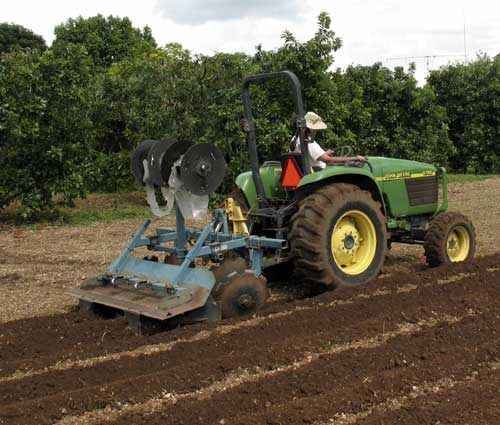
A lot of behind the scenes prep work goes on at Bee Heaven Farm before the first seeds are planted. The cover crop, which fixes nitrogen and other nutrients, has been mowed and tilled under to also add organic matter to the soil. The next step is to create rows of raised beds, where the vegetables will get planted.

Making beds

Making beds

The bedding attachment behind the tractor cuts into the soil and shapes it into a bed with channels on either side (where tractor tires pass). Native soil is not very deep in Redland. It averages about 1/4 inch over limestone rock. At Bee Heaven Farm — after rock-plowing, years of building up organic matter, and mounding up the beds — soil is maybe 4-6 inches deep, and very rocky. That’s it! That’s what your food grows in! The beds then need to be shaped and leveled by hand with a hoe. Rows of plants will then get planted by hand or with a seeder in each bed, either as transplanted starts or directly seeded. Tomatoes are planted in one row, beets in 4 rows, greens in 8 rows, or anything in between.

Bedding attachment

Bedding attachment in action

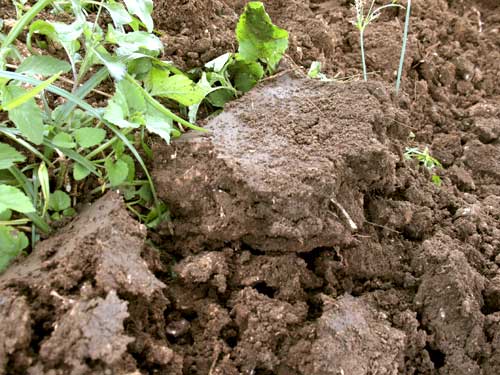
This past Saturday when I arrived, Farmer Margie was driving the tractor with the bedding attachment on the back, making passes up and down the main planting area. The bedding process wasn’t going very well. I saw one row wasn’t straight, kind of tapered into the next row. As she climbed down from the tractor, Margie explained that was where the tractor had actually slipped in the ground. The soil was wet from scattered rain showers blowing through because of a cold front. The wet soil was also getting compacting into clay-ey clumps, losing aeration and fluffiness that had been created by tilling. (For a detailed explanation of soil compaction and air spaces, read Margie’s post on tilth at Bee Heaven Farm’s Blog.)

Wet soil clumps

Wet soil clumps

Margie grumbled that she would have to wait until the weather cleared and the soil dried out, then till all over again to erase the curving beds of compacted soil, and attempt bedding again. Clearly every step of the growing process is affected by weather, in ways both subtle and obvious. Too much rain, not enough rain, too hot, too cold, too windy — the farmer is almost always at the mercy of the weather.

Read Full Post »

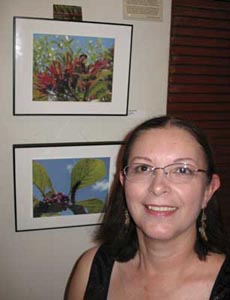
The photographer and her work

The photographer and her work. Photo by Margie Pikarsky.

As I entered the Miami Beach Botanical Gardens, the sweet, intoxicating scent of jasmine greeted me. Friends were waiting for me at the exhibit, and I was glad they came out to see the art and to show support. Farmer Margie and her husband Nick took turns taking pictures of me with my pictures, and it felt like paparazzi. Now I know what it’s like on the other side of the lens! Margie pointed out that the picture Firebush was hanging right below the sign that said FIRE extinguisher. Hmmm, seems like the people who were hanging the art have a sense of humor, I like that. Robert the Cantankerous Chef also came, and was discussing what kind of caterpillar that was. He thinks it’s a zebra Gulf Fritillary butterfly, and Margie thinks it might be a brown orange julia. [Both caterpillars are quite similar in appearance and both are natives, according to Margie, who looked these things up. Thanks for the fact checking!]

Claire Tomlin of The Market Company (whom I’ve met at the South Florida Farmers Market) provided veggie snacks, and Schnebleys brought a variety of fruit wines. I sampled the avocado wine, and it’s similar to pinot grigio with a whiff of avocado, and it’s actually pretty good. Heard the lychee wine (my favorite) ran out fairly quickly. Hung out till the very end with my friend photographer Mark Diamond, waiting to hear the announcements of the winning artists, including audience choice, but neither us of won anything. Thanks for your votes, it’s all good. I’m glad to be in the show, and hope that more shows are to come.

The pictures look a lot better in person, so if you haven’t seen them and you’re in the area, stop in and take a look for yourself. The show is up for only this week. I’m coming by on Saturday afternoon to pick them up — unless you want to take them home with you…? Let me know…

Botanist Steven Woodmansee wrote about the plants depicted in the art works. Here’s what he wrote about my pieces, which was posted on a card next to them.

1.  Beautyberry  – This photograph depicts one of our showier native flowering plants. American beautyberry (Callicarpa americana) is a member of the mint family (Lamiaceae), and its leaves are aromatic when crushed, although it is not recommended for culinary practices.

However, the clusters of purple fruit do attract birds, especially mockingbirds, who will defend “their” plant from other encroaching birds. It is native to upland habitats including pinelands and hammocks, and prefers full sun.  Branches may be clipped, and used in flower arrangements, as they last several days.  In cultivation, it is best to cutback the plant to one third its size at least once a year.  It is native throughout Florida and portions of the southeastern United States.

2.  Firebush – (Hamelia patens) is a member of the coffee plant family (Rubiaceae).  The showy tubular red flowers attract a plethora of butterflies and hummingbirds (and in this photo, a honey bee).  A favorite for the butterfly garden, firebush flowers year ’round, and grows well in partial shade.

Its fruits are devoured by birds.  It is recommended that for a bushy appearance and longevity, plants be cut back to one third its size at least once per year.  This species is a must for any Florida yard.  It is native across most of peninsular Florida where it can be found in swamps and hammocks.

Read Full Post »

Farmer Margie's blog!

Farmer Margie's blog!

Farmer Margie has posted on this blog, and now she’s got the blog fever and started her own, Bee Heaven Farm’s blog. The news and details will be a lot more specific to daily operations at the farm. Meanwhile, Redland Rambles will keep rambling about Bee Heaven, the CSA and its members, other growers in Redland Organics, and whatever’s going on in Redland that’s relevant and that I find out about in a timely manner. Am cutting back on the politics, though…

Read Full Post »

« Newer Posts - Older Posts »