Feeds:
Posts
Comments

Archive for the ‘people’ Category

John Ikerd

John Ikerd

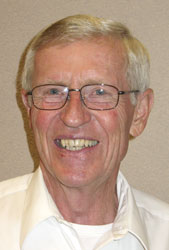
Back again to the Small Farms Conference. (Nope, I’m not done blogging about it.) The keynote speaker was Dr. John Ikerd, author and Professor Emeritus of Agricultural Economics from the University of Missouri, whose speech was Small Farms in the Year 2050. (An earlier version is on his web site.) According to the conference bio, Ikerd “came to the conclusion that not only was American agriculture not sustainable but neither was the American economy or society.” He is a huge advocate of sustainability and local food systems, and has written a great number of papers with that perspective.

Ikerd posed the question, “Can farmers meet the challenges of creating a sustainable agricultural system? Innovative farmers commit to meet needs of the present without diminishing future productivity.” He said that the current industrial approach to farming is simply not sustainable, and that lack of sustainability is a major part of a growing global economic problem. Industrial farming uses an enormous amount of fossil fuel, generates over one fifth of all greenhouse gas emissions in the US, and maintains an income disparity for farm and food workers working for low wages.

So what’s the solution? According to Ikerd, the local food movement (which evolved from the organic food movement in the 1980s) has more potential for transforming society. It requires a fundamental change in thinking, primarily that local growers are producing food that is good, clean and fair, not a commodity that large, industrial farmers produce.

Sustainable agriculture is based on people compared to industrial agriculture which is centered on capital and technology. Ikerd described local farmers who choose to grow high-quality food that is natural, organic and sustainable. They work with the forces of nature, and fit their farm to the land and climate. Their crops are diverse and complex because nature is diverse and complex.

In 2050, Ikerd predicted a connectedness among local growers who create regional liaisons among themselves to market their crops, forming the backbone of a national network of community-based food systems. Out of local/regional connectedness comes farmers markets, CSAs, farmers selling directly to restaurants and markets, farm-to-school and farm-to-hosptal programs. Ikerd mentioned Alice Waters and her legendary restaurant Chez Panisse which set the trend decades ago by serving fresh, local and seasonal food from local and sustainable farms.

He also predicted in 2050 the major trend in food marketing is targeted toward a specific group of consumers, not the mainstream. Sustainable farmers work to build relationships with their customers instead of making a quick sale. Their customers are not naive hippies, but conscious buyers looking for food with ecological and social integrity, and expect farmers to have the same integrity and care about their customers and society. Ultimately there is a sense of connectedness — between growers and their customers, and between customers connecting with their food and the place it comes from — which ensures ecological and sustainable integrity.

Ikerd’s speech was full of fire and brimstone, and got a standing ovation. It was fascinating to hear Ikerd’s predictions for a new food system. But it’s not that far off into the future. Something similar to what he describes is happening right in our own backyard. Redland Organics is a group of local organic and natural growers that Farmer Margie organized to market their diverse foods directly to the CSA members and buyers at the farmers market. You could say that Redland Organics is cutting edge.

“Change happens one person at a time. Never underestimate the power of individual choices,” Ikerd said. So, here’s some questions to chew on: What are your choices? How are you making changes? How do you connect with your food and where it comes from? Most importantly, have you returned to the common sense pursuit of happiness?
Read Full Post »

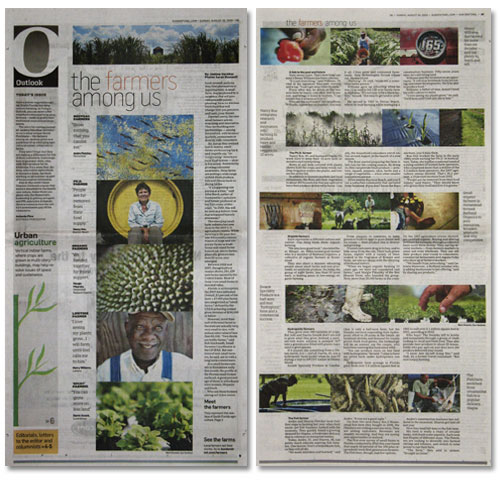
The spread in Sunday's Outlook section

The spread in Sunday's Outlook section

Did you happen to see the article about local farmers in Sunday’s Sun Sentinel? Margie Pikarsky, Hani Khouri and Gabrielle Marewski, among others, were interviewed by Jaideep Hardikar, a journalist from Nagpur, a city in central India. His beat is rural India and agriculture. Jaideep is here in South Florida finishing up a six month fellowship through the Alfred Friendly Press Fellowship program. He is one of 10 fellows selected this year to work in American newspapers. He also met up with us at the Small Farms Conference earlier this month.

Note: Jaideep’s article The Farmers Among Us has been removed from the Sun-Sentinel online archive. Discovered that on Oct. 13, 2009.

Read Full Post »

Free Screening of FRESH: The Movie

Saturday August 22, 2009 at 1:00 pm

Hollywood Branch Library
2600 Hollywood Blvd.Hollywood, FL 33020

A brief Q&A to follow movie. Taste local flavors from farmers in SFLA, and Pat of Yummy Yard will discuss ways to transform your yard into an edible garden.

For more information please contact Alexandra at 305-297-2000 or alexandra(at)nestpartners.com

FRESH celebrates the farmers, thinkers and business people across America who are re-inventing our food system. Each has witnessed the rapid
transformation of our agriculture into an industrial model, and confronted the consequences: food contamination, environmental pollution, depletion of natural resources, and morbid obesity. Forging healthier, sustainable alternatives, they offer a practical vision for a future of our food and our planet.

Among several main characters, FRESH features urban farmer and activist, Will Allen, the recipient of MacArthur 2008 Genius Award; sustainable farmer and entrepreneur Joel Salatin, made famous by Michael Pollan’s book, The Omnivore’s Dilemma; and supermarket owner, David Ball, challenging our Wal-Mart dominated economy.

Thanks to Melissa Contreras of the Urban Oasis Project for passing this along.

Read Full Post »

Florida avocados

Florida avocados

Take a good look at this season’s avocados, and savor the flavor. This season might be the last time you’ll see and taste Florida avocados, if the laurel wilt disease gets out of control in Miami-Dade County. It’s caused by the tiny redbay ambrosia beetle that carries a fungus which kills avocado trees fairly quickly. In Brevard County, where there are mostly neighborhood avocado trees, UF/IFAS researchers spotted the disease in October 2008, and by May 2009 the same trees were dead.

Last week the rumors were flying among growers that laurel wilt was spotted in a Miami-Dade grove. This Wednesday night it was confirmed by UF/IFAS scientists at an emergency meeting held at the Miami-Dade County Extension Service office. Over 120 concerned avocado growers packed into the meeting room to hear the grim news. This tiny beetle presents an enormous threat to their livelihood.

One tree suspected of laurel wilt came back positive for the disease using DNA testing, and four additional samples had been taken from three other groves for testing. This is the first time the fungus has been spotted in a commercial grove in Miami-Dade County, and it could severely harm a $12.7 million industry.

There are 892 growers and 6773 acres of avocado groves in the county, according to the USDA’s 2007 survey. If the disease cuts Florida’s commercial avocado crop in half, which could happen, it could cost the state $27 million in total economic impact and enough lost worker hours to equal 275 full-time jobs, according to UF/IFAS.

Plant inspectors and insect trappers from the Florida Dept. of Agriculture are surveying the ag production area from Goulds south — 140 commercial groves numbering 7000 acres, according to their calculations. They’re also setting sentinel traps to track the beetle, similar to what’s being done with fruit flies. Their survey should be 70-80 percent complete by this Friday Aug. 7. At the time of the meeting, they have not yet found signs of the beetle or laurel wilt.

If you’re a homeowner and you have an avocado tree in your yard, check it often for signs of beetle infestation or laurel wilt. If you see anything suspicious, call the Division of Plant Industry at 305-252-4360 or 888-397-1517 and an inspector will come take a sample for DNA testing. If the sample comes back positive, you’ll be instructed on how to treat or properly dispose of your tree. Do NOT cut it down and throw it on the street for pickup, because that could help spread the beetle and its fungal infection to other trees in the neighborhood.

State representatives Ileana Ros-Lehtinen and Mario Diaz-Balart were instrumental in pushing the USDA to give UF a $1.9 million grant to find a way to mitigate and manage laurel wilt. Other local politicians who are actively involved are County Mayor Carlos Alvarez and County Commissioner Katy Sorensen.

On the other hand, Mayor Carlos Alvarez recently drafted a new county budget that slashed Extension office funding to almost zero. The office also relies on matching funds from UF/IFAS to educate and support growers and homeowners about plant diseases and various agricultural issues. This drastic cut couldn’t come at a worse time. County commissioners are meeting on Sept. 3 and 17 (after their August vacation) to vote on the new budget. Please take the time to call or email your county commissioner and tell them not to cut funds for Extension and local growers! For locavores, doing that’s a no-brainer, right??

Miami-Dade County Mayor Carlos Alvarez http://www.miamidade.gov/mayor/
Miami-Dade County Commissioners http://www.miamidade.gov/commiss/
Representative Ileana Ros-Lehtinen http://ros-lehtinen.house.gov/
Representative Mario Diaz-Balart http://mariodiazbalart.house.gov/index.html

More info on redbay ambrosia beetle
http://www.doacs.state.fl.us/pi/enpp/ento/x.glabratus.html

More info on laurel wilt
http://trec.ifas.ufl.edu/RAB-LW/
http://www.doacs.state.fl.us/pi/enpp/pathology/laurel_wilt_disease.html

Miami-Dade County Extension Service http://miami-dade.ifas.ufl.edu
Miami-Dade DERM http://www.miamidade.gov/derm/
UF/IFAS Tropical Research & Education Center http://trec.ifas.ufl.edu/
Fla. Dept. of Agriculture and Consumer Services http://www.doacs.state.fl.us

Read Full Post »

Zak H Stern

Zak H Stern

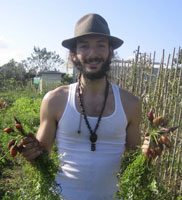
Well, not my prostate, but Zak’s. Former WWOOF-er Zak H Stern has been blogged by Budget Travel. Read the article here.

And what’s a WWOOF-er, you ask? That would be a volunteer apprentice who has registered through WWOOF (World Wide Opportunities on Organic Farms), and works on a chosen farm for room and board for an agreed period of time. For the volunteer, it’s a great way to learn about different crops, pick up various farm skills, and meet all kinds of people. Some volunteers already have experience from other farms, others are just starting out. For the farmer, it’s a great way to pass on knowledge, and get willing workers for a nominal cost.

Two seasons ago (2007-2008) Zak worked at Bee Heaven Farm for part of the season. He was cheerful and positive, and a delight to have on the farm and at market. His poem, While my Prostate is Small, was published in The COMmunity POST, the weekly Redland Organics CSA newsletter that goes out with the shares. I got his permission to reprint it. Enjoy!

While my prostate is small

By Zak H Stern

While my prostate is small….
I will travel the world,
Take long bus trips with no ac
And not stop fifty times to pee
While my prostate is small….
I will sleep through the night,
Drink a milkshake before bed
Without a hint of fright.
While my prostate is small….
I will enjoy my youth,
Smooth skin, sharp eyes,
A mind looking for truth.
While my prostate is small….
I will learn how to live,
How to love, how to listen,
How to take, how to give.
While my prostate is small….
I will withdraw from school,
Go live on a farm,
and learn how to live off the fat of the land.
While my prostate is small….
I will live my life to the fullest.

Published in The COMmunity POST, Week 15, March 8, 2008

Read Full Post »

« Newer Posts - Older Posts »