Feeds:
Posts
Comments

Archive for the ‘people’ Category

real-dirt-book
The Real Dirt

The last presenter of the last session of the last day was not to be missed. Peter Burkard, farmer and published author, spoke on the panel “Local Food System Development.” I got his permission to post his speech it its entirely, and you can read it below. Although this blog’s focus is on Redland Organics’ growers and customers, what Peter has to say is extremely relevant in South Florida.

If you want to read more, his book is called The Real Dirt: An Organic Grower’s Journey and the Values that Inspired It, which sells for $15 a copy. You can get yours by contacting him at PMBORGANIC(at)aol.com. (Please remember to take out the (at) and put in the @ when you order your copy. Am doing this to ward off spam.) Peter is also a member of the Southwest Florida Small Farmers Network.


The Holy Land is Everywhere

You know those cars that are plastered with like 30 bumper stickers? I recently saw one of these at a small farmers’ market in the little town of Burnsville in the North Carolina mountains. Now usually I find myself in agreement with most sentiments on such cars and I knew this one would be no different, being at a farmers’ market and all. So I checked it out a little and among other incisive bits of wisdom like “JUST SAY NO TO SEX WITH PRO-LIFERS” was this one that I really liked: “THE HOLY LAND IS EVERYWHERE”. The idea being that we need to be worshiping the entirety of creation, not just some special place set aside.

As we go forth today, this is the vision and mind-set which it is our job to create amongst the majority of our fellow humans, an understanding and appreciation of the immense value of undegraded land. Undegraded land can either have massive value as wilderness, through free ecosystem services, or in its agricultural potential…and the best of farms will marry the two. We need the majority of the public to not only reject agribusiness but along with it reject the mechanistic, controlling, reductionist worldview upon which agribusiness is based. To do that, they need to both be informed about the reality of industrial agriculture and be able to experience our positive alternatives and the fabulous food that we provide.

Wendell Berry draws the distinction between industrialism and agrarianism, in which industrialism is a way of thought based upon monetary capital and technology, while agrarianism is a way of thought based on a sustainable relationship with the land, preferably land on which the farmer’s family lives. He sees this as the overarching theme of all our efforts…the replacement of the dominant destructive, unsustainable model which is destroying the prospects for life as we know it, with our culture of respect for our life-support system and each other.

This industrialism we fight against is easy to see every day throughout Florida in the destruction of excellent farmland under the developer’s bulldozers. Following this near-removal of food growing from areas most inhabited by people, industrial, chemicalized agriculture is given a quasi-monopoly over our food supply. Rural land is of course cheaper but is also conveniently out of sight, so the vast majority of the public has little if any direct contact with the production of their food.

It is up to us to change that, locating some of our attractive, sustainable alternatives in urban and suburban settings. By reversing the trend of the last hundred years of separating people from their food supply, we both provide the model for a more sustainable future and enlist more of the admiring public to our cause. For it is only after a sufficient number of voters and tax payers join our side that the policy makers will be forced to act or else be removed from office.

There are a great many successful alternatives to the industrial food system. We need to be those model alternatives, as well as unite with our like-minded brethren, be they fellow producers, consumers, or even competitors, so as to maximize our political clout. In our area of the Central and South Florida West coast, we’ve established a small farmer network to enable us to learn from each other and also acquire strength through numbers, so as to better move our agenda forward politically. I’d like to encourage other areas to create their own similar networks of growers.

Still, at the same time, I’d like to promote what I see as the best answer, one for which all you need is yourself. There is one food production method that stands out as clearly the most local, most fresh, most flavorful, most fun, most providing of exercise, and most reducing of our carbon footprint. That is growing as much of your own food as possible at home. Even though I’ve sold produce at a market for 30 years, I’ve never thought of this backyard grower as competition; instead, once one tastes the difference in truly fresh, organic produce, they will surely seek out what they aren’t able to grow themselves from us market gardeners. Besides, it is the right thing for the world. (If you’ve ever been to Europe, you’ve seen not only vastly better transportation and health-care systems but also a lot more–in some places almost universal–home food and flower gardens.) So grow as much as you can at home or in a community garden and buy the rest from other small farmers, local whenever possible.

Time for some policy specifics. These are specific elements of the food system that we need to be striving towards. I’ll call it my “John Lennon section”…Imagine these things being reality. But we need to do more than just imagine them and work towards making them a reality. So pick one or two you are most passionate about and get involved with making them happen.

–URBAN FRINGE AND EVEN URBAN LAND WHICH IS SET ASIDE IN PERPETUITY FOR AGRICULTURAL ACTIVITY, THROUGH THINGS LIKE CONSERVATION EASEMENTS AND SPECIAL TAX TREATMENT,
–MORE URBAN COMMUNITY GARDENS,
–THE TEARING DOWN OF URBAN LAWS WHICH PROHIBIT AGRICULTURAL ACTIVITIES,
–MORE SCHOOL GARDENS AND CHILD EDUCATION ABOUT FOOD PRODUCTION,
–MORE WIDESPREAD USE OF FARM-TO-SCHOOL PROGRAMS,
–MORE FARM TO CHEF CONNECTIONS,
–MORE ACCESS TO FRESH, LOCAL FOOD FOR THE URBAN POOR,
–CONTINUED EXPANSION OF FARMERS’ MARKETS AND CSA’S,
–MUNICIPAL AND EXTENSION EFFORTS TO ENCOURAGE MORE HOME FOOD PRODUCTION, MEANING TRADITIONAL AND ROOFTOP GARDENS, FRUIT TREES, SPROUTING, CHICKENS, BEES, RABBITS, TILAPIA, AND SO ON,
–MORE TOWN-TO-FARM NUTRIENT CYCLING,
–THE CONTINUATION AND/OR EXPANSION OF GOVERNMENT INCENTIVES FOR GREEN ENERGY AND WATER CONSERVATION MEASURES IN CONJUNCTION WITH FARMING,
–COUNTIES PROVIDING LAND FOR ESTABLISHING WORKING FARMS DESIGNED TO TRAIN NEW FARMERS,
–MATCHING PROPERTY OWNERS WITH POTENTIAL SHARECROPPING OR RENTING FARMERS AND GARDENERS,
–MANDATING WORKING FARMS OR COMMUNITY GARDENS BE INCORPORATED IN ALL HOUSING DEVELOPMENTS OVER A CERTAIN SIZE. (NEEDED TO BE DONE LONG AGO.)

This isn’t a world we need to create from scratch. Most of these ideas are already being turned into reality somewhere in this country…or they exist in a fledgling way and we just need to help them along.

There will always be battles with those seeking to preserve an obsolete and unsustainable status quo. These same Chamber of Commerce types either have fought in the past or still do fight for things like making toxic children’s toys, nuclear weapons, and gas guzzlers, destroying old growth forests, hunting and processing whales, and preserving the slave trade.

Just because an activity creates jobs–creates commerce–does NOT mean that is something we as a society should be encouraging…not an automatic good. As I give talks in support of my book, The Real Dirt, an Organic Grower’s Journey and the Values that Inspired it, this is one of the points I emphasize, the merging of a strong sense of ethical values with our livelihoods. It should be clear that we are on the right side. Just remember that what we envision is a far more just, peaceful, and sustainable world, and that fact alone should sufficiently inspire us.

written by Peter Burkard
Read Full Post »

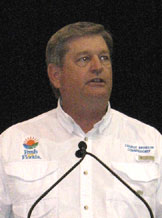
The first day of the Small Farms Conference officially began with a kick-off speech by Commissioner Charles Bronson. He’s the head of the Florida Dept. of Agriculture and Consumer Services, a huge agency which oversees the agriculture industry and food supply, provides consumer protection, and manages one million acres of state forests.

Bronson wasted no time and began his speech with the dramatic statement, “Agriculture is in big trouble, huge huge trouble” because of the current economic situation. He stated that fuel prices are 60 per cent of farm expenses, and the cost of production has been slammed by these rising fuel prices. According to Bronson, “Consumers are paying six cents on the dollar for food, and would be shocked to find out how much it actually costs to produce food if subsidies were not taken into account. We can’t fool the public that food is really that cheap.” Bronson explained that large farms are spending too much money to produce food for the prices that they are getting. “Food prices will go up when the public understands that we [farmers] are spending way more than what we are getting. The rest of the world will not feed us.”

Commissioner Charles Bronson

Commissioner Charles Bronson

One solution Bronson posed was to alternate growing food crops with fuel crops. University of Florida (UF) is the leader in developing cellulose as a fuel crop, and Highlands County is set to develop 35 million gallons of ethanol. Pessimistic about getting our oil supply cut off, Bronson said, “We have to be 100 per cent self-sufficient again, and reduce oil costs.” His hope of self-sufficiency also comes with construction of more offshore oil platforms in the Gulf of Mexico. He claimed they are not eyesores because they are completely underwater, and will not leak one drop of oil during a hurricane.

Bronson ended on a hopeful note. “Small agriculture has to pick up the pace, to grow specialty crops, put them directly to market, and make sure that the food supply is safe and healthy. Small farms are very important to the country and the state again.”

. . . . .

In the past, I’ve heard from reliable sources that food prices in this country really are lower because of the huge subsidies that agribusiness is getting from the federal government. Environmental advocates will include long-run ecological costs, such as eroding topsoil and pesticide residues, which raise the true cost of food even higher.

A 2006 law written by Florida’s congressional delegation put a huge area of federal waters surrounding Florida off limits to drilling until 2022. However, it’s not a done deal. The Senate will take up a vote in September that would bring drilling rigs as close as 10 miles off Florida.
http://news.yahoo.com/s/mcclatchy/20090727/pl_mcclatchy/3280169

University of Florida has studied biomass for ethanol coming from sugarcane, corn, citrus byproducts, and sweet sorghum, with sugarcane as the most promising source. “Potential Feedstock Sources for Ethanol Production in Florida,” UF/IFAS Publication #FE650 http://edis.ifas.ufl.edu/FE650, published July 2006.

Read Full Post »

Roadtrip!

Hani's new ride

Rode up to the Small Farms Conference with Margie and Nick from Bee Heaven, Gabriele from Paradise and Hani of Redland Mediterranean. We gathered in Redland in the late morning and took a leisurely drive up US 27 to Kissimmee.

Traveling with growers is a bit different than traveling with regular city folk. For one, they laugh at things

Queso Balnco at Guines Ranch

Queso Blanco at Guines Ranch

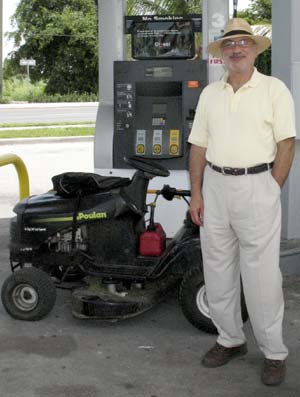
that city folk would find ordinary or ignore. At the first stop, The Southern Belle Truck Stop in South Bay, Hani admired a rider mower at the pump. Looks like the owner just rolled right up to get gas. Didn’t know you could take those things on the road.

Next, farmers know where to get good eats off the beaten track. Further down 27, Margie pulled in at Guines Ranch for homemade queso blanco made from cow’s milk. There were herds of cows and goats in the front fields. (They do sell goats for meat, in case you’re interested.) The queso was mild and squeaked a little when I chewed it. Was a good snack along with organic (not local) cherries and organic (not local) dried goldenberries. Local eats 1, not local 2. Could do better, I guess.

Spotted a sign in Avon Park that said it was in South Florida, which started a discussion of how far north is South Florida, and where the line (or fuzzy boundary) is drawn. What is the criteria that determines where northern South turns into southern Central Florida. Is it climate, geography, distance? (If anybody knows, please let me know.) And, if it’s grown in Avon Park, then is it local to Miami? They’re both in South Florida! The word local — along with the words organic and natural — seems to have its definition stretched and pummeled into meaning something different than your county or immediate neighborhood.

Navigating with an iPhone, GPS and Blackberry

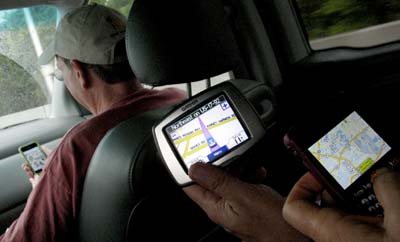
Third, farmers know how to find their way even if it’s off the beaten track. Later in the afternoon came the navigational challenge to cut over from 27 and the Osceola Heritage Park on Route 192 in Kissimmee. It took an iPhone, Garmin and Blackberry (plus an old fashioned paper map) to figure out the route. After much discussion, we arrived at the Park and checked in at the conference. Lots of interesting sessions Saturday and Sunday. More to follow…

Read Full Post »

The Urban Oasis Project is an all-volunteer organization dedicated to building food gardens in the city. Think fruits and vegetables growing in a garden in your backyard. Bananas, okra, melons, herbs, mmmm. Urban Oasis Project is the brainchild of CSA member Melissa Contreras, who together with Art Friedrich, host monthly meetings and potlucks. The next one is right around the corner, this Saturday August 1 at 4 pm in North Dade.

Art emailed details: Yvrose Valdez, has offered to host the next garden potluck at her house!  She is a Master Gardener, and I think she’s growing more than all of the community gardens combined on her modest house-lot! You don’t want to miss it!

We will begin to gather around 4PM on Aug 1st, with garden tours at 4:30 and 5PM.

At 5:30 we’ll have a quick more formal meeting to talk about the future of Urban Oasis Project, formalize some by-laws, vote in officers, and sign papers for incorporation, and officially birth the Urban Oasis Project (in the eyes of the state).

Around 6:15 we’ll kick off the potluck and feast upon the delicious wonders. Please bring a dish of some sort, or a dessert. If it’s homegrown, that’s great, but it doesn’t have to be – we know many of you are beginners and that this is a more sparse time in the harvest season for all of us.

Everyone is welcome to bring seeds and plants to trade or share with each as well!

Yvrose lives near 108th St. and NE 2nd Ave., so this will be more convenient for all of you living north of Miami.  You must RSVP for the actual address!

Send your RSVP to Art theedibleyardmiami(at)gmail.com or Melissa admin(at)urbanoasisproject.org .

Read Full Post »

Hani Khouri says "Cheese!"

Hani Khouri says "Cheese!"

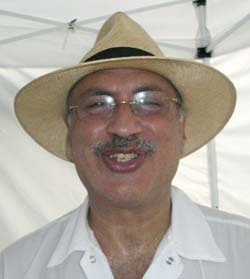
Hani Khouri, owner of Redland Mediterranean Organics (and the latest grower to join Redland Organics), makes cheese and ice cream from goat milk. Wait a minute… what’s that… goat milk ice cream? Um, how does it taste? Like really, really good ice cream. And when was the last time that you experienced a flavor like papaya-wild orchid or mango-wild orchid, fruity and sweet with a perfume-y finish. No goat flavors in the ice cream, no worries. How Hani does it is a secret, he says, and I’ve tried to find out.

The ice cream flavors run towards the tropical. There’s jakfruit, mamey, and plain mango, from fruits sourced locally in Redland and subject to availability. For traditionalists there’s vanilla bean, chocolate (to die for), peach, raspberry and strawberry. All flavors are sweetened with agave.

Hani also makes two kinds of cheeses. One is a firm cheese with texture like feta but less salt and no goat-y flavor. It’s

Labneh with olive oil

Labneh with olive oil

one of my favorites. I’ve put it in sandwiches and salads, goes great with arugula. Last Saturday I sampled Hani’s latest offering — labneh, a soft cheese with the spreadability of cream cheese, and with the familiar tang of goat (but not too much). Labneh, Hani explained to me, begins as goat milk yoghurt that is drained and salted. No fan of typical goat cheese, I hesitated before sampling the it with olive oil on whole wheat pita — and was pleasantly surprised by its flavor — a mild goat presence, but not too overwhelming — nice!

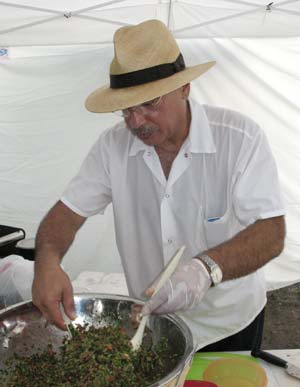
Also on the Redland Mediterranean Organics menu is hummus, tabouli, falafel and baba ganoush. They’re all super fresh. When I dropped by Hani’s tent last on a rainy Saturday afternoon at the Coconut Grove Organic Farmers Market, he was finely chopping organic mint to stir into the tabouli. (The mint was picked at Bee Heaven Farm just the day before, and so were the scallions.) The invigorating aroma of mint floated into the air and drew people to the tent. “What’s that you’re making,” they asked, and hung around waiting for him to finish.

Stirring mint into fresh tabouli

Stirring mint into fresh tabouli

“So what is local food?” Hani asked as he chopped and stirred. “How far do you go to get locally produced food?” The boundaries of a local food area could be set at 100 miles. Or it could be 400 miles. Hani quoted the Farm Bureau as saying local for Miami is anywhere from Florida. Or it could be 7 hours by truck or plane — now wait a minute, that’s pushing it! But where does local food come from — a warehouse, or the field or orchard? And how does it get to the market — airplane, truck, goat cart or walking? Hani asked again, “How far can local food travel and stay local?” I replied, “Redland Organics CSA sources food from 150 miles or less.” Hani gets his goat milk even closer than that — about 50 feet from his kitchen door to the Nubian goats that he raises. He laughed and said proudly, “I’m a local producer who’s also a chef.” He also sells what he makes, and eats what he sells.

Hungry yet? Find Hani Khouri and goodies from Redland Mediterranean Organics at the Saturday farmer’s market in Coconut Grove on Grand Ave. and Margaret St. (just west of 32 Ave.), or at the new greenmarket by The Alamo at the Jackson Memorial complex on Thursdays around lunchtime. Enjoy!

Read Full Post »

« Newer Posts