Feeds:
Posts
Comments

Archive for the ‘photo’ Category

Vanishing of the Bees, an intriguing new documentary about Colony Collapse Disorder, is back in town for a FREE one-night screening.  

Date: Sunday August 21, 2011
Time: 6:30 pm to 8:30 pm
Location: Fairchild Tropical Botanic Garden
10901 Old Cutler Road
Coral Gables FL 33156

Back in May, Vanishing of the Bees showed for only one night at the new, state of the art Coral Gables Cinematheque. And it was a good turnout — over 200 people packed the auditorium. Proceeds from that screening went to support Slow Food Miami’s school garden program.

Beekeeper John Herring and filmmaker Maryam Henein at the May screening.

The filmmaker, Maryam Henein, was present to introduce her film and answered questions after the showing. She was accompanied by John Herring, a beekeeper from Broward County, who brought a sample hive and various tools of his trade, who also answered questions about bees. Farmer Margie Pikarsky and interns Mike and Sadie from Bee Heaven Farm came with many boxes of local honey and wildflower bouquets for sale.

Vanishing of the Bees is a real-life mystery story which begins with two commercial beekeepers, David Hackenberg and Dave Mendes, who tell similar stories of how one day they came to check on their hives and found them inexplicably empty. They realized their problem wasn’t only with their hives, or happening in Southwest Florida where they were located. It was a growing, serious problem in 35 states and also in Europe. Bees were either vanishing, or their immune systems were succumbing to all kinds of pathogens. Populations were dying faster than they could be replaced, and nobody knew why. The film goes on a journey that follows David and Dave as they try to solve their mystery, and in the process they discover how they can keep their bees healthy and productive, and their beekeeping businesses alive.
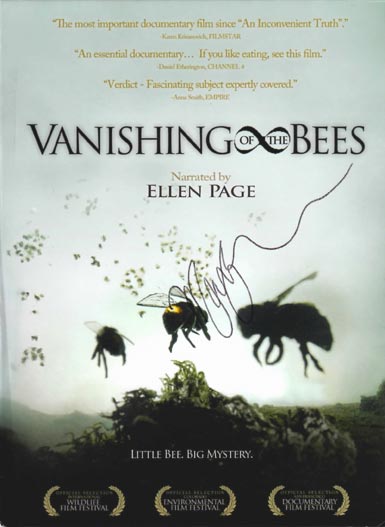
Through the course of researching and making her film, Maryam became a passionate and tireless activist for the honeybee. Her love and concern is clearly apparent in the film, which weaved a magic spell around the audience that night. As the story unfolded, people were pulled in; and at one scene in the middle, you could almost hear a pin drop as facts built up and pointed to the most likely causes of bee die-offs. The camerawork is amazing, bringing you very close to slow-motion bees in mid-flight, and editing and animation are superb.

Support the bees

The film does end on a hopeful note, that it’s not too late for ordinary people to save the honeybee. “Colony Collapse Disorder is a wake up call,” Maryam said after the screening. “There’s a big abyss between the people who know and the people who don’t know. Every one of you is a worker bee” to get out the word and take action.

She mentioned several ways you can help the bees and support your own good health. The easiest thing to do is buy organic produce and local honey. (You can find both at local farmers markets.) Organic farmers are not allowed to use systemic pesticides or other dangerous chemicals that can harm bees. Most organic farms tend to have a happy mix of several kinds of plants that support bees, and most farms keep hives and sell local honey. 
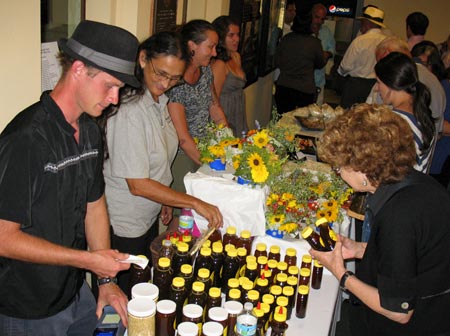
Mike and Margie from Bee Heaven Farm with honey and wildflower bouquets for sale at the screening.

Another simple thing you can do is avoid buying “honey-flavored” breads, cereals and other products. They are sweetened with honey blends imported from China. “Funny honey” is diluted with lactose syrup, high fructose corn syrup or other sweeteners. It is also tainted with strong antibiotics and lead residues. Corporate bakeries — and the film named General Mills and Pillsbury — buy imported honey because it is very cheap. (Real honey costs a lot more because U.S. beekeepers can’t produce enough to meet demand.) 

If you have the space, a fun thing you can do is plant a bee-friendly garden, with an assortment of plants that bloom throughout the year to attract pollinators. Choose low-maintenance native plants and wildflowers, keep fruit trees, or raise vegetables in your garden or in containers on your patio or balcony. Whatever you do, DO NOT use systemic pesticides! Those are the kind that are applied once a season or once a year as a soil drench, and “provide protection without spraying.” Plants suck those chemicals up through their roots, and all their cells and pollen itself become poisoned. Bees then gather tainted pollen, bring it back to their hive, and make themselves very sick from it, sick to the point of death. 

Support the film

Vanishing of the Bees is a completely independent production, and it took a long time and a lot of money to make it happen. From researching and writing the script to the final edit took about four years to make, and it cost half a million dollars. (Just the editing alone took a year and cost a good chunk of money.) Maryam raised funds a little bit at a time, from donations and sponsorships, and they went toward paying film expenses. When she wasn’t filming, she supported herself at times as a waitress, and admitted that for a while she was on food stamps and maxed out credit cards to survive. 

Maryam and her producers are making their money back with donations and DVD sales. Right now, they are running a promotion and selling the DVD on their web site for a reduced price of $14.99 for a personal viewing license. (They might also be selling the DVD at Sunday’s screening.) Maryam wants to get her DVD into schools. “Education is the beginning,” she said. “We are the generation waking up. The change is coming up in the generations behind us.” At the time of the May screening, she needed to raise about $12 thousand to develop a companion study guide. She is self-distributing her film, and is actively seeking venues for future screenings. The next Florida screening is in Tampa on August 29th.

Read Full Post »

Chewy dried bananas

Bunches of blotchy and bruised bananas.

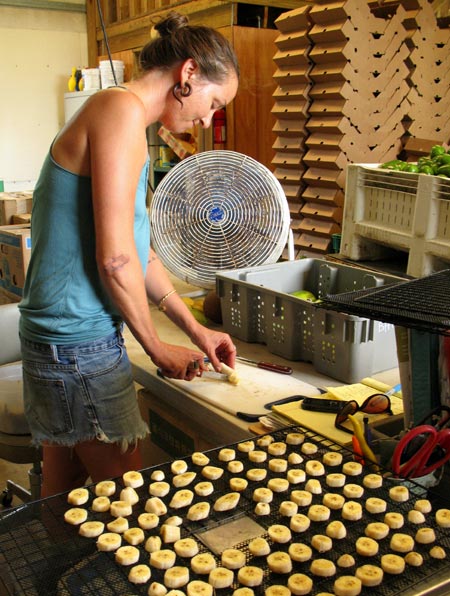
Sadie was working in the barn the last Saturday when I came to pick up my summer fruit order. She was sitting at a table with several bunches of blotchy bananas. They didn’t look very good, but when Sadie peeled one, the flesh was perfectly ripe and ready to eat. Because the skins weren’t pretty enough, the bananas would be used in another way.

The drying rack filled up with sliced bananas as Sadie cuts up more.

Sadie trimmed bruised spots, and cut thick slices, almost a half inch thick. Those were laid on a dehydrator drying rack spaced about an inch apart. When the rack was full, it went inside the large dehydrator humming in a corner. It already held several racks of bananas and star fruit in various stages of dryness. The fruit will take several hours to dry. Then it will be put in the Fruits of Summer dried fruit mix that Bee Heaven Farm sells at farmers markets in the winter.

Sadie showed me a plastic bag full of dried banana slices and offered me some. “I think it tastes like banana bread,” she said. The thick slice was chewy and sweet and had an intense flavor. “I like thick ones. Thin slices dry up too crispy,” she continued. I reached for another slice and chewed slowly. Yeah, it tasted something like banana bread, only better — there weren’t all the other ingredients to dilute the flavor.

If you have a dehydrator, making dried fruit is easy to do. All it takes are a few hours or overnight. Dried bananas and other dried items keep well sealed in a plastic bag and refrigerated.

Halfway dried banana slice hot out of the dehydrator.

Read Full Post »

Kattia documents the arrival of Redland mangoes.

A person can move away from Miami but their craving for flavors of the place will stay for a long time. Case in point, friends Kattia and Chris moved away about 10 years ago, and live in tropical fruit exile all the way up in Sanford. If they want a fresh mango, they have to go to the store and settle for fruit imported from Mexico. They complained those out-of-season offshore mangoes just don’t have the flavor, juiciness and aroma of a home grown mango from Miami. And why should they? Imported fruit is picked half-ripe, then dunked in hot water to kill pathogens, which also kills taste.

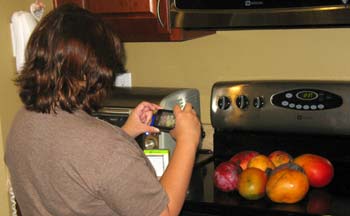
I told my friends about the bumper crop we had this summer, and they asked when I was coming up. Right away, I replied, and loaded up my car with sacks of plump red and golden Kent mangoes from Paradise Farm, and headed north on I-95. About four hours later, I pulled into their driveway, and Kattia and I lugged eight pounds of mangoes and a box full of empty canning jars to her kitchen. 

“When life hands you mangos, make jam!” said Kattia with delight. (If this sounds like a familiar adventure, she and I made lychee freezer jam two summers ago.) The canning process she followed wasn’t all that difficult, even for a novice like me. “The trick to making cooked jam is to have everything ready and waiting to go,” she said. 

First, we made sure that everything we needed to use was clean and ready. Jars, rings and other utensils were run through the dishwasher beforehand. (If you don’t have a dishwasher, sterilize everything in a big pot of boiling water to kill any dangerous bacteria that can spoil food and make you sick.) 

As the dishwasher hummed, we peeled, seeded and chopped mangoes. Six cups of fruit were destined for jam, and went into a big pot to cook. (The rest of the fruit was stuffed into the freezer.) Lemon juice was added “to wake up the taste of mangoes,” and pectin was stirred in. “Pectin is what makes the jam set,” Kattia explained. “Pectin and lemon help mangoes give off juice.” She also added a bit of butter to reduce foaming as the mixture cooked.

Mashing chopped mango as it cooks. Note 5 and a half cups of sugar, and rings in the background, ready to go.

Out came the potato masher, and the fruit was smashed into smaller pieces, to the texture of rough applesauce. Heat was raised to a rolling boil — when you stir, bubbles keep forming — and the fruit mixture was stirred constantly. Sugar was quickly added, and stirred until everything came back to a rolling boil for one more minute. (If you think five and a half cups is a horrifying amount of sugar, keep in mind that this is called a low-sugar recipe. A regular amount would be 10 cups.)

When the mango mixture got soupy and looked translucent, it was time to fill up jars. “It helps to lay out everything you need because assembly goes quickly,” Kattia said. She set a wide mouth funnel into a jar, and ladled mango mixture up to the very neck. Next, using a magnetic grabber, she fished a lid out from a small pot of simmering water, centered it on top of the jar, and screwed on a ring. The filled, sealed jar was then turned upside down on a towel on the counter.

“With the inversion method of canning, the fruit goes to the top of the jar, and the air goes to the bottom of the jar,” Kattia explained. “When you flip it over, the air goes to the top, and creates a vacuum, and it seals the jar.”

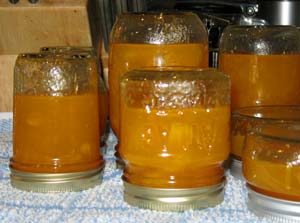
Jam cooling upside down. When a jar is flipped over, the air inside will rise to the top and create a vacuum.

The jars stayed upside down until they were cool to the touch. This took about an hour or so. Then we turned them right side up and tested the seal. A properly sealed jar lid was hard, without any give. Two jars had lids that popped or flexed a little, and they went back upside down for about 15 minutes longer. (If that still didn’t do the trick, the jam would have to be eaten right away — what a tragedy! — or processed in a pot of boiling water for long term keeping.) The whole process took about two hours, including prep and filling jars.

Voila! We had jam! It wasn’t that difficult to make. The hardest part, and it’s not really that hard, is to track down canning supplies. Kattia bought jars, lids and canning paraphernalia at a nearby Super Wal-Mart. If your local store doesn’t carry what you need, you can find canning kits and jars online. Labels would be helpful if you’re making a batch to give away. 

When we were done, pretty golden jars of mango jam were lined up on Kattia’s counter. The sweet tropical taste of Miami’s summer had been captured to savor for later. (It’s not the same as having fresh mangoes, but the stash in the freezer comes close.) I drove back home with several jars, some to keep and some to share. My jar is meant for for medicinal purposes, as it were, for later in the year. A bit of sunshiney mango jam spread on buttered toast will chase away any gray winter blahs!

Kattia’s Mango Jam

6 cups mangoes, peeled, seeded, chopped
juice of 1 lemon
3 Tbps. low or no-sugar pectin
5 1/2 cups sugar
1 pat of butter

Peel, seed and chop mangoes. Put them into a large pot with lemon juice and mash with a potato masher. Stir in butter and pectin and keep stirring. Raise heat to a boil. Skim off any foam. Then quickly stir in the sugar a bit at a time until it dissolves. Keep stirring at a rolling boil for 1 minute longer. When the mixture looks transparent, it is ready to put into jars.

Ladle mango mixture into a jar up to its neck. Do not overfill, as you need an air space. Wipe off any spills and put on the lid and ring. Place jar upside down on towel to cool. Repeat with other jars until all your mixture is used up. Let jars cool to touch, then turn over and test seal. If the lid pops, flip it over to sit for a few more minutes, or refrigerate.

Read Full Post »

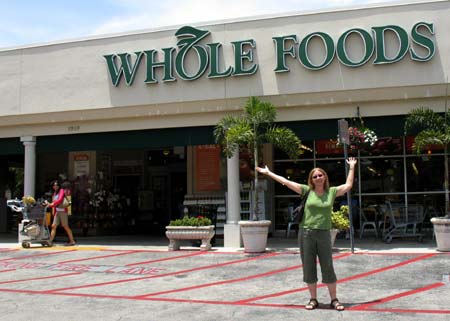
In front of the store in Winter Park.

Last week I was up in Sanford visiting with friends Kattia, Chris and Holden. Kattia knows I’m a big fan of Whole Foods, and took me to visit the store at Winter Park.

Hardees in front and Donnies on the left.

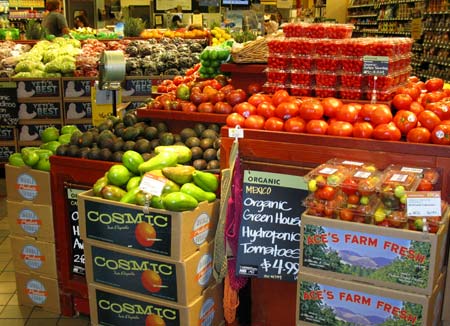
The first thing I saw when I walked in through the front door was a heap of Florida avocados. They looked suspiciously familiar. I peered closer and saw the sign: Bee Heaven Farm, Homestead FL. “Kattia, look! Margie’s avocados!” I shouted, astonished by the presence of Redland raised Hardee and Donnie avocados. (One Hardee was starting to ripen and showed dark red streaks. It will turn burgundy red when it is completely ripe.)

Hardee avocados from Bee Heaven Farm.

The fruits were right under a spotlight and their green skins glowed in the light. They made the California Haas avocados stacked behind them look dark, drab and unremarkable by comparison. I pulled out my camera to take a picture. Kattia and her son Holden made theselves scarce over by the bulk bins, and the employee stacking produce looked at me with curiosity.

Massive mamey from Health and Happiness Farm.

I then noticed mamey stacked nearby, and looked more closely. The sign said Health and Happiness Farm, Homestead FL. “Kattia, look! Sal’s mamey is here too!” Next to the mamey were sapodillas from Kopali Organics, also from Homestead. I looked around and didn’t see my friends. Gee, you just can’t take me anywhere… But Redland fruit travels everywhere!

Read Full Post »

Monstrous mango

Ginormous mango — look closely at the scale to see how much it weighs.

Nothing says summer in Miami like eating one or two (or three) mangoes a day. And with massive quantities of mangoes available everywhere, that’s easy to do. Home grown or roadside mangoes just don’t compare to half ripe, faintly flavored fruit coming in from Mexico. Just do yourself a favor and don’t even look at those when you are surrounded by local abundance.

Bet you can’t eat but one of these monstrous mangoes! It came from Possum Trot Tropical Fruit Nursery, where Robert Barnum must be feeding it some amazing compost to grow that big. Can its extreme size be attributed to global warming? Look closely at the dial on the scale. It weighs over four pounds! Bet you can’t eat two!

Read Full Post »

« Newer Posts - Older Posts »