Feeds:
Posts
Comments

Archive for the ‘photo’ Category

At the Small Farms Conference, Nick and Margie Pikarsky of Bee Heaven Farm were part of a panel on solar power.
Nick Pikarsky

Nick Pikarsky

They gave a presentation on the two solar systems they have installed at their farm. One is a passive hot water collector, and the other system powers a water pump and freezer.

Water pump and freezer system

This system is used to pump water from the well for the bar, with extra power for the freezer. The pump provides water for everyday farm water uses. The system also does minor irrigation in a small area, consisting of a small mist house and a garden size drip system.

Solar panels mounted on roof of pump house

Solar panels mounted on roof of pump house

Two solar panels are mounted on top of the freezer shed, and were set at a compromise angle between summer and winter positions. Since the farm is so close to the equator in South Florida, the angle of the sun doesn’t change much through the seasons. They learned quickly that you can’t have anything obscuring the panels. A crawling vine once covered part of one panel and reduced the power output considerably. When nearby branches and a flowering bush grow too tall, they get cut back. After hurricanes Katrina and Wilma, the farm was without power two weeks and one week accordingly. The house didn’t have water, but the barn did, and the system was hooked up to supply for the house as well.
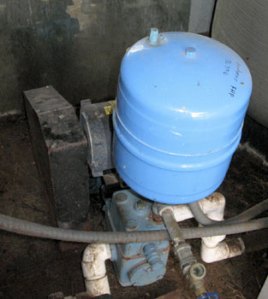
24V Dankoff Solar Force irrigation pump

24V Dankoff Solar Force irrigation pump

Nick researched the literature, spoke with suppliers and decided on a 24 volt DC system as a compromise between efficiency and economy. 12V systems are cheaper but more inefficient, and 48V systems were a bit too expensive. Choose the type of pump based on your needs — depth of water table, amount of water needed, and duty cycle — then size the solar system accordingly, Margie advised. The irrigation pump is a 24V Dankoff Solar Force (now sold under the Conergy brand). The pump system runs off 2 deep-cycle batteries charged by a small controller unit. It also powers a Sundanzer 8 cu. ft. 24V freezer chest, and a couple of emergency lights in the barn and pump house.

Inverter and breaker panel mounted on wall. Batteries, pump and freezer on the floor of the pump house.

Inverter and breaker panel mounted on wall. Batteries, pump and freezer on the floor of the pump house.

Passive water heater

Bee Heaven participated in Florida Keys GLEE a few years ago and learned about TCT Solar, which makes passive solar hot water collectors. This particular model is 50 gallons, and was mounted to serve as the roof of an outdoor shower stall. It provides plenty of scalding hot water for the shower, a washing machine, and the big sink in the barn. The passive system heats water only when there is sun, but the water stays hot! It requires no electricity and works really well.
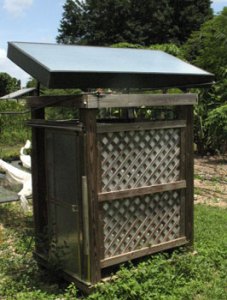
Passive collector mounted on top of outdoors shower.

Passive collector mounted on top of outdoors shower.

Barn system

There is a third system at Bee Heaven Farm that has not yet been fully implemented. It will someday serve all the power needs in the barn. The barn
has a Solar 5K 48V inverter which is designed to power the walk-in cooler, tools, lighting and standard 120V AC appliances. Nick and Margie calculate they need a total of 20 PV panels to power the barn, along with a complement of 40 batteries. It’s too expensive to do that all at once, so they’re hoping to implement in stages, and are excited about new government incentives to help with the purchases. There’s an A-B switch in the barn to go on or off the grid. Margie said their goal is to be completely free of the grid.
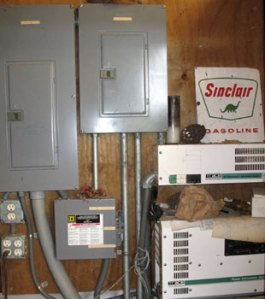
Barn breaker panels, A-B switch and inverter.

Barn breaker panels, A-B switch and inverter.

FPL has a net metering policy, but there’s a catch, Margie cautioned. They require you to be down when they are down, and you have to buy power from FPL at retail, yet they buy power from you at wholesale, and that’s a significant difference. FPL will give you credit if you generate more power
than you use, but at the end of the year, you lose any credit you’ve accumulated. Other speakers on the panel cautioned users to try to negotiate a contract with their utility that’s equitable.

Costs

These are the prices when the systems were built 5-7 years ago. Some things are now cheaper, and some things are more expensive.

Solar collector for hot water $1400 (copper piping and stand not included)

Pump and freezer system:
Batteries 400 x 2
Sharp modules (solar panels) 550 x 2
Rack for modules 200
Charge controller 140
Dankoff pump 2500
Pressure tank 200
Sundanzer freezer 1200
Total: 6200 + labor & shed

Download system diagrams for the solar water heater and for the solar pump.

Thanks to Margie for collaborating in the writing of this article, and Nick for the systems diagrams.

Read Full Post »

Florida avocados

Florida avocados

Take a good look at this season’s avocados, and savor the flavor. This season might be the last time you’ll see and taste Florida avocados, if the laurel wilt disease gets out of control in Miami-Dade County. It’s caused by the tiny redbay ambrosia beetle that carries a fungus which kills avocado trees fairly quickly. In Brevard County, where there are mostly neighborhood avocado trees, UF/IFAS researchers spotted the disease in October 2008, and by May 2009 the same trees were dead.

Last week the rumors were flying among growers that laurel wilt was spotted in a Miami-Dade grove. This Wednesday night it was confirmed by UF/IFAS scientists at an emergency meeting held at the Miami-Dade County Extension Service office. Over 120 concerned avocado growers packed into the meeting room to hear the grim news. This tiny beetle presents an enormous threat to their livelihood.

One tree suspected of laurel wilt came back positive for the disease using DNA testing, and four additional samples had been taken from three other groves for testing. This is the first time the fungus has been spotted in a commercial grove in Miami-Dade County, and it could severely harm a $12.7 million industry.

There are 892 growers and 6773 acres of avocado groves in the county, according to the USDA’s 2007 survey. If the disease cuts Florida’s commercial avocado crop in half, which could happen, it could cost the state $27 million in total economic impact and enough lost worker hours to equal 275 full-time jobs, according to UF/IFAS.

Plant inspectors and insect trappers from the Florida Dept. of Agriculture are surveying the ag production area from Goulds south — 140 commercial groves numbering 7000 acres, according to their calculations. They’re also setting sentinel traps to track the beetle, similar to what’s being done with fruit flies. Their survey should be 70-80 percent complete by this Friday Aug. 7. At the time of the meeting, they have not yet found signs of the beetle or laurel wilt.

If you’re a homeowner and you have an avocado tree in your yard, check it often for signs of beetle infestation or laurel wilt. If you see anything suspicious, call the Division of Plant Industry at 305-252-4360 or 888-397-1517 and an inspector will come take a sample for DNA testing. If the sample comes back positive, you’ll be instructed on how to treat or properly dispose of your tree. Do NOT cut it down and throw it on the street for pickup, because that could help spread the beetle and its fungal infection to other trees in the neighborhood.

State representatives Ileana Ros-Lehtinen and Mario Diaz-Balart were instrumental in pushing the USDA to give UF a $1.9 million grant to find a way to mitigate and manage laurel wilt. Other local politicians who are actively involved are County Mayor Carlos Alvarez and County Commissioner Katy Sorensen.

On the other hand, Mayor Carlos Alvarez recently drafted a new county budget that slashed Extension office funding to almost zero. The office also relies on matching funds from UF/IFAS to educate and support growers and homeowners about plant diseases and various agricultural issues. This drastic cut couldn’t come at a worse time. County commissioners are meeting on Sept. 3 and 17 (after their August vacation) to vote on the new budget. Please take the time to call or email your county commissioner and tell them not to cut funds for Extension and local growers! For locavores, doing that’s a no-brainer, right??

Miami-Dade County Mayor Carlos Alvarez http://www.miamidade.gov/mayor/
Miami-Dade County Commissioners http://www.miamidade.gov/commiss/
Representative Ileana Ros-Lehtinen http://ros-lehtinen.house.gov/
Representative Mario Diaz-Balart http://mariodiazbalart.house.gov/index.html

More info on redbay ambrosia beetle
http://www.doacs.state.fl.us/pi/enpp/ento/x.glabratus.html

More info on laurel wilt
http://trec.ifas.ufl.edu/RAB-LW/
http://www.doacs.state.fl.us/pi/enpp/pathology/laurel_wilt_disease.html

Miami-Dade County Extension Service http://miami-dade.ifas.ufl.edu
Miami-Dade DERM http://www.miamidade.gov/derm/
UF/IFAS Tropical Research & Education Center http://trec.ifas.ufl.edu/
Fla. Dept. of Agriculture and Consumer Services http://www.doacs.state.fl.us

Read Full Post »

Zak H Stern

Zak H Stern

Well, not my prostate, but Zak’s. Former WWOOF-er Zak H Stern has been blogged by Budget Travel. Read the article here.

And what’s a WWOOF-er, you ask? That would be a volunteer apprentice who has registered through WWOOF (World Wide Opportunities on Organic Farms), and works on a chosen farm for room and board for an agreed period of time. For the volunteer, it’s a great way to learn about different crops, pick up various farm skills, and meet all kinds of people. Some volunteers already have experience from other farms, others are just starting out. For the farmer, it’s a great way to pass on knowledge, and get willing workers for a nominal cost.

Two seasons ago (2007-2008) Zak worked at Bee Heaven Farm for part of the season. He was cheerful and positive, and a delight to have on the farm and at market. His poem, While my Prostate is Small, was published in The COMmunity POST, the weekly Redland Organics CSA newsletter that goes out with the shares. I got his permission to reprint it. Enjoy!

While my prostate is small

By Zak H Stern

While my prostate is small….
I will travel the world,
Take long bus trips with no ac
And not stop fifty times to pee
While my prostate is small….
I will sleep through the night,
Drink a milkshake before bed
Without a hint of fright.
While my prostate is small….
I will enjoy my youth,
Smooth skin, sharp eyes,
A mind looking for truth.
While my prostate is small….
I will learn how to live,
How to love, how to listen,
How to take, how to give.
While my prostate is small….
I will withdraw from school,
Go live on a farm,
and learn how to live off the fat of the land.
While my prostate is small….
I will live my life to the fullest.

Published in The COMmunity POST, Week 15, March 8, 2008

Read Full Post »

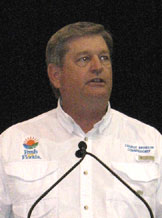
The first day of the Small Farms Conference officially began with a kick-off speech by Commissioner Charles Bronson. He’s the head of the Florida Dept. of Agriculture and Consumer Services, a huge agency which oversees the agriculture industry and food supply, provides consumer protection, and manages one million acres of state forests.

Bronson wasted no time and began his speech with the dramatic statement, “Agriculture is in big trouble, huge huge trouble” because of the current economic situation. He stated that fuel prices are 60 per cent of farm expenses, and the cost of production has been slammed by these rising fuel prices. According to Bronson, “Consumers are paying six cents on the dollar for food, and would be shocked to find out how much it actually costs to produce food if subsidies were not taken into account. We can’t fool the public that food is really that cheap.” Bronson explained that large farms are spending too much money to produce food for the prices that they are getting. “Food prices will go up when the public understands that we [farmers] are spending way more than what we are getting. The rest of the world will not feed us.”

Commissioner Charles Bronson

Commissioner Charles Bronson

One solution Bronson posed was to alternate growing food crops with fuel crops. University of Florida (UF) is the leader in developing cellulose as a fuel crop, and Highlands County is set to develop 35 million gallons of ethanol. Pessimistic about getting our oil supply cut off, Bronson said, “We have to be 100 per cent self-sufficient again, and reduce oil costs.” His hope of self-sufficiency also comes with construction of more offshore oil platforms in the Gulf of Mexico. He claimed they are not eyesores because they are completely underwater, and will not leak one drop of oil during a hurricane.

Bronson ended on a hopeful note. “Small agriculture has to pick up the pace, to grow specialty crops, put them directly to market, and make sure that the food supply is safe and healthy. Small farms are very important to the country and the state again.”

. . . . .

In the past, I’ve heard from reliable sources that food prices in this country really are lower because of the huge subsidies that agribusiness is getting from the federal government. Environmental advocates will include long-run ecological costs, such as eroding topsoil and pesticide residues, which raise the true cost of food even higher.

A 2006 law written by Florida’s congressional delegation put a huge area of federal waters surrounding Florida off limits to drilling until 2022. However, it’s not a done deal. The Senate will take up a vote in September that would bring drilling rigs as close as 10 miles off Florida.
http://news.yahoo.com/s/mcclatchy/20090727/pl_mcclatchy/3280169

University of Florida has studied biomass for ethanol coming from sugarcane, corn, citrus byproducts, and sweet sorghum, with sugarcane as the most promising source. “Potential Feedstock Sources for Ethanol Production in Florida,” UF/IFAS Publication #FE650 http://edis.ifas.ufl.edu/FE650, published July 2006.

Read Full Post »

Roadtrip!

Hani's new ride

Rode up to the Small Farms Conference with Margie and Nick from Bee Heaven, Gabriele from Paradise and Hani of Redland Mediterranean. We gathered in Redland in the late morning and took a leisurely drive up US 27 to Kissimmee.

Traveling with growers is a bit different than traveling with regular city folk. For one, they laugh at things

Queso Balnco at Guines Ranch

Queso Blanco at Guines Ranch

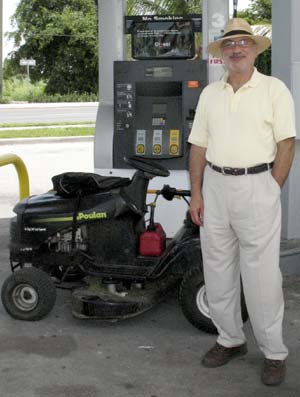
that city folk would find ordinary or ignore. At the first stop, The Southern Belle Truck Stop in South Bay, Hani admired a rider mower at the pump. Looks like the owner just rolled right up to get gas. Didn’t know you could take those things on the road.

Next, farmers know where to get good eats off the beaten track. Further down 27, Margie pulled in at Guines Ranch for homemade queso blanco made from cow’s milk. There were herds of cows and goats in the front fields. (They do sell goats for meat, in case you’re interested.) The queso was mild and squeaked a little when I chewed it. Was a good snack along with organic (not local) cherries and organic (not local) dried goldenberries. Local eats 1, not local 2. Could do better, I guess.

Spotted a sign in Avon Park that said it was in South Florida, which started a discussion of how far north is South Florida, and where the line (or fuzzy boundary) is drawn. What is the criteria that determines where northern South turns into southern Central Florida. Is it climate, geography, distance? (If anybody knows, please let me know.) And, if it’s grown in Avon Park, then is it local to Miami? They’re both in South Florida! The word local — along with the words organic and natural — seems to have its definition stretched and pummeled into meaning something different than your county or immediate neighborhood.

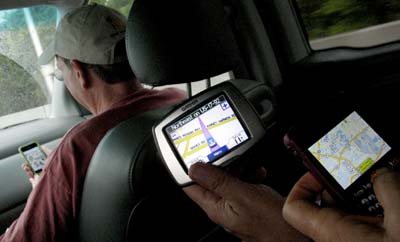
Navigating with an iPhone, GPS and Blackberry

Third, farmers know how to find their way even if it’s off the beaten track. Later in the afternoon came the navigational challenge to cut over from 27 and the Osceola Heritage Park on Route 192 in Kissimmee. It took an iPhone, Garmin and Blackberry (plus an old fashioned paper map) to figure out the route. After much discussion, we arrived at the Park and checked in at the conference. Lots of interesting sessions Saturday and Sunday. More to follow…

Read Full Post »

« Newer Posts - Older Posts »