Feeds:
Posts
Comments

Archive for the ‘politics’ Category

BY ANDRES VIGLUCCI
aviglucci@miamiherald.com

For a generation, a sharp and sometimes controversial line has contained Miami-Dade’s explosive urban growth like a gasket, largely insulating the county’s fragile agricultural hinterlands, surviving wetlands and two national parks from subdivisions and commercial-strip development. Now the days of holding the line on the Urban Development Boundary — the focus of some of the fiercest local battles over growth and the environment — may be drawing to an end.Measures approved by the Florida Legislature with little scrutiny or debate in the waning moments of this year’s session would dismantle the state oversight that has acted as the principal brake on repeated efforts by the county commission to breach the line for new development.The measures, almost sure to be signed by business-friendly Gov. Rick Scott, would significantly water down the state’s 25-year-old growth-management system, giving counties and municipalities far greater freedom to amend the local comprehensive development plans that are meant to control suburban sprawl. The UDB, which runs along the inside of the county’s western and southern edges as well as its southeastern coastal fringe, is a key feature of Miami-Dade’s comp plan. Development outside the line is limited, in most areas, to one dwelling per five acres.

Read more: http://www.miamiherald.com/2011/05/22/2226826/state-dismantles-growth-management.html

Read Full Post »

Dr. Marvin Dunn tells it like it is, while Local 10’s Todd Tongen looks on.

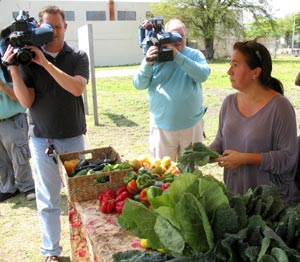
This Wednesday things were definitely not business as usual at the Roots in the City Farmers Market in Overtown. All the vendors were gone — no Nature Boyz, no Redland Organics, no Hani’s goat cheese. Members of the media, including three TV stations and four bloggers, were interviewing curious neighbors, and protesters with signs milled around. Only one tent belonging to RITC was up at noon, and market manager Maggi Pons was stacking collards, yellow squash, scallions and other produce as if it were a normal day at the market. Only she wasn’t selling — she was giving it all away because the market couldn’t sell anything.

Maggi Pons, RITC market manager, and the media.

Last week the owner of the land that the market sits on had been served with a notice of violation. The South Florida Smart Growth Land Trust was cited by the City of Miami for “illegal sale of fruits and merchandise from open stands and vacant lots” and “failure to obtain a Class I special permit.” The market is allegedly illegal, and the media reported last week that it would be shut down. “It’s not just the wrong permit,” Maggi Pons fumed. “It’s a lot more complicated than that. The city doesn’t have a permit for a fresh produce market, so we have to take out a special events permit, good for only two times a year.”

Mayor Tomas Regalado sent two spokesmen to try to smooth the waters and clarify the situation. Alan Morley insisted that the mayor “loves the market.” He explained the city only wants the market to get the proper permits and licensing, not shut it down, and they have until the weekend to comply. “Certain criteria have to be met. They didn’t go through the right permit process,” he stressed.

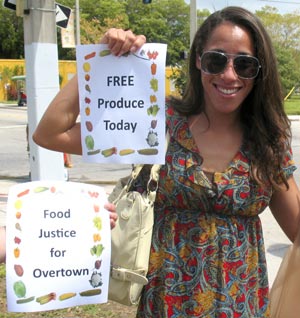
Asha Loring came to shop and joined the protest.

According to Pat Santangelo, the other spokesman, it’s all a big misunderstanding. “We have a lot of unnecessary paranoia,” he said. “If you’re going to run the market as a business, you need to comply with certain things.” He pointed out that the market required an annual certificate of use permit, a Class I permit, and a business tax receipt, and fees would be waived or reduced. When I asked Santangelo if the Class I permit was the two-times-a-year special events permit that market leaders were distressed about, he explained that it was an “unlimited” permit. (He said it was an “annual” permit, as quoted by Local 10 News.)

Yet market founder Dr. Marvin Dunn claimed he repeatedly called the city about the violation and didn’t get an answer. It got him hot under the collar, so he rounded up protesters and alerted the media. He said he got the certificate of use since the very beginning. The only solution he saw is to request a resolution from the city commission to allow his market to operate for six months at a time. But even that is politically uncertain, and as Dunn put it, “Who can run a market on a whim?”

Not all the vendors were happy about a day off. Instead of selling produce on Wednesday, Farmer Margie Pikarsky of Bee Heaven Farm stayed home. “Since we won’t be there, we won’t be bringing fresh, local, organic veggies to the underserved, food desert neighborhood. And, we won’t be employing the local resident that helps us with the setup and breakdown each week. How does that help anyone??” she said.

Neighbor James Branson is thankful for the food.

Wednesday’s free food giveaway was a big hit with the neighbors. Three women staggered away with four grocery bags brimming with collards and other produce. Area resident James Branson was delirious about his full shopping bag. “God is good,” he exclaimed, pointing to the sky. “Give thanks for the food on the table!” Neighbors who came late were disappointed. By 1:20 p.m. the RITC tables were completely empty of produce and the tent came down.

Giving food away may work in the short term, but in the long term it’s not a solution to either the problem of permits and codes — or developing a local food economy. It appears the City of Miami doesn’t have an ordinance that specifically applies to farmers markets. Spokesman Santangelo called the situation with RITC “a good learning process” for market people to learn how to comply with existing regulations. Yet he gave no answer when asked how the city can help this market (or others) navigate the permitting process smoothly and quickly.

Fresh veggies up for grabs.

The local food movement is growing, but it’s a slow and painful process. For every step forward, it appears there are two steps back. Farmers markets are the best way for small local growers to find buyers, and for buyers to find fresh, local produce at a fair price, especially in underserved neighborhoods. Instead of trying to shoehorn market compliance into codes that were written to address different situations that don’t quite fit, perhaps a new ordinance needs to be passed to support markets and allow the local food scene to flourish. (While Miami takes a tough stance on code enforcement, South Miami willingly embraces its new grower supported market.) Whichever the city, the most important thing is to get fresh food into the hands of people who need it most and have grown to count on it.

In the Media:

Read about the protest at CBS 4, Local 10 and the Miami Herald here and here. Mango & Lime has a thoughtful post and an update about zoning and permits (at the bottom of the page). Read Dr. Marvin Dunn’s letter to the editor in the Miami Herald. Read Commissioner Richard Dunn’s letter to the editor here. Read about Dr. Dunn’s “Food Justice for Overtown” protest here. Read about Marvin Dunn’s negotiations with the Overtown CRA officials here.


RITC Farmers Market got media attention.

Read Full Post »

Katie Edwards

MW: How to keep the land in agriculture? The farmer thinks that the land was your bank, that’s your retirement fund.

KE: I’d rather see us focus, before we start looking out, start looking in and focus more on reinvestment. Even in the city of Homestead there are things that we can be doing for energized growth. I think, you take the lazy approach and say Ok you know what, I don’t like what I drew on that piece of paper, scratch, give me a new one. That’s the mentality. It’s so much easier.

MW: So you’re saying the urban sprawl is not economically viable any more?

KE: I don’t think it ever was. I don’t think it ever was. I don’t think it makes sense to build up out of there. I don’t think we should vilify farmers for the predicament that they’re in. I don’t think that they created it That’s the plot in life God gave them, is they’ve got land that has to be planted, and they’ve got to be able to take out money to sell their crops, to buy their seed, their inputs, their fuel at the beginning of the season, and what do they do, they go to the bank. Pre-NAFTA they were making money and they didn’t have these issues. And all of sudden, it’s like everything happened. We convert row crop land to nurseries, and we end up that there are 1200 nurseries in Miami-Dade County, that’s too many. And then what happens? We’ve got water restrictions and people aren’t buying plants. And then we have a recession and housing market, there’s nothing to landscape. People would rather pay off bills rather than landscape or re-sod their homes. Most of the nurseries are on small parcels. They can’t put a subdivision in there. So what do the growers do? They are abandoning, they’re walking away from their properties saying I can’t make it, sorry. That’s the problem. Drive around Redland and see how many nurseries there are with for sale signs up, vacant ground covering those lands there. They can’t afford to maintain them. That’s the problem I’ve encountered.

MW: How does Farm Bureau speak for the small guy? Or is Farm Bureau only for the big guys?

KE: I’ve got quite a lot of small growers [as members]. A lot of these guys are new farmers, some are generational growers, but some are completely new to the business. We’re just trying to find ways trying to make everyone happy, because in my industry the people that I represent are so diverse, ethnically, gender-wise, age, income and what they grow. You’re going to have some issues that collectively we all agree on, but everyone needs a different type of help and assistance. What my big farmers need help with are immigration issues, so most of their issues are federal. With the smaller farmers need mostly are county, they want help with their certificate of occupancy at farmers markets, they want help with ag assessment, they want help marketing, they want help making inroads talking with chefs.

MW: In other communities you have farmers communicating with chefs. Food writers are writing about eating local food. Would be great if more restaurants sourced locally.

KE: Absolutely! You help promote, you do incentives, you provide more awareness and recognition like for programs like Redland Raised. And the farmers have the chance to be entrepreneurs, to adapt and to be creative. Because if we’re going to be adaptive in the industry and keep looking for new and emerging markets, we can’t have the state, or most oftentimes the county saying, no you can’t do this. With the winery for example, I helped Peter Schnebly with the winery ordinance. Originally, that was illegal. And all the residents in the Redland were fighting against it saying it will be disruptive, it’s not going to do anything for us, and now they all love it. And that was the whole thing, trying to find a way to get creative. You have to have common sense. You have to give growers enough flexibility to be able to be entrepreneurs, to be creative and to stay in business.

MW: What issues come up at fundraisers?

KE: Each population has its issues. The issues in Sweetwater aren’t the same as the issues in Homestead or the Redland. And you talk and you learn. Part of what I do is try to bring people together, find commonalities, and then figure, where we can compromise and where can we get stuff done.

One of the biggest issues in West Kendall is dealing with the homeowners associations. With the huge rate of foreclosures and trying to strike a balance between the rights of the condo association, the rights of the homeowner, the rights of the bank that actually has title when someone has to walk away from the mortgage. How do you look at it as a human being, but what does the law say? You can’t keep asking private citizens to bear more of the brunt of the economic crisis when it comes to the HOAs and the foreclosures.

The other issue that’s important to me is property tax reform. It’s very expensive to be a homeowner in Miami-Dade County. When I began doing comparisons online, looking at the Miami-Dade Property Appraisers website, I saw the complete inequities in what we’re paying but we’re all sharing the same services. Let’s say I pay 2 thousand dollars a year in property taxes, my neighbor next door pays less because they bought their home in 1998, that to me is not fair. We’ve got to figure out something holistically that provides people an opportunity to share in government services that’s not based on some fictitious value, which is to me all these fair market values are, it’s just whatever the market is. I’m willing to put it out there and tell people we’ve got to have a serious conversation on how to fix this and make it at least equitable and fair for all of Floridians.

When I come back from Tallahassee I’m still going to go in to the Royal Palm Diner, and I’m still gonna have to face these people who are going to grill me and say, why did you sell out, why did you do this? I want to be able to still be Katie and still be a member of this community and have my name in good standing. I don’t understand how anybody could ever lose sight of the fact that they are going up there not for themselves but for other people. And these people, they’re giving you their vote, which is the most powerful thing they could ever give you. If someone says, I can’t give you a donation, I say that’s fine, what I really need is your vote. The money is great but it can only go so far, though. When people come to you and they say, when you get elected I want you to help me work on these projects, I’m like, absolutely. You have to give them an open door, you have to be accessible.

Read Full Post »

Several months ago, I had the chance to interview Katie Edwards. She is running for State Representative, District 119, and is currently the executive director of Farm Bureau. Katie is quite familiar with issues that affect growers in South Dade; and since I blog about growers, our interview focused on agricultural issues.

I have not contacted or interviewed her opponents Frank Artiles, Nestor A. Iglesias, and Graziella Renee Denny. I did  look at their web sites to see where they stand on the issues. Iglesias doesn’t have one. Denny’s web site is completely blank. And Artiles is concerned about the economy, jobs, property tax issues, education, healthcare — everything under the sun except local ag! Do any of these candidates know where their food comes from? Do they care about who grows their food? It appears that only Katie does.

Don’t forget to vote on Tuesday November 2nd!

MW: What does Farm Bureau do?

KE: Farm Bureau is a membership organization. We have about 4 thousand members,  about 2100 who are actively engaged in farm production. All of the vegetable farmers are FB members. About 80 percent of the nursery growers are Farm Bureau members. Most of the tropical fruit growers I represent, apiaries or beekeepers, and aquaculture. That would be everything from koi and Everglades ciclid to the Everglades alligator farms. So what we do represent in terms of membership is incredibly diverse. Most of our membership lives here in South Miami-Dade County.

MW: Tell me about your job with Farm Bureau.

KE: I’ve worked with Farm Bureau  for about seven years now, and I reach out to politicians and like to get them down here so that they can fully appreciate the impact of their decisions. I want them to remember the nursery growers and farmers down in Homestead, and to think about those family farmers when they vote on a bill.

One thing very important to Farm Bureau and to me is helping educate policy makers so that there is an appreciation for agriculture, the state’s leading industry, and also for them to recognize that within their own county we’re the ones producing the food. So you have to look at it very holistically and reach out to the people outside of our borders.

MW: There’s been a lot in the local media about the freeze. How have you been putting a face to the farmer, and what kind of feedback have you gotten?
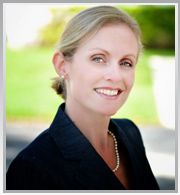
Katie Edwards

KE: When people think about a freeze and agriculture, people think, how is this going to impact the price of orange juice? Consumers don’t realize the amount of capital that the grower already has in the ground from the very moment that seed is sown. You’ve got your land rent, you’ve got your labor expenses, so when a freeze comes and wipes out and devastates your crop, you still have expenses that you can’t recover and pass along.

Sometimes it’s a race against time because every season you’re getting essentially a four-month window to make make enough money to cover your expenses, and then maybe offset money that you lost last year. And the last couple of seasons we’ve had a very difficult time trying to keep up with fertilizer and fuel expenses.

The other thing is going forward, this freeze helps us remember how important American agriculture is. If we don’t have a safe domestic food supply that can produce for all of us during the winter months, then we’re dependent on foreign countries.

MW: Are there any subsidies for growers here in Florida?

KE: The subsidies are for primarily commodities. Just so you understand, the stuff we grow here is not subsidized. So 97 percent of what Florida produces is not subsidized, maybe some peanuts and a little bit of tobacco and some cotton in the Panhandle, which accounts for 3 percent. But everything that we grow down here are not commodities. Like the old saying, we’re price takers not price makers.

MW: What’s your position on the UDB?

KE: When I go downtown and speak [before the county commission], I choose my battles carefully and I choose them wisely, because if I’m always going downtown against something, you lose credibility very quickly. I’ve seen that happen to people in this area. But with the UDB, we’re not one of the organizations that’s out there in bed with the developers saying we want to have more projects. I mean the Parkland project scares us, because if I lose 900 acres of agricultural land, that’s the chink in the chain. It’s like, you can get one, it can go right after that. And what about the property rights of the guy — we all have property rights — what about the property rights of the guy next to him? Doesn’t he have the right to keep farming without being a nuisance to homeowners and all the ancillary issues that goes along with that? He made an investment, he wants to continue farming. I have to protect his rights too.

I think we can all agree that we want to have agriculture in Southwest Miami-Dade County. I don’t think there’s anybody that says, I don’t want agriculture here. And if they do, I’d be very surprised. But I think a common goal — and I like to look at the commonalities — we all want to have agriculture here in Miami-Dade. So I look at it and say ok, take the UDB issue off the table, and let’s spend our time, our resources, our capital, talking about what we can all do to help make sure that farmers aren’t forced to make the difficult decision to then have to sell to the developer. That’s the whole crux of the problem.

Tell me what you’re doing to help the local farmers. I want to do my own reality TV show and call it Do You Want To Be A Farmer, and invite all these people to come down here. I’m going to say to them, you go to the bank, you go to farm credit, take out a loan for 10 million dollars, I want to see you make a buck. They wouldn’t know what end was up and even how to turn a damn tractor! I’ve said that for years, that’s what I’m up against. I’m losing farmers to foreign competition and you guys aren’t helping the farmers out.

(To be continued)

Read Full Post »

Hey there Redland Ramblers! This is guest blogger Melissa Contreras, founder of Urban Oasis Project. Last night, a group of Redland and Miami farmers and I returned home after a weekend at the 2nd Small Farms/Alternative Enterprises Conference in Kissimmee.  I have always been a farmer wannabe, and as such, I grow food for my family, my pet bunnies,  and a few friends on my 1/4 acre “urban homestead” in Kendall.  I was happy to learn at the conference that this small scale of growing is now being officially considered as part of our local food system, as it should be! The University of Florida/IFAS Extension isn’t just for big farmers and agribusiness, we little people count too!

Cast of characters on this road trip included Bee Heaven Farmer Margie, husband Nick, their new farm manager Jane;  Muriel of Little River Market Garden, Mario of Guara Ki Farm, and me.  Meeting up at Bee Heaven Farm, we shared a ride in Margie’s van, and took the scenic route around the shores of Lake Okeechobee on US 27. It was beautiful! Cows and egrets mingled in green pastures, Nick spotted a sandhill crane, and tri-color herons searched for underwater snacks near the water’s edge. Along the way, through what was once a river of grass, we saw fields of sugarcane (some organic), and picturesque views which reminded me that while South Florida is often thought of as a metropolitan built environment,  it still belongs to Mother Nature, though altered. Hopefully Everglades restoration will return the river of grass to its rightful owner.

After 4 hours on the road, we arrived  and checked into our hotel, the posh and sophisticated Super 8. Hey, we’re on a budget, OK?  I shared a suite with Margie, Nick, and Jane.  After repeated promises to Jane that I would not confuse her with my husband in the middle of the night, she decided to sleep on the couch.  But, I digress.  We had a nice lunch in restored historic downtown Kissimmee, an old cowboy town with a lovely lakefront, unique and colorful wooden homes with gingerbread mill work, unusual eateries and watering holes like ” The Wicked Stepsister,” a nice antique shop,  and so much more. Next time you’re in the neighborhood, take a break from the Orlando area tourist traps and visit this authentic town.

After lunch, we proceeded to the Osceola Heritage Center, site of the next day’s convention, for meetings of the Greater Everglades Foodshed Alliance, the Florida Food Policy Council, and a pre-conference pow-wow with Extension agents from all over Florida. The Greater Everglades Foodshed Alliance meeting was a recap of the Food Summit for interested parties.  The Florida Food Policy Council will “bring together stakeholders from diverse food-related sectors to examine how the food system is operating and to develop recommendations on how to improve it. FPCs may take many forms, but are typically either commissioned by state or local government, or predominately a grassroots effort. Food policy councils have been successful at educating officials and the public, shaping public policy, improving coordination between existing programs, and starting new programs.” (definition from foodsecurity.org). We are forming a soon-to-be Miami food policy council. (Contact Mario if you have a stake in our local food system and want to participate in this new effort.)

Those who attended the informal Friday meetings were also invited to sit in on the pre-conference event for UF/IFAS Extension agents, in which  Dr. Danielle Treadwell, Dr. Mickey Swisher, and Sarasota Extension’s new Director and doctoral candidate Evangeline “Van” Linkous  talked about our changing food system from their different points of view and varying expertise.  Dr. Treadwell champions UF research in organic and sustainable farming, and feels that “educating consumers is an important part of what we do.”  Dr. Swisher said she was surprised to discover the “30 mile problem” in which  “disadvantaged communities in Florida’s urban areas often live 30-40 miles from areas where fresh produce is grown.”  Van’s background is in planning and she was a member of the Delaware Valley Regional Planning Council before coming back to Florida from Philadelphia and the University of Pennsylvania. She feels that much urban zoning could be converted to mixed-use, which could mean urban farms and farm stands could be located within high-density urban populations, giving urbanites more access to local, fresh food. A kindred spirit! We are quite lucky to have these three women in Extension.

So, if you’re catching on to a theme here, the conference tagline was “Sustaining Small Farms…Strengthening Florida’s Communities.”  There was much excitement among attendees on that Friday before the conference, seeing our major research institutions catching onto interests of so many people in local food,  and food justice as a paradigm shift from our current system. Further illustrating this point is the choice of keynote speaker for the conference: my personal hero, Will Allen, founder of  Growing Power, Inc.

I will write more about Saturday of the conference in the next post:  keynote speaker Will Allen, the three Florida Innovative Farmer Award winners, conference workshops, amazing local foods lunch and more! Come back  for more, including pictures!

Read Full Post »

« Newer Posts - Older Posts »