Feeds:
Posts
Comments

Archive for the ‘recipe’ Category

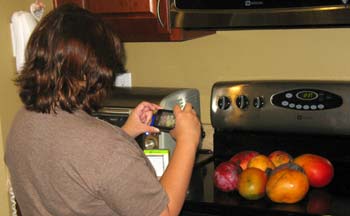
Kattia documents the arrival of Redland mangoes.

A person can move away from Miami but their craving for flavors of the place will stay for a long time. Case in point, friends Kattia and Chris moved away about 10 years ago, and live in tropical fruit exile all the way up in Sanford. If they want a fresh mango, they have to go to the store and settle for fruit imported from Mexico. They complained those out-of-season offshore mangoes just don’t have the flavor, juiciness and aroma of a home grown mango from Miami. And why should they? Imported fruit is picked half-ripe, then dunked in hot water to kill pathogens, which also kills taste.

I told my friends about the bumper crop we had this summer, and they asked when I was coming up. Right away, I replied, and loaded up my car with sacks of plump red and golden Kent mangoes from Paradise Farm, and headed north on I-95. About four hours later, I pulled into their driveway, and Kattia and I lugged eight pounds of mangoes and a box full of empty canning jars to her kitchen. 

“When life hands you mangos, make jam!” said Kattia with delight. (If this sounds like a familiar adventure, she and I made lychee freezer jam two summers ago.) The canning process she followed wasn’t all that difficult, even for a novice like me. “The trick to making cooked jam is to have everything ready and waiting to go,” she said. 

First, we made sure that everything we needed to use was clean and ready. Jars, rings and other utensils were run through the dishwasher beforehand. (If you don’t have a dishwasher, sterilize everything in a big pot of boiling water to kill any dangerous bacteria that can spoil food and make you sick.) 

As the dishwasher hummed, we peeled, seeded and chopped mangoes. Six cups of fruit were destined for jam, and went into a big pot to cook. (The rest of the fruit was stuffed into the freezer.) Lemon juice was added “to wake up the taste of mangoes,” and pectin was stirred in. “Pectin is what makes the jam set,” Kattia explained. “Pectin and lemon help mangoes give off juice.” She also added a bit of butter to reduce foaming as the mixture cooked.

Mashing chopped mango as it cooks. Note 5 and a half cups of sugar, and rings in the background, ready to go.

Out came the potato masher, and the fruit was smashed into smaller pieces, to the texture of rough applesauce. Heat was raised to a rolling boil — when you stir, bubbles keep forming — and the fruit mixture was stirred constantly. Sugar was quickly added, and stirred until everything came back to a rolling boil for one more minute. (If you think five and a half cups is a horrifying amount of sugar, keep in mind that this is called a low-sugar recipe. A regular amount would be 10 cups.)

When the mango mixture got soupy and looked translucent, it was time to fill up jars. “It helps to lay out everything you need because assembly goes quickly,” Kattia said. She set a wide mouth funnel into a jar, and ladled mango mixture up to the very neck. Next, using a magnetic grabber, she fished a lid out from a small pot of simmering water, centered it on top of the jar, and screwed on a ring. The filled, sealed jar was then turned upside down on a towel on the counter.

“With the inversion method of canning, the fruit goes to the top of the jar, and the air goes to the bottom of the jar,” Kattia explained. “When you flip it over, the air goes to the top, and creates a vacuum, and it seals the jar.”
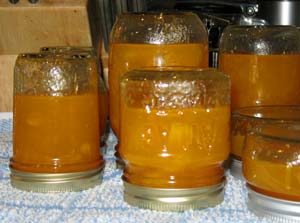
Jam cooling upside down. When a jar is flipped over, the air inside will rise to the top and create a vacuum.

The jars stayed upside down until they were cool to the touch. This took about an hour or so. Then we turned them right side up and tested the seal. A properly sealed jar lid was hard, without any give. Two jars had lids that popped or flexed a little, and they went back upside down for about 15 minutes longer. (If that still didn’t do the trick, the jam would have to be eaten right away — what a tragedy! — or processed in a pot of boiling water for long term keeping.) The whole process took about two hours, including prep and filling jars.

Voila! We had jam! It wasn’t that difficult to make. The hardest part, and it’s not really that hard, is to track down canning supplies. Kattia bought jars, lids and canning paraphernalia at a nearby Super Wal-Mart. If your local store doesn’t carry what you need, you can find canning kits and jars online. Labels would be helpful if you’re making a batch to give away. 

When we were done, pretty golden jars of mango jam were lined up on Kattia’s counter. The sweet tropical taste of Miami’s summer had been captured to savor for later. (It’s not the same as having fresh mangoes, but the stash in the freezer comes close.) I drove back home with several jars, some to keep and some to share. My jar is meant for for medicinal purposes, as it were, for later in the year. A bit of sunshiney mango jam spread on buttered toast will chase away any gray winter blahs!

Kattia’s Mango Jam

6 cups mangoes, peeled, seeded, chopped
juice of 1 lemon
3 Tbps. low or no-sugar pectin
5 1/2 cups sugar
1 pat of butter

Peel, seed and chop mangoes. Put them into a large pot with lemon juice and mash with a potato masher. Stir in butter and pectin and keep stirring. Raise heat to a boil. Skim off any foam. Then quickly stir in the sugar a bit at a time until it dissolves. Keep stirring at a rolling boil for 1 minute longer. When the mixture looks transparent, it is ready to put into jars.

Ladle mango mixture into a jar up to its neck. Do not overfill, as you need an air space. Wipe off any spills and put on the lid and ring. Place jar upside down on towel to cool. Repeat with other jars until all your mixture is used up. Let jars cool to touch, then turn over and test seal. If the lid pops, flip it over to sit for a few more minutes, or refrigerate.
Read Full Post »

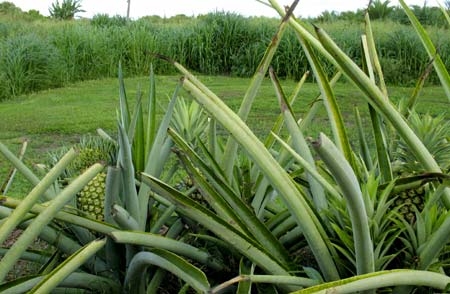
Tim’s pineapple patch. Lettuce and cabbage planting area is in the background, now overgrown with weeds.

Tim Rowan is a hard working farmer. In the winter he grows certified organic lettuces and cabbages. And in the summer, when it’s so hot that some farmers take a break, Tim is still growing things. His latest hobby, as he calls it, is raising pineapples. He has a test patch with over 70 pineapple plants in various stages of maturity. (Most started from tops salvaged from his kitchen where he is a chef at Deering Bay Yacht and County Club. He also grew several pineapples at his vegetable garden there.) Some plants on his farm are already bearing fruit. I asked Tim to save me a pineapple, and recently he let me know mine was ready, come and get it.

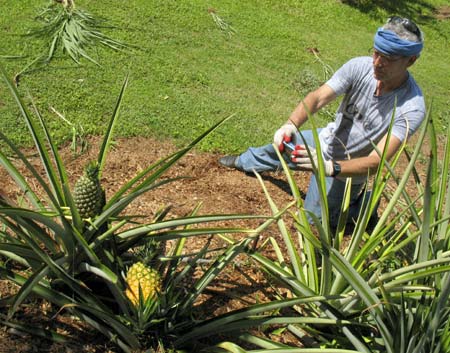
Tim Rowan photographs the pineapple before it gets picked.

And there it was, in all its glory — a very large pineapple perched on a short stalk sprouting from the center of of a spray of long, narrow, sharp toothed leaves. (If you’ve never seen a pineapple plant, it looks like a bromeliad.) The fruit was fully mature and golden yellow in color. It had a distinctive top — not one leafy crown, but at least six or eight all in a row. It looked like the pineapple was sporting a mohawk. Both Tim and I took pictures from various angles while it was still on the plant. If a pineapple could have charisma, this one did. Check out Tim’s blog post about his adventures growing pineapples.

Pineapple sporting a mohawk top.

Tim had left the fruit growing on the plant so I could pick it myself. “Hold it with both hands, give it a little twist and snap it off,” he said. I did, and it came off easily in my hands. I was impressed by how heavy and substantial it was. Turns out it weighed five pounds.

Several large suckers or shoots were growing from the base of the plant. They looked like overgrown pineapple tops. Tim broke one off carefully, and at its base were strands of white roots, ready to plant. This sucker would grow into a new plant which would bear fruit in one year. Tim removed other suckers and planted them too. “From one plant you can get as many as eight new plants,” he said as he set them into the ground. You can also plant pineapple tops, but it takes two years to flower and another six months for the fruit to mature.

Picking pineapples, location not specified. Florida Photographic Collection.

Pineapples are not unusual for South Florida. Settlers started growing pines, as they were called, in 1860 at Plantation Key. From the late 1880s to the early 1900s, pineapple was a popular crop, and almost everybody had a patch. Plantations stretched from Plantation Key to the south, to Elliott’s Key (as it was spelled then), north to Lemon City settlement, up the coast to Yamato (west of Boca Raton) which was farmed by Japanese, and as far north as Indian River. The fruit was shipped by schooner and then rail to northern cities. Competition from Cuba and Hawaii, diseases, bugs, and freezes eventually wiped out the industry by the time of WWI.

Boxing pineapples for shipping. Florida Photographic Collection.

In more recent times, “A guy tried producing specialty pineapple in the mid-late 1990’s on the S.W. corner of Naranja Road and Quail Roost,” county agriculture manager Charles LaPradd told me in an email. “They were the small super sweet golden ones that sell for a fairly high price, so he thought he could compete against the imported ones. He couldn’t and went out of business.” These days, almost all the pineapple in stores is grown offshore. Costa Rica is the top supplier for pineapples for the United States.

Shipping pineapples by boat. Florida Photographic Collection.

Pineapple may not be grown on a large scale in Redland anymore, but many people grow a few plants in their own gardens. They are easy to grow, like full sun, and because the plant has a shallow root system, doesn’t mind growing in a container.

Besides planting the top, save the peel of a homegrown or organic pineapple and use it to make a pineapple flavored vinegar. Here’s the recipe from Wild Fermentation by Sandor Ellix Katz. Use it to make salad dressing, put it on avocado, stir into salsa, or wherever you need a sweet-sour tang.

Mexican Pineapple Vinegar

1/4 cup sugar
peel of 1 pineapple (organic or home grown)
1 quart (4 cups) water
cheesecloth (or coffee filter)
glass jar

1. In a jar or bowl, dissolve the sugar in 1 quart of water. Coarsely chop and add the pineapple peel. Cover with cheesecloth (or coffee filter) to keep flies out, and leave to ferment at room temperature.

2. When you notice the liquid darkening, after about 1 week, strain out the pineapple peels and discard.

3. Ferment the liquid 2 to 3 weeks more, stirring or agitating periodically, and your pineapple vinegar is ready. Keep in refrigerator.

Read Full Post »

Hot chilis, the heart of kimchee.

I first met Muriel Olivares last year at Bee Heaven Farm, where she was farm manager for the season. Not only did she help things run smoothly, but she was always making interesting things with the veggies that were in the barn that week. One Friday I discovered that she had brine pickled a gigantic jar of French breakfast radishes, and I blogged about it here. Another Friday it was a big batch of kimchee — garlicky, peppery, a bit pungent, and totally amazing.

I’d learned how to make vinegary quick pickles from Hiromi, another farm intern from a few years ago, but fermentation was new to me. So when I got Muriel’s email that she was going to hold a kimchee making workshop at her Little River Market Garden, I jumped at the chance. Finally I would learn her secrets!

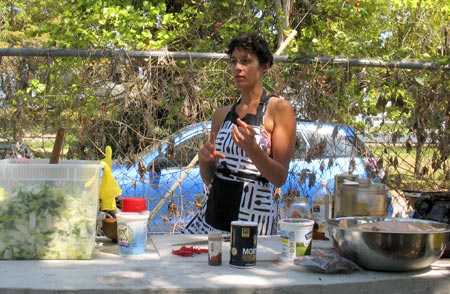
Urban farmer Muriel Olivares at her outdoor kitchen.

About two dozen people were thinking the same way and showed up too. Located in a leafy, secluded corner of northeast Miami, Muriel’s city-lot-sized garden had been transformed from a grassy vacant yard with a few fruit trees to a flourishing mini-farm, complete with wood fired pizza oven and outdoor kitchen. It was there that Muriel was set up with all the necessary tools and ingredients, including a restaurant-sized tub of chopped and brined Napa cabbage.

Getting a sniff of chili paste. This is what preserves the cabbage and other vegetables.

The recipe is posted on three different blogs — Little River Market Garden, My Edible Yard, and mango&lime — so I won’t repeat the exact details. Suffice to say that the ratio is 2 parts cabbage (about one head of Napa or bok choy) to one part radish/daikon/turnip and 2 cups of chili paste. (Carrots, half as much as daikon, can be used to sweeten it a bit.) The heart of the matter is the freshly-made chili paste. Muriel made it with several onions, a prodigious amount of garlic, half as much of ginger, and plenty of fresh and dried hot peppers, which were moistened with cider vinegar, a bit of honey and a bit of olive oil. (OK, so the oil isn’t truly authentic, but Argentineans use olive oil for everything.) She blended it together and soon the thick aroma of peppers and garlic wafted over us sitting in the nearby chairs. “Chili paste is what preserves kimchee,” Muriel said, explaining that garlic and peppers have antibacterial qualities. “Salt is not what’s keeping it sterile.”

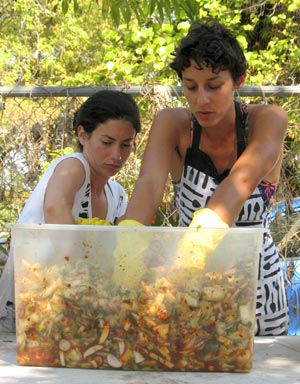
Olivia and Muriel mixing all the ingredients. Don’t forget gloves if you mix a big batch by hand. The peppers will burn!

An assistant was drafted and the yellow gloves came on to mix the tub full of copped vegetables and chili paste. It smelled great and everybody crowded around to smell the spicy aroma, take pictures and fill their empty jars to take home.

But now the real fun begins. Kimchee is fermented food, and there wasn’t enough vinegar to pickle it, so preservation has to come from other means. Muriel advised to leave the open jar out on the counter for as long as three days. At home, I took the lid off the jar, weighed down the contents with a plastic bag of water, and covered it with a coffee filter held down with a rubber band. No refrigeration allows natural fermentation to begin. Muriel had cautioned to set the jar in a shallow bowl or dish, because liquid would come out. Sure enough, it did for several days, along with a strong odor. “Liquid comes out as the bacteria metabolize, which releases gas bubbles, which makes water rise over the top, ” Muriel explained in an email.

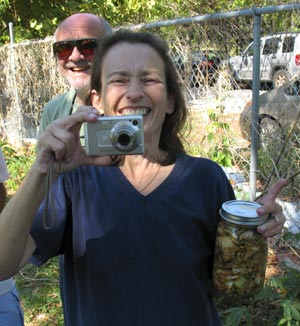
Ara, who writes My Edible Yard blog, shoots it out with me. Say kimchee!

My jar stayed out for five days, just to see what would happen next, and liquid stopped seeping out on the fourth or fifth day. Took the filter and bag off, leaving about an inch of space, and put the lid back on. The jar of kimchee is now sitting in the refrigerator. “Putting a lid on it and putting it in the fridge dramatically slows down fermentation (bacteria metabolism) so liquid will stop coming out.  A little pressure may form in the jar so it’s good to leave a small space (meaning not full to the top),” Muriel added in her email.

Kimchee can stay out longer, I was told by Farmer Margie, and then keep in the frig for months (if it doesn’t get all eaten). It would only be fitting to bring the jar to Bee Heaven’s barn, where my discoveries in fermentation began, and try it out on this season’s interns and apprentices. Stay tuned!

Read Full Post »

Roselle

A bin full of roselle at farmers market.

One of the more unusual things in the last CSA box was roselle, grown by Cliff Middleton of Three Sisters Farm. Roselle, also known as Jamaican sorrel, is a species of hibiscus used to make cranberry-tasting beverages. You might also know the drink as “jamaica” (pronounced ha-MAI-ka), popular in Latin countries.

This is what to do:

1. Remove the buds from the stems using a sharp paring knife.
2. Carefully trim the fleshy red calyx away from each inner seed pod.
3. Boil the calyxes with some ginger root  in a pot of water and let them steep for a good long time, 12 hours to overnight. The longer they steep, the stronger the flavor.
4. Sweeten with honey, or not, and enjoy the tart drink. Typically, you drink it chilled, but I suppose you could try it warm on a cold day.

Pictures of boiling calyxes and the final drink are over on Farmer Muriel’s Little River Market Garden blog.

Throw away the seed pods. They are immature and will not grow. You can’t eat them, either. The buds or calyxes will keep for a while in the refrigerator, but make sure the plastic bag they’re in is unzipped so they can breathe (or use those new zipper plastic bags with little holes in them for keeping produce). Fresh roselle was available at the Liberty City, South Miami farmers markets last week, and Overtown Roots in the City farmers market this week. Dried sorrel is available at Jamaican markets.

Download last year’s CSA newsletter with a similar recipe and a bit more info on roselle.

Read Full Post »

Winter melon for summer

Rachel presents the winter melon. Photo by Daniel.

One of the more unusual offerings at the Bee Heaven Farm summer fruit sales has been winter melon, also known as wax gourd. It’s called that because of the white, waxy coating on its green skin. A few weeks ago, I rode up with Farmer Margie to fetch them from C&B Farms up in Clewiston. The growers boxed and shipped the giant melons to various northern cities that have large Asian populations.  I’m told the Chinese consider winter melon a cooling food, and that these melons grow much larger in China.

A slice of winter melon.

These melons are huge and heavy! The one in the picture weighed at least 20 pounds. There’s no way that you could sit down and eat the whole thing, nor would you want to. Usually you buy it by the chunk. The flavor is very mild and slightly sweet, similar to a honeydew, and the flesh is white. The melon is very juicy and releases a lot of clear liquid after you cut it. A slice doesn’t keep very long in the frig, maybe a couple days at most, and then it starts to get mushy in places. If you’re not going to use all of it, wrap peeled and seeded chunks in plastic and freeze.

Winter melon is best eaten cooked, not raw. Recipes abound on the Internet for winter melon soup, stir fry, drinks and even pickles. You can also freeze peeled and seeded chunks for later use. After sifting through all kinds of possibilities, I settled on making soup. I had all the ingredients on hand — homemade vegetable broth, a couple skinless chicken thighs, carrots, mushrooms, scallions, garlic and ginger. The melon chunks softened as they cooked and turned translucent. They took on the color and taste of the broth. I added salt and pepper, and finished with some toasted sesame oil for more flavor. The soup was good, but I can’t say for certain if it was cooling. It was hot soup, after all.

Chicken vegetable soup with chunks of winter melon and a drizzle of toasted sesame oil.

Maybe next time I’ll try making a simple drink to test the cooling properties of the melon. A drink recipe I found on asianhealthyrecipe.com calls for one pound of melon and 5-6 cups of water. These are the instructions: Cut the melon into chunks and cook it skin, seeds and all, until some liquid comes out of the melon. Then add water, bring to a boil. Remove from heat. Add honey to taste, and serve either hot or cold. The recipe didn’t say if you’re supposed to strain the chunks out, but if you did that, I suppose you could eat the melon in a separate dish, maybe mixed in with something else. (It is, after all, quite mild flavored.) The drink is supposed to be cooling — and slimming, if you leave out the honey.

Have you tried winter melon? What recipes do you have for it?

Read Full Post »

« Newer Posts - Older Posts »