Feeds:
Posts
Comments

Raise your voice!

UPDATE: Mayor Gimenez is coming to Homestead to meet with the community!

An additional Town Hall Meeting was recently scheduled for August 24, 2011 at 7:00 pm. The address is: William Dickinson Community Center, 1601 Krome Avenue, Homestead FL. 

By now you’ve already heard that the new Miami-Dade County Mayor, Carlos Gimenez, is cutting the county budget. When it comes to local agriculture, these cuts could run very deep.

To slash an estimated $1.2 million from the county’s general operating fund, over $700,000 for UF/IFAS Extension Services was proposed to be gutted. If county funding is drastically cut, Extension will lose matching funds from University of Florida. To shave off another $300,000 in the budget, the county Agricultural Manager’s office would be completely eliminated.

Cuts to Extension

Since the Palmetto Bay Town Hall meeting on August 9th, Mayor Gimenez said he would reinstate full funding to Extension, and partial funding for the Agricultural Manager. (However, it is unclear what “full funding” means for Extension, since its budget was cut by 20% back in 2009 by former mayor Carlos Alvarez, and never completely restored since then.)

The originally proposed budget cuts put some Extension programs at risk of disappearing, and crippled others. At risk were a number of important consumer and agriculture programs that have a huge impact on the community, such as the 4H youth leadership program, and various consumer services for low income families and seniors.

Both the urban horticulture program assistant position, and the Commercial Agriculture and Horticulture programs were threatened with elimination. These programs provide ongoing training and certification for vegetable and fruit growers, landscapers and nurserymen. Growers would have to spend extra money to travel to other counties to get their industry-required training.

Ongoing workshops and seminars for commercial farmers were slated to be completely wiped out. This is the heart and soul of Extension, which teams up with UF researchers to provide growers the latest information how to fight diseases and pests (like the red bay ambrosia beetle which threatens the avocado industry), new methods of production, and new varieties of plants and crops.

Agriculture Manager

Also on the chopping block was the county Agriculture Manager. The job is currently held by Charles LaPradd, a fourth generation local grower who acts as the liason between county government and local growers. His voice is the only one in local government speaking up for the county’s $2.7 billion industry in this county. (That’s only second to tourism in income in Miami-Dade.) In the space of six years, the Ag Manager brought in almost $7 million in grant funding used to support and promote local agriculture.

Among many projects, one of the most visible was the Redland Raised campaign, designed to get branding and recognition for locally grown food in Publix supermarkets. Charles was involved in the push to pass three new county ordinances last year that promote B&B’s and agritourism, and allow growers to make and sell jams, pickles and other value added products.

Be the voice

The current budget proposal is only preliminary. It can and has already been changed. Bowing to pressure from a vocal showing at a packed Town Hall meeting in Palmetto Bay last week, Mayor Gimenez has already reversed his stance.

Go and make your voice heard in person! Mayor Gimenez is holding a series of Town Hall meetings through the month of August, at various places around the county. It’s rumored that the mayor said the squeaking wheel will get the grease, so word to the wise, get out there and squeak speak!

The remaining meetings are listed below:

Tuesday, August 16, 2011

Location: Miami Art Museum, 101 West Flagler Street, Miami, FL 33130
Time: 7:00pm – 8:00pm

Thursday, August 18, 2011

Location: Coral Gables Country Club, 997 North Greenway Drive, Coral Gables, FL 33134
Time: 7:00pm – 8:00pm

Wednesday, August 23, 2011

Location: Hialeah Senior High School, 251 East 47th Street, Hialeah, FL 33013
Time: 7:00pm – 8:00pm

If you can’t make it to a Town Hall omeeting, contact Carlos Gimenez’s office at:

Office of the Mayor
Stephen P. Clark Center
111 NW 1st Street
Miami, FL 33128
mayor@miamidade.gov
305-375-5071

However, the commissioners still need to vote on the proposed budget, and there’s a good chance their vote could still reduce or eliminate funding. There will be two public hearings, on September 8th and September 22nd, at Commission Chambers in the Stephen P. Clark Center in downtown Miami. Next comes the commisioners’ final approval for the budget. You can find a list of commissioners and their contact information here.

Locavores, this is not the time to be complacent and think the worst is over. Don’t sit back and watch support and resources dwindle for your local farmers and fellow citizens.  Educate your commissioners on how important Extension and the Ag Manager are to local agriculture — and the local food scene. You still have time to let them know how the budget cuts will also impact your eating choices or your business.

Download the proposed FY 2011-12 budget from the county web site.

Download an intelligent and passionate editorial written by Mike Dill, re the impact of cuts to ag services, which was recently published in the South Dade News-Leader.

Mayor Gimenez backtracks on cuts to agriculture budget

Following an outpouring of support, agricultural services will not face the drastic reductions originally proposed in the county budget.

The Miami Herald, posted on Friday August 12,2011.

By Christina Veiga
cveiga@MiamiHerald.com

More than 100 people packed into the council chamber at town hall in Palmetto Bay for a meeting the discuss the Miami-Dade County budget, Tuesday, August 9, 2011. Miami-Dade Mayor Carlos Gimenez discussed his proposed county budget, answered questions, and took public comments.

South Miami-Dade’s agriculture community will not face the dire cuts originally proposed in Mayor Carolos Gimenez’s preliminary budget.

The announcement, made Tuesday by a mayoral aide at a budget town hall meeting in Palmetto Bay, was met with cheers from supporters who have recently flooded elected officials with calls, e-mails, letters and visits.

The county’s agricultural extension service and agricultural manager’s office will still face cuts, however. Ag extension is now poised to lose $140,000 instead of the $800,000 originally proposed. And the agricultural manager’s office is expected to lose its assistant, while the rest of the manager’s budget will be restored with a federal grant, county spokeswoman Vanessa Santana-Peñate said.

Still, compared to the drastic cuts initially proposed, the new plan is a “tremendous blessing,”said Theresa Smith, director of communications for the Dade County Farm Bureau.

To read more: http://www.miamiherald.com/2011/08/10/2353728/mayor-gimenez-backtracks-on-cuts.html

Chewy dried bananas

Bunches of blotchy and bruised bananas.

Sadie was working in the barn the last Saturday when I came to pick up my summer fruit order. She was sitting at a table with several bunches of blotchy bananas. They didn’t look very good, but when Sadie peeled one, the flesh was perfectly ripe and ready to eat. Because the skins weren’t pretty enough, the bananas would be used in another way.

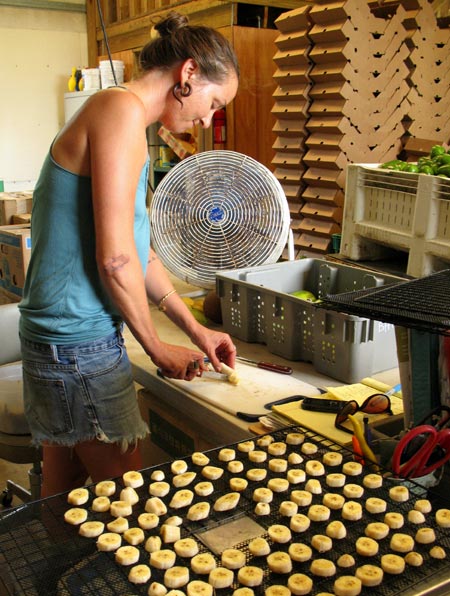
The drying rack filled up with sliced bananas as Sadie cuts up more.

Sadie trimmed bruised spots, and cut thick slices, almost a half inch thick. Those were laid on a dehydrator drying rack spaced about an inch apart. When the rack was full, it went inside the large dehydrator humming in a corner. It already held several racks of bananas and star fruit in various stages of dryness. The fruit will take several hours to dry. Then it will be put in the Fruits of Summer dried fruit mix that Bee Heaven Farm sells at farmers markets in the winter.

Sadie showed me a plastic bag full of dried banana slices and offered me some. “I think it tastes like banana bread,” she said. The thick slice was chewy and sweet and had an intense flavor. “I like thick ones. Thin slices dry up too crispy,” she continued. I reached for another slice and chewed slowly. Yeah, it tasted something like banana bread, only better — there weren’t all the other ingredients to dilute the flavor.

If you have a dehydrator, making dried fruit is easy to do. All it takes are a few hours or overnight. Dried bananas and other dried items keep well sealed in a plastic bag and refrigerated.

Halfway dried banana slice hot out of the dehydrator.

The new schedule for the next Dinner in Paradise has been released. Dinners are very popular and do sell out quickly, so don’t wait to buy your tickets…

Join us for another stellar season with Miami’s best chefs preparing a delicious five course meal made with local organic products and paired with fine wines. The magic and charm of our lush edible landscape coupled with the finest chefs creates a uniquely intimate dining experience under the stars. Each year, we donate proceeds to a local charity or organization philosophically in line with our vision of sustainable, healing, and healthy organic food. This year we are sponsoring Youth L.E.A.D., Slow Food Miami, and Troy Community Academy.

Youth L.E.A.D seeks to educate and empower young people to adopt healthy, sustainable behaviors and advocate for food & environmental justice in their schools and communities.  Slow Food Miami is an all volunteer run organization that works to implement local school and community gardens. Troy Academy Community serves a total of 60 youths between the ages of 13 and 18 who are failing in traditional school settings and are involved in the juvenile justice system. They give hands on learning approaches to provide positive alternatives and futures for at risk youth.

Guests arrive at 5:00pm for cocktail reception and farm tour, followed by dinner at 6:00pm. (Dinners starting March 11 and after: cocktail reception at 6:00pm and dinner at 7:00pm)

Each dinner is $165.00 per person + tax and processing. Reservations are required. Make reservations and pay online at the Paradise Farms website.

December 11th

Loews Hotel Miami Beach/ Chefs Fredrick Delaire & Jason Prevatt
Azul at the Mandarin Oriental/Chef Joel Huff
Daniel Ganem/Kane Steakhouse

January 8th

The Forge/Chef Dewey LaSossa
River Oyster Bar/Chef David Bracha
Sugarcane/Chef Timon Balloo

March 11th

Meat Market/Chef Sean Brasel
Sushi Samba/ Michael Bloise
Area 31 at the Epic Hotel/Chef Michael Reidt

March 25tth, Theme: Spontaneity

Michael’s Genuine/Chef Michael Schwartz
BLT Steak at The Betsy/Chef Sam Gorenstein
Essensia at The Palms Hotel/Chef Frank Jeannetti

April 15th, Theme: Seafood

Lido Restaurant at The Standard/Chef Mark Zeitouni
Sra Martinez/Chef Michelle Bernstein
Hedy Goldsmith/Michael’s Genuine

April 29th

Cecconi’s/Chef Sergio Sigala
1500°/Chef Paula DeSilva
Eden Roc/Chef Thorsten Leighty

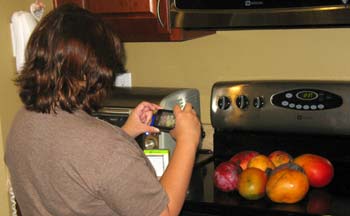
Kattia documents the arrival of Redland mangoes.

A person can move away from Miami but their craving for flavors of the place will stay for a long time. Case in point, friends Kattia and Chris moved away about 10 years ago, and live in tropical fruit exile all the way up in Sanford. If they want a fresh mango, they have to go to the store and settle for fruit imported from Mexico. They complained those out-of-season offshore mangoes just don’t have the flavor, juiciness and aroma of a home grown mango from Miami. And why should they? Imported fruit is picked half-ripe, then dunked in hot water to kill pathogens, which also kills taste.

I told my friends about the bumper crop we had this summer, and they asked when I was coming up. Right away, I replied, and loaded up my car with sacks of plump red and golden Kent mangoes from Paradise Farm, and headed north on I-95. About four hours later, I pulled into their driveway, and Kattia and I lugged eight pounds of mangoes and a box full of empty canning jars to her kitchen. 

“When life hands you mangos, make jam!” said Kattia with delight. (If this sounds like a familiar adventure, she and I made lychee freezer jam two summers ago.) The canning process she followed wasn’t all that difficult, even for a novice like me. “The trick to making cooked jam is to have everything ready and waiting to go,” she said. 

First, we made sure that everything we needed to use was clean and ready. Jars, rings and other utensils were run through the dishwasher beforehand. (If you don’t have a dishwasher, sterilize everything in a big pot of boiling water to kill any dangerous bacteria that can spoil food and make you sick.) 

As the dishwasher hummed, we peeled, seeded and chopped mangoes. Six cups of fruit were destined for jam, and went into a big pot to cook. (The rest of the fruit was stuffed into the freezer.) Lemon juice was added “to wake up the taste of mangoes,” and pectin was stirred in. “Pectin is what makes the jam set,” Kattia explained. “Pectin and lemon help mangoes give off juice.” She also added a bit of butter to reduce foaming as the mixture cooked.

Mashing chopped mango as it cooks. Note 5 and a half cups of sugar, and rings in the background, ready to go.

Out came the potato masher, and the fruit was smashed into smaller pieces, to the texture of rough applesauce. Heat was raised to a rolling boil — when you stir, bubbles keep forming — and the fruit mixture was stirred constantly. Sugar was quickly added, and stirred until everything came back to a rolling boil for one more minute. (If you think five and a half cups is a horrifying amount of sugar, keep in mind that this is called a low-sugar recipe. A regular amount would be 10 cups.)

When the mango mixture got soupy and looked translucent, it was time to fill up jars. “It helps to lay out everything you need because assembly goes quickly,” Kattia said. She set a wide mouth funnel into a jar, and ladled mango mixture up to the very neck. Next, using a magnetic grabber, she fished a lid out from a small pot of simmering water, centered it on top of the jar, and screwed on a ring. The filled, sealed jar was then turned upside down on a towel on the counter.

“With the inversion method of canning, the fruit goes to the top of the jar, and the air goes to the bottom of the jar,” Kattia explained. “When you flip it over, the air goes to the top, and creates a vacuum, and it seals the jar.”

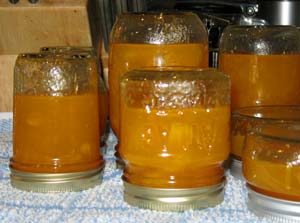
Jam cooling upside down. When a jar is flipped over, the air inside will rise to the top and create a vacuum.

The jars stayed upside down until they were cool to the touch. This took about an hour or so. Then we turned them right side up and tested the seal. A properly sealed jar lid was hard, without any give. Two jars had lids that popped or flexed a little, and they went back upside down for about 15 minutes longer. (If that still didn’t do the trick, the jam would have to be eaten right away — what a tragedy! — or processed in a pot of boiling water for long term keeping.) The whole process took about two hours, including prep and filling jars.

Voila! We had jam! It wasn’t that difficult to make. The hardest part, and it’s not really that hard, is to track down canning supplies. Kattia bought jars, lids and canning paraphernalia at a nearby Super Wal-Mart. If your local store doesn’t carry what you need, you can find canning kits and jars online. Labels would be helpful if you’re making a batch to give away. 

When we were done, pretty golden jars of mango jam were lined up on Kattia’s counter. The sweet tropical taste of Miami’s summer had been captured to savor for later. (It’s not the same as having fresh mangoes, but the stash in the freezer comes close.) I drove back home with several jars, some to keep and some to share. My jar is meant for for medicinal purposes, as it were, for later in the year. A bit of sunshiney mango jam spread on buttered toast will chase away any gray winter blahs!

Kattia’s Mango Jam

6 cups mangoes, peeled, seeded, chopped
juice of 1 lemon
3 Tbps. low or no-sugar pectin
5 1/2 cups sugar
1 pat of butter

Peel, seed and chop mangoes. Put them into a large pot with lemon juice and mash with a potato masher. Stir in butter and pectin and keep stirring. Raise heat to a boil. Skim off any foam. Then quickly stir in the sugar a bit at a time until it dissolves. Keep stirring at a rolling boil for 1 minute longer. When the mixture looks transparent, it is ready to put into jars.

Ladle mango mixture into a jar up to its neck. Do not overfill, as you need an air space. Wipe off any spills and put on the lid and ring. Place jar upside down on towel to cool. Repeat with other jars until all your mixture is used up. Let jars cool to touch, then turn over and test seal. If the lid pops, flip it over to sit for a few more minutes, or refrigerate.