Feeds:
Posts
Comments

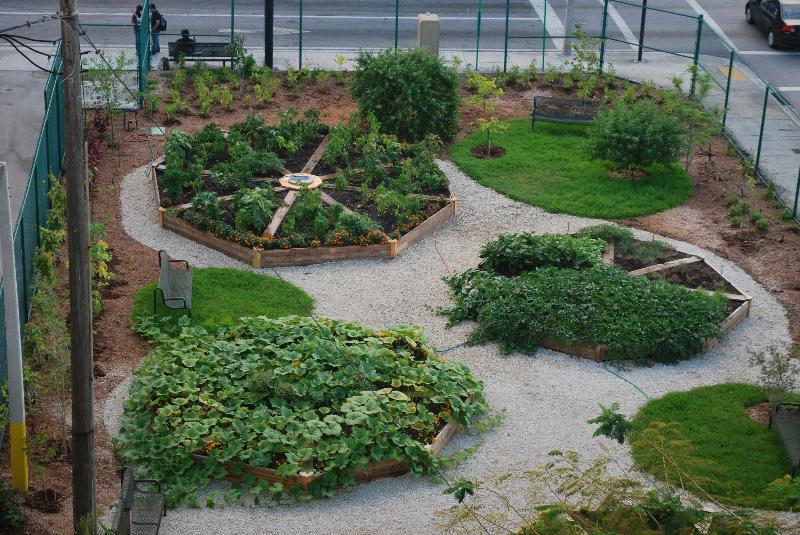
Miami Culinary Institute’s Organic Culinary Garden  

Official Grand Opening on July 14th at 10:00 am

Gabriele Marewski, in a newly formed partnership with Natural Greenscapes, brings the ambiance and magic of Paradise Farms to the new Culinary Garden for the new Miami Culinary Institute at the Miami Dade College Wolfson Campus. All of these partners are very excited about being on the cutting edge of effecting change in how culinary students come to know their ingredients: a new Seed to Soil initiative.

The garden has over 40 different fruits, 30 different herbs and a variety of delicious tropical shrubs and edible flowers.  This living classroom brings to the students a unique opportunity to be directly involved in planting and harvesting their own food. Food scraps from the Institute’s kitchen will be composted and used in the garden for a true “soil to soil” sustainable process.

Gabriele will also teach a class in Fall as part of the Institute’s Enthusiasts Program, as the garden becomes the platform for growing culinary gardeners (www.miamidadeculinary.com).

The garden is located on the southeast corner of NE 6th St. & NE 1st Ave.  Please join us on Thursday, July 14th at  10 am for the Grand Opening!

Free and open to the public. Light refreshments will be served.

Monstrous mango

Ginormous mango — look closely at the scale to see how much it weighs.

Nothing says summer in Miami like eating one or two (or three) mangoes a day. And with massive quantities of mangoes available everywhere, that’s easy to do. Home grown or roadside mangoes just don’t compare to half ripe, faintly flavored fruit coming in from Mexico. Just do yourself a favor and don’t even look at those when you are surrounded by local abundance.

Bet you can’t eat but one of these monstrous mangoes! It came from Possum Trot Tropical Fruit Nursery, where Robert Barnum must be feeding it some amazing compost to grow that big. Can its extreme size be attributed to global warming? Look closely at the dial on the scale. It weighs over four pounds! Bet you can’t eat two!

It’s not every day that farmer Gabrielle Marewski holds an open house at her Paradise Farm. Usually the only time you can visit is for one of her well-known Dinners in Paradise, held in the winter. To get a tour in the off season is a rare treat. From her invitation:

Come visit the farm this Saturday from 9 am to noon!

We would like to thank you for all your questions about organic gardening as well as your inquiries about our produce and other items we sell! Your excitement is certainly contagious and we have decided to offer a tour and a farm market on Saturday July 9th.

Please join us for a tour of our farm! Our farm market will include items such as our delicious oyster mushrooms, organic plants for your garden, iced flower-power tea, and much more! Reservations are required so that we may plan accordingly. The tour will begin promptly at 9:30am so please arrive at least 15 minutes before hand.

The tour is $10 per adult and $6 per child. Please call to make a reservation: 305-248-4181. We look forward to seeing you!

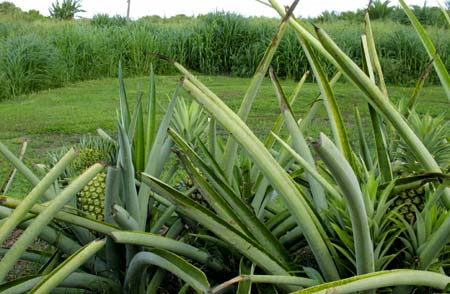
Tim’s pineapple patch. Lettuce and cabbage planting area is in the background, now overgrown with weeds.

Tim Rowan is a hard working farmer. In the winter he grows certified organic lettuces and cabbages. And in the summer, when it’s so hot that some farmers take a break, Tim is still growing things. His latest hobby, as he calls it, is raising pineapples. He has a test patch with over 70 pineapple plants in various stages of maturity. (Most started from tops salvaged from his kitchen where he is a chef at Deering Bay Yacht and County Club. He also grew several pineapples at his vegetable garden there.) Some plants on his farm are already bearing fruit. I asked Tim to save me a pineapple, and recently he let me know mine was ready, come and get it.

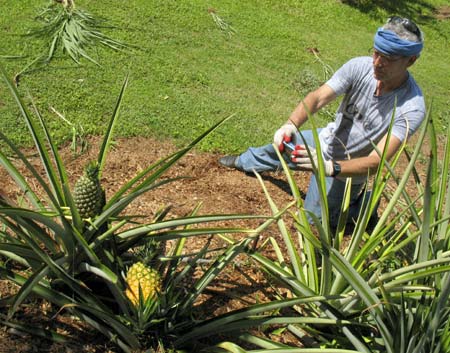
Tim Rowan photographs the pineapple before it gets picked.

And there it was, in all its glory — a very large pineapple perched on a short stalk sprouting from the center of of a spray of long, narrow, sharp toothed leaves. (If you’ve never seen a pineapple plant, it looks like a bromeliad.) The fruit was fully mature and golden yellow in color. It had a distinctive top — not one leafy crown, but at least six or eight all in a row. It looked like the pineapple was sporting a mohawk. Both Tim and I took pictures from various angles while it was still on the plant. If a pineapple could have charisma, this one did. Check out Tim’s blog post about his adventures growing pineapples.

Pineapple sporting a mohawk top.

Tim had left the fruit growing on the plant so I could pick it myself. “Hold it with both hands, give it a little twist and snap it off,” he said. I did, and it came off easily in my hands. I was impressed by how heavy and substantial it was. Turns out it weighed five pounds.

Several large suckers or shoots were growing from the base of the plant. They looked like overgrown pineapple tops. Tim broke one off carefully, and at its base were strands of white roots, ready to plant. This sucker would grow into a new plant which would bear fruit in one year. Tim removed other suckers and planted them too. “From one plant you can get as many as eight new plants,” he said as he set them into the ground. You can also plant pineapple tops, but it takes two years to flower and another six months for the fruit to mature.

Picking pineapples, location not specified. Florida Photographic Collection.

Pineapples are not unusual for South Florida. Settlers started growing pines, as they were called, in 1860 at Plantation Key. From the late 1880s to the early 1900s, pineapple was a popular crop, and almost everybody had a patch. Plantations stretched from Plantation Key to the south, to Elliott’s Key (as it was spelled then), north to Lemon City settlement, up the coast to Yamato (west of Boca Raton) which was farmed by Japanese, and as far north as Indian River. The fruit was shipped by schooner and then rail to northern cities. Competition from Cuba and Hawaii, diseases, bugs, and freezes eventually wiped out the industry by the time of WWI.

Boxing pineapples for shipping. Florida Photographic Collection.

In more recent times, “A guy tried producing specialty pineapple in the mid-late 1990’s on the S.W. corner of Naranja Road and Quail Roost,” county agriculture manager Charles LaPradd told me in an email. “They were the small super sweet golden ones that sell for a fairly high price, so he thought he could compete against the imported ones. He couldn’t and went out of business.” These days, almost all the pineapple in stores is grown offshore. Costa Rica is the top supplier for pineapples for the United States.

Shipping pineapples by boat. Florida Photographic Collection.

Pineapple may not be grown on a large scale in Redland anymore, but many people grow a few plants in their own gardens. They are easy to grow, like full sun, and because the plant has a shallow root system, doesn’t mind growing in a container.

Besides planting the top, save the peel of a homegrown or organic pineapple and use it to make a pineapple flavored vinegar. Here’s the recipe from Wild Fermentation by Sandor Ellix Katz. Use it to make salad dressing, put it on avocado, stir into salsa, or wherever you need a sweet-sour tang.

Mexican Pineapple Vinegar

1/4 cup sugar
peel of 1 pineapple (organic or home grown)
1 quart (4 cups) water
cheesecloth (or coffee filter)
glass jar

1. In a jar or bowl, dissolve the sugar in 1 quart of water. Coarsely chop and add the pineapple peel. Cover with cheesecloth (or coffee filter) to keep flies out, and leave to ferment at room temperature.

2. When you notice the liquid darkening, after about 1 week, strain out the pineapple peels and discard.

3. Ferment the liquid 2 to 3 weeks more, stirring or agitating periodically, and your pineapple vinegar is ready. Keep in refrigerator.
Dances with rebar


Sadie working rebar out of the ground.

After Bee Heaven Farm’s CSA season ended in May, work shifted to cleaning up planting beds and putting things away. Irrigation hoses and tapes that watered plants at ground level were rolled up. Bamboo poles that supported colorful heirloom beans were pulled up and stacked in the barn. And the toughest job of all was to take down the tomato trellising.

Giving a good tug to see if rebar will come loose.

Heirloom tomatoes are indeterminate, meaning their vines just grow and grow. Their limit is determined by the height of trellising. At Bee Heaven Farm, the support is about 6 feet. Rebar — just like what you’d find on a construction site — is set into the ground several feet apart along each row. Wire mesh is run along the rebars from one end of the row to the other, and this is what supports tomato vines. But when the growing season is over, the mesh needs to be rolled back up and rebar pulled out and put away in the barn for the summer.

Triumphant Sadie takes rebar back to the barn.

Farm interns Mike and Sadie had the tough job of removing trellising, including all the rebar. How hard could it be to pull a piece of metal out of the ground? Pretty hard, I discovered. The soil is dry and holds the steel like cement. You have to wiggle the rebar around, widen its hole, pour some water in to soften the soil, push and pull and twist the rebar around, add more water, maybe catch your breath, and do it again until finally, finally it loosens up and you can tug it out of the ground. (It’s quite a workout for the arms!)

Sadie had her own rebar dance going. She swayed back and forth using her arms and body weight to move the rebar, and worked around in a big circle. Occasionally she stopped to pour a bit of water into the hole she was making.

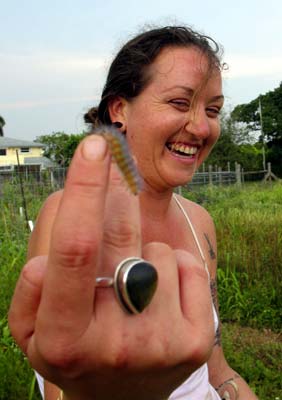
Ginormous wooly bear caterpillar rescued from a hole in the ground.

There was a moment of life and death drama when a wooly bear caterpillar fell into the water-filled hole. Sadie rushed to rescue it. This is quite a magnificent wooly bear! Not sure what kind of butterfly it grew up to be — any ideas?

Sadie and the wooly bear.