Feeds:
Posts
Comments

Several months ago, I had the chance to interview Katie Edwards. She is running for State Representative, District 119, and is currently the executive director of Farm Bureau. Katie is quite familiar with issues that affect growers in South Dade; and since I blog about growers, our interview focused on agricultural issues.

I have not contacted or interviewed her opponents Frank Artiles, Nestor A. Iglesias, and Graziella Renee Denny. I did  look at their web sites to see where they stand on the issues. Iglesias doesn’t have one. Denny’s web site is completely blank. And Artiles is concerned about the economy, jobs, property tax issues, education, healthcare — everything under the sun except local ag! Do any of these candidates know where their food comes from? Do they care about who grows their food? It appears that only Katie does.

Don’t forget to vote on Tuesday November 2nd!

MW: What does Farm Bureau do?

KE: Farm Bureau is a membership organization. We have about 4 thousand members,  about 2100 who are actively engaged in farm production. All of the vegetable farmers are FB members. About 80 percent of the nursery growers are Farm Bureau members. Most of the tropical fruit growers I represent, apiaries or beekeepers, and aquaculture. That would be everything from koi and Everglades ciclid to the Everglades alligator farms. So what we do represent in terms of membership is incredibly diverse. Most of our membership lives here in South Miami-Dade County.

MW: Tell me about your job with Farm Bureau.

KE: I’ve worked with Farm Bureau  for about seven years now, and I reach out to politicians and like to get them down here so that they can fully appreciate the impact of their decisions. I want them to remember the nursery growers and farmers down in Homestead, and to think about those family farmers when they vote on a bill.

One thing very important to Farm Bureau and to me is helping educate policy makers so that there is an appreciation for agriculture, the state’s leading industry, and also for them to recognize that within their own county we’re the ones producing the food. So you have to look at it very holistically and reach out to the people outside of our borders.

MW: There’s been a lot in the local media about the freeze. How have you been putting a face to the farmer, and what kind of feedback have you gotten?

Katie Edwards

KE: When people think about a freeze and agriculture, people think, how is this going to impact the price of orange juice? Consumers don’t realize the amount of capital that the grower already has in the ground from the very moment that seed is sown. You’ve got your land rent, you’ve got your labor expenses, so when a freeze comes and wipes out and devastates your crop, you still have expenses that you can’t recover and pass along.

Sometimes it’s a race against time because every season you’re getting essentially a four-month window to make make enough money to cover your expenses, and then maybe offset money that you lost last year. And the last couple of seasons we’ve had a very difficult time trying to keep up with fertilizer and fuel expenses.

The other thing is going forward, this freeze helps us remember how important American agriculture is. If we don’t have a safe domestic food supply that can produce for all of us during the winter months, then we’re dependent on foreign countries.

MW: Are there any subsidies for growers here in Florida?

KE: The subsidies are for primarily commodities. Just so you understand, the stuff we grow here is not subsidized. So 97 percent of what Florida produces is not subsidized, maybe some peanuts and a little bit of tobacco and some cotton in the Panhandle, which accounts for 3 percent. But everything that we grow down here are not commodities. Like the old saying, we’re price takers not price makers.

MW: What’s your position on the UDB?

KE: When I go downtown and speak [before the county commission], I choose my battles carefully and I choose them wisely, because if I’m always going downtown against something, you lose credibility very quickly. I’ve seen that happen to people in this area. But with the UDB, we’re not one of the organizations that’s out there in bed with the developers saying we want to have more projects. I mean the Parkland project scares us, because if I lose 900 acres of agricultural land, that’s the chink in the chain. It’s like, you can get one, it can go right after that. And what about the property rights of the guy — we all have property rights — what about the property rights of the guy next to him? Doesn’t he have the right to keep farming without being a nuisance to homeowners and all the ancillary issues that goes along with that? He made an investment, he wants to continue farming. I have to protect his rights too.

I think we can all agree that we want to have agriculture in Southwest Miami-Dade County. I don’t think there’s anybody that says, I don’t want agriculture here. And if they do, I’d be very surprised. But I think a common goal — and I like to look at the commonalities — we all want to have agriculture here in Miami-Dade. So I look at it and say ok, take the UDB issue off the table, and let’s spend our time, our resources, our capital, talking about what we can all do to help make sure that farmers aren’t forced to make the difficult decision to then have to sell to the developer. That’s the whole crux of the problem.

Tell me what you’re doing to help the local farmers. I want to do my own reality TV show and call it Do You Want To Be A Farmer, and invite all these people to come down here. I’m going to say to them, you go to the bank, you go to farm credit, take out a loan for 10 million dollars, I want to see you make a buck. They wouldn’t know what end was up and even how to turn a damn tractor! I’ve said that for years, that’s what I’m up against. I’m losing farmers to foreign competition and you guys aren’t helping the farmers out.

(To be continued)
You can buy heirloom tomato starts raised at Bee Heaven Farm this weekend at the Edible Garden Festival held at Fairchild Tropical Botanic Garden.

Here’s a list of what kinds of starts will be available this weekend.

Heirloom tomato starts: Mexico, Speckled Roman, Zapotec Pleated, Homestead 24, Taxi, Tigerella, Black Prince, Amish Gold (an awesome cross between Sun Gold and Amish Paste), Black Cherry, Brown Berry, Black Plum, Black Zebra, Cream Sausage, Green Zebra, Red Zebra, Black Zebra,  Large Red, Lime Green Salad, Italian Heirloom, Federle, Opalka, Orange Banana, Super Snow White Cherry, Pink Ping Pong, Striped German, Tiny Tim, Koralik, Dr. Carolyn, Tommy Toe, Sun Gold, Creole, Healani, Tropic, Jaune Flamme, Matt’s Wild Cherry, Peacevine, Podland Pink, Podland Pink, Yellow Pear and many more!

Several varieties of tomato starts are registered in the Slow Food Ark of Taste. They are: Cherokee Purple, Radiator Charlie’s Mortgage Lifter, Sudduth’s Brandywine, Amish Paste, Aunt Ruby’s German Green, German Pink, Valencia and Red Fig. For a food to be listed in the Ark of Taste, “it has to have something exceptionally good, like flavor, or be in danger of disappearing because not enough people are growing it anymore,” Margie explained.

Veggie & Herb Starts: Arugula, Listada de Gandia Eggplant, Florida Highbush Eggplant, Garlic Chives, and more.

First harvests from Redland Organics growers:

From Redland farms: Certified organic Avocados, Carambola, curryleaf, fresh dried allspice berries, Thai basil, jakfruit, Rachel’s Eggs, local Wildflower Farm Honey and Tropical Fruit Honey.

From Punta Gorda partner Worden Farm: Cukes, squash, radishes, turnips, dandelions, bok choy, scallions, collards, dill & basil.

Prices for any combination of starts are $3 each, buy 5 get an extra one free (6 for $15). Buy 15 get 5 more free (20 for $45). All new this season, Redland Organics will have a credit card terminal and a SNAP terminal to make your shopping easier.

Also at the Festival, Margie is scheduled to give a talk about growing tomatoes called Beefsteaks are BORING! “Get away from beefsteaks, they take too long to grow. Be more adventurous!” she said. “Cherry tomato varieties do so much better down here.”

Several Redland Organics growers, members and others connected to R. O. will be giving presentations. Here’s the select lineup:

Saturday Oct. 23

1:30 p.m. Green Garden Enchiladas cooking demo by Adri Garcia, Greenrocks Foods, LLC.  Mise en Place, LLC., Cooking Tent
2:00 p.m.
Cheese making demonstration with Hani Khouri, Corbin A

Sunday Oct. 24

10:30 a.m. Drip Irrigation workshop, Muriel Olivares, next to Butterfly Garden
11:30 a.m. Tomato time! Beefsteaks are BORING!  Margie Pikarsky, Garden House
12:00 p.m. Urban Food Forests, Marion Yanez, Corbin A
12:30 p.m. How to Make a Raised Bed Garden, Urban Oasis Project, next to Butterfly Garden
2:30 p.m. Your Edible Organic Garden, Ben Thacker, Garden House

Edible Garden Festival
Saturday October 23 and Sunday October 24, 2010
9:30 am to 4:30 pm
Fairchild Tropical Botanical Garden
10901 Old Cutler Road Coral Gables, FL 33156
Phone: 305-667-1651

Ready set start

You haven’t heard much from me these last few months because I’ve been feeling de-pleated by condo board responsibilities. Small problems were looking big, and bigger problems looked overwhelming. Time to hit the reset button, so I headed down to Bee Heaven a couple weeks ago to get some much needed farm therapy.

Fall is planting time down in Redland. Summer is just too hot, too buggy and too rainy to grow much of anything. Planting starts in the fall near the start of the dry season, and harvest is in the spring. The growing seasons here are completely upside down compared to the temperate climate Up North.

Jane transplanted starts into their first pot.

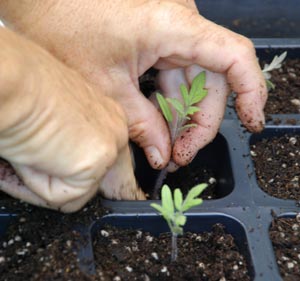
It was a sunny, breezy Saturday afternoon when I visited Bee Heaven. Margie and her manager Jane Cameron were puttering in the potting shed, transplanting starts, or baby vegetable plants, from the seed beds to small pots. A bit of soil went into the bottom of each pot. Then, one by one, Jane carefully lifted each start out of its bed and placed it into its new home. She set the plant down with one hand, put more soil around it with her other hand, and pressed the soil down gently. The work had a gentle rhythm. Repeat it a hundred more times or so, and that was the afternoon’s task.

Growers will tell you there’s something hopeful about working with baby plants. “It’s so exciting to see them grow from seed,” Jane said. “It’s empowering. It feels exciting to see the plant first poking out of the ground, to see the energy. You don’t get that with a plant already started that you buy from the store.”

You’re not thinking of bugs, or disease or freeze — although those risks are there, even at that stage. Some starts’ leaves had evidence of bugs munching along the edges. Another start revealed a small black caterpillar near its roots, as it was gently lifted out of the seed bed. The caterpillar would grow up to be a butterfly of some kind, Margie explained, but in the meantime, it was chomping on little roots. A note was made in the input log, and the plants and seed tray would be treated with BT for the caterpillars.

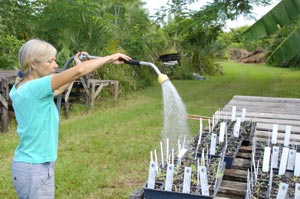
Jane watered the starts after transplanting.

Labels were placed into the pots, so you knew what kind of plant it was. Trays of pots were taken to an outside table made from old wooden pallets, where the starts soaked up sunshine and would grow and grow. Jane watered them lightly, holding the spray nozzle high above, so water fell gently like rain. Smaller starts were waiting on other outside tables nearby, still too young for transplant, maybe in a few more days. “They aren’t finished sprouting,” Margie said. When the little plants show four true leaves, then they are ready to pot up.

Most of the starts I saw that day were heirloom tomatoes with exotic names like Black From Tula, Red Calabash, and Zapotec Pleated. “ZAP-otec. That sounds like the name of a pharmaceutical,” Jane remarked. “Feeling de-pleated? Try Zapotec,” Margie chimed in. “It will pleat you back in no time!” Now there’s an idea — plant (and eat) heirloom tomatoes to be re-plete with energy.

Work done, I ambled around Bee Heaven to see how other things were going. Bright sunshine and clear blue sky were good medicine in itself, and soon I was feeling less de-pleated. A light breeze ruffled leaves, and mockingbirds twittered background music from a nearby big tree and from the hedges further over. Roosters living in nearby chicken tractors got a call and response chorus going. “Ur-ur-ER-ah,” one rooster called, and another responded an similar way, and another, and suddenly I was in the midst of poultry opera. “Here I am, how are you,” they seemed to be calling. “I am here,” I told them. (Yes, I talk to chickens.) I am here, I am fine, pleated and replete. Farm therapy works!

Didn’t make  it to the 2010 Florida Small Farms Conference? Speaker presentations on Alternative Energy, Alternative Enterprises, Business and Marketing, Horticulture, Livestock, and Organic and Sustainable Farming have been posted as downloadable PDF’s on the conference web site.

Click here for the presentations page.

Sunday, October 17th Rain or Shine
From 10am-3pm
at the Little River Market Garden
8290 NE 4th Ave.
Street parking all along our block


Heirloom tomato seedling ready for transplanting into your garden. Photo by Muriel Olivares.


We’ve prepared a really nice selection of our favorite varieties, mostly heirloom, grown in 65% homemade compost and 35% sphagnum peat moss. NO chemicals, NO pesticides.

All plants are in 4″ re-used plastic pots.

$4.00 each, every 5 get one free!

All seed packets are $3.00 each.

CASH ONLY PLEASE!

Bring boxes, carts or bags to carry your seedlings home.

SEEDLINGS:

CHERRY TOMATOES: Sungold, Black Cherry, Amish Red, Ghost Cherry
SAUCE TOMATOES: Amish Paste, Federele
SLICING TOMATOES: Cherokee Purple, Gold Medal, Lime Green Salad, Florida Pink, Black Prince, Green Zebra
PEPPERS: Golden Hot, Early Jalapeno, Biscayne Cubanelle, Antohi Romanian
EGGPLANTS: Orient Charm, Black Coral, Long Italian Purple, Raveena
BASIL: Genovese Basil
ARUGULA: Rocket

SEEDS:
*Luffa Gourd, *Mustard, *Gandules a.k.a Pigeon Peas, Sunhemp, Buckwheat, Cow Peas

*There will also be a small selection of seeds for sale.  These are plants that grow very well in our climate and most of them make good cover crops.

For more information:

web site: Little River Market Garden
phone: 786-991-4329