Feeds:
Posts
Comments

Breakfast is served

Join Slow Food Miami for breakfast at the Pinecrest Farmers Market, located at 11000 Red Road.

Sunday, December 13
9:30 AM – 11:00 AM

$8 for Slow Food Members; $10 for non-members
RSVP to Exileatmed@comcast.net

MENU:

Organic Egg Strata with Hani’s Goat Cheese and Fresh Herbs
Joanna’s Breads
Local Fruit Salad
Fresh Tomato with Organic Lucini Olive Oil and Aged Parmesan
Coffee

GUEST SPEAKERS:

Katie Edwards, Executive Director of the Dade County Farm Bureau
Holly Hickman, Congressional candidate and author

Breakfast produced by Slow Food Miami, The Market Company, JoAnna’s Marketplace and Redland Mediterranean Organics.

Shop for fresh produce and support our local farmers. REMEMBER “No Farms, No Food.”

To market, to market

Pinecrest Gardens Farmers Market

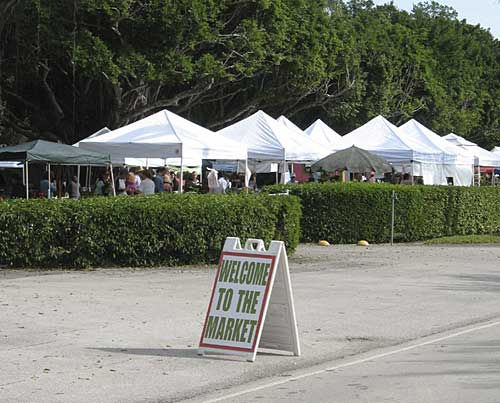
Suddenly it’s farmers market season again! A new market sprang up on Sunday morning in the Pinecrest Gardens parking lot. Formerly the South Florida Farmers Market, it has all your old favorite vendors and plus a few new ones. And it was mobbed! Despite a 9 a.m opening time, plenty of people pestered vendors at 8 a.m. (the old opening time) as they were setting up. Farmer Margie Pikarsky of Bee Heaven Farm emailed me, “Business was great. Best start day for a market. Pretty darn good, considering it was also a new location, and a month earlier!!!”

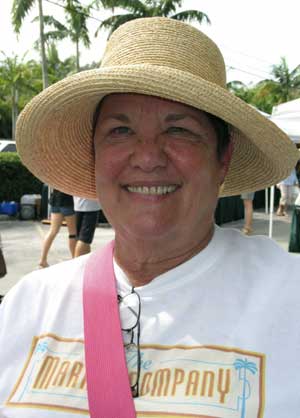
Claire Tomlin, The Market Company

The change in location was a long time coming. Germaine Butler, the founding president of the Pinecrest Garden Club, is delighted to have the Pinecrest Gardens Farmers Market at the garden. “I wanted a market for seven years,” she told me. “This is a community garden, and the market fits in here.” It took some persuading from Farmer Margie, Mitch Rabin of Living Colors Nursery, and Tim Rowan of The Lettuce Farm, to move the market to its new location. Claire Tomlin, who owns The Market Company which runs this market, is happy with the move. She said there’s plenty of room, plus it seemed a natural fit with the neighborhood. Compared to the Gardener’s location, the vibe is definitely more laid back, with people strolling up and down the long row of vendors. And there’s plenty of overflow parking along Killian Drive.

The large Redland Organics tent is located at the west end. If you’re in the CSA, and you want more of something in your share, you can find it at the market. If you’re not in the CSA, this is your chance to get the same things your friends are enjoying. You’ll also find goodies at RO tent that you won’t find in your box, such as smoked eggs, dried fruit, local raw honey, tomato plants, various tropical fruits from Possum Trot Nursery, and delicate oyster mushrooms (which debuted at Ramble) grown by Paradise Farms.

Fresh Local Organic at the Redland Organics tent

Redland Mediterranean Organics holds down the east end of the market. Stroll over to see Hani Khouri tending the falafel fryer, and get a taste of his goat cheese, hummus and tabouleh. Yeah, there’s another guy selling similar food, but it just doesn’t taste the same. And if you want pumpkin pie ice cream made with fresh goat milk, this is the only place you can find it.

And while you are there, stroll through the Pinecrest Gardens themselves. Admission is free, and docents from the garden club will give tours at 10:30 a.m. and 12:30 p.m. The garden club has big plans to put in a world-class kitchen and bring in world-class chefs to give cooking classes, according to Germaine Butler. Once an avid rose grower, she now plants arugula in the front yard, and has a philosophy of “sow it, grow it, serve it, eat it.” Sounds like a good match of garden and farmers indeed!

CSA share: week 2

CSA share: week 2

How to make cheese

notes from workshop given by Hani Khouri at Fairchild Ramble

1 gallon fresh raw goat milk milk will produce approximately 1 pound cheese.

Heat milk to a boil. Add 1/3 cup lemon juice, apple cider vinegar or another acidic medium. This will cause the milk to curdle. Remove from heat.

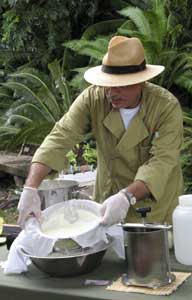
Hani Khouri strains curds from whey with a cheesecloth-lined colander.

Have a colander lined with cheesecloth, set inside a larger bowl. Pour curdled milk into it to strain out whey (liquid). What to do with whey – can use in baking instead of water, use as base for soup or smoothies, or in pickling. (Hani pours it on his plants.)

Stir in salt to preserve, can use coarse or pickling salt. Don’t use iodized. Optional: can add fresh chopped herbs — oregano, thyme, sage. At this stage, if you hang the cloth and let a ball form, you get mozzarella.

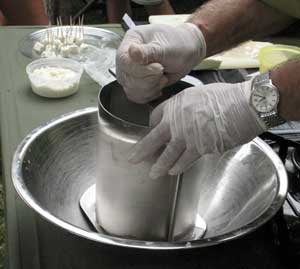
Pushing whey out with cheese press. Finished cheeses are in background.

After it’s fully drained, put into cheese press (can get online at Gaiam). Press all the whey out, keep turning the press and keep pushing the whey out. Let it stand overnight. Don’t let the press stand in the whey.

Take out cheese from press and remove cheesecloth, and let cheese air dry on bamboo mat for three days, turning frequently. Rub the cheese with coarse salt every day.

Cook the cheese in brine (3 parts water, 1 part salt). The longer it boils, the more crumbly the texture. Be careful so the buttermilk doesn’t separate from the cheese. After cooking cheese, need to keep it in brine for storage.

Serve as you would in a Greek salad, or with chopped tomato and olive oil, or with watermelon.

text by Art Friedrich, urban farmer, member of Urban Oasis Project
photos by Antonio Guadamuz, member of Urban Oasis Project

Saturday, Nov 28, 2009

Art Friedrich and partner Luigi (in flannel) touring ECHO

Getting out beyond SE FL to see what other things are happening in organic and sustainable agriculture in Florida, 16 folks headed out to ECHO (Educational Concerns for Hunger Organization) Global Farm and Worden’s Organic Farm in N. Ft. Myers and Punta Gorda, respectively. The group consisted of a number of the workers and WWOOF’ers from Bee Heaven Farm, as well as the big brain behind it all, Farmer Margie. Joining them were a number of local food enthusiasts from Urban Oasis Project and some of the new batch of Master Gardener Interns. [Note: Margie organizes a trip to ECHO and Worden every year during the Thanksgiving weekend, for the purpose of enlightening her farm interns and volunteers, and others who want to make the trip.]

Our first stop was the ECHO Global Farm, a christian based project started over 25 years ago to combat the problem of world hunger, primarily in the tropical zone, using the most concrete and long-lasting ways. Tours are available daily, and are well worth the $8. The tour consists of two hours of seeing and hearing about numerous fascinating plants, and methods of growing highly nutritious foods using unconventional and conventional methods that require little monetary outlay. There are six different recreated environments, such as a rainforest, an arid area, a monsoon climate (like we have, with 6 months dry and 6 months really wet), and the fascinating urban garden section.

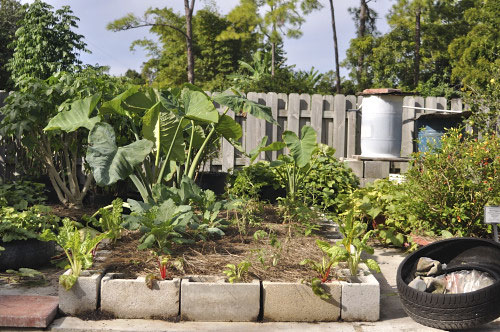
Container gardening taken to a new level.

The urban garden section showed some great examples of reusing trash, such as old tires, to create containers. Also fascinating was the wicking gardens that are mostly made up of a carpet with a little bit of soil in top and some gravel or even cans wrapped in socks for the plants to have structure to grow on. You fill a closed bucket with a hole in the bottom with water, stick it on an edge of the carpet, and let the garden suck the moisture out as it needs it! This is a great way to use a minimum of water and soil. While some of us had questions about the safety of carpet material, other types of substrate could be developed. Probably any old canvas or woven mat material would do. They try laying the carpet out in the natural UV rays of the sun to break down harmful chemicals.

I also enjoyed the mention of their research using human urine as fertilizer — it is packed full of good nutrients and is sterile! In some countries, this has been government sanctioned for a while, such as in Sweden, where some housing developments have been built with urine diverting toilets that drain to some big tanks. When the farmers need fertilizer, they just pull up, pump some of the liquid gold out, and spray it right on their fields! The savings in water and fertilizer are stellar, and it is only cultural taboo that makes the subject so difficult.

Urban homesteading at its finest!

The Moringa tree is a favorite plant there. They call it the Miracle Tree. One can eat almost any part of it, and it is incredibly dense with nutritive value, and the tree grows in almost any condition. I’ve started my own little plantation at my house in S. Miami.
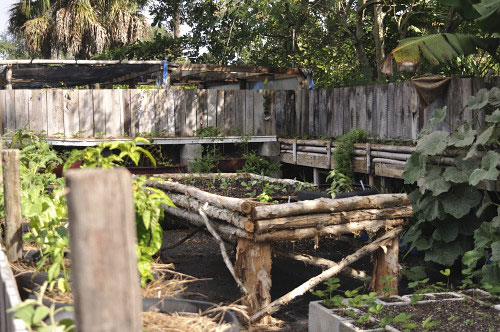
Rustic raised bed

ECHO is also a seed bank, and they send seeds all over the world to see what works, with attention to both the physical and the cultural aspects. This aspect impresses me. It is applied science that recognizes humanity’s needs as a driving force in experimentation. And the needs of the global poor are great, but with sensitivity and ingenuity, the poor can be given the tools they need to improve their own lives in a sustainable and self-empowering way. ECHO taps into their own knowledge and traditions and offers a broader knowledge base for them to work with.

Endless fields at Worden Farm

The second half of our day was visiting Worden Farm in Punta Gorda. The farm is a brilliant example of hard work and smart planning to generate massive amounts of organic vegetables, sold all along the Gulf Coast. The farm is 55 acres, with about 35 in production, and is only six years old. The soil is almost pure sand, so lots of chicken manure is used as their fertilizer, as well as cover crops to slowly improve the quality. Long rows of raised beds made with plastic sheeting make upkeep relatively easy, and the veggies all looked absolutely flawless.

Drip irrigation system at Worden Farm

The plastic sheeting with drip tape irrigation underneath also helps limit water use, as well as the extra work of short watering cycles very frequently. Extra work to reduce the negative environmental impacts of the farm is a tradeoff they are happy to make. Those plastic sheets at the end of the season don’t hit a trash pile. They go to an agricultural plastics recycler.

Touring Worden Farm by electric cart. L-R: Wwoofer, Eva Worden, Cesar Contreras, Margie Pikarsky (back turned), Melissa Contreras

Farm Ferrari

Cow at Worden Farm