Feeds:
Posts
Comments

Go make your beds

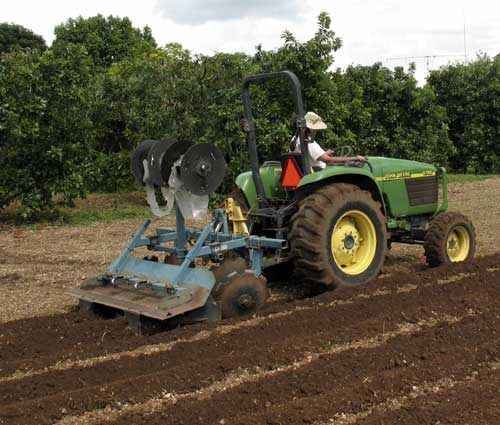
A lot of behind the scenes prep work goes on at Bee Heaven Farm before the first seeds are planted. The cover crop, which fixes nitrogen and other nutrients, has been mowed and tilled under to also add organic matter to the soil. The next step is to create rows of raised beds, where the vegetables will get planted.
Making beds

Making beds

The bedding attachment behind the tractor cuts into the soil and shapes it into a bed with channels on either side (where tractor tires pass). Native soil is not very deep in Redland. It averages about 1/4 inch over limestone rock. At Bee Heaven Farm — after rock-plowing, years of building up organic matter, and mounding up the beds — soil is maybe 4-6 inches deep, and very rocky. That’s it! That’s what your food grows in! The beds then need to be shaped and leveled by hand with a hoe. Rows of plants will then get planted by hand or with a seeder in each bed, either as transplanted starts or directly seeded. Tomatoes are planted in one row, beets in 4 rows, greens in 8 rows, or anything in between.

Bedding attachment

Bedding attachment in action

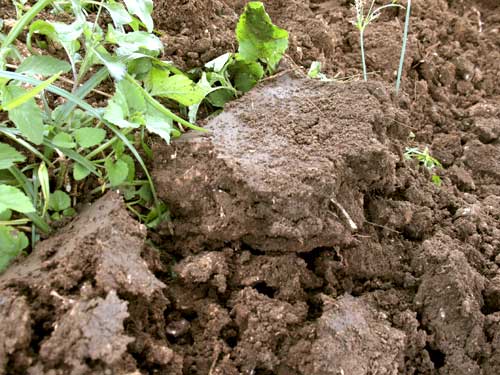
This past Saturday when I arrived, Farmer Margie was driving the tractor with the bedding attachment on the back, making passes up and down the main planting area. The bedding process wasn’t going very well. I saw one row wasn’t straight, kind of tapered into the next row. As she climbed down from the tractor, Margie explained that was where the tractor had actually slipped in the ground. The soil was wet from scattered rain showers blowing through because of a cold front. The wet soil was also getting compacting into clay-ey clumps, losing aeration and fluffiness that had been created by tilling. (For a detailed explanation of soil compaction and air spaces, read Margie’s post on tilth at Bee Heaven Farm’s Blog.)
Wet soil clumps

Wet soil clumps

Margie grumbled that she would have to wait until the weather cleared and the soil dried out, then till all over again to erase the curving beds of compacted soil, and attempt bedding again. Clearly every step of the growing process is affected by weather, in ways both subtle and obvious. Too much rain, not enough rain, too hot, too cold, too windy — the farmer is almost always at the mercy of the weather.

The Miami-Dade County Cooperative Extension staff, in an expression of our appreciation for our supporters and friends in our recent budget resurrection, would like to invite the community to a “Thank You” reception on Tuesday, October 27th from 3 to 6 PM. As this is an informal gathering we do not expect to have a program or an agenda. No speeches or presentations, just light refreshments, snacks, and fellowship.

Please come by for afternoon break or stay the while! We all would enjoy having some time to individually thank each member of the community that worked behind the scenes, communicated with the County Commission, and/or took the time to speak at one or numerous public meetings on our behalf .

Hope to see you all.

Best regards,

Don Pybas

UF/IFAS Extension Office
18710 SW 288 St.
Homestead, FL 33030-2309
Phone  (305) 248-3311

Heirloom tomato starts

Heirloom tomato starts

The Edible Garden Festival is coming up this weekend Oct. 24-25 at Fairchild Garden. Farmer Margie and her crew will be there, selling starts of heirloom tomatoes, basil, arugula, garlic chives, lemongrass and chard so you can plant them in your garden. (She promises to have an even bigger selection at Ramble next month.)

Heirloom varieties available for this month’s event are mostly small and plum-fruited types. The larger, beefsteak types won’t be ready for another three weeks. I’ve met heirloom tomato fans who explain they buy starts year after year from Redland Organics because there are certain varieties (like black tomatoes, such a deep dark red it looks almost black) that only Margie sells.

You can also get fruits that are in season now: avocados, carambolas, perhaps bananas, cas guava, and antidesma (bignay). Also available are the usual offerings of organic eggs in lovely shades of browns — and even light green ones from auracana hens — and wildflower honey from hives kept on the farm.

====================================

Events presented by growers or members of Redland Organics CSA:

LECTURES
Saturday, October 24
12:00 p.m. Growing Organic Heirloom Tomatoes, Margie Pikarsky
1:00 p.m. Edible Landscaping in Paradise, Gabriele Marewski

Sunday, October 25
4:00 p.m. Extreme Edible Landscaping: Urban Homesteading!, Melissa Contreras

GARDENING DEMONSTRATIONS

Sunday, October 25
10:00 a.m. Slow Food School Gardens, Hunter Reno
1:30 p.m. Square Foot Gardening with Kids, Hunter Reno

People sign up because:

  • They want to get really fresh food straight from the farms, not food that’s been in warehouses, distribution centers and back storage (like buying clubs and co-ops get).
  • They want organic/pesticide-free food.
  • They want to support local farmers.
  • They eat a lot of veggies.
  • Their doctor told them to.
  • They want a ‘greener’ footprint.
  • They’ve been in CSAs in other parts of the country (this category increasing).
  • They were in a buying club or a co-op and realized all they’re getting there is the same exact stuff they can get at the grocery store.

People leave because:

  • They find out they really DON’T eat as many veggies as they thought.
  • They move away.
  • They are uncomfortable with surprises, because they don’t know in advance what they are going to get.
  • They want more of what they call ‘traditional veggies’ — meaning the basic 10 things they buy at the grocery store, some of which don’t grow here, or only during a limited time (in season), and they can’t understand why they can’t get, for example, onions or tomatoes or potatoes at the start of the season (and all season long!).
  • They’re stuck in the grocery store ‘pretty food’ paradigm (ooh, it has a bad spot, throw it out!) and can’t accept ‘real food’ complete with buggies (extra protein, anyone?), and soil (vegetables grow in dirt? can’t we get rid of it?).

Thanks to Farmer Margie for sending me her rant!

If you’re new to this area, you might be thinking ah, fall, time for harvest. Not! The growing seasons are upside down this far south. During the long, hot summer, most growers take a break. They start preparing the soil and planting in September and October. This time of year is their “spring.” The first crops are harvested around November, maybe earlier, depending on what you’re planting. So if you’ve had a garden when you lived in northern latitudes, and you want to have one here, you have to adjust for the location and climate and soil.

Farmer Margie was interviewed for a recently published article in the Fort Lauderdale Sun-Sentinel called How to plant a fall vegetable garden in South Florida. In it she discusses all-important soil preparation and how to grow heirloom tomatoes (one of her specialties). You can read the article online. (Hopefully they will keep it in the online archives for a while!)