Feeds:
Posts
Comments

Several months ago, I blogged about Jaideep Hardikar, a journalist from India who was here in the States on a fellowship. He wrote the article The Farmers Among Us that was published in the Sun-Sentinel. The original article profiled several growers who belong to Redland Organics, but is no longer available online. A shortened version was published on the front page of the Business section of the Miami Herald on Tuesday Oct. 13th. You can read it here.

According to the article,

Across the United States, consumers are increasingly buying directly from local farms through a model started decades ago in Switzerland and Japan now known as Community Supported Agriculture.

Nationwide, sales from farms directly to consumers — including CSA and farmers markets — jumped 49 percent from $812 million in 2002 to $1.2 billion in 2007, according to the most recent Department of Agriculture census. That’s twice as many sales as a decade earlier, the federal agency said.

Estimates of active CSA programs vary, but the 2007 U.S. census found more than 12,500 farms selling directly to consumers in every state. The National Center for Appropriate Technology, an agriculture think tank, estimates CSA programs supplied food to more than 270,000 households last year.

Farmer Margie told me that last season she had 440 CSA members, and has 465 members this season. She started Redland Organics CSA in 2002 with only 25 members. There are at least 100 on the waiting list. Turnover varies, maybe about 35%. Margie also mentioned that in January there will probably be a very limited number of trial shares available, and only to those folks already asking about them. She is pretty much at full capacity already. If you’re not a CSA member, but still want to get the same food, you can shop at the South Florida Farmers Market in Pinecrest.

Sleeps wit' da fishes

Sleeps wit' da fishes

The other Saturday I rambled down to Bee Heaven to pick up a tilapia and some callaloo for dinner. If you’ve never done that, you’re missing out on some good eating. The fish are ridiculously fresh. They were swimming early that same morning just before getting put on ice. You won’t eat anything fresher unless you catch it yourself. When you order a tilapia, you get the whole fish. It’s your job to scale, gut and clean it before cooking, but that isn’t too difficult to do. The average weight per fish is about 1.5 pounds, maybe a bit more.

The tilapia is farm raised by Wayne and Carmen of American Viking Aqua Farms, a mom-n-pop operation right around the corner from Bee Heaven. Although the fish is a bit more expensive than what you can get at at the grocery store, it has been raised without chemicals. Technically they are not organic because the fish food isn’t, though Wayne and Carmen want to move in that direction. They also use a biofilter to clean their water, and have a natural filtration system which lets them use the nutrients to grow native mangroves for use in bioremediation projects.

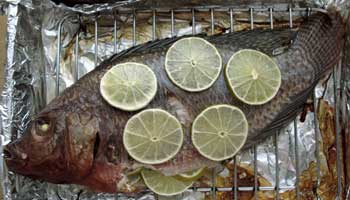
Plans for Mr. Fish were to roast it whole. It was scaled, gutted and cleaned, then its cavity stuffed with slices of lime and branches of fresh thyme, and more lime slices on top. Was baked it in the oven at 350 for about 20 minutes (more or less), until the flesh flaked when stuck with a knife.

Mr. Fish meets his demise

Mr. Fish meets his demise

Mmmmmm good eating! The flesh was tender, moist and delicate. Limes on top kept it moist, and the flavors of lime and thyme permeated. Well, maybe a bit too much lime… will try with lemon next time, and use a bit less, and add garlic or onion. I don’t pretend to be a chef, or even a halfway good cook, but I have my moments and this was one of them. Your meal is only as good as the ingredients!

If you got a tilapia how did you prepare it? Feel free to share your recipe in the comments section below!

Today we received this welcome message from Teresal Olczyk, one of our Extension Agents with whom we’ve worked closely for many years.

Yes, we are back in business thanks to you and many other supporters.  We were restored  at about 84% thanks to the hard work of all community and many organizations.

The County Commission restored our county general revenue funding at about 84% ($887,000) of our adjusted submitted budget request.  As Extension general revenue funding was eliminated in the Mayor’s proposed budget, along with many other agencies and services we would have not been here as of October 1st otherwise.  We are back in business thanks to the hard work and determination of a team of 4-H leaders and members conducted during the past several weeks, the agriculture community spearheaded by Farm Bureau and the Council of Presidents of the Ag. organizations, Master Gardeners, various volunteers and advisory committee members, and individual clientele that were upset with the thought of our not being here to provide the services to the residents of this community.

Many people contacted commissioners personally, wrote letters, faxes, e-mails, included information on the Extension budget crisis on their websites and blogs and attended the budget meetings.

The realization of having a reduced budget means we still have impacts to our budget and operations.  We will lose three vacant agriculture agent positions, and sadly we are also having to eliminate one county funded agent position to meet our budgeted amount.

Teresa Olczyk
Extension Agent IV
Commercial Ag./Ornamentals
UF IFAS, Miami-Dade County Extension

Common Roots opening

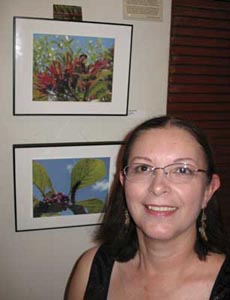
The photographer and her work

The photographer and her work. Photo by Margie Pikarsky.

As I entered the Miami Beach Botanical Gardens, the sweet, intoxicating scent of jasmine greeted me. Friends were waiting for me at the exhibit, and I was glad they came out to see the art and to show support. Farmer Margie and her husband Nick took turns taking pictures of me with my pictures, and it felt like paparazzi. Now I know what it’s like on the other side of the lens! Margie pointed out that the picture Firebush was hanging right below the sign that said FIRE extinguisher. Hmmm, seems like the people who were hanging the art have a sense of humor, I like that. Robert the Cantankerous Chef also came, and was discussing what kind of caterpillar that was. He thinks it’s a zebra Gulf Fritillary butterfly, and Margie thinks it might be a brown orange julia. [Both caterpillars are quite similar in appearance and both are natives, according to Margie, who looked these things up. Thanks for the fact checking!]

Claire Tomlin of The Market Company (whom I’ve met at the South Florida Farmers Market) provided veggie snacks, and Schnebleys brought a variety of fruit wines. I sampled the avocado wine, and it’s similar to pinot grigio with a whiff of avocado, and it’s actually pretty good. Heard the lychee wine (my favorite) ran out fairly quickly. Hung out till the very end with my friend photographer Mark Diamond, waiting to hear the announcements of the winning artists, including audience choice, but neither us of won anything. Thanks for your votes, it’s all good. I’m glad to be in the show, and hope that more shows are to come.

The pictures look a lot better in person, so if you haven’t seen them and you’re in the area, stop in and take a look for yourself. The show is up for only this week. I’m coming by on Saturday afternoon to pick them up — unless you want to take them home with you…? Let me know…

Botanist Steven Woodmansee wrote about the plants depicted in the art works. Here’s what he wrote about my pieces, which was posted on a card next to them.

1.  Beautyberry  – This photograph depicts one of our showier native flowering plants. American beautyberry (Callicarpa americana) is a member of the mint family (Lamiaceae), and its leaves are aromatic when crushed, although it is not recommended for culinary practices.

However, the clusters of purple fruit do attract birds, especially mockingbirds, who will defend “their” plant from other encroaching birds. It is native to upland habitats including pinelands and hammocks, and prefers full sun.  Branches may be clipped, and used in flower arrangements, as they last several days.  In cultivation, it is best to cutback the plant to one third its size at least once a year.  It is native throughout Florida and portions of the southeastern United States.

2.  Firebush – (Hamelia patens) is a member of the coffee plant family (Rubiaceae).  The showy tubular red flowers attract a plethora of butterflies and hummingbirds (and in this photo, a honey bee).  A favorite for the butterfly garden, firebush flowers year ’round, and grows well in partial shade.

Its fruits are devoured by birds.  It is recommended that for a bushy appearance and longevity, plants be cut back to one third its size at least once per year.  This species is a must for any Florida yard.  It is native across most of peninsular Florida where it can be found in swamps and hammocks.

Edible landscapes

The trend of people growing veggies in their yards is really taking off. Several experienced gardeners were interviewed in a recent article in The Miami Herald. Redland Organics grower Gabriele Marewski, of Paradise Farms, is one of the featured growers.

The article was published on Sunday Oct. 4th in the Home and Design section. You can read it online.