Feeds:
Posts
Comments

Posts Tagged ‘Robert Barnum’

Have you thawed out yet? We had two weeks of record-breaking cold temperatures this month. It seemed each night a new low was recorded, and the cold went on for the longest stretch anyone could remember. “I’ve been down here for 40 years and I’ve never seen a cold snap like this,” marveled Cliff Middleton of Three Sisters Farm. And this long cold spell did break yet another record. Beginning January 2nd, we had 12 days in a row of temps dropping below 50 degrees, and came one day short of breaking the record of 13 days straight, set in Miami in Jan/Feb 1940, according to the National Weather Service.

The weekend of Saturday January 9th brought historic lows that were well below freezing. And by the wee hours of Monday January 11, hopes of any chance of crops escaping harm died as the temperature dropped into the high to mid 20s and stayed there for several hours. That was long enough to destroy cold-sensitive plants.
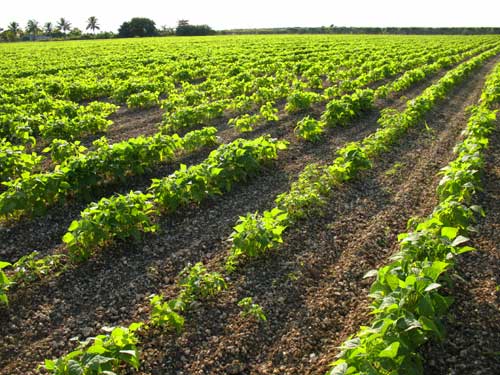
Green bean field, Homestead Organics. Taken on Friday Jan. 8, before the last freeze.
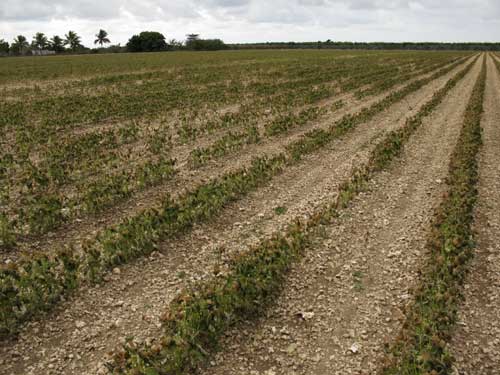
Same green bean field, Homestead Organics. Taken on Friday Jan. 15, after the freeze.

The growers of Redland Organics got hit hard by the freeze this past week. Dan Howard of Homestead Organics had five fields planted with green beans. He watered the crops for days to protect them from the cold. But early Monday Jan. 11th, the temperature fell as low as 28 degrees on his front porch, with the coldest temps around 4 – 5 a.m., and it stayed below freezing until dawn.There was no fighting it. All 22 acres of green beans were damaged.

“Farmers gamble with the weather and are risk takers,” Dan said. Sometimes they gamble and lose. Because of the freeze, Dan says he lost $100K in sales. He has crop insurance, but since beans are not a specialty crop, insurance will only pay for seed and fertilizer and not much more. He’s all ready to replant, though. “Don’t have much of a choice otherwise,” he laughed. The Friday before the last freeze, he cultivated one field, preparing the soil for planting. And just the other day he loaded his truck with bean seeds and was ready to start over again.

Cliff Middleton lost all of his above ground crops, but not as many root crops. He fought the cold by “basically saturating the land with water,” he explained. “But that many hours of cold will kill plants. Callaloo has a very low tolerance for cold and is all burned. The results of the damage will last for a year. All the fruit trees will react to this.”

Robert Barnum of Possum Trot got patchy frost in his grove, and is concerned about long-term damage to his sensitive tropical trees. He grows 300 types, and caimito, anona and guanabana are the most cold sensitive. “The cold will kill cambium, the growing layer between the bark and the wood,” Robert explained. Branches or a trunk less than four inches in diameter will die more easily, depending on how cold the temperature falls and for how long. “A tree looks OK for a while, and then the damage shows up later. Some damage takes months to show up. Lots of things can show up. Buds might not form, or form small, or not set fruit and drop off,” he said. Sounds like there might not be as much fruit this summer, but time will tell.

Heirloom pole beans damaged by the cold. Bee Heaven Farm, Jan. 15.

It was simply too cold for too long, and pole beans and heirloom tomatoes at Bee Heaven Farm didn’t make it. Margie Pikarsky and her crew covered them up with Reemay (floating row cover) for two weeks. The plants made it though the first freeze right after New Year’s, and at first it seemed like they would survive the cold. But Reemay wasn’t effective on that fateful Monday morning. Pole beans, including the dappled Dragons Tongue beans blogged about on Mango & Lime are pretty much all dead. Leaves are burned and withered, and it’s uncertain if the plants will have enough energy to grow new leaves and blooms. The heirloom tomatoes are also pretty much destroyed. Don’t expect too many heirloom tomatoes this season at the farmers market. Read more about the freeze at the Bee Heaven Farm blog. Not all was lost, though. I saw carrots, radishes, kohlrabi and dill looking no worse for the wear.
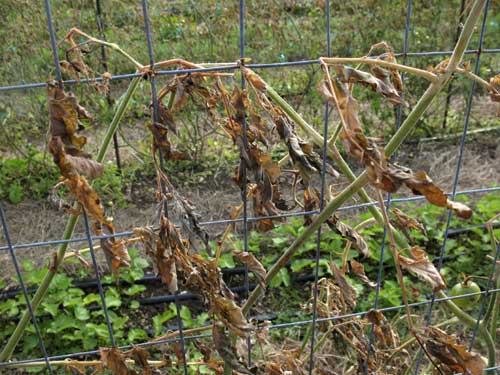
Heirloom tomato plant completely destroyed by the cold. Bee Heaven Farm, Jan. 15.

Gabriele Marewski of Paradise Farms covered her raised vegetable beds with Reemay and her vegetables survived, along with the microgreens. But the edible flowers that she is known for did not. “They were vining too much and it was almost impossible to cover them all,” she explained. “The flowers are a total loss.” Crop insurance doesn’t cover edible flowers or microgreens, and considers them “experimental,” and the quantities she grows are too small to get coverage. Oyster mushrooms slowed down because of the lower humidity, but Gabriele expects a big flush of growth as it warms up, and plenty of mushrooms in time for market this Saturday.

[Note: Heard that Worden Farm had major losses and is replanting fast and furious. They had much colder temps for much longer up in Punta Gorda. Hope to get an interview with them soon.]

So, for the next month or two, pickings might be slim when it comes to local produce. You just may not find some things (like beans) that you got earlier in the season, at least not for a while; and other things (like heirloom tomatoes) may not be available at all or in very limited quantities. Despite that, do make it a point to support your local growers when you shop at farmers markets and grocery stores. They need your help to bounce back from their losses.
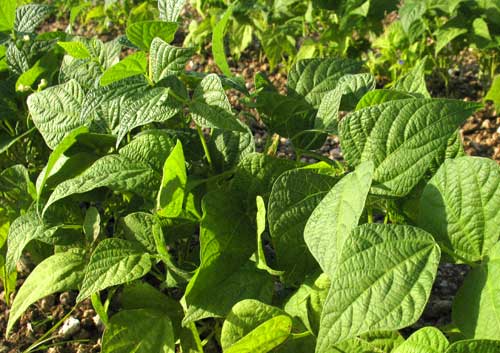
Healthy green bean plant, before the freeze.

Damaged green bean plant, after the freeze.

Read Full Post »

Piper betel leaf

Fans of piper betel, rejoice! It survived the freeze somewhat well. Robert Barnum told me that the lower leaves got burned by the cold, but the ones higher up survived. Piper betel is a shrubby, branching, leafy vine that climbs as high as the treetops. Robert has to climb up a tall ladder to harvest it from the higher levels. The piper also spreads from tree to tree like ground cover. It appears not to damage the tree it’s on at all, just uses it as a support.

Piper betel is a member of the black pepper family, and is used usually as an outer wrapper, or cooked or steamed. Frodnesor at Food For Thought used it successfully as a wrapper for a Vietnamese dish a few weeks ago. Bill at Tinkering With Dinner combined it in a stir fry with lemongrass and sugar, and got a taste of root beer. Fascinating! But don’t try it raw. La Diva Cucina discovered that the hard way when she put it in a salad a few weeks ago. Cooked is so much better, darling! Robert advises to use piper where you want a smoky, sausagey flavor. He uses it in various ways — as a layer in lasagna, cooked with greens, or blanched first to use as a wrap for sushi rolls. He also created a recipe where he dips the piper betel leaf into tempura batter and fries it.

Robert Barnum stands in front of a tree covered by piper betel. Picture taken before the last freeze.

Medicinal uses of piper betel:

The betel leaf is used in a number of traditional remedies for the treatment of stomach ailments, infections, and as a general tonic. It is often chewed in combination with the betel nut (Areca catechu), as a stimulatory. Some evidence suggests that betel leaves have immune boosting properties as well as anti-cancer properties. [Note: this is NOT the areca that you can get at Home Dept. If you do want to grow it, Robert has it.]

Trade Winds Fruit web site

……….

Broad Spectrum Antibacterial Activity of Betel

One such medicinal plant studied was Piper betle L. Results showed that among the 300 plant species screened, P. betle maintained a broad spectrum antibacterial activity against all the test pathogens, such as Ralstonia, Xanthomonas, and Erwinia. It was also revealed that the P. betle solvent extract had more superior action than streptomycin

Food & Fertilizer Technology Center, Phillipines

Read Full Post »

Record-breaking cold temperatures rolled in, and a freeze warning was issued for several nights in a row this week. The farmers in Redland scrambled to protect their crops from the freezing cold, but generally fared well. CSA growers located further north — Worden Farms in Punta Gorda, and C&B Farms in Clewiston — got frost damage on Tuesday night. They’re still evaluating how much damage they got, and if any crops were lost.

As a result, there may be less in the share box this Saturday and maybe for the next week or so. Freeze damage is one reason, and less veggies growing is another. “Plants don’t like to grow when it’s cold. They like to go dormant,” grower Dan Howard explained to me. If there’s a killer frost and lettuce (for example) is burned by cold, that’s it, there’s no more local lettuce to eat until it’s replanted and harvested again. Remember, as CSA members, you agreed to share the same risks as the growers! No faking it with lettuce from Belize or somewhere… not in this CSA! (Also, because vegetables were damaged by the cold, or were not ready to pick, there will be less in the stores and the prices will go up.)

Reemay, or floating row cover, protects delicate greens and pole beans against freeze damage.

Margie Pikarsky at Bee Heaven Farm protected delicate basil, heirloom tomatoes, and pole beans with large sheets of Reemay, or floating row cover. It’s a spun polyester fabric that is used to cover plants, much like a blanket. The row cover acts like a blanket to hold in the heat and keep plants warm. Margie added she’s not watering as much, because that runs the risk of plants mildewing, or hot condensation cooking entire plants. Her crops have been covered since the first freeze warnings on Saturday, and the Reemay will stay up until the cold blast forecast for this coming weekend.

On Wednesday afternoon, Dan Howard of Homestead Organics, was cautiously optimistic. “Tuesday night it went down to 33, 34 degrees, but not a killer freeze,” he told me. He had prepared his bean fields by watering them quite extensively during the day on Tuesday. (It’s just too much acreage to use row cover.) Dan explained that his crews “soaked the ground down real good. Water insulates the ground to keep it from getting colder. Well water is 75 degrees, the same temperature year round. Dry ground gets colder than wet ground.” He explained that ground temperature is the most important for the plants, keeps the roots from freezing.

If the temperature gets below 32 for any length of time, plants will become permanently damaged from the cold. “Anything below 32 is bad, and at temps of 28, 29 degrees, it’s a total loss,” Dan explained. Monday night wasn’t that severe because there was a blanket of cloud cover, which acted as insulation and kept the temperatures from dropping too low. Tuesday night the sky was clear and temperatures dropped — but it was windy, and that made a difference. The moving air keeps ice from forming on the leaves. “If there’s no wind and clear sky, you get frost,” Dan said. And frost is what kills plants. It coats the leaves and burns them much like frostbite. Leaves turn black and wilted from the damage and the plant will die. Farmers can knock ice off the plants by spraying fields with water in the middle of the night, Dan explained. That’s why they’re up all night, watching the temps, checking the plants watering in the fields and groves.

In a similar vein, Robert Barnum of Possum Trot Nursery watered his tropical fruit grove on Tuesday night. He has giant pumps to draw well water, and tree-high sprinklers dotted through his grove. Tuesday night temps dropped to 36, and Robert was up at midnight and again at 3 am watering and checking on his trees. He explained that water gives off heat as it freezes, 353 kilocalories per gram of water to be exact, and that bit of heating warms the plants. Once the water on the plant freezes, it keeps the temperature constant at 32 degrees even if air temperatures drop below that, because a heavy coat of ice acts as insulation. But you have to keep watering, he insisted, to keep that small but important heating process going.

By Wednesday night Robert was less optimistic than Dan, and said the thermometer already read 39 degrees at 9 pm. The sky was clear and the winds were dying down. It looked like there would be a killer frost that night. Margie said the temperature dropped hard and fast — and then something unexpected happened. Some light cloud cover rolled in, and those clouds were enough to act like a blanket keeping heat from radiating away from the ground at night. Temps hovered around freezing, then came back up a bit. “I never saw anything like that,” Margie told me. But the main reason why the anticipated killer frost didn’t happen, according to Jonathan Crane at TREC: when the temperature fell to 35 it also reached the dew point. When the temperature meets the dew point, heat is released and the temperature rises, and that is what happened on Wednesday night. (There might have also been a bit of ground fog.) End result, no freeze, and crops were spared — this time. A more severe blast of cold air is forecast for the weekend, and growers (especially to the north of us) are bracing themselves.

To learn more about how frost forms and dew point, take a look at this web page.

Read Full Post »

It took a bit of arm twisting, but Robert Barnum, the Cantankerous Chef, sent over recipes for Possum Pizza and pictures. Enjoy!

Possum Pizza Dough

7 cups plus 2 tbsp. King Arthur flour
2 cups plus 2 tbsp. tepid water
1/3 cup olive oil
1 pkt. yeast
1 tsp. salt

Put 2 tbsp. flour, 1 tsp. sugar and 2 tbsp. tepid water in mixing bowl and let sit at room temperature for several hours or over night. Put bowl in mixing stand (Kitchen Aid) with dough hook and mix slowly as you add the flour, oil, salt and water. Mix and knead till smooth, 2-3 minutes. Put out on a smooth surface with some flour dusted over the kneading surface. Knead for several minutes and return to the now oiled mixing bowl and cover with dry towel for 1-3 hours. Then place the dough on a smooth flour dusted surface and knead for several minutes and form a ball. Cut the ball into 8 pieces of similar size and roll into balls and place on a tray to double in size again. Each ball can then be made into a 6-8″ thick or 12″thin crust pizza. For outdoor baking on gas or real wood fired smoker/oven, the thick crust works easier for handling. It takes about 4-6 minutes to cook. (I leave the 8 balls of dough on the tray and after they rise place the whole tray into the smoker and bake for about 30 minutes for king sized hamburger buns with a smoky flavor.

Possum pizza cooking on a wood fired grill. Those are smoked eggs off to the side. Photo by Robert Barnum.

Possum Pizza Sauce and Toppings

Herb Onion Butter Sauce
1-2 sticks butter
1-3 onions peeled and sliced either way
2 tbsp. minced garlic
2 tbsp. thyme

Saute all till onions either soft or caramelized, your preference.

Tomato Sauce
2-3 cups of homemade tomato sauce
1 small can tomato paste
2 small cans tomato sauce
1/2 cup cooking wine or beer
— seasonings if no homemade tomato sauce (canned tomatos with basil, garlic, onions, celery, green pepper, salt, black pepper, oregano, hot sauce and soy sauce).
— simmer browned Italian sausage in the sauce to cut and use for toppings while preparing other ingredients for the pizza. It adds flavor to the sauce and the cut medallions of sausage for topping the pizza. Heat and reduce till desired consistancy.

Toppings:
smoked eggs sliced thin
thin sliced green and or red pepper
thin sliced onion
thin sliced mushrooms
thin sliced black olives
thin sliced pepperoni
thawed green peas and corn
thin sliced heart of palm
small chunks of ham
sliced italian sausage
shreded cheeses (can use 1 to many different types, what ever is left over in the fridge)
1 small tin of flat or rolled anchovies

Flatten the dough sort of thick if using outdoors grill for easier handling. Then put herb butter and tomato sauces on 1/2 of each pizza for variation. Each pizza feeds one to overfull. The herb butter side gets the corn, peas, onions, egg, ham, olives, heart of palm and shredded cheese. The tomato side gets cheese, italian sausage, pepperoni, mushroom, green pepper, onions and anchovies.

Read Full Post »

Possum Pizza

No, it doesn’t have opossum in it…  but it’s Possum Trot Robert Barnum’s own ‘creation’.

Robert has been bitten with the smoking bug, big-time. Since he put some eggs next to whatever else he was smoking on his specially-modified barbie, he’ll smoke just about anything! …and no, he tries not to inhale 😉

So, last Thursday, he invited Marian (who, unfortunately, got called in last-minute to work),  plus the whole crew from Bee Heaven Farm to enjoy his Possum Pizza. Hani & his wife also joined us. This was a ‘make your own pizza’ affair, for which he provided balls of dough, a couple of sauces (homemade, of course), shredded cheese and an assortment of toppings. This time, he had both a whole wheat and a white flour dough, and the toppings included pepperoni, sausage (sliced), a seasoned ground meat of some sort (no, not ‘possum, I told ya already!), bacon, ham, sliced smoked eggs, corn, green pepper strips, peas, hearts of palm (from the famous drive-by harvest – see BHF’s blog about that adventure), King mushrooms, and probably something else I’m forgetting…

We all trooped over there after winding down a long day of weeding and transplanting tomatoes on the farm, bringing freshly-brewed tea and ice, to join some of Robert’s homemade Antidesma (bignay) wine. We met his other guests, a couple of who drove down all the way from Ft. Lauderdale to partake of the goodies. I’d say it was well worth the drive!

Since only one of our group had any real pizza making experience, our pizzas were anything but round. To help slide them on/off the smoker, Robert fabricated pizza peels out of some scavenged hardwood and thin pieces of scrap aluminum – with a generous dusting of corn meal, those pizzas rolled right off. With a not-so-generous dusting, they kind of  stuck on their way to the smoking shelf, and they got even more warped. Oh, well – master pizza makers we’re NOT, but they still ate well.

After partaking (and sharing) our creations, Robert surprised us with some of his exotic fruit ice creams – this time it was Monstera (aka Ceriman) ice cream, and a Passion-Allspice ice. And to finish it off, a small glass of a thick, after-dinner lychee wine that left us all mmmmmming.

Early-birds that we are, we were finished by 8:30pm, and meandered on home to bed. I think we encountered a grand total of 3 cars on the way home. Only in Redland!

Read Full Post »

« Newer Posts - Older Posts »