Feeds:
Posts
Comments

Posts Tagged ‘small farms conference’

Greetings once again, Redland Ramblers! Guest blogger Melissa Contreras here again, founder of Urban Oasis Project, urban micro-farmer.  I’m back to tell you about day two of my trip to the Small Farms/Alternative Enterprises Conference last weekend.

After rising early, we all piled into Margie’s van and headed over to the Osceola Heritage Park for the official beginning of the conference. Since I know that all you local foodies want to know about the food, let me start with breakfast: rather light fare was provided at the conference, but like our full lunch, it consisted mostly of Florida farm-grown food. A deep dish frittata of free-range Florida eggs with cream from grass-fed cows was served, accompanied by Lambeth Groves’ orange juice, cold and fresh, a perfect blend of sweetness and acidity. We were treated to Florida’s “other juice,” Muscadine grape juice: crisp, lightly sweet, and perfumed of dewy-misted grapes, from Lakeridge Winery and Vineyard in the high country of Clermont. Certified organic blueberries from Gail and Mike Waldron of Bay Lake Blueberries in Marion County mingled with mangos from our own Dr. Jonathan Crane of TREC in Homestead.  Fair trade coffee was provided by Sweetwater Organic Coffee Company of Gainesville, which purchases from Rainforest Alliance-certified small farmers in the Tropics. For our coffee, we actually had the luxury of choosing milk from 2 small dairies, Dakin Dairy Farm of Myakka City, or Kurtz and Sons Dairy of Live Oak. Bubba and Leslie Kurtz run a “grass-fed dairy farmstead” of Jerseys and Shorthorns, and work to keep their milk as close to Nature as possible. This is not a business slogan for them, it is a way of life. After coffee finished with Nature’s perfect food, I was ready for a full day of conference and break-out sessions.

We all headed over to the big lunch room for the opening session. Welcomes came from kick-off speakers Dr. Joan Dusky of UF/IFAS in Gainesville and Dr. Ray Mobley of FAMU in Tallahassee, a co-sponsor of the event. FAMU and UF and are Florida’s 2 land grant universities, dating back to the ugly days of segregation, when black people went to one university and white people went to another. (Beside the obvious injustice of this, it begs another question- where did the original inhabitants of this land go? But that is another story.)

Next came the Florida Innovative Farmer Awards! These awards are given to farmers and ranchers who are leaders and innovators, based on the following criteria (quote):

  • Success in making farming systems more profitable over the long term.
  • Ability to use farming practices that enhance, rather than harm, natural resources.
  • Leading -or participating in-  activities that support viable communities, either through economic development or contribution to regional food systems.
  • Effective outreach and/or education about sustainable agriculture ideas and practices to others, such as producers, community leaders, agricultural educators, and the general public.

There were 3 winners of these awards, the first being Chris and Eva Worden of Worden Farm in Punta Gorda. They got up on the stage in front of their small farmer peers, and were given a well-deserved round of thunderous applause. Both are Ivy League educated, Yale and Cornell, but are very down-to-Earth and in love with their vocation and avocation, farming. Upon acceptance of the award, Chris said to the audience, “We love to grow crops.” They grow 50 different varieties, mostly vegetables, some fruit, and do it organically, using soil and water conservation techniques. They have a CSA, sell at farmers markets, have workshops at the farm, art programs, and “grow future farmers and gardeners.” They help community gardens, about which Eva knows a thing or two, having authored papers on the subject. She said “anyone who works with community gardens knows that it is easy to start one, harder to maintain them, so we stay with them, encourage and help them.” Eva explained that they “grow great crops, connect with the local community, and promote the viability of the family farm.”
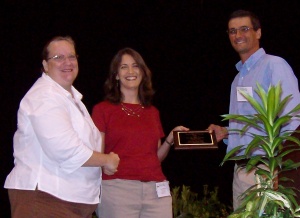
(L-R) Christine Kelly-Begazo, Eva Worden, Chris Worden. The Wordens receiving the Florida Innovative Farmer Award, a happy achievement for the work they love!

I went to Worden Farm last year with Farmer Margie and the WWOOFers, and my folks from Urban Oasis Project. We had a tour of the farm, and got to see the amazing results Chris and Eva get from good stewardship of their 55 certified organic acres. Because they supply some of the food in Redland Organics CSA shares, I thanked them for feeding my family. By the way, have you thanked your farmer lately?

The second recipient of the awards was Trish Strawn of Deep Creek Ranch in Deland. Trish and her dad, David, work the family farm which has been around since 1883. Trish said they got into grass-fed beef because her dad had a health issue, but she said if you ask her dad, he’ll say it’s because they’re “cutting edge.” The room broke into laughter.Trish is Co-Leader of Slow Food Orlando, and a founding member of the Florida Food Policy Council. She is also a lot of fun to go out and have a beer and a lot of good laughs with, which we did later that night. Trish and her dad are the real deal. Joel Salatin must be proud.

The third award recipient was George Owens of Chipley, FL, who has a mixed cattle and timber/forestry operation, or silvopasture. George could not be present for the awards because his son had just come home for a short visit from Afghanistan. All were very happy for him. The award presenters said “we tend toward a monoculture system, so when we get someone who does integration, we want to encourage it.”  I am a believer in agroecology, and it is very encouraging to hear agricultural professionals talk about moving away from monocultures!

I was very excited to hear my friend Will Allen of Growing Power, Inc. give the keynote address. Unfortunately, Will had some knee surgery which made it impossible for him to travel to the conference, though that was the original plan. Technology to the rescue! The AV geeks got the satellite/internet hookup to Will Allen up and running, and we were able to see and hear him on 2 large screens, and he was able to see and hear us.

That's me with Will Allen at a Growing Power workshop last year. Will loves scooping Lake Perch out of his aquaponics tanks! He loved to fish when he lived in Miami too.

Larger than life on the big screen, Will spoke about the history of Growing Power, all the amazing past, present and future projects they have, and was enthusiastic and inspirational as always. Larger than life is a profound statement when referring to Will Allen, who stands tall at 6’7” and weighs 230 pounds. Will played basketball for the University of Miami in the 1970’s, and still wears an orange and green UM cap with his signature royal blue Growing Power sweatshirt with cut-off sleeves. His biceps are bigger than many supermodel’s waists, and he keeps them that way by working hard every day, growing food for Milwaukee’s inner city on 3 acres, 2 blocks from one of the country’s largest low-income housing projects, in what was an urban food desert until Will’s good food movement became a good food revolution. Will is not an armchair CEO. He gets his hands dirty. He loves farming like Chris and Eva Worden do. I think some of us are born agrarian. It is not a choice, it’s in our blood, and it’s who we are.

Will showed many slides of Growing Power in action: composting thousands of tons of Milwakee’s food and brewery waste and “growing soil” as he says; passing compost through the digestive tracts of thousands of worms, creating rich worm castings fertilizer; raising tilapia and lake perch in the bottom level of a 3-tiered, homemade aquaponics system, with watercress growing in the middle layer, and tomatoes on top; raising chickens and bees in the city; providing a safe after-school space for urban youth to learn green job skills; feeding senior citizens healthy food with a “food basket” CSA; providing a retail grocery space with their fresh salad greens, eggs, and so much more to the neighborhood in which Growing Power’s urban farm resides.

“If people can grow safe, healthy, affordable food, if they have access to land and clean water, this is transformative on every level in a community.  I believe we cannot have healthy communities without a healthy food system.”

Will is a major inspiration for what we do in Urban Oasis Project, doing our part to make good, clean, safe, healthy, and local food accessible to all. Access to real food should be a right of all citizens. Will says “we can’t wait around for government or others to do it, we have to do it, just start doing things.”

I could go on about Will Allen forever, but I’ll stop here. Please come back for Part Three, highlighting local food lunches and conference workshops!
Read Full Post »

Hey there Redland Ramblers! This is guest blogger Melissa Contreras, founder of Urban Oasis Project. Last night, a group of Redland and Miami farmers and I returned home after a weekend at the 2nd Small Farms/Alternative Enterprises Conference in Kissimmee.  I have always been a farmer wannabe, and as such, I grow food for my family, my pet bunnies,  and a few friends on my 1/4 acre “urban homestead” in Kendall.  I was happy to learn at the conference that this small scale of growing is now being officially considered as part of our local food system, as it should be! The University of Florida/IFAS Extension isn’t just for big farmers and agribusiness, we little people count too!

Cast of characters on this road trip included Bee Heaven Farmer Margie, husband Nick, their new farm manager Jane;  Muriel of Little River Market Garden, Mario of Guara Ki Farm, and me.  Meeting up at Bee Heaven Farm, we shared a ride in Margie’s van, and took the scenic route around the shores of Lake Okeechobee on US 27. It was beautiful! Cows and egrets mingled in green pastures, Nick spotted a sandhill crane, and tri-color herons searched for underwater snacks near the water’s edge. Along the way, through what was once a river of grass, we saw fields of sugarcane (some organic), and picturesque views which reminded me that while South Florida is often thought of as a metropolitan built environment,  it still belongs to Mother Nature, though altered. Hopefully Everglades restoration will return the river of grass to its rightful owner.

After 4 hours on the road, we arrived  and checked into our hotel, the posh and sophisticated Super 8. Hey, we’re on a budget, OK?  I shared a suite with Margie, Nick, and Jane.  After repeated promises to Jane that I would not confuse her with my husband in the middle of the night, she decided to sleep on the couch.  But, I digress.  We had a nice lunch in restored historic downtown Kissimmee, an old cowboy town with a lovely lakefront, unique and colorful wooden homes with gingerbread mill work, unusual eateries and watering holes like ” The Wicked Stepsister,” a nice antique shop,  and so much more. Next time you’re in the neighborhood, take a break from the Orlando area tourist traps and visit this authentic town.

After lunch, we proceeded to the Osceola Heritage Center, site of the next day’s convention, for meetings of the Greater Everglades Foodshed Alliance, the Florida Food Policy Council, and a pre-conference pow-wow with Extension agents from all over Florida. The Greater Everglades Foodshed Alliance meeting was a recap of the Food Summit for interested parties.  The Florida Food Policy Council will “bring together stakeholders from diverse food-related sectors to examine how the food system is operating and to develop recommendations on how to improve it. FPCs may take many forms, but are typically either commissioned by state or local government, or predominately a grassroots effort. Food policy councils have been successful at educating officials and the public, shaping public policy, improving coordination between existing programs, and starting new programs.” (definition from foodsecurity.org). We are forming a soon-to-be Miami food policy council. (Contact Mario if you have a stake in our local food system and want to participate in this new effort.)

Those who attended the informal Friday meetings were also invited to sit in on the pre-conference event for UF/IFAS Extension agents, in which  Dr. Danielle Treadwell, Dr. Mickey Swisher, and Sarasota Extension’s new Director and doctoral candidate Evangeline “Van” Linkous  talked about our changing food system from their different points of view and varying expertise.  Dr. Treadwell champions UF research in organic and sustainable farming, and feels that “educating consumers is an important part of what we do.”  Dr. Swisher said she was surprised to discover the “30 mile problem” in which  “disadvantaged communities in Florida’s urban areas often live 30-40 miles from areas where fresh produce is grown.”  Van’s background is in planning and she was a member of the Delaware Valley Regional Planning Council before coming back to Florida from Philadelphia and the University of Pennsylvania. She feels that much urban zoning could be converted to mixed-use, which could mean urban farms and farm stands could be located within high-density urban populations, giving urbanites more access to local, fresh food. A kindred spirit! We are quite lucky to have these three women in Extension.

So, if you’re catching on to a theme here, the conference tagline was “Sustaining Small Farms…Strengthening Florida’s Communities.”  There was much excitement among attendees on that Friday before the conference, seeing our major research institutions catching onto interests of so many people in local food,  and food justice as a paradigm shift from our current system. Further illustrating this point is the choice of keynote speaker for the conference: my personal hero, Will Allen, founder of  Growing Power, Inc.

I will write more about Saturday of the conference in the next post:  keynote speaker Will Allen, the three Florida Innovative Farmer Award winners, conference workshops, amazing local foods lunch and more! Come back  for more, including pictures!

Read Full Post »

John Ikerd

John Ikerd

Back again to the Small Farms Conference. (Nope, I’m not done blogging about it.) The keynote speaker was Dr. John Ikerd, author and Professor Emeritus of Agricultural Economics from the University of Missouri, whose speech was Small Farms in the Year 2050. (An earlier version is on his web site.) According to the conference bio, Ikerd “came to the conclusion that not only was American agriculture not sustainable but neither was the American economy or society.” He is a huge advocate of sustainability and local food systems, and has written a great number of papers with that perspective.

Ikerd posed the question, “Can farmers meet the challenges of creating a sustainable agricultural system? Innovative farmers commit to meet needs of the present without diminishing future productivity.” He said that the current industrial approach to farming is simply not sustainable, and that lack of sustainability is a major part of a growing global economic problem. Industrial farming uses an enormous amount of fossil fuel, generates over one fifth of all greenhouse gas emissions in the US, and maintains an income disparity for farm and food workers working for low wages.

So what’s the solution? According to Ikerd, the local food movement (which evolved from the organic food movement in the 1980s) has more potential for transforming society. It requires a fundamental change in thinking, primarily that local growers are producing food that is good, clean and fair, not a commodity that large, industrial farmers produce.

Sustainable agriculture is based on people compared to industrial agriculture which is centered on capital and technology. Ikerd described local farmers who choose to grow high-quality food that is natural, organic and sustainable. They work with the forces of nature, and fit their farm to the land and climate. Their crops are diverse and complex because nature is diverse and complex.

In 2050, Ikerd predicted a connectedness among local growers who create regional liaisons among themselves to market their crops, forming the backbone of a national network of community-based food systems. Out of local/regional connectedness comes farmers markets, CSAs, farmers selling directly to restaurants and markets, farm-to-school and farm-to-hosptal programs. Ikerd mentioned Alice Waters and her legendary restaurant Chez Panisse which set the trend decades ago by serving fresh, local and seasonal food from local and sustainable farms.

He also predicted in 2050 the major trend in food marketing is targeted toward a specific group of consumers, not the mainstream. Sustainable farmers work to build relationships with their customers instead of making a quick sale. Their customers are not naive hippies, but conscious buyers looking for food with ecological and social integrity, and expect farmers to have the same integrity and care about their customers and society. Ultimately there is a sense of connectedness — between growers and their customers, and between customers connecting with their food and the place it comes from — which ensures ecological and sustainable integrity.

Ikerd’s speech was full of fire and brimstone, and got a standing ovation. It was fascinating to hear Ikerd’s predictions for a new food system. But it’s not that far off into the future. Something similar to what he describes is happening right in our own backyard. Redland Organics is a group of local organic and natural growers that Farmer Margie organized to market their diverse foods directly to the CSA members and buyers at the farmers market. You could say that Redland Organics is cutting edge.

“Change happens one person at a time. Never underestimate the power of individual choices,” Ikerd said. So, here’s some questions to chew on: What are your choices? How are you making changes? How do you connect with your food and where it comes from? Most importantly, have you returned to the common sense pursuit of happiness?

Read Full Post »

real-dirt-book
The Real Dirt

The last presenter of the last session of the last day was not to be missed. Peter Burkard, farmer and published author, spoke on the panel “Local Food System Development.” I got his permission to post his speech it its entirely, and you can read it below. Although this blog’s focus is on Redland Organics’ growers and customers, what Peter has to say is extremely relevant in South Florida.

If you want to read more, his book is called The Real Dirt: An Organic Grower’s Journey and the Values that Inspired It, which sells for $15 a copy. You can get yours by contacting him at PMBORGANIC(at)aol.com. (Please remember to take out the (at) and put in the @ when you order your copy. Am doing this to ward off spam.) Peter is also a member of the Southwest Florida Small Farmers Network.


The Holy Land is Everywhere

You know those cars that are plastered with like 30 bumper stickers? I recently saw one of these at a small farmers’ market in the little town of Burnsville in the North Carolina mountains. Now usually I find myself in agreement with most sentiments on such cars and I knew this one would be no different, being at a farmers’ market and all. So I checked it out a little and among other incisive bits of wisdom like “JUST SAY NO TO SEX WITH PRO-LIFERS” was this one that I really liked: “THE HOLY LAND IS EVERYWHERE”. The idea being that we need to be worshiping the entirety of creation, not just some special place set aside.

As we go forth today, this is the vision and mind-set which it is our job to create amongst the majority of our fellow humans, an understanding and appreciation of the immense value of undegraded land. Undegraded land can either have massive value as wilderness, through free ecosystem services, or in its agricultural potential…and the best of farms will marry the two. We need the majority of the public to not only reject agribusiness but along with it reject the mechanistic, controlling, reductionist worldview upon which agribusiness is based. To do that, they need to both be informed about the reality of industrial agriculture and be able to experience our positive alternatives and the fabulous food that we provide.

Wendell Berry draws the distinction between industrialism and agrarianism, in which industrialism is a way of thought based upon monetary capital and technology, while agrarianism is a way of thought based on a sustainable relationship with the land, preferably land on which the farmer’s family lives. He sees this as the overarching theme of all our efforts…the replacement of the dominant destructive, unsustainable model which is destroying the prospects for life as we know it, with our culture of respect for our life-support system and each other.

This industrialism we fight against is easy to see every day throughout Florida in the destruction of excellent farmland under the developer’s bulldozers. Following this near-removal of food growing from areas most inhabited by people, industrial, chemicalized agriculture is given a quasi-monopoly over our food supply. Rural land is of course cheaper but is also conveniently out of sight, so the vast majority of the public has little if any direct contact with the production of their food.

It is up to us to change that, locating some of our attractive, sustainable alternatives in urban and suburban settings. By reversing the trend of the last hundred years of separating people from their food supply, we both provide the model for a more sustainable future and enlist more of the admiring public to our cause. For it is only after a sufficient number of voters and tax payers join our side that the policy makers will be forced to act or else be removed from office.

There are a great many successful alternatives to the industrial food system. We need to be those model alternatives, as well as unite with our like-minded brethren, be they fellow producers, consumers, or even competitors, so as to maximize our political clout. In our area of the Central and South Florida West coast, we’ve established a small farmer network to enable us to learn from each other and also acquire strength through numbers, so as to better move our agenda forward politically. I’d like to encourage other areas to create their own similar networks of growers.

Still, at the same time, I’d like to promote what I see as the best answer, one for which all you need is yourself. There is one food production method that stands out as clearly the most local, most fresh, most flavorful, most fun, most providing of exercise, and most reducing of our carbon footprint. That is growing as much of your own food as possible at home. Even though I’ve sold produce at a market for 30 years, I’ve never thought of this backyard grower as competition; instead, once one tastes the difference in truly fresh, organic produce, they will surely seek out what they aren’t able to grow themselves from us market gardeners. Besides, it is the right thing for the world. (If you’ve ever been to Europe, you’ve seen not only vastly better transportation and health-care systems but also a lot more–in some places almost universal–home food and flower gardens.) So grow as much as you can at home or in a community garden and buy the rest from other small farmers, local whenever possible.

Time for some policy specifics. These are specific elements of the food system that we need to be striving towards. I’ll call it my “John Lennon section”…Imagine these things being reality. But we need to do more than just imagine them and work towards making them a reality. So pick one or two you are most passionate about and get involved with making them happen.

–URBAN FRINGE AND EVEN URBAN LAND WHICH IS SET ASIDE IN PERPETUITY FOR AGRICULTURAL ACTIVITY, THROUGH THINGS LIKE CONSERVATION EASEMENTS AND SPECIAL TAX TREATMENT,
–MORE URBAN COMMUNITY GARDENS,
–THE TEARING DOWN OF URBAN LAWS WHICH PROHIBIT AGRICULTURAL ACTIVITIES,
–MORE SCHOOL GARDENS AND CHILD EDUCATION ABOUT FOOD PRODUCTION,
–MORE WIDESPREAD USE OF FARM-TO-SCHOOL PROGRAMS,
–MORE FARM TO CHEF CONNECTIONS,
–MORE ACCESS TO FRESH, LOCAL FOOD FOR THE URBAN POOR,
–CONTINUED EXPANSION OF FARMERS’ MARKETS AND CSA’S,
–MUNICIPAL AND EXTENSION EFFORTS TO ENCOURAGE MORE HOME FOOD PRODUCTION, MEANING TRADITIONAL AND ROOFTOP GARDENS, FRUIT TREES, SPROUTING, CHICKENS, BEES, RABBITS, TILAPIA, AND SO ON,
–MORE TOWN-TO-FARM NUTRIENT CYCLING,
–THE CONTINUATION AND/OR EXPANSION OF GOVERNMENT INCENTIVES FOR GREEN ENERGY AND WATER CONSERVATION MEASURES IN CONJUNCTION WITH FARMING,
–COUNTIES PROVIDING LAND FOR ESTABLISHING WORKING FARMS DESIGNED TO TRAIN NEW FARMERS,
–MATCHING PROPERTY OWNERS WITH POTENTIAL SHARECROPPING OR RENTING FARMERS AND GARDENERS,
–MANDATING WORKING FARMS OR COMMUNITY GARDENS BE INCORPORATED IN ALL HOUSING DEVELOPMENTS OVER A CERTAIN SIZE. (NEEDED TO BE DONE LONG AGO.)

This isn’t a world we need to create from scratch. Most of these ideas are already being turned into reality somewhere in this country…or they exist in a fledgling way and we just need to help them along.

There will always be battles with those seeking to preserve an obsolete and unsustainable status quo. These same Chamber of Commerce types either have fought in the past or still do fight for things like making toxic children’s toys, nuclear weapons, and gas guzzlers, destroying old growth forests, hunting and processing whales, and preserving the slave trade.

Just because an activity creates jobs–creates commerce–does NOT mean that is something we as a society should be encouraging…not an automatic good. As I give talks in support of my book, The Real Dirt, an Organic Grower’s Journey and the Values that Inspired it, this is one of the points I emphasize, the merging of a strong sense of ethical values with our livelihoods. It should be clear that we are on the right side. Just remember that what we envision is a far more just, peaceful, and sustainable world, and that fact alone should sufficiently inspire us.

written by Peter Burkard

Read Full Post »

800 strong

What do you get when you put a bunch of small farmers together in a large room? Spontaneous combustion of brain synapses! You’ll need to get a burn permit! On Saturday the official count was 800 participants (700 pre-registered and 100 walk-ups) from all corners of Florida. There was lots of good energy from all those people meeting and sharing information and ideas.

This was the first year for the Small Farms Conference, and word is the UF/IFAS organizers want to do it again. Commissioner Bronson said in his speech that he’s budgeted $15K for the conference next year.

Also, if you weren’t able to attend and feel bad about missing out, speakers’ handouts and recordings or transcripts of presentations will be posted on the conference website in a week or so. Will keep you posted.

Thanks to Gabriele, Margie, Hani and Nick for collaborating on this post.

Read Full Post »

« Newer Posts - Older Posts »