Feeds:
Posts
Comments

Archive for the ‘agritourism’ Category

Join us Wednesday, February 24, 2010 for
A Possum Trot Experience! presented by Bee Heaven Farm

POTATO PANDEMONIUM

Native to the New World Tropics, potatoes are used around the world in many different cuisines. Experience the incredible variety of potatoes at this one-of-a-kind event.

MENU
Potato Vichyssoise Soup with Multicolored Chips
Potato Salad with Carambola Relish
Scallopes Potato with Betel Leaf
Individual Potato Souffles
Parsley Potatoes
Smoked Potato Medley
Meat ‘n Potatoes
Potato Pancakes Topped with Fruit & Cas/Passion Sauce

Your unconventional experience will include sampling from a selection of 35 years’ worth of home-made wines from tropical fruits grown on the farm.

Limited seating in quasi-formal setting in a rustic old Florida farmhouse.
$100 per person * 6:30 pm serving
Come early for an informal class on sustainable cooking techniques and unusual uses for local ingredients.

RSVP with advance payment required by Saturday, February 20th.
Cancellations accepted up to 48 hours prior to event.
No refunds for no-shows or late cancellations.

REGISTER NOW

Where:
Possum Trot Tropical Fruit Nursery
14955 SW 214th St
Miami, FL 33187-4602
305-235-1768

Read Full Post »

Valentine’s Day, February 14th features LOVIN IN THE GARDEN

Join us for dining, music and dancing under the stars

Come join us once again for the most romantic day of the year by spending an enchanted evening in paradise! LOVIN IN THE GARDEN will tempt you and your lover’s senses throughout the evening as you stroll in the beautiful tropical gardens; recline together under the stars with a glass of delicious wine; indulge in our aphrodisiac-inspired menu kissed with organic herbs; paired with equally sensual wines selected by Sommelier Shari Gherman.

Private chefs and brother/sister team Christopher Siragusa and Mary Siragusa will delight you with their farm fresh tropical cuisine with a specialty in edible flowers. Love songs fill the air to inspire passion and excitement, it will stir your senses, encourage you and your lover’s desire to be close… you’ll be dancing in the moonlight. LOVIN IN THE GARDEN is the sure way to make this Valentine’s Day the one you will always remember.

Please visit www.paradisefarms.net to make reservations.

Read Full Post »

Anderson’s Corner doesn’t look like it will last much longer. It’s depressing to drive by there and see it all ramshackle and rickety, instead of restored and vibrant. I doubt if the current owners, who are struggling with upkeep, will be able to hold on much longer if they are going to get fined $500 a day. This might be the tipping point. Anybody out there with deep pockets who would like to help save this property?

The word was that the new bed and breakfast ordinance, which was drafted this summer with input from area growers, has gone to the county commission for a vote — but it has been pushed back and pushed back on the calendar. No telling when it will come up for a vote. It was supposed to in October, then in November. A yes from the commission will allow growers to add commercial kitchens and farm stands, and to legally to make and sell value-added agricultural products — jams, cheese, dried fruit, pickles and the like — in addition to the bed and breakfast provision. This new ordinance will essentially promote agritourism, which will allow the farmers to stay in business.

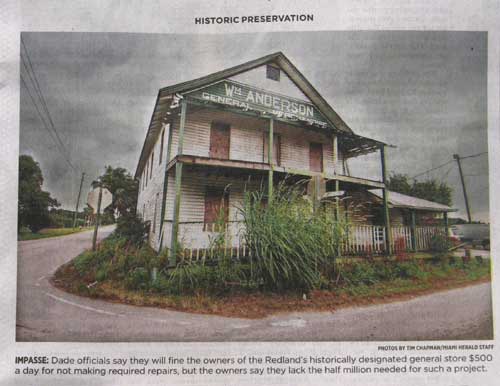
Anderson’s Corner, as photographed by Tim Chapman of the Miami Herald.

Redland’s Anderson’s Corner store at center of historic preservation battle

Miami-Dade officials have cracked down on the owners of the vacant, 100-year-old Anderson’s Corner general store in the Redland to prevent `demolition by neglect.’

BY ANDRES VIGLUCCI
aviglucci@MiamiHerald.com

The Anderson’s Corner general store, a modest, two-story wood-frame building on a corner in the rural Redland, doesn’t look like much. The white paint is peeling, porches sag, shattered windows are boarded up, and the Dade County pine siding is badly splintered where a hit-and-run motorist took out a chunk of wall last month.Yet the long-vacant country store, built around 1911 by a Redland pioneer, is one of Miami-Dade’s oldest and most resonant buildings — and also one of its most endangered.

And now it’s a test case in a county effort to boost enforcement of an ordinance meant to save historically designated buildings from what is happening to Anderson’s Corner, a phenomenon commonly described by preservationists as “demolition by neglect.”

“It’s sad to see these things happening, especially to a building that important,” said Kathleen Kauffman, Miami-Dade’s historic preservation officer. “And we don’t have that many wood-frame buildings left, period.”

Kauffman has cited the property’s longtime owners, Brian Simmons and his wife, Jessica Olsen, for failure to maintain a designated historic building. If the owners don’t make repairs sufficient to halt its deterioration, they will be fined $500 a day until the deficiencies are corrected.

Recently, the owners organized a cleanup, removing accumulated trash from the property and resealing boarded-up windows that had been forced open.

But Simmons said that he and his wife, small local farmers, lack the resources to do extensive repairs. They had planned a full renovation when they purchased it in 1997 but were unable to secure financing, he said. They have since had constant trouble keeping up with maintenance because vandals or homeless people regularly break in and damage the old building, Simmons said.

“It’s a money pit,” he said. “If I had the money, that place would be shining. It’s a piece of history, I know that. It makes us sick to know the condition it’s in. But my resources are tight.”

Subrata Basu, Miami-Dade’s assistant planning and zoning director, said he sympathizes with the owners’ difficulties but noted that they knew they were purchasing a protected building 12 years ago.

“It’s the owners’ responsibility to maintain the property — not just a historic property, but any property,” Basu said. “But it becomes a different issue when it’s a historic building.”

CITATION TRIGGER

County ordinances bar demolition or exterior alterations of buildings designated as historic. To address cases where owners allow historic buildings to slide into ruin — either deliberately or because of inability to properly maintain them — the ordinance gives the preservation officer the power to levy the $500-a-day fine.

But the ordinance had not been enforced, in part because the small office of three people lacked the resources to do so, Kauffman and Basu said. When the planning and zoning department last year absorbed the office, formerly housed at the county’s cultural affairs department, Basu had zoning inspectors undergo training to enforce the rules.

Complaints from neighbors over the worsening condition of Anderson’s Corner triggered the citation, the first under the new policy.

“I really resent that place falling apart,” said Peter Hoffman, one of the complainants, who lives catty-cornered from the old country store in an even older wood-frame building — the area’s original two-story 1904 schoolhouse, which is immaculately maintained.

“Locals and tourists knock the windows out,” he said. “They just kick those things out and they go in the building. It’s falling apart. The front porch is going to be in the street before the summer. And I’m worried about someone starting a fire.”

ABOUT ITS HISTORY

The store was the center of a settlement built by the first pioneers to claim homesteads in what was then, at the turn of the last century, a hardscrabble wilderness. Built by William Anderson, who worked for railroad magnate Henry Flagler, it provided living quarters for his family and served as a general store for what became a thriving farming community.

Editor and historian Howard Kleinberg called it “South Dade’s historic centerpiece.”

Designated a historic building by the county in 1981, Anderson’s Corner is part of a larger district made up of other surviving structures from the period, including the old schoolhouse. Anderson’s Corner is also on the National Register of Historic Places.

In the early 1990s, tropical fruit grower Joan Green and chef Mario Martinez transformed the old general store into a well-reviewed gourmet restaurant that used local produce in its dishes. It was just starting to gain popularity when Hurricane Andrew in 1992 took the building’s roof off and knocked the second story askew, putting an end to Anderson’s Corner’s brief-lived second incarnation.

The building has been vacant ever since.

Armed with $750,000 in grants, Green and Martinez gutted the building and began what was meant to be a complete restoration. Steel columns were installed to support the structure and a new roof put on. But the two had a falling-out amid what Green says were endless bureaucratic obstacles and financial disagreements.

The county pulled a $250,000 grant and, after lengthy litigation, the partners ended their involvement by selling to Simmons and Olsen, Green said, calling it “one of the greatest disappointments I have had in my life.”

“They had some idea about what they wanted to do there, but quite frankly it didn’t make any sense, economic or otherwise,” Green said in an e-mail from the Caribbean, where she now lives aboard a catamaran. “I have felt like crying every time I drive by the property because I have observed it deteriorating. I feel sad about all of the public money that went into the project that came to nothing.”

Dade Heritage Trust, a preservation group that loaned Green and Martinez money for the renovation, “never got a penny back,” said executive director Becky Roper Matkov.

“So much effort went into that, it’s such a shame,” Matkov said.

Simmons said he and his wife still dream about reopening Anderson’s Corner, but they were never able to secure financing for what he estimates would be a $500,000 restoration job. The couple, who live on a farm down the road, also had triplets since buying the historic property, limiting their time to focus on restoration or maintenance of the building.

Simmons said he would sell the property, but his wife, who grew up in South Miami-Dade, won’t hear of it.

“I had some great offers, but my wife said no,” Simmons said. “I would sell it today.”

BEHIND THE NEGLECT

Meanwhile, the building continues to deteriorate. Customers from a cantina next door litter the property with beer cans and bottles, Simmons complains. He believes cantina customers are responsible for some of the vandalism.

The cantina owner, for his part, says he believes the historic building is an eyesore and would like to see it gone.

“It has no value,” said the owner, Edelmiro Iglesias. “It has no floor and holes everywhere. It’s just going to fall down by itself.”

At least one neighbor thinks the vandalism may be deliberate, noting the historic property is one of a fewin the Redland with commercial zoning — thus potentially a target for someone hoping to cash in by building new retail.

“Piece by piece, it has been disappearing. Every day a piece goes missing. Almost as if it was being dismantled,” said John Green (no relation to the former owner), who has a small farm nearby. “It’s almost a sin to see this old edifice taken apart.”

Basu, the county planning official, said he believes there’s hope for saving Anderson’s Corner, which he believes would make a “wonderful” bed and breakfast. His agency is now drafting an ordinance to permit such lodging in the Redland.

But he concedes that the case underscores the difficulty in enforcing preservation laws. He hopes enforcement will stave off the building’s deterioration by ensuring that it is secured and, if necessary, shored up. But forcing actual renovation is well beyond the scope of the ordinance, and he acknowledges that the fine amount is “weak.”

“If someone is not cooperating, it can become a nightmare,” Basu said. “You can force them to do something immediate, but if they’re not into it, you eventually go back to where you started.”
© 2009 Miami Herald Media Company. All Rights Reserved.

Read Full Post »

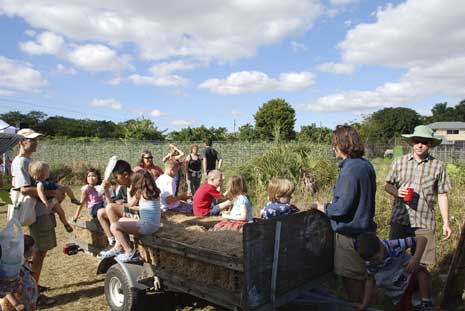
Hanging out at Farm Day 2008. (Grant Livingston was the musician last year.)

Farm Day

Come to the country!
Fun for the whole family!

Sunday, December 20
11:30 am – 3:30 pm

* Food * Activities * Hay Rides *
* Farm Market *
Locally-grown seasonal organic produce, dried fruit, heirloom tomato plants for sale.
* Live Music *
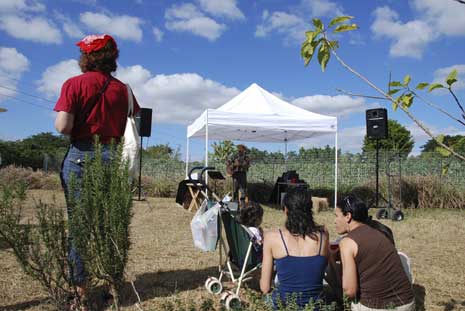
With Jennings & Keller: Fusion Folk Americana

Your optional $10 donation helps support our internship and student artist programs
and includes a chance to win a Smith & Hawken BioStack Composter ($129 value).

Directions:
From southbound US1, turn right (west) onto Bauer Drive (SW 264 St.) and go approx. 5 miles. The farm is about 1/3 mile past Redland Road (SW 187 Ave.) Look for the farm sign and flags.

This is Bee Heaven Farm’s annual open house. Every year more and more people show up. Last year over 200 folks participated in the event. Here’s some tips so you can have more fun: Get there early! Bring your kids, but leave the dogs at home. Bring a covered dish to share in the potluck. Bring money to buy veggies, honey, fresh herbs and flowers, and other farm goodies. Bring old clothes to make scarecrows.

Most of the local farmers who have been growing food for the CSA will be at the party. Confirmed rsvp’s: Robert Barnum of Possum Trot Nursery who will cook local foods and roast corn. Hani Khouri of Redland Mediterranean Organics will have goat milk ice cream, goat cheese and authentic Lebanese dishes, and will bring his fryer to make falafel. Still waiting on rsvp’s: Cliff Middleton and the other Clifton of Three Sisters Farm (callaloo and yuca); Gabriele Marewski of Paradise Farms (oyster mushrooms), Dan Howard of Homestead Organics (green beans, yellow squash, zucchini) and Murray Bass of Wyndham Organics (avocados).

The donations collected will go toward two very worthy causes. Farm Day overlaps during Art Loves Farms, an art students residency at Bee Heaven. Eight students from DASH will be living on the farm for four days making art, which will be exhibited at a later date. The donations will be split between an honorarium for a guest artist who will give a workshop with the students, and farm internship expenses. Almost all the farm workers are interns or volunteers who have come from all over the United States, sharpening their farming skills learning how to grow new crops. Some of the volunteers/interns have gone on to run farms of their own. (Oh, and if you see a videographer roaming around, that would be me documenting both events.)

Here are some pictures from last year’s Farm Day.

Sylvia, CSA member and site host, shopping at the mini market.

Kids of all ages get up close with a real tractor.

All aboard for a hayride.

When was the last time you made a scarecrow?

Read Full Post »

text by Art Friedrich, urban farmer, member of Urban Oasis Project
photos by Antonio Guadamuz, member of Urban Oasis Project

Saturday, Nov 28, 2009

Art Friedrich and partner Luigi (in flannel) touring ECHO

Getting out beyond SE FL to see what other things are happening in organic and sustainable agriculture in Florida, 16 folks headed out to ECHO (Educational Concerns for Hunger Organization) Global Farm and Worden’s Organic Farm in N. Ft. Myers and Punta Gorda, respectively. The group consisted of a number of the workers and WWOOF’ers from Bee Heaven Farm, as well as the big brain behind it all, Farmer Margie. Joining them were a number of local food enthusiasts from Urban Oasis Project and some of the new batch of Master Gardener Interns. [Note: Margie organizes a trip to ECHO and Worden every year during the Thanksgiving weekend, for the purpose of enlightening her farm interns and volunteers, and others who want to make the trip.]

Our first stop was the ECHO Global Farm, a christian based project started over 25 years ago to combat the problem of world hunger, primarily in the tropical zone, using the most concrete and long-lasting ways. Tours are available daily, and are well worth the $8. The tour consists of two hours of seeing and hearing about numerous fascinating plants, and methods of growing highly nutritious foods using unconventional and conventional methods that require little monetary outlay. There are six different recreated environments, such as a rainforest, an arid area, a monsoon climate (like we have, with 6 months dry and 6 months really wet), and the fascinating urban garden section.

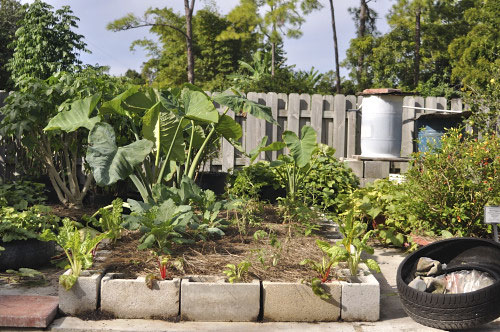
Container gardening taken to a new level.

The urban garden section showed some great examples of reusing trash, such as old tires, to create containers. Also fascinating was the wicking gardens that are mostly made up of a carpet with a little bit of soil in top and some gravel or even cans wrapped in socks for the plants to have structure to grow on. You fill a closed bucket with a hole in the bottom with water, stick it on an edge of the carpet, and let the garden suck the moisture out as it needs it! This is a great way to use a minimum of water and soil. While some of us had questions about the safety of carpet material, other types of substrate could be developed. Probably any old canvas or woven mat material would do. They try laying the carpet out in the natural UV rays of the sun to break down harmful chemicals.

I also enjoyed the mention of their research using human urine as fertilizer — it is packed full of good nutrients and is sterile! In some countries, this has been government sanctioned for a while, such as in Sweden, where some housing developments have been built with urine diverting toilets that drain to some big tanks. When the farmers need fertilizer, they just pull up, pump some of the liquid gold out, and spray it right on their fields! The savings in water and fertilizer are stellar, and it is only cultural taboo that makes the subject so difficult.

Urban homesteading at its finest!

The Moringa tree is a favorite plant there. They call it the Miracle Tree. One can eat almost any part of it, and it is incredibly dense with nutritive value, and the tree grows in almost any condition. I’ve started my own little plantation at my house in S. Miami.

Rustic raised bed

ECHO is also a seed bank, and they send seeds all over the world to see what works, with attention to both the physical and the cultural aspects. This aspect impresses me. It is applied science that recognizes humanity’s needs as a driving force in experimentation. And the needs of the global poor are great, but with sensitivity and ingenuity, the poor can be given the tools they need to improve their own lives in a sustainable and self-empowering way. ECHO taps into their own knowledge and traditions and offers a broader knowledge base for them to work with.

Endless fields at Worden Farm

The second half of our day was visiting Worden Farm in Punta Gorda. The farm is a brilliant example of hard work and smart planning to generate massive amounts of organic vegetables, sold all along the Gulf Coast. The farm is 55 acres, with about 35 in production, and is only six years old. The soil is almost pure sand, so lots of chicken manure is used as their fertilizer, as well as cover crops to slowly improve the quality. Long rows of raised beds made with plastic sheeting make upkeep relatively easy, and the veggies all looked absolutely flawless.

Drip irrigation system at Worden Farm

The plastic sheeting with drip tape irrigation underneath also helps limit water use, as well as the extra work of short watering cycles very frequently. Extra work to reduce the negative environmental impacts of the farm is a tradeoff they are happy to make. Those plastic sheets at the end of the season don’t hit a trash pile. They go to an agricultural plastics recycler.

Touring Worden Farm by electric cart. L-R: Wwoofer, Eva Worden, Cesar Contreras, Margie Pikarsky (back turned), Melissa Contreras

Farm Ferrari

Cow at Worden Farm

Read Full Post »

« Newer Posts - Older Posts »