Feeds:
Posts
Comments

Archive for the ‘farm’ Category

This weekend, come meet farmer Rachael Middleton and chef Jon Gambino of Three Sisters Farm, which is located, quite conveniently, across the street from the Fruit and Spice Park. Rachael and Jon are bringing plants and tastes of their farm to GrowFest!

The farmer and chef couple will have an assortment of edible plants for sale, whatever they are able to haul across the street for the weekend. “We have some interesting different fruit trees, and cool tropical roots, like malanga. We have a good variety of heirloom tomato seedlings and some different peppers,” Rachael told me. Besides vegetable seedlings, they’re also offering larger plants as well.

“We have a lot of big stuff that we can’t bring across the street, but we will have a plant list and give a sampling of what our nursery has right now. Since we are an active farm year round, we are always producing root stocks and pups, and have suckers in abundance at the farm. People are welcome to contact us if they are interested in getting plants anytime throughout the growing season,” Rachael said.

Tastes will come mostly from whatever is in season at their organic and biodynamic farm. “We will offer a variety of drinks, including a sorrel drink (it really tastes like Hawaiian Punch). We’ll also have jaboticaba sorbet (and a limited quantity of fresh jaboticaba fruit!).”

Chef Jon recently acquired a wood fire oven, which he has been using to bake fresh bread for his Farm Meals. “The oven is one of our favorite new things this season,” Rachael said. “It’s amazing, and we have been doing a lot of baking at the farm lately because of it. We are going to bring the oven over to the park and bake fresh bread and make pizzas.” Come find out what kind of tropical toppings will grace goodies hot out of the oven at GrowFest!

Three Sisters Farm

If you would love to visit and dine at Three Sisters Farm, chef Jon Gambino offers a Farm Meal every Saturday by reservation only. “The meal begins with a private tour where you get to see everything we are growing on our active, working, natural farm,” Rachael said.  “At the end of the tour, you are seated on our beautiful tropical tiki deck, where if you time your reservation right, you will be able to catch a beautiful view of the sunset.

“The farm meal uses all of our own ingredients (sometimes supplementing with some of the best of what our neighbors have to offer) to create a multi-course gourmet tasting feast. Our ingredients are a wide variety including tropical fruits, veggies you know and love and some you may not know you love yet, tropical roots, and spices.  What Jon does with all those amazing ingredients is equally varied and exciting. He also makes delicious handmade pastas, fantastic breads and pizzas (baked in our wood fire oven, which you can see from the tiki deck).

“The Farm Meal is $85 a person and we sometimes offer a fish option for an additional $15. Don’t worry about not being full, it’s a multi-course (at least 5) feast. Do dress comfortably for walking around on the farm and outdoor dining.  It’s BYOB, no cork fee.”

The next Farm Meal is scheduled for Oct. 26th. This Saturday, Oct. 19th, there is no Farm Meal because of the festival. “We are pretty much a two man (sometimes three) show,” Rachael explained.

For reservations and more information:
Three Sisters Farm
18401 SW 248th St.
Homestead, FL 33031
305-209-8335

Read Full Post »

avos-cluster

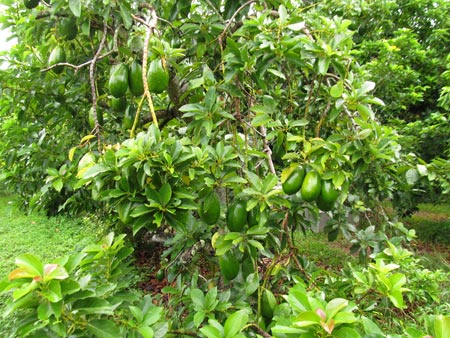
In August and early September, the stars of Bee Heaven Farm are the shiny green Donnie avocados grown to almost football size. Stroll through the grove even this late in summer and you’ll see many, both on the branches and littering the ground below.

Summertime is a good time to visit fruit growers in Redland, because as you tour their groves, they’ll pick a fruit and let you taste it. So when the newest member of the Extension office, Tropical Fruit Agent Jeff Wasielewski, came to visit, that’s exactly what farmer Margie Pikarsky did. She took him for a walk around her farm, where they paused at different fruit trees, tasted a couple things along the way, and shared stories about the trees’ health and growth. “Visiting smart, forward-thinking growers like Margie is important for me as a learning tool and not just a social visit,” he said. (The UF/Miami-Dade County Extension office shares the latest agriculture information from University of Florida’s researchers with farmers and gardeners in the county. Some of the ways are through workshops, educational materials, field consulatations, and their web site.)

Tropical Fruit Agent Jeff Wasielewski and Margie Pikarsky open up an avocado.

Tropical Fruit Agent Jeff Wasielewski and Margie Pikarsky open up an avocado.

Margie’s pride and joy is the grove of over 90 avocado trees, which she herself planted back in 1996. She and Wasielewski stopped at one tree where she picked up a windfall avocado and handed it to him. It looked ready to eat, so he pulled pruning snips from a case on his belt, and cut open the fruit.

He’s a tall, easy going man with a ready smile and 18 years of tropical fruit experience, and 21 years of horticulture in South Florida. You might already know him from lectures, articles and videos he made for Fairchild Tropical Botanic Garden, where he was the Educational Outreach Specialist. He’s developed keen senses and loads of experience when it comes to tropical fruit and plants. All it took was one taste and he said the avocado was a day away from being perfectly ripe.

Further down the row of trees, he noticed a dead branch, which Margie snapped off. “Be careful,” he warned. “A dead branch like that can attract other beetles now suspected of carrying laurel wilt.” Margie explained that she removes dead branches from the trees as soon as she finds them, and trims the trees every year. So far her grove looks healthy, but laurel wilt disease remains a lurking concern.

Laurel wilt is a dangerous avocado disease that appeared in Miami-Dade County a few years ago. It is spread by the red bay ambrosia beetle, which is tinier than a grain of rice. Wasielewski  explained that the beetle burrows into healthy avocados and other trees in the laurel family. “It cultivates a fungus that eventually kills the tree branch by branch by disrupting its vascular system. Signs of the disease are quick branch dieback or tiny holes and sawdust towers where the beetles enter the tree. The tree will die very quickly if infected. Commercial growers are advised to quickly and completely remove the tree and its roots. The removed tree should be burned in place, out of fear of spreading infested wood to other groves and trees. Root removal is necessary because the disease may spread from tree to tree through root grafts,” he told me in an email.

So far there have been over 2000 trees removed due to laurel wilt in commercial groves in Redland, and  growers are worried, and anxious for a cure. When the first tree in a large commercial grove was suspected of having the disease, Extension held a standing room only meeting for growers, informing them of the threat. They continue to provide updated information on their website and with occasional meetings. (Yes, backyard trees in town are also at risk. Find info for homeowners at Save The Guac web site.)

Jeff and Margie

Jeff and Margie

As Tropical Fruit Agent, one of Wasielewski’s goals is to inform avocado growers of new research on combating laurel wilt. “It’s important that I am on the cutting edge of what is going on in the tropical fruit world,” he said. University of Florida has done tests, and complied a list of pesticides that will kill the ambrosia beetle. Unfortunately, none of them can be used in an organic grove. Local organic growers are pressuring the scientists to test substances approved for use in organic production.

Margie expressed her frustration to Wasielewski at the current lack of effective organic options. He said he would keep her informed as to new research into alternative treatments. “I want growers to have options as far as doing things in an environmentally friendly way. I let them know their options and the value of each option. Growers are then free to make a choice on how they want to proceed, but only if they are armed with new knowledge and multiple options,” he told me in an email.

For now, it’s wait and see how bad laurel wilt gets in Redland, and how quickly research can come up with solutions that all growers can use. Wasielewski is an important addition to the Extension office during a critical time for tropical fruit growers.

As for Bee Heaven Farm, over the years Margie has accumulated a wide variety of other tropical fruit trees, tucked away here and there among the vegetable beds. Sapodilla, carambola, longan, mango, and bananas are planted in various spots on her five acre farm. If her avocado trees have to go, she’ll plant different fruit trees and more vegetables, she once told me. But until then, she and other growers will put up a fight to save their groves.

Got a question about tropical fruit? Contact Jeff Wasielewski at 305-248-3311, ext. 227 or email at jwasielewski@ufl.edu .

Read Full Post »

The big barn in the back of Bee Heaven Farm is where a lot of things happen. In the winter, a packing line for CSA shares is set up in its large open space.  Then in summer a slightly different packing line is set up to sort and box organic  avocados from the Bee Heaven grove.

Trees in the Bee Heaven grove are loaded with fruit.

Trees in the Bee Heaven grove are loaded with fruit.

Periodically through the summer, Farmer Margie delivers pallets of freshly-harvested large green Donnies and red-skinned Hardees directly to the Whole Foods Market Florida warehouse in Pompano Beach, where they are distributed to area stores the very next day.

Cleaning and grading avocados.

Cleaning and grading avocados.

Because the barn is a certified organic packing house, from summer through fall, local grower Murray Bass backs in trailer loads of his organic avocados to pack there. His crew cleans, sorts and boxes avocados all day long.

Filling boxes to be sold under Uncle Matt's brand.

Filling boxes to be sold under Uncle Matt’s brand.

Then pallet loads of his avocados are taken over to the Florida City State Farmers Market Facility, where they are kept in a large drive-up cooler. Big rigs from Publix and Whole Foods can back in easily to the loading docks to pick up their orders. Look for Murray’s avocados sold under the Uncle Matt’s brand!

Unloading pallets of Uncle Matt's avocados at the Florida City market.

Unloading pallets of Uncle Matt’s avocados at the Florida City market.

Read Full Post »

Summertime is down time

summer-moon

Rising almost-full moon on Summer Solstice Eve.

It’s officially summer time! The solstice was last Friday, followed by a supermoon (when the moon is at the very closest to Earth all year). But it sure felt like summer months before. Summer is a hot, humid, sweaty, weedy time at Bee Heaven Farm. The CSA season ended in late April. The last of the carrots got found and pulled up at Gleaning Day in early May. And now the vegetable beds take a well-deserved rest until planting season in fall. Yes, fall — not spring.

If you are from anywhere north of Florida, you’ll quickly discover that farming seasons are upside down here, compared to what you may be used to in, say, North Carolina. There, the growing season is in full swing. Here, farmers let the fields rest and go on vacation. When the fall harvest winds down Up North, the planting season begins down here.

Lost in the weeds. (Can you find the bee?)

Lost in the weeds. (Can you find the bee?)

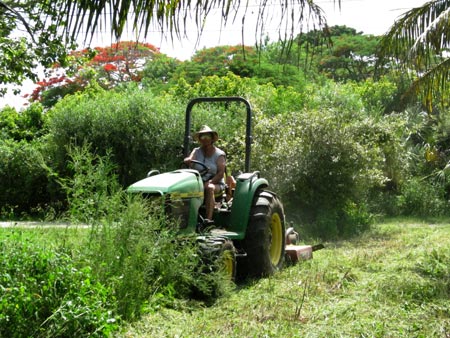
In the last two months, weeds sprang up to waist and shoulder height in the vegetable beds. They flourished because of days of torrential rain. Finally, on a dry day, Farmer Margie attached the brush hog to the green John Deere tractor and mowed them all down.

summer-mow

Weeds have met their match.

Summer is time for fruit. Lychees made their brief appearance for a couple weeks in May. Margie’s creamy Donnie avocados can get as big as footballs. Mangoes in all their varieties are definitely the queen of the summer fruit. Much coveted mamey, with its sweet salmon-colored flesh, is coming in. Massive jackfruit looks primordial with its thick, spiky hide. Sapodilla and longans are ripening. Summer is definitely a good time to become a fruitarian!

summer-avos

Donnie avocados ripening.

Read Full Post »

Onionville was so amazing that I had to document it with my video camera. Here, farmer Arturo Gonzalez takes me on a brief tour of a sea of red and yellow onions drying in the barn at Bee Heaven Farm. If you are a CSA member, you ate his lovely red spring onions not too long ago. There’s plenty more where that came from, if you like such things. Keep your eyes open for onions in the summer offerings.

This is the very first farm video I’m posting on the blog and on YouTube. If you want to see more videos, let me know and I’ll post some more, now and then, when I get a chance.

Read Full Post »

« Newer Posts - Older Posts »