Feeds:
Posts
Comments

Archive for the ‘food’ Category

Slip sliding away

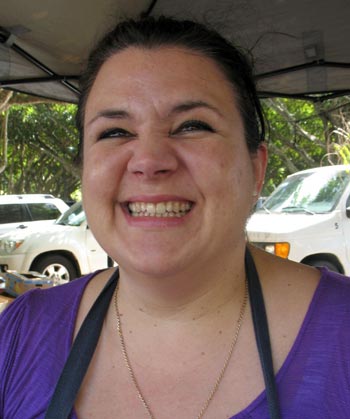
Chef Adri Garcia

It was lunchtime and I was hungry, prowling Pinecrest Gardens Green Market for something to eat one Sunday last month. Came across Chef Adri Garcia at the west end of the market. She was cooking up sliders made with grass-fed beef raised on a farm in rural Northwest Florida near the Georgia-Alabama border.

Now I don’t usually eat beef and didn’t think I missed it. But Adri insisted this was different. Grass-fed, not corn fed. Cows roaming in bucolic pastures, none of this chemical feedlot nonsense. She recommended the sliders, and her dad Carlos Garcia was at the grill and quickly whipped some up, accompanied by seasoned potato morsels. The meat was seasoned nicely with “four secret ingredients” that Adri refused to divulge. (Garlic might be on of them.) The meat was  chewy and had texture but wasn’t tough, and was lean, not too greasy. A really nice beef flavor came through and I had a moment of food bliss.

Then I came to my senses and asked for grilled onions. Took another bite, oh so good. Reminded me of burgers that I ate when I was a kid — only better. Adri suggested adding her quick pickled cucumbers with onions and red pepper. Sure, why not, load ‘er up. They added a pleasant sweet-sour bite. A Real Coke with real sugar (none of that fructose stuff) from Mexico completed my trip down memory lane when food was, well, real.

Yum! Sink your teeth into this!

The grass-fed meat was sourced from Arrowhead Beef, a co-op of family farms in Chipley FL that raises Parthenais cattle, an heirloom breed which originated in France in 1893. The cattle ranges freely on open pasture eating grass and forage, and is never given antibiotics nor hormones (according to the farm’s brochure). The beef is restaurant quality and wet aged for 28 days.

Adri is the South Dade distributor for Arrowhead. Order your cuts and come pick them up at the market on Sunday morning. Contact her at 786-368-3479 or adrigar2003@yahoo.com for prices and ordering information. Prices are 25 to 35 per cent less than Whole Foods. Free delivery for orders of $100 or more.

Chef Adri will be at the Pinecrest Gardens market through May. As for her prepared foods, she has added Asian tacos with tri-color sesame slaw, hoagies made with Italian style sausage, peppers and onions, and homemade piraguas (Puerto Rican snowcones) to the menu.
Read Full Post »

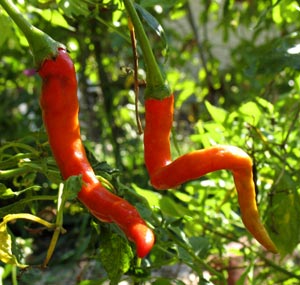
Hot chilis, the heart of kimchee.

I first met Muriel Olivares last year at Bee Heaven Farm, where she was farm manager for the season. Not only did she help things run smoothly, but she was always making interesting things with the veggies that were in the barn that week. One Friday I discovered that she had brine pickled a gigantic jar of French breakfast radishes, and I blogged about it here. Another Friday it was a big batch of kimchee — garlicky, peppery, a bit pungent, and totally amazing.

I’d learned how to make vinegary quick pickles from Hiromi, another farm intern from a few years ago, but fermentation was new to me. So when I got Muriel’s email that she was going to hold a kimchee making workshop at her Little River Market Garden, I jumped at the chance. Finally I would learn her secrets!

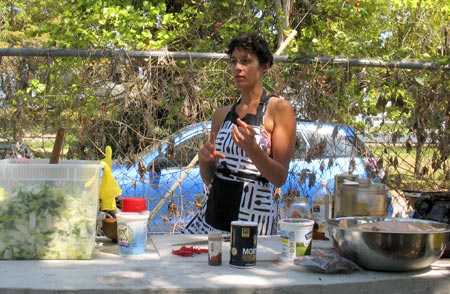
Urban farmer Muriel Olivares at her outdoor kitchen.

About two dozen people were thinking the same way and showed up too. Located in a leafy, secluded corner of northeast Miami, Muriel’s city-lot-sized garden had been transformed from a grassy vacant yard with a few fruit trees to a flourishing mini-farm, complete with wood fired pizza oven and outdoor kitchen. It was there that Muriel was set up with all the necessary tools and ingredients, including a restaurant-sized tub of chopped and brined Napa cabbage.

Getting a sniff of chili paste. This is what preserves the cabbage and other vegetables.

The recipe is posted on three different blogs — Little River Market Garden, My Edible Yard, and mango&lime — so I won’t repeat the exact details. Suffice to say that the ratio is 2 parts cabbage (about one head of Napa or bok choy) to one part radish/daikon/turnip and 2 cups of chili paste. (Carrots, half as much as daikon, can be used to sweeten it a bit.) The heart of the matter is the freshly-made chili paste. Muriel made it with several onions, a prodigious amount of garlic, half as much of ginger, and plenty of fresh and dried hot peppers, which were moistened with cider vinegar, a bit of honey and a bit of olive oil. (OK, so the oil isn’t truly authentic, but Argentineans use olive oil for everything.) She blended it together and soon the thick aroma of peppers and garlic wafted over us sitting in the nearby chairs. “Chili paste is what preserves kimchee,” Muriel said, explaining that garlic and peppers have antibacterial qualities. “Salt is not what’s keeping it sterile.”

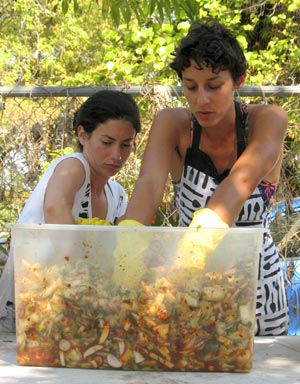
Olivia and Muriel mixing all the ingredients. Don’t forget gloves if you mix a big batch by hand. The peppers will burn!

An assistant was drafted and the yellow gloves came on to mix the tub full of copped vegetables and chili paste. It smelled great and everybody crowded around to smell the spicy aroma, take pictures and fill their empty jars to take home.

But now the real fun begins. Kimchee is fermented food, and there wasn’t enough vinegar to pickle it, so preservation has to come from other means. Muriel advised to leave the open jar out on the counter for as long as three days. At home, I took the lid off the jar, weighed down the contents with a plastic bag of water, and covered it with a coffee filter held down with a rubber band. No refrigeration allows natural fermentation to begin. Muriel had cautioned to set the jar in a shallow bowl or dish, because liquid would come out. Sure enough, it did for several days, along with a strong odor. “Liquid comes out as the bacteria metabolize, which releases gas bubbles, which makes water rise over the top, ” Muriel explained in an email.

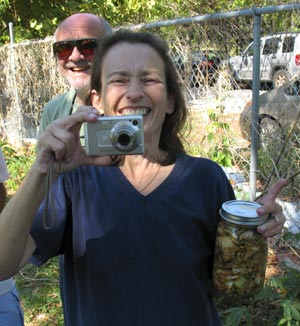
Ara, who writes My Edible Yard blog, shoots it out with me. Say kimchee!

My jar stayed out for five days, just to see what would happen next, and liquid stopped seeping out on the fourth or fifth day. Took the filter and bag off, leaving about an inch of space, and put the lid back on. The jar of kimchee is now sitting in the refrigerator. “Putting a lid on it and putting it in the fridge dramatically slows down fermentation (bacteria metabolism) so liquid will stop coming out.  A little pressure may form in the jar so it’s good to leave a small space (meaning not full to the top),” Muriel added in her email.

Kimchee can stay out longer, I was told by Farmer Margie, and then keep in the frig for months (if it doesn’t get all eaten). It would only be fitting to bring the jar to Bee Heaven’s barn, where my discoveries in fermentation began, and try it out on this season’s interns and apprentices. Stay tuned!

Read Full Post »

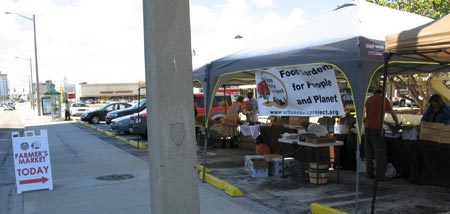
Upper East Side Farmers Market is located on the north west corner of Biscayne Boulevard and 79 St.

The newest grower-supported farmers market has opened at the Biscayne Plaza shopping center in northeast Miami. The Upper East Side Farmers Market is managed by Melissa Contreras and the Urban Oasis Project, a local non-profit which is also involved with the Liberty City Farmers Market.

Red leaf butterhead lettuce

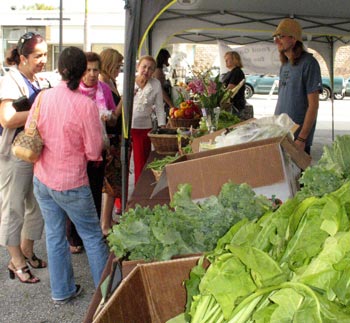
The market is small (only four tents) but carries a wide assortment of seasonal fruits and vegetables. All the food is locally grown (within 150 miles of Miami) from several farms and market gardens, and most of it is organic. The selection changes from one week to the next, and some things sell out quickly — so come early for arugula and callaloo. (Those sold out early two weeks in a row.) Some of the produce available last Saturday was sweet starfruit, stubby forked carrots, beautiful red leaf butterhead lettuce that looked airbrushed, bunches of dill and parsley, massive purple-top turnips, kale, and black sapote, just to mention a few things.

In addition to fresh produce, the market offers a wide selection of prepared foods, which also vary from one week to the next. Art Friedrich, co-founder of Urban Oasis, brought quart jars of brine-cured sauerkraut, and zucchini bread to die for. Oval loaves of artisanal bread lay in a basket next to local wildflower honey and Hani’s Organics baba ghanoush. On the next Saturday, bagged worm castings and bottles of worm tea (natural fertilizer) were available from Fertile Earth Foundation. The most surprising discovery was one-pound bags of rice, both white and brown, organically grown in Florida (in rotation with sugar cane) south of Lake Okeechobee.

Friends hanging out at the market.

I visited the market on the first two Saturdays it was open, and each time it was busy with a steady stream of customers. Melissa Contreras, co-founder of Urban Oasis, guess-timated that they had at least 100 shoppers on the first Saturday. Prices at this new market are a bit lower than what you might expect to see at a farmers market, plus they accept food stamps and match EBT purchases up to $10.

“The point of this market is to bring the communities together,” said Kelliann McDonald, spokesperson for Terranova, the center’s developer. She pointed out that the location is right between an upscale neighborhood and a poorer one. She envisions the market becoming common ground for both groups.

For several hours on Saturday, people shopped, tasted fruit, hung out for a little bit and told stories at this brave new market. Whether it will become a community hub remains to be seen, but one can only hope the people in the area, both rich and poor, will embrace the farmers and their bounty.

Look for the Upper East Side Farmers Market in front of Payless at Biscayne Plaza Shopping Center, located on the northwest corner of Biscayne Blvd. and 79 St. in Miami. Open on Saturdays from 9 am to 2 pm until May 28, 2011.

Read Full Post »

Check out this article in the Miami Herald today about Teena’s Pride CSA pickups at area Whole Foods stores. Farmer Margie Pikarsky is also quoted.

Farm fresh: Shoppers can now order straight from growers

Whole Foods offers help to Community Supported Agriculture programs. Consumers can now pick up their pre-ordered produce from local farms at stores.

By ELAINE WALKER
ewalker@MiamiHerald.com

Geane Brito has to wait until her two kids get out of school before going to Whole Foods in Miami Beach to pick up their box of vegetables for the week from Teena’s Pride in the Redland.

Magnus and Isadora Kron, ages 8 and 10, dash immediately into the store, eager to take inventory of the seasonal vegetables just picked from a local farm: broccoli leaves, heirloom tomatoes, poblano peppers and carrots with the tops still attached.

Brito’s family is part of a growing group in South Florida and around the country embracing Community Supported Agriculture. For $20 to $40 a week, they buy ultra-fresh food straight from the farm at prices similar to the grocery store. And their contribution helps small farmers remain in business.

“I want my children to have the experience of knowing that fresh vegetables don’t grow at the supermarket,” said Brito, who lives on South Beach.

While the CSA concept historically has cut the grocery store out of the equation, Whole Foods stores in Florida are aiming to change that. The chain is kicking off a program to offer local farms free use of Whole Foods stores throughout the state as drop-off and pick-up points for the weekly deliveries.

Read more: http://www.miamiherald.com/2011/02/07/2055665/farm-fresh-shoppers-can-now-order.html

Read Full Post »

The Liberty City farmers’ market has a new home from now though April 2011!

Still every Thursday from noon to 6pm, about 10 blocks west of original location, new address is:

African Heritage Cultural Arts Center
6161 NW 22nd Ave
Miami, Florida 33142
305-638-6771

Additional info at www.urbanoasisproject.org

Please come visit this local grower-supported market, which still has some of the best local, mostly organic, affordable produce in town for everyone!

It serves the under-served, and doubles EBT (food stamp) money up to $10 per visit. Credit and debit accepted!

This location is in a beautiful park, highly visible at the intersection of two main roads, is fenced in, has ample parking and bathrooms, and has children’s programs and after-school care. It is owned by the county, and has been a hub of African heritage culture and arts events for years.

Read Full Post »

« Newer Posts - Older Posts »