Feeds:
Posts
Comments

Archive for the ‘location’ Category

Miami Culinary Institute’s Organic Culinary Garden  

Official Grand Opening on July 14th at 10:00 am

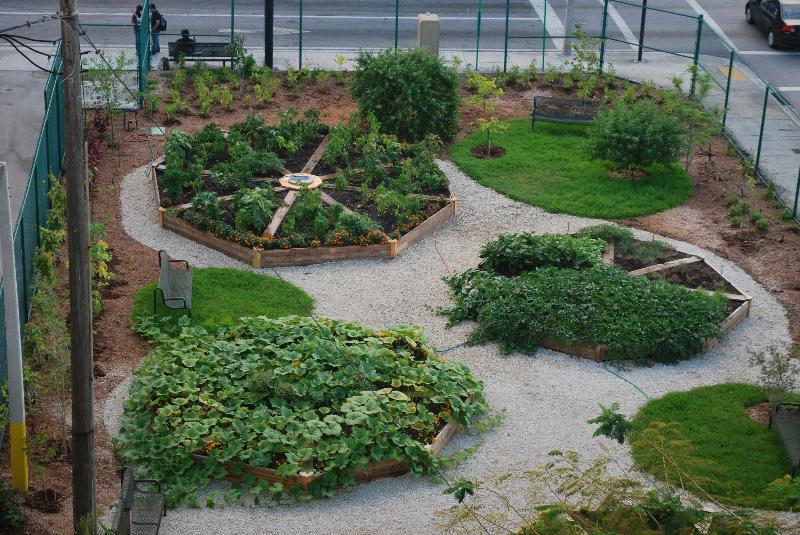
Gabriele Marewski, in a newly formed partnership with Natural Greenscapes, brings the ambiance and magic of Paradise Farms to the new Culinary Garden for the new Miami Culinary Institute at the Miami Dade College Wolfson Campus. All of these partners are very excited about being on the cutting edge of effecting change in how culinary students come to know their ingredients: a new Seed to Soil initiative.

The garden has over 40 different fruits, 30 different herbs and a variety of delicious tropical shrubs and edible flowers.  This living classroom brings to the students a unique opportunity to be directly involved in planting and harvesting their own food. Food scraps from the Institute’s kitchen will be composted and used in the garden for a true “soil to soil” sustainable process.

Gabriele will also teach a class in Fall as part of the Institute’s Enthusiasts Program, as the garden becomes the platform for growing culinary gardeners (www.miamidadeculinary.com).

The garden is located on the southeast corner of NE 6th St. & NE 1st Ave.  Please join us on Thursday, July 14th at  10 am for the Grand Opening!

Free and open to the public. Light refreshments will be served.

Read Full Post »

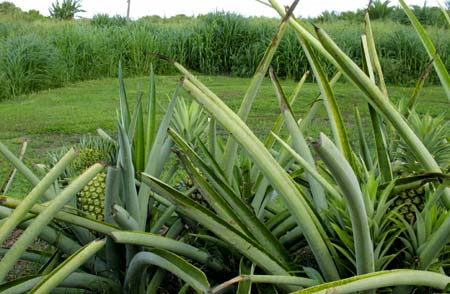
Tim’s pineapple patch. Lettuce and cabbage planting area is in the background, now overgrown with weeds.

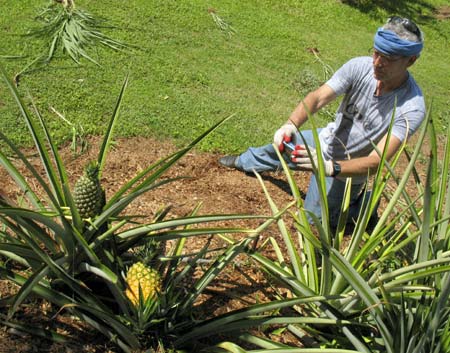
Tim Rowan is a hard working farmer. In the winter he grows certified organic lettuces and cabbages. And in the summer, when it’s so hot that some farmers take a break, Tim is still growing things. His latest hobby, as he calls it, is raising pineapples. He has a test patch with over 70 pineapple plants in various stages of maturity. (Most started from tops salvaged from his kitchen where he is a chef at Deering Bay Yacht and County Club. He also grew several pineapples at his vegetable garden there.) Some plants on his farm are already bearing fruit. I asked Tim to save me a pineapple, and recently he let me know mine was ready, come and get it.

Tim Rowan photographs the pineapple before it gets picked.

And there it was, in all its glory — a very large pineapple perched on a short stalk sprouting from the center of of a spray of long, narrow, sharp toothed leaves. (If you’ve never seen a pineapple plant, it looks like a bromeliad.) The fruit was fully mature and golden yellow in color. It had a distinctive top — not one leafy crown, but at least six or eight all in a row. It looked like the pineapple was sporting a mohawk. Both Tim and I took pictures from various angles while it was still on the plant. If a pineapple could have charisma, this one did. Check out Tim’s blog post about his adventures growing pineapples.

Pineapple sporting a mohawk top.

Tim had left the fruit growing on the plant so I could pick it myself. “Hold it with both hands, give it a little twist and snap it off,” he said. I did, and it came off easily in my hands. I was impressed by how heavy and substantial it was. Turns out it weighed five pounds.

Several large suckers or shoots were growing from the base of the plant. They looked like overgrown pineapple tops. Tim broke one off carefully, and at its base were strands of white roots, ready to plant. This sucker would grow into a new plant which would bear fruit in one year. Tim removed other suckers and planted them too. “From one plant you can get as many as eight new plants,” he said as he set them into the ground. You can also plant pineapple tops, but it takes two years to flower and another six months for the fruit to mature.

Picking pineapples, location not specified. Florida Photographic Collection.

Pineapples are not unusual for South Florida. Settlers started growing pines, as they were called, in 1860 at Plantation Key. From the late 1880s to the early 1900s, pineapple was a popular crop, and almost everybody had a patch. Plantations stretched from Plantation Key to the south, to Elliott’s Key (as it was spelled then), north to Lemon City settlement, up the coast to Yamato (west of Boca Raton) which was farmed by Japanese, and as far north as Indian River. The fruit was shipped by schooner and then rail to northern cities. Competition from Cuba and Hawaii, diseases, bugs, and freezes eventually wiped out the industry by the time of WWI.

Boxing pineapples for shipping. Florida Photographic Collection.

In more recent times, “A guy tried producing specialty pineapple in the mid-late 1990’s on the S.W. corner of Naranja Road and Quail Roost,” county agriculture manager Charles LaPradd told me in an email. “They were the small super sweet golden ones that sell for a fairly high price, so he thought he could compete against the imported ones. He couldn’t and went out of business.” These days, almost all the pineapple in stores is grown offshore. Costa Rica is the top supplier for pineapples for the United States.

Shipping pineapples by boat. Florida Photographic Collection.

Pineapple may not be grown on a large scale in Redland anymore, but many people grow a few plants in their own gardens. They are easy to grow, like full sun, and because the plant has a shallow root system, doesn’t mind growing in a container.

Besides planting the top, save the peel of a homegrown or organic pineapple and use it to make a pineapple flavored vinegar. Here’s the recipe from Wild Fermentation by Sandor Ellix Katz. Use it to make salad dressing, put it on avocado, stir into salsa, or wherever you need a sweet-sour tang.

Mexican Pineapple Vinegar

1/4 cup sugar
peel of 1 pineapple (organic or home grown)
1 quart (4 cups) water
cheesecloth (or coffee filter)
glass jar

1. In a jar or bowl, dissolve the sugar in 1 quart of water. Coarsely chop and add the pineapple peel. Cover with cheesecloth (or coffee filter) to keep flies out, and leave to ferment at room temperature.

2. When you notice the liquid darkening, after about 1 week, strain out the pineapple peels and discard.

3. Ferment the liquid 2 to 3 weeks more, stirring or agitating periodically, and your pineapple vinegar is ready. Keep in refrigerator.

Read Full Post »
What does the new Miami-Dade County mayor have in common with growers in Redland? They have the UDB, or Urban Development Boundary — a line in the county’s master plan designed to limit development from encroaching on precious farmland. Read this excellent article in the Miami Herald which lays out where Carlos Gimenez and Julio Robaina stand on this sensitive issue. Then don’t forget to vote in the runoff election on June 28!

Mayor will have key role on holding line on development

The new mayor of Miami-Dade County will be more important than ever when it comes to holding the line on building outside the Urban Development Boundary, following state changes recently signed into law by Gov. Rick Scott.

By Matthew Haggman

mhaggman@miamiherald.com

When it comes to moving the Urban Development Boundary, the power of Miami-Dade County government, and its soon-to-be new mayor, has never been greater.

For more than three decades, the UDB — the line that keeps growth from encroaching west and south into fragile agricultural lands and wetlands — has been a critical curb on sprawling large-scale development from encroaching on the doorstep of the Everglades. But recent changes by the Republican-controlled Legislature that were signed into law by Gov. Rick Scott have severely limited state oversight of planning decisions by city and county governments — such as moving the UDB. State planners previously served as a check on such efforts and could stand in the way of decisions to move the line, but now can only provide non-binding comments in most cases.

Read more: http://www.miamiherald.com/2011/06/15/2268668/mayor-will-have-key-role-on-holding.html

Read Full Post »

BY ANDRES VIGLUCCI
aviglucci@miamiherald.com

For a generation, a sharp and sometimes controversial line has contained Miami-Dade’s explosive urban growth like a gasket, largely insulating the county’s fragile agricultural hinterlands, surviving wetlands and two national parks from subdivisions and commercial-strip development. Now the days of holding the line on the Urban Development Boundary — the focus of some of the fiercest local battles over growth and the environment — may be drawing to an end.Measures approved by the Florida Legislature with little scrutiny or debate in the waning moments of this year’s session would dismantle the state oversight that has acted as the principal brake on repeated efforts by the county commission to breach the line for new development.The measures, almost sure to be signed by business-friendly Gov. Rick Scott, would significantly water down the state’s 25-year-old growth-management system, giving counties and municipalities far greater freedom to amend the local comprehensive development plans that are meant to control suburban sprawl. The UDB, which runs along the inside of the county’s western and southern edges as well as its southeastern coastal fringe, is a key feature of Miami-Dade’s comp plan. Development outside the line is limited, in most areas, to one dwelling per five acres.

Read more: http://www.miamiherald.com/2011/05/22/2226826/state-dismantles-growth-management.html

Read Full Post »

The choice is not local or organic but how, through your organic food purchases, you can incorporate supporting local agriculture, local communities and and local economies into an organic lifestyle. The more you were into local culture, the more important it is to support organics in your region.
– George Siemon, Organic Valley

Carolann and Ted Baldyga, Hani Khouri

As the locavore dinner unfolded I couldn’t help thinking that maybe this was the way previous generations ate in this area. Crab, wild pig, cobia, coconut for sure, and other foods were later introduced. Many tropical things, whether native or  introduced, don’t grow in more northern latitudes. Jaboticaba, bignay, betel leaf, callaloo, Red Ceylon peach, rangpur lime, Mysore raspberries  — you’re not going to find most of those at a supermarket in Miami — or New Jersey! (But you can find some things at farmers markets, or grow others in your back yard.)

James and Donna Patrick, Laura Veitia

Earth Dinner calls for us to honor the earth, the very dirt we stand on, by honoring our food. And by so doing, we honor our farmers — a stubborn, determined, independent tribe — who work very hard to feed us. In fact most of the growers who provided the ingredients for our dinner were present — Robert Barnum, Margie Pikarsky, Hani Khouri, George Figueroa, Teena Borek, and guests Thi and Bill Squire representing our local Slow Food Miami chapter.

Bill and Thi Squire

Robert and Margie’s Earth Dinner was only one of two in the entire state of Florida. I’m a bit surprised there weren’t more. A wide range of food grows in the spaces outside urban development, and agriculture is the state’s second largest source of revenue. City dwellers are quick to forget that they live among farmers, even as farmers are pushed back by relentless waves of development.

Robin and Carol Faber

Margie stood up and spoke at the close of dinner. “This dinner is about the importance of the local farmer. It’s important that we support the local foodshed and the richness of the local food here. This is the way to keep our country strong and our food safe. By keeping food regional, it’s easier to control food safety.”

Anthony Rodriguez, George Figueroa, Tina Trescone

Know where your food comes from, or how it was grown and processed. Connect the food with the place where you live, and you will be healthier and stronger for it. At last month’s Earth Dinner, the taste of this place was in the food and drink. It was unlike any dinner I’d eaten anywhere else. And it sure made for good experience and good memories! If I were to savor a perfectly ripe Mysore raspberry or take a sip of bignay wine, blindfolded, years from now, I would remember in a heartbeat this dinner and this particular abundant land — thanks to our local farmers!

Read Full Post »

« Newer Posts - Older Posts »