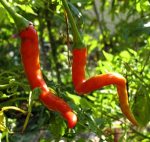
Hot chilis, the heart of kimchee.
I first met Muriel Olivares last year at Bee Heaven Farm, where she was farm manager for the season. Not only did she help things run smoothly, but she was always making interesting things with the veggies that were in the barn that week. One Friday I discovered that she had brine pickled a gigantic jar of French breakfast radishes, and I blogged about it here. Another Friday it was a big batch of kimchee — garlicky, peppery, a bit pungent, and totally amazing.
I’d learned how to make vinegary quick pickles from Hiromi, another farm intern from a few years ago, but fermentation was new to me. So when I got Muriel’s email that she was going to hold a kimchee making workshop at her Little River Market Garden, I jumped at the chance. Finally I would learn her secrets!
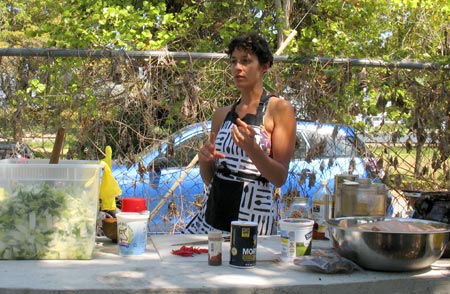
Urban farmer Muriel Olivares at her outdoor kitchen.
About two dozen people were thinking the same way and showed up too. Located in a leafy, secluded corner of northeast Miami, Muriel’s city-lot-sized garden had been transformed from a grassy vacant yard with a few fruit trees to a flourishing mini-farm, complete with wood fired pizza oven and outdoor kitchen. It was there that Muriel was set up with all the necessary tools and ingredients, including a restaurant-sized tub of chopped and brined Napa cabbage.

Getting a sniff of chili paste. This is what preserves the cabbage and other vegetables.
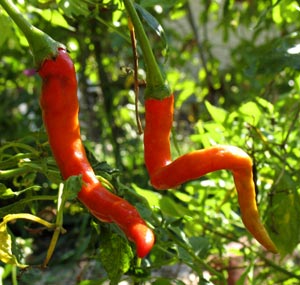
The recipe is posted on three different blogs — Little River Market Garden, My Edible Yard, and mango&lime — so I won’t repeat the exact details. Suffice to say that the ratio is 2 parts cabbage (about one head of Napa or bok choy) to one part radish/daikon/turnip and 2 cups of chili paste. (Carrots, half as much as daikon, can be used to sweeten it a bit.) The heart of the matter is the freshly-made chili paste. Muriel made it with several onions, a prodigious amount of garlic, half as much of ginger, and plenty of fresh and dried hot peppers, which were moistened with cider vinegar, a bit of honey and a bit of olive oil. (OK, so the oil isn’t truly authentic, but Argentineans use olive oil for everything.) She blended it together and soon the thick aroma of peppers and garlic wafted over us sitting in the nearby chairs. “Chili paste is what preserves kimchee,” Muriel said, explaining that garlic and peppers have antibacterial qualities. “Salt is not what’s keeping it sterile.”

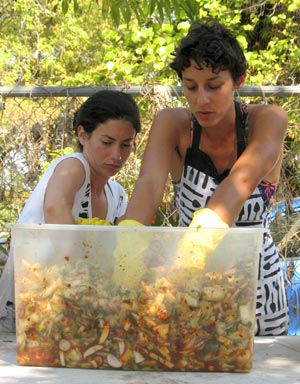
Olivia and Muriel mixing all the ingredients. Don’t forget gloves if you mix a big batch by hand. The peppers will burn!
An assistant was drafted and the yellow gloves came on to mix the tub full of copped vegetables and chili paste. It smelled great and everybody crowded around to smell the spicy aroma, take pictures and fill their empty jars to take home.
But now the real fun begins. Kimchee is fermented food, and there wasn’t enough vinegar to pickle it, so preservation has to come from other means. Muriel advised to leave the open jar out on the counter for as long as three days. At home, I took the lid off the jar, weighed down the contents with a plastic bag of water, and covered it with a coffee filter held down with a rubber band. No refrigeration allows natural fermentation to begin. Muriel had cautioned to set the jar in a shallow bowl or dish, because liquid would come out. Sure enough, it did for several days, along with a strong odor. “Liquid comes out as the bacteria metabolize, which releases gas bubbles, which makes water rise over the top, ” Muriel explained in an email.

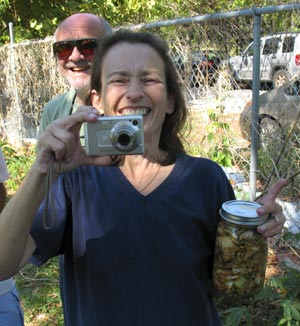
Ara, who writes My Edible Yard blog, shoots it out with me. Say kimchee!
My jar stayed out for five days, just to see what would happen next, and liquid stopped seeping out on the fourth or fifth day. Took the filter and bag off, leaving about an inch of space, and put the lid back on. The jar of kimchee is now sitting in the refrigerator. “Putting a lid on it and putting it in the fridge dramatically slows down fermentation (bacteria metabolism) so liquid will stop coming out. A little pressure may form in the jar so it’s good to leave a small space (meaning not full to the top),” Muriel added in her email.
Kimchee can stay out longer, I was told by Farmer Margie, and then keep in the frig for months (if it doesn’t get all eaten). It would only be fitting to bring the jar to Bee Heaven’s barn, where my discoveries in fermentation began, and try it out on this season’s interns and apprentices. Stay tuned!
Read Full Post »




 Redland Rambles