
CSA share: week 12
CSA share: week 12
Posted in farm, fruits, photo, vegetables, tagged Bee Heaven Farm on February 13, 2010|
The heirloom tomatoes available at market are winding down. They will be very scarce for weeks, assuming there won’t be patchy frost tonight, which still has potential to damage weakened plants.
Weeks later, you can still see signs of freeze damage at Bee Heaven Farm — and signs of recovery.

Tomatoes blooming after the freeze
The heirloom tomatoes vary in damage. Some varieties are all but destroyed by the freeze. The ones with blackened, shriveled leaves are not coming back. A few varieties are re-growing leaves and still have fruit ripening on the vines. And some look positively fluffy with their green leaves and are blooming again. The quantity and quality of the second bloom tomatoes remains to be seen. If they’re just as nice as the ones we’ve had so far, expect more heirloom tomatoes at market, just not right away, perhaps in a couple months. “Hope springs forth!” Margie said.

Purple Pod heirloom beans blooming after the freeze.
The heirloom beans have been all but decimated. One variety with purplish stems, known as Purple Pod, re-grew leaves and looks a lot better than a week or two after the freeze. It’s even putting out a few, shy blooms. The question is, will those blooms set and grow beans. And if they grow, how big and what shape are they going to be in? All of that is doubtful because they have a big problem with mildew. “The leaves are all frozen out and the plants are more vulnerable to everything,” Margie explained to me.
This is the lasting, almost hidden freeze damage that takes weeks to emerge. The Gold of Bacau beans aren’t coming back very well at all, and the few pods that have grown since the freeze are small and misshapen, nothing you would want to buy at the market or find in your CSA box.

Freeze damaged Gold of Bacau beans.
Posted in agritourism, chef, events, food, photo, vegetables, tagged Possum Trot Nursery, potato, Robert Barnum on February 10, 2010| 4 Comments »
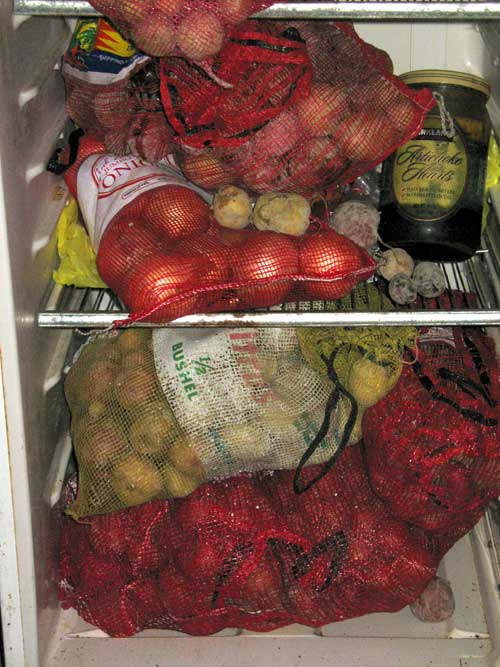
Potato heaven
Robert Barnum called the other day to tell me about his preps for the upcoming Potato Pandemonium dinner. He has two refrigerators bulging with potatoes, both the one in the kitchen and the one on the front porch. Not everybody has a frig on the front porch brimming with spuds, so this I had to see for myself. Yup, the porch frig held at least four onion sacks stuffed with spuds, and the kitchen frig held another two full sacks.
The kitchen table held an overflow of potatoes in several buckets, which were sorted by shape and color — dark skinned that look purplish-blue-black inside, red skinned that are red inside, golden ones, and delicate fingerling potatoes. Not sure how many pounds that adds up to, but it looks like it should be enough for 30 guests. Robert explained the spuds were gleaned from a nearby field. There’s nothing wrong with the tubers; they’re perfectly good to eat, and would otherwise be plowed under.
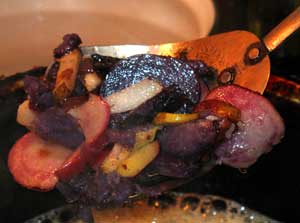
Multicolor chips just out of the fry pot
Robert mentioned he browsed through his extensive collection of cook books for inspiration, but the actual dish will be his version. “All these recipes come out of my head,” he explained. “Some of these have never been done, or done the way I plan to do it.” He offered a test batch of Potato Salad with Carambola Relish, which had a tropical and tangy dressing, no typical mayo here. Bubbling in a pot of oil were Multicolored Chips, and sure enough some potatoes are really red inside, looked like small chioggia beets. Ultimately each dish will be interpreted with his signature flair — tropical ingredients straight from his grove, and food cooked over a wood fired grill.
If you’ve never been out to Possum Trot Tropical Fruit Nursery, it’s a unique corner of Redland, not to be missed. Intrigued? Here’s the link to register for the Pandemonium.
Posted in food, photo, recipe, vegetables, tagged pickles, radishes on February 9, 2010| 5 Comments »
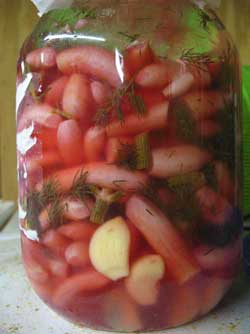
French breakfast radishes pickling in brine.
Overwhelmed by the amount of radishes that you’ve been seeing in your CSA box? Couldn’t possibly eat them all right away? Pickle them! I didn’t know you could make brine pickles with radishes until I saw a giant jar on top of the barn refrigerator. Thanks to farm intern Jamie for telling me how the pickles were made. Haven’t tried the recipe yet but it looks simple enough. These radishes would be a tasty addition to a meat and cheese sandwich.
Brine-cured pickled radishes
Brine is 1 tbsp. pickling salt to 1 qt. water
cut up or whole radishes
several whole cloves of peeled garlic
several branches of dillWash and trim radishes. Wash and chop dill. Put them in a jar along with peeled garlic. Mix up brine and pour over radish mix until just covered. Fill any air space at the top with a plastic bag full of water. It also acts as a weight to hold the radishes down. Cover mouth of the jar with a coffee filter kept in place with string or elastic. Let the pickles sit undisturbed for at least 3 to 5 days. Test the pickles after 5 days, may want to ferment them longer. When they are to your liking, move the jar to chill in the refrigerator. The pickles will keep for several months.
Posted in farmer/grower, fruits, photo, recipe, tagged Green Groves, Steven Green on February 6, 2010|

Steven Green, Green Groves
Meet Steven Green of Green Groves. His day job is professor of tropical biology, conservation and statistics at UM. He also has a two and a half acre grove of various fruit trees. The cute little clementines from a couple weeks ago were his. This week we have lemons from his grove. Steve doesn’t know the name of the variety but does know it was planted in 1938. He says their flavor is “much brighter and more flavorful,” than your average supermarket lemon, and the fruit has a moderate amount of seeds and thick skin.
Steven grows lemon, lime, carambola, calamondin, allspice, monstera, avocado, tangerine, 5 kinds of mango, and lychee. He has been growing fruit since he moved to Redland in 1978, when he bought a 2 1/2 acre avocado grove with trees planted originally in the 1930s. There are still a few of those left, including the lemons. In 1991 Steve planted lychees, but Hurricane Andrew knocked them all down the following year. Putting his scientific knowledge to good use, Steve replanted 125 lychee trees at what he calls the “optimal distance” for orb weaver spiders. They prefer a span of about 2 meters from branch edge to branch edge for their webs. Once the spiders made their webs and settled in, there have been no problems with caterpillar moths in the groves. Lychees have so few pests, Steve says, that he doesn’t used pesticides in his grove. He’s now in the process of getting the grove certified organic.

Lemon from Green Grove
When Steven has way too many lemons, he makes this North African lemon preserve:
Cut the lemon into quarters, bury in kosher salt, add chilis (optional).
Can take out spoonfuls of liquid to cook with.
Store salted lemons in frig.

 Redland Rambles