Feeds:
Posts
Comments

Archive for the ‘photo’ Category

How to make cheese

notes from workshop given by Hani Khouri at Fairchild Ramble

1 gallon fresh raw goat milk milk will produce approximately 1 pound cheese.

Heat milk to a boil. Add 1/3 cup lemon juice, apple cider vinegar or another acidic medium. This will cause the milk to curdle. Remove from heat.

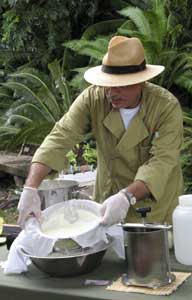
Hani Khouri strains curds from whey with a cheesecloth-lined colander.

Have a colander lined with cheesecloth, set inside a larger bowl. Pour curdled milk into it to strain out whey (liquid). What to do with whey – can use in baking instead of water, use as base for soup or smoothies, or in pickling. (Hani pours it on his plants.)

Stir in salt to preserve, can use coarse or pickling salt. Don’t use iodized. Optional: can add fresh chopped herbs — oregano, thyme, sage. At this stage, if you hang the cloth and let a ball form, you get mozzarella.

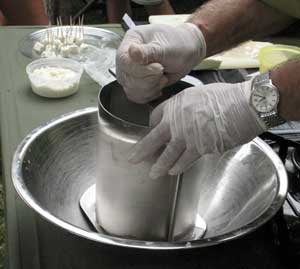
Pushing whey out with cheese press. Finished cheeses are in background.

After it’s fully drained, put into cheese press (can get online at Gaiam). Press all the whey out, keep turning the press and keep pushing the whey out. Let it stand overnight. Don’t let the press stand in the whey.

Take out cheese from press and remove cheesecloth, and let cheese air dry on bamboo mat for three days, turning frequently. Rub the cheese with coarse salt every day.

Cook the cheese in brine (3 parts water, 1 part salt). The longer it boils, the more crumbly the texture. Be careful so the buttermilk doesn’t separate from the cheese. After cooking cheese, need to keep it in brine for storage.

Serve as you would in a Greek salad, or with chopped tomato and olive oil, or with watermelon.

Read Full Post »

text by Art Friedrich, urban farmer, member of Urban Oasis Project
photos by Antonio Guadamuz, member of Urban Oasis Project

Saturday, Nov 28, 2009

Art Friedrich and partner Luigi (in flannel) touring ECHO

Getting out beyond SE FL to see what other things are happening in organic and sustainable agriculture in Florida, 16 folks headed out to ECHO (Educational Concerns for Hunger Organization) Global Farm and Worden’s Organic Farm in N. Ft. Myers and Punta Gorda, respectively. The group consisted of a number of the workers and WWOOF’ers from Bee Heaven Farm, as well as the big brain behind it all, Farmer Margie. Joining them were a number of local food enthusiasts from Urban Oasis Project and some of the new batch of Master Gardener Interns. [Note: Margie organizes a trip to ECHO and Worden every year during the Thanksgiving weekend, for the purpose of enlightening her farm interns and volunteers, and others who want to make the trip.]

Our first stop was the ECHO Global Farm, a christian based project started over 25 years ago to combat the problem of world hunger, primarily in the tropical zone, using the most concrete and long-lasting ways. Tours are available daily, and are well worth the $8. The tour consists of two hours of seeing and hearing about numerous fascinating plants, and methods of growing highly nutritious foods using unconventional and conventional methods that require little monetary outlay. There are six different recreated environments, such as a rainforest, an arid area, a monsoon climate (like we have, with 6 months dry and 6 months really wet), and the fascinating urban garden section.

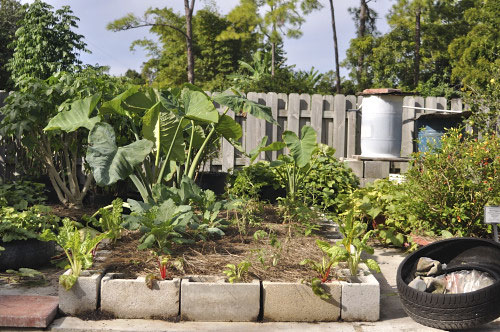
Container gardening taken to a new level.

The urban garden section showed some great examples of reusing trash, such as old tires, to create containers. Also fascinating was the wicking gardens that are mostly made up of a carpet with a little bit of soil in top and some gravel or even cans wrapped in socks for the plants to have structure to grow on. You fill a closed bucket with a hole in the bottom with water, stick it on an edge of the carpet, and let the garden suck the moisture out as it needs it! This is a great way to use a minimum of water and soil. While some of us had questions about the safety of carpet material, other types of substrate could be developed. Probably any old canvas or woven mat material would do. They try laying the carpet out in the natural UV rays of the sun to break down harmful chemicals.

I also enjoyed the mention of their research using human urine as fertilizer — it is packed full of good nutrients and is sterile! In some countries, this has been government sanctioned for a while, such as in Sweden, where some housing developments have been built with urine diverting toilets that drain to some big tanks. When the farmers need fertilizer, they just pull up, pump some of the liquid gold out, and spray it right on their fields! The savings in water and fertilizer are stellar, and it is only cultural taboo that makes the subject so difficult.

Urban homesteading at its finest!

The Moringa tree is a favorite plant there. They call it the Miracle Tree. One can eat almost any part of it, and it is incredibly dense with nutritive value, and the tree grows in almost any condition. I’ve started my own little plantation at my house in S. Miami.
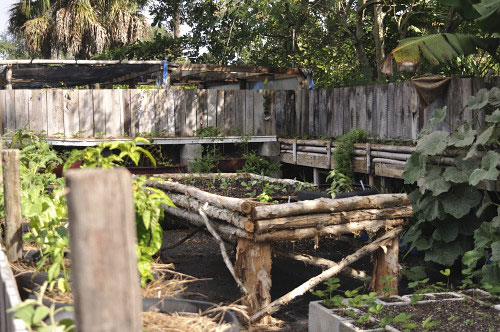
Rustic raised bed

ECHO is also a seed bank, and they send seeds all over the world to see what works, with attention to both the physical and the cultural aspects. This aspect impresses me. It is applied science that recognizes humanity’s needs as a driving force in experimentation. And the needs of the global poor are great, but with sensitivity and ingenuity, the poor can be given the tools they need to improve their own lives in a sustainable and self-empowering way. ECHO taps into their own knowledge and traditions and offers a broader knowledge base for them to work with.

Endless fields at Worden Farm

The second half of our day was visiting Worden Farm in Punta Gorda. The farm is a brilliant example of hard work and smart planning to generate massive amounts of organic vegetables, sold all along the Gulf Coast. The farm is 55 acres, with about 35 in production, and is only six years old. The soil is almost pure sand, so lots of chicken manure is used as their fertilizer, as well as cover crops to slowly improve the quality. Long rows of raised beds made with plastic sheeting make upkeep relatively easy, and the veggies all looked absolutely flawless.

Drip irrigation system at Worden Farm

The plastic sheeting with drip tape irrigation underneath also helps limit water use, as well as the extra work of short watering cycles very frequently. Extra work to reduce the negative environmental impacts of the farm is a tradeoff they are happy to make. Those plastic sheets at the end of the season don’t hit a trash pile. They go to an agricultural plastics recycler.

Touring Worden Farm by electric cart. L-R: Wwoofer, Eva Worden, Cesar Contreras, Margie Pikarsky (back turned), Melissa Contreras

Farm Ferrari

Cow at Worden Farm

Read Full Post »
Happy Thanksgiving!

As we gather for our bountiful feast, let us give thanks today and through the season for our local farmers who work very hard to provide us with fresh, healthy and delicious food.

Read Full Post »

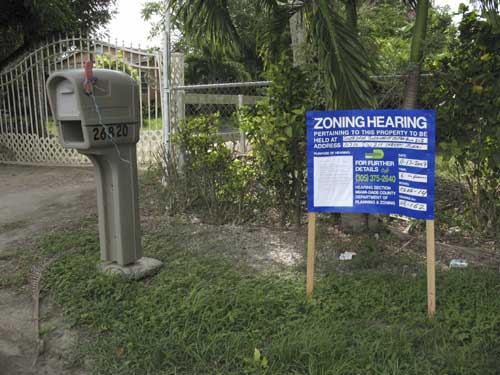
26820 SW 187 Ave.

Last Tuesday an overflow crowd packed the Community Zoning Appeals Board room and spilled into the hall for Mr. Bernardo Campuzano’s zoning hearing regarding his request to build a private soccer club on 9.2 acres of former plant nursery. On one side of the room sat Mr. C and his supporters, including about two dozen kids. On the other side was the opposition, consisting mostly of aggravated neighbors.

Mr. C’s attorney spoke first. He explained that Mr. C is a soccer instructor who has established many soccer clubs. As for concerns about the soccer stadium, the lighting would be what you find in a parking lot, preventing overspill, not tall stadium lights. They will work to preserve the agricultural character of the property — to a loud chuckle from the side with the neighbors — with a landscaping buffer. The attorney claimed the private soccer club is compatible with agricultural activity and consistent with the CDMP (Comprehensive Development Master Plan), and that private recreational facilities are one of the approved uses outside the UDB (Urban Development Boundary). And, he claimed that the stadium would address unmet recreational needs of the agricultural community. Also speaking in favor of the stadium was his law partner, who echoed that they support the rural residential community. Four other people came up to the podium and spoke simply and briefly in support of the soccer club, generally agreeing that sports are good for kids and keeps them out of trouble, and claiming the stadium is a good investment and a good project. Even Mr. C stood up and said that he will create a soccer academy for kids, and doesn’t see anything like that in the area.

Then came the neighbors’ turn to voice their objections. Almost the entire right side of the room stood when asked if they wanted to speak against the project, but the number was limited to six, same as those in favor. First up was a woman who expressed concern about sewage and groundwater contamination of locally grown produce, and also stated that the stadium belongs in an existing park. Next, a grower said the stadium is completely inappropriate use of agricultural land, that the noise coming from the property has been disruptive, that lights at night disturb plant growth, and that the stadium would not serve her agricultural operation or any of her workers in any way. Next, a man who raises exotic birds was impassioned in his complaint against the constant noise and smoke from illegal burns. He claims the lights and noise have been disruptive to his birds’ breeding cycle this past year, and production has dropped.

Then a woman who had been a professional soccer coach and referee expressed concerns about rowdy fans and the potential for violence. One long-time resident worried about groundwater contamination from vehicle leaks in the proposed unpaved parking lot, pointed out insufficient well and sewage capacity and restroom facilities, and doubted if Mr. C would really provide bottled water as required by the EQCB (Environmental Quality Control Board). The last person allowed to speak was another long-time resident, who explained that he had sponsored a successful soccer club and suggested that Mr. C do something similar instead of building a soccer facility.

Mr. C’s attorney was allowed a rebuttal to the neighbors’ statements. Regarding the sewage and contamination concerns, he said that EQCB and DERM (Dept. of Environmental Resource Management) imposed several restrictions, and that DERM did approve use. He repeated their intent is to preserve the character of the property while providing a service, and to create the least impact possible on the property. He also repeated that recreational facilities are approved use outside the UDB.

One by one the zoning council members voiced their opinions. The council chair agreed with the water and sewage issues, explaining the Mr. C’s property is two miles from the nearest sewer line and impossible to hook up. The vice chair stated he didn’t think this is the right location for a soccer stadium. The next council member put it simply, “I’m a country boy. I grew up in the Redlands. I don’t like it.” And the last council member also agreed the soccer stadium is not compatible with the agricultural area, and that soccer players belong at school or at a park. The chairman moved to deny in its entirety with prejudice, and the vice chair seconded. The council’s vote was unanimous 4-0 to deny with prejudice. Applause broke out from the opposition side of the room. Mr C and his family and supporters quickly slipped out the door, while those against the stadium chatted in small groups, voicing their concerns or savoring their victory. One person remarked this was the first time she saw all her neighbors together at the same time. This situation had brought the community together.

So what will Mr. C do next? Nobody knows, and I didn’t have a chance to ask him after the hearing. The message he got was loud and clear. After all his expense and trouble to arrange for a zoning hearing, his plan was shot down, and the neighbors are determined and united against ongoing noisy night activities. The only choices Mr. C has left are to stop the soccer games, or sell the property and play somewhere else. Or, he could build a McMansion and sell it. Or, he could revive the previous agricultural use of the property. Imagine, growing plants quietly, in the dark, without an increase in sewage or traffic. What an idea!

Read Full Post »

Hani Khouri and Martha Montes de Oca

Chef and goat cheese maker Hani Khouri of Redland Mediterranean Organics has joined forces with Martha Montes de Oca, owner of Sous Chef 2 Go, to offer ready-made takeout lunches during the week. You get a choice of one of Hani’s Lebanese dishes or one of Martha’s Hispanic creations. Prices range around $7-9 for the meal.

Right now the prepared lunch is strictly takeout. Bistro tables will be set outside when the weather is cooler. Also, fresh local produce will be for sale at the store in a few weeks as the season picks up.

I dropped by a few days ago to check things out. Hani’s special of the day was lamb kofta. He was busy in the kitchen patting ground lamb between his hands and shaping it into oval kebabs, then cooking them on the grill. Lunch was two generous sized kebabs topped with chopped parsley and ripe tomato, resting on a pita. The lamb was cooked through, seasoned with minced onion, a dash of chipotle and other spices. A generous dollop of hummus topped with a puddle of olive oil was served on the side. Humble hummus, I’ve had it a million times, but Hani’s actually tastes like chickpeas!

Lamb kofta with hummus and pita

Martha’s lunches are Hispanic in flavor. Her daily special was chicken fricassee simmering in a crock pot. Its delicious aroma filled the kitchen and made my mouth water. She explained that all her ingredients are organic except for the meats. The customer has the option of organic (more expensive) or natural (less expensive). She also said, with a proud smile, that she deciphered the familiar favorite SazĂłn Goya, and created a similar blend with all-organic seasonings minus MSG.

To find out what the lunch of the day is, go to the Sous Chef 2 Go web site and click on the picture of the take-out bag. That will lead you to the lunch/takeout menu. Drop in for lunch, or call ahead to order a recipe that you can cook at home.

Sous Chef 2 Go
7758 SW 88 St.
Miami, FL 33156
305.595.8010
contact[at]souschef2go.com

Read Full Post »

« Newer Posts - Older Posts »