Feeds:
Posts
Comments

Archive for the ‘politics’ Category

Melon run

Farmer Margie, winter melons, and Mike Counts.

Last month I rode up with Farmer Margie to C&B Farms up near Clewiston to load up with fruit for the summer fruit sales. We came back packed to the rafters with melons. Loaded in the back were three boxes of cantaloupes (the last of the season this far south), and six big heavy boxes of some of the cutest round watermelons I ever saw. They are called “personal size” and it’s easy to see how one person could very easily gobble one up. And at the other end of the size scale, we snagged several ginormous winter melons that had originally been destined for Asian communities up north. Each one of the winter melons was about 20 pounds, but that is just a guesstimate.

The CSA got a lot of food from C&B Farms through the regular season. A quick look at the newsletters (you read and kept yours, didn’t you?) shows that we ate zucchini, celery, rosemary, strawberries, yellow squash, green beans and mint — to name a few things — grown there. Margie kept telling me that I ought to go up and visit C&B, so when she called me the other day about making the melon run, I jumped at the chance.
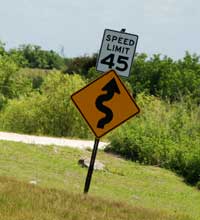
Snake Road wiggles like a snake.

We rode up up I-75 and headed west on a bright sunny morning with big puffy clouds in the sky. Margie spotted all kinds of things — an occasional bird perched in a dead maleleuca tree, big green shrubs studded with pale pink wild hibiscus native to the Everglades, and a golden brown snake rippling across the road. About an hour into the journey, we turned onto Snake Road (but didn’t see any snakes there). Swamp lilies grew in the canals on either side of the road as it turned and twisted past cow pastures dotted with cabbage palms and cypress domes. Swallow-tailed kites soared above. The sawgrass was in bloom, sending up long feathery clusters of small, reddish flowers. We passed through the bustling Big Cypress Seminole Indian Reservation, took a turn and found ourselves in the Devil’s Garden agricultural area.

C&B Farms in Clewiston

C&B Farms is sandwiched between Clewiston and the edge of the Everglades. According to owner Chuck Obern, the farm is 2500 acres in size, with 1500 acres that are tillable. Of that, 1000 acres are planted  conventionally and 500 acres are in organic production. Chuck offered us a quick tour of his farm, so Margie and I hopped into his truck and headed down a sandy road into the heart of the farm. One side of the farm is organic, and the other side is conventionally farmed. The two sides are separated by a large ditch and a row of of trees. Each side has separate farming equipment and packing lines, where the produce is rinsed and boxed, and there’s a separate organic section in the enormous cooler.
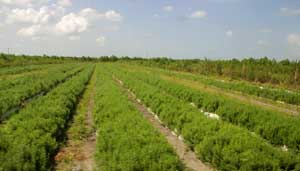
A 2-acre block of rosemary.

Mid-June is pretty much the end of the season and there wasn’t that much growing at C&B. It’s already too hot. We passed by two-acre blocks or fields of herbs — dill that had already bolted, marjoram, knee high sage, bushy rosemary, tarragon, oregano, spearmint, and parsley. We passed by long brown piles of compost, which is used mostly for water and nutrient retention, or as a soil conditioner. The soil is light gray and sandy, very sandy, and it’s amazing they can get so much to grow in it. We passed by blocks of cantaloupe, personal sized watermelons, and butternut squash.

Pumping station for drip irrigation. Barrels hold liquid fertilizer.

Crops are irrigated two different ways. There’s an automated double drip irrigation system (double meaning two lines of drip tape per planting row). Water is pumped from a ditch or a well, and liquid fertilizer is mixed in. A computerized system controls how much water is sent where and when. There’s also the seep irrigation system in which water is pumped into or out of the ditches to raise or lower the water table under the fields. The water seeps into the soil from underneath, rather than drip down from the top. Seep irrigation water is reused or recirculated several times before it is sent to a retention area. Excess water is treated to remove phosphorus before it is released back into a canal bordering the Everglades ecosystem.

During peak season, 500 workers are in the fields picking and packing. But at the end of the season, with a lot less growing, there are only about 100 workers. Fields were dotted with trailer-mounted portapotties complete with a handwashing and sanitizing station, as required by recent federal food safety laws. These regulations also require that workers can’t wear jewelry or bring outside food or drink into the fields.

The federal food safety act is actually many sets of guidelines that came about after the e. coli incident with contaminated jalapenos from Mexico a few years ago. Since then, domestic growers have to comply with stricter standards of produce handling cleanliness. To check compliance, a major food safety certifier comes once a year to check procedures, equipment, and records over a period of three days.
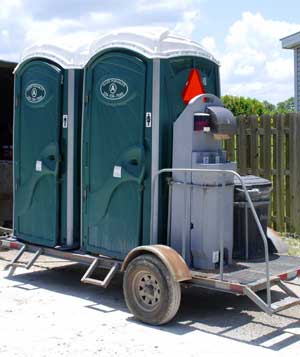
Mobile portapotties, with handwashing station, that are taken out to the fields.

Surprisingly, Central and South American growers do not have to comply with the same strict federal food safety laws as domestic growers. The vast majority of imported produce is not inspected. At most only one to two per cent (maybe even less) of the food coming in is checked for the same standards of cleanliness and safety, and pesticide residues. “There’s no traceability, no accountability,” Chuck complained. “And no guidelines. It’s not a level playing field.” Imported or “offshore” produce is priced less than domestically grown produce, and American farmers find it hard to compete. Their costs have gone up due to extra work and expenses meeting the new guidelines.

So what should a conscientious food shopper do? “Vote with your dollars,” said Mike Counts, the C&B sales manager. “Your dollar ultimately makes the statement. If enough people do it, they will change.” That said, we finished loading up and headed back out on the highway. One hundred miles later we were back at Bee Heaven, unloading fresh melons that had been picked just a few days before. Maybe it costs a little more to buy local and organic, but as you sink your teeth into those juicy fruits, you’ll have the satisfaction of knowing that you’re keeping a couple of local farmers in business.
Read Full Post »

Some of you buy local produce through the CSA and others drop by the farmers market on Sunday. But there’s still a lot more that local growers could do to get their fruits and veggies to your table, or you to their table!

Farmer Margie has written about three ordinances up for a second reading on Tuesday Feb. 9th at 2 pm, before the Miami-Dade County Commission’s Budget, Planning and Sustainability Committee headed by Commissioner Katy Sorenson. One proposed ordinance would allow for B&B’s in the farm area, one would allow growers to process products that they grow (making dried fruit or ice cream, for example), and one would allow building a distillery to make spirits from local fruits. Click over to the Bee Heaven Farm’s blog for more info.

Read the full agenda for the Committee meeting here. (The link posted on the BHF blog doesn’t work.) You can also download pdf’s of the proposed ordinances from that web page. Don’t forget to contact Commissioner Sorenson at District8@miamidade.gov or (305) 375-5218 to give her your support on these ordinances. They are scheduled to come up for a final vote before the full commission sometime in April.

Read Full Post »

The end of an era?

Katy Sorenson has long been a friend to the farmers. She is best known for fighting attempts to move the Urban Development Boundary (UDB) which has restrained urban sprawl; for promoting zoning changes that would allow struggling family farmers to have alternative streams of agriculture-related income; and for promoting agri-tourism. Without her on the Commission, some farmers I’ve talked to fear their voices will no longer be heard, and the last remaining farm land will be devoured by waiting developers. Is this the end of an era, or will somebody as strong stand up and take Katy’s place?

Read the official announcement on the District 8 site, where you can also download her statement.

Read the Miami Herald article published on Friday, Feb. 5, 2010:

Miami-Dade Commissioner Katy Sorenson won’t seek 5th term

Miami-Dade Commissioner Katy Sorenson won’t seek a fifth term, closing a noteworthy career and opening the door for a new commissioner for South Miami-Dade.

BY MATTHEW HAGGMAN
mhaggman@MiamiHerald.com

Miami-Dade Commissioner Katy Sorenson will not seek reelection this fall, ending a 16-year run on the county board distinguished by her advocacy for the environment and social equality.

The commissioner announced plans to collaborate with the University of Miami to develop a leadership initiative on public service for people aspiring to run for local and state elected office. The effort, she said, will have the backing of the Knight Foundation and Dade Community Foundation.

Read more here:

http://www.miamiherald.com/news/miami-dade/story/1463960.html

Read Full Post »

Fan mail

It’s not every day that I get a thank you note from those in the higher echelons. Back in December, this note appeared in my inbox.

Dear Ms. Wertalka:

I wanted to compliment you on your blog, Redland Rambles. It’s a great vehicle for promoting local agriculture as well as putting a face and story behind those who grow our food and plants.

Keep up the great work!

Warm regards,
Katie Edwards

Katie A. Edwards
Candidate, State Representative, District 119
P.O. Box 900398
Homestead, FL 33090
Phone: (786) 266-8010
E-Mail: Katie@Elect-Edwards.com
www.Elect-Edwards.com

Paid political advertisement paid for and approved by Katie A. Edwards, Democrat, for State Representative, District 119.

I met Katie briefly this summer at the laurel wilt workshop, held at the UF/IFAS Extension offices. She’s currently the Executive Director of the Dade County Farm Bureau. Now she has set her sights on a higher goal, State Representative for District 119, which includes Redland, sprawls east to Pinecrest, and winds north through West Kendall and into Sweetwater.

On her campaign web site, Katie says that South Dade needs a strong voice in state government. “Protection of South Dade’s unique ecological resources is a priority if we are going to achieve a quality of life that is environmentally sustainable and socially responsible.” She’s the only candidate in that district who speaks for the growers in Redland. I may be wrong, but at first glance, her opposition doesn’t seem aware that they even have the county’s prime agricultural land in their district. As much as I didn’t want to get political when I first started this blog, maybe now it’s time to start having conversations with the people who want to make decisions for my farmer friends in Redland. Stay tuned…

Read Full Post »

Redland Raised, Fresh From FloridaRedland Raised launch event:
Thursday Oct. 29th, 10- 11 am
Publix at Tropicaire Shopping Center
7805 SW 40th Street, Miami

Starting this week, you won’t have to go too far to find locally grown produce. Redland Raised branded green beans, yellow squash, zucchini, boniato, okra and avocados will be available at all 1000 Publix stores in the state, during the local growing season which runs from November through April.

Miami-Dade County, Publix and the Florida Department of Agriculture and Consumer Services Fresh From Florida program teamed up to promote a “buy local” program throughout the county and state.

Charles LaPradd, Miami-Dade’s agriculture manager, was quoted as saying, “We were looking for a way to just make our local produce down here known a little bit better,” LaPradd said. “When you go local, you go green.”

Needless to say, larger local growers are delighted with this huge new market for their produce. Publix says the Redland Raised will help them keep transportation costs down, which should result in lower prices for customers, and a smaller carbon footprint.

Miami-Dade County’s agriculture industry is number two in the state (after Palm Beach County) and 18th in the country, generating an estimated $2.7 billion for the local economy.

On the Miami-Dade County web site, on the Office of the County Mayor’s page:

Buy Local, Redland Raised available at Publix

For South Floridians who want to buy local… the shopping experience is about to get even better. Thanks to a partnership with Publix Super Markets, more than 1,000 Publix stores will soon feature locally-grown fresh produce. The produce will be dubbed Redland Raised.

Along with ”organic”, ”buy-one-get-one-free”, and ”on sale” – Redland Raised can be the new buzz word in grocery store shopping. While Publix has always supported our local agriculture industry – shoppers who walk the produce aisle can now look for special labeling and displays that show when green beans, zucchini, avocados and more come from our very own backyard.

Redland Raised is a way to educate and encourage our residents to invest in local produce and in turn, stimulate our local economy. Miami-Dade County’s agriculture industry is number 2 in the state and number 18 in the country, generating an estimated $2.7 billion for our local economy.

I would like to thank Publix Super Markets for making it possible to promote our local brand, and for their continued investment in our community.

Enjoy Redland Raised!

Sincerely,
Mayor Carlos Alvarez

Read Full Post »

« Newer Posts - Older Posts »