Feeds:
Posts
Comments

Earth Dinner 2011

Earth Dinner Celebration
A Possum Trot Experience

Featuring local seasonal organic produce from Redland farms

Saturday, April 30th, 6 p.m.
at Possum Trot Tropical Fruit Nursery

Guests will be treated to a brief farm tour followed by a 7-course farm dinner prepared by Possum Trot owner, the “Cantankerous Chef” Robert Barnum, using ingredients exclusively* grown or produced within the South Florida Greater Everglades Foodshed (Lake Okeechobee south to Key West).
*except flour & olive oil

MENU

Okeechobee wild boar, Florida grass-fed beef, wild-caught local fish
Redland grown seasonal vegetables and fruit
Local tropical fruit wines
Goat cheese

Producers: Bee Heaven Farm, Hani’s Mediterranean Organics, Possum Trot Tropical Fruit Nursery, Three Sisters Farm, Miguel Bode Honey, Florida Keys Sea Salt, Schnebly Redland’s Winery

Wild-caught fish and boar donated by Michael’s Genuine Food & Drink and Trigger Seafood

Part of a series of Earth Dinners sponsored by The Chefs Collaborative and Organic Valley

Get Tickets Now! $130 per person.
Attendance limited. Advance reservations required by April 25th.

Possum Trot Tropical Fruit Nursery is located in the Redland farming area south of Miami, next door to the Monkey Jungle.

Best of Blogs vote

Click here to vote for my blog on BOB - South Florida's Best of BlogsRedland Rambles has been nominated in the Sun-Sentinel’s Best of Blogs competition, in the “Foodies” category. A keen-eyed reader pointed out that it is also listed in the “Neighborhood” category. (Don’t ask me how it got listed twice, I don’t know…) Pick one category and vote. I tried voting in both, but it won’t let me. Hopefully all the votes will be counted.

If you like this blog, please register with Sun-Sentinel and place your vote! Voting is limited to one vote per person per day per Category and per “Best Overall Blog.”

Prize money will go to good use — cash will pay for gas to make more trips to more farms in Redland, and to more markets around town, resulting in more blog posts.

Don’t wait, the contest ends on April 11, 2011 at 10:00 a.m. Vote early, vote often!

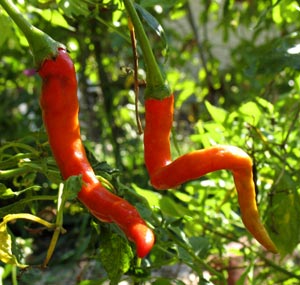
Hot chilis, the heart of kimchee.

I first met Muriel Olivares last year at Bee Heaven Farm, where she was farm manager for the season. Not only did she help things run smoothly, but she was always making interesting things with the veggies that were in the barn that week. One Friday I discovered that she had brine pickled a gigantic jar of French breakfast radishes, and I blogged about it here. Another Friday it was a big batch of kimchee — garlicky, peppery, a bit pungent, and totally amazing.

I’d learned how to make vinegary quick pickles from Hiromi, another farm intern from a few years ago, but fermentation was new to me. So when I got Muriel’s email that she was going to hold a kimchee making workshop at her Little River Market Garden, I jumped at the chance. Finally I would learn her secrets!

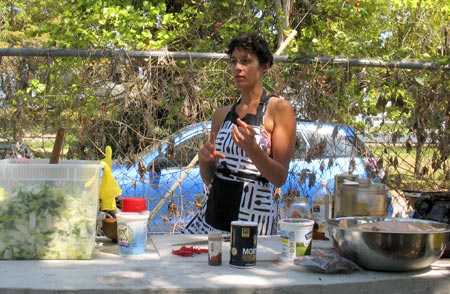
Urban farmer Muriel Olivares at her outdoor kitchen.

About two dozen people were thinking the same way and showed up too. Located in a leafy, secluded corner of northeast Miami, Muriel’s city-lot-sized garden had been transformed from a grassy vacant yard with a few fruit trees to a flourishing mini-farm, complete with wood fired pizza oven and outdoor kitchen. It was there that Muriel was set up with all the necessary tools and ingredients, including a restaurant-sized tub of chopped and brined Napa cabbage.

Getting a sniff of chili paste. This is what preserves the cabbage and other vegetables.

The recipe is posted on three different blogs — Little River Market Garden, My Edible Yard, and mango&lime — so I won’t repeat the exact details. Suffice to say that the ratio is 2 parts cabbage (about one head of Napa or bok choy) to one part radish/daikon/turnip and 2 cups of chili paste. (Carrots, half as much as daikon, can be used to sweeten it a bit.) The heart of the matter is the freshly-made chili paste. Muriel made it with several onions, a prodigious amount of garlic, half as much of ginger, and plenty of fresh and dried hot peppers, which were moistened with cider vinegar, a bit of honey and a bit of olive oil. (OK, so the oil isn’t truly authentic, but Argentineans use olive oil for everything.) She blended it together and soon the thick aroma of peppers and garlic wafted over us sitting in the nearby chairs. “Chili paste is what preserves kimchee,” Muriel said, explaining that garlic and peppers have antibacterial qualities. “Salt is not what’s keeping it sterile.”

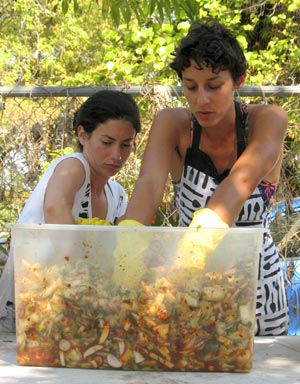
Olivia and Muriel mixing all the ingredients. Don’t forget gloves if you mix a big batch by hand. The peppers will burn!

An assistant was drafted and the yellow gloves came on to mix the tub full of copped vegetables and chili paste. It smelled great and everybody crowded around to smell the spicy aroma, take pictures and fill their empty jars to take home.

But now the real fun begins. Kimchee is fermented food, and there wasn’t enough vinegar to pickle it, so preservation has to come from other means. Muriel advised to leave the open jar out on the counter for as long as three days. At home, I took the lid off the jar, weighed down the contents with a plastic bag of water, and covered it with a coffee filter held down with a rubber band. No refrigeration allows natural fermentation to begin. Muriel had cautioned to set the jar in a shallow bowl or dish, because liquid would come out. Sure enough, it did for several days, along with a strong odor. “Liquid comes out as the bacteria metabolize, which releases gas bubbles, which makes water rise over the top, ” Muriel explained in an email.

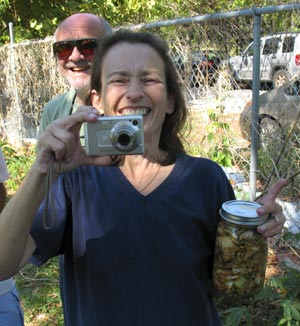
Ara, who writes My Edible Yard blog, shoots it out with me. Say kimchee!

My jar stayed out for five days, just to see what would happen next, and liquid stopped seeping out on the fourth or fifth day. Took the filter and bag off, leaving about an inch of space, and put the lid back on. The jar of kimchee is now sitting in the refrigerator. “Putting a lid on it and putting it in the fridge dramatically slows down fermentation (bacteria metabolism) so liquid will stop coming out.  A little pressure may form in the jar so it’s good to leave a small space (meaning not full to the top),” Muriel added in her email.

Kimchee can stay out longer, I was told by Farmer Margie, and then keep in the frig for months (if it doesn’t get all eaten). It would only be fitting to bring the jar to Bee Heaven’s barn, where my discoveries in fermentation began, and try it out on this season’s interns and apprentices. Stay tuned!

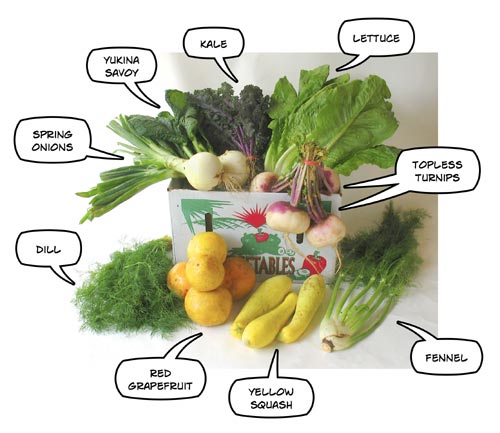
CSA share: week 17

CSA share: week 17

Dr. Marvin Dunn tells it like it is, while Local 10’s Todd Tongen looks on.

This Wednesday things were definitely not business as usual at the Roots in the City Farmers Market in Overtown. All the vendors were gone — no Nature Boyz, no Redland Organics, no Hani’s goat cheese. Members of the media, including three TV stations and four bloggers, were interviewing curious neighbors, and protesters with signs milled around. Only one tent belonging to RITC was up at noon, and market manager Maggi Pons was stacking collards, yellow squash, scallions and other produce as if it were a normal day at the market. Only she wasn’t selling — she was giving it all away because the market couldn’t sell anything.
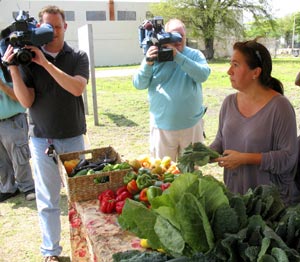
Maggi Pons, RITC market manager, and the media.

Last week the owner of the land that the market sits on had been served with a notice of violation. The South Florida Smart Growth Land Trust was cited by the City of Miami for “illegal sale of fruits and merchandise from open stands and vacant lots” and “failure to obtain a Class I special permit.” The market is allegedly illegal, and the media reported last week that it would be shut down. “It’s not just the wrong permit,” Maggi Pons fumed. “It’s a lot more complicated than that. The city doesn’t have a permit for a fresh produce market, so we have to take out a special events permit, good for only two times a year.”

Mayor Tomas Regalado sent two spokesmen to try to smooth the waters and clarify the situation. Alan Morley insisted that the mayor “loves the market.” He explained the city only wants the market to get the proper permits and licensing, not shut it down, and they have until the weekend to comply. “Certain criteria have to be met. They didn’t go through the right permit process,” he stressed.
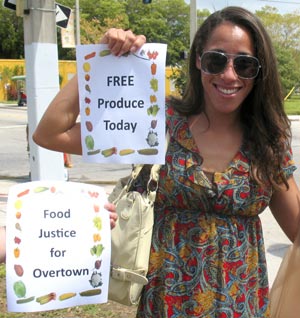
Asha Loring came to shop and joined the protest.

According to Pat Santangelo, the other spokesman, it’s all a big misunderstanding. “We have a lot of unnecessary paranoia,” he said. “If you’re going to run the market as a business, you need to comply with certain things.” He pointed out that the market required an annual certificate of use permit, a Class I permit, and a business tax receipt, and fees would be waived or reduced. When I asked Santangelo if the Class I permit was the two-times-a-year special events permit that market leaders were distressed about, he explained that it was an “unlimited” permit. (He said it was an “annual” permit, as quoted by Local 10 News.)

Yet market founder Dr. Marvin Dunn claimed he repeatedly called the city about the violation and didn’t get an answer. It got him hot under the collar, so he rounded up protesters and alerted the media. He said he got the certificate of use since the very beginning. The only solution he saw is to request a resolution from the city commission to allow his market to operate for six months at a time. But even that is politically uncertain, and as Dunn put it, “Who can run a market on a whim?”

Not all the vendors were happy about a day off. Instead of selling produce on Wednesday, Farmer Margie Pikarsky of Bee Heaven Farm stayed home. “Since we won’t be there, we won’t be bringing fresh, local, organic veggies to the underserved, food desert neighborhood. And, we won’t be employing the local resident that helps us with the setup and breakdown each week. How does that help anyone??” she said.
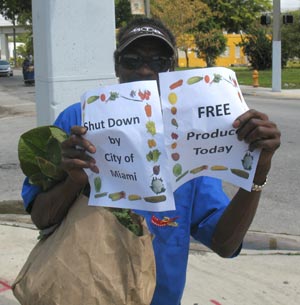
Neighbor James Branson is thankful for the food.

Wednesday’s free food giveaway was a big hit with the neighbors. Three women staggered away with four grocery bags brimming with collards and other produce. Area resident James Branson was delirious about his full shopping bag. “God is good,” he exclaimed, pointing to the sky. “Give thanks for the food on the table!” Neighbors who came late were disappointed. By 1:20 p.m. the RITC tables were completely empty of produce and the tent came down.

Giving food away may work in the short term, but in the long term it’s not a solution to either the problem of permits and codes — or developing a local food economy. It appears the City of Miami doesn’t have an ordinance that specifically applies to farmers markets. Spokesman Santangelo called the situation with RITC “a good learning process” for market people to learn how to comply with existing regulations. Yet he gave no answer when asked how the city can help this market (or others) navigate the permitting process smoothly and quickly.

Fresh veggies up for grabs.

The local food movement is growing, but it’s a slow and painful process. For every step forward, it appears there are two steps back. Farmers markets are the best way for small local growers to find buyers, and for buyers to find fresh, local produce at a fair price, especially in underserved neighborhoods. Instead of trying to shoehorn market compliance into codes that were written to address different situations that don’t quite fit, perhaps a new ordinance needs to be passed to support markets and allow the local food scene to flourish. (While Miami takes a tough stance on code enforcement, South Miami willingly embraces its new grower supported market.) Whichever the city, the most important thing is to get fresh food into the hands of people who need it most and have grown to count on it.

In the Media:

Read about the protest at CBS 4, Local 10 and the Miami Herald here and here. Mango & Lime has a thoughtful post and an update about zoning and permits (at the bottom of the page). Read Dr. Marvin Dunn’s letter to the editor in the Miami Herald. Read Commissioner Richard Dunn’s letter to the editor here. Read about Dr. Dunn’s “Food Justice for Overtown” protest here. Read about Marvin Dunn’s negotiations with the Overtown CRA officials here.


RITC Farmers Market got media attention.