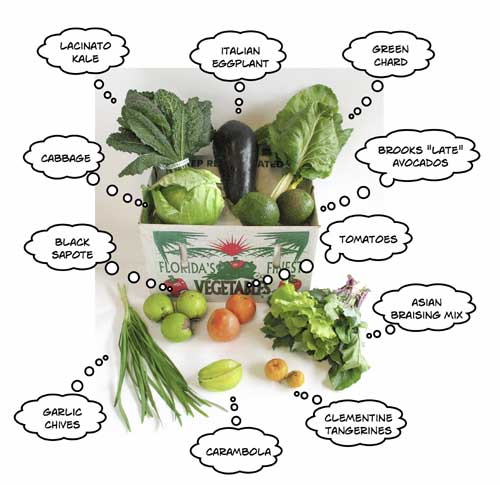
CSA share: week 7
BREAKING NEWS! Due to unforeseen circumstances, Paradise Farms will not attend the Gables Market this Saturday. However, they do intend to be at market on the following Saturday, Jan. 23rd.
Paradise Farms will be at the Coral Gables Farmers Market beginning this Saturday, January 16th. Farmer Gabriele Marewski says her farm has survived the cold winter blast and she will have carrots, peppers, baby greens, herbs and those fabulous oyster mushrooms for sale.
The Gables market, now in its nineteenth year, takes place every Saturday 8 am to 1 pm, running from January 16 to March 27. It’s located in downtown Coral Gables, in front of Coral Gables City Hall at the intersection of LeJeune Road and Biltmore Way, next to Miracle Mile.
For more information, contact the Economic Sustainability Department at 305-460-5311 or click here.
Posted in events, food, market | Tagged farmers market, Gabriele Marewski, Paradise Farms | 3 Comments »
Record-breaking cold temperatures rolled in, and a freeze warning was issued for several nights in a row this week. The farmers in Redland scrambled to protect their crops from the freezing cold, but generally fared well. CSA growers located further north — Worden Farms in Punta Gorda, and C&B Farms in Clewiston — got frost damage on Tuesday night. They’re still evaluating how much damage they got, and if any crops were lost.
As a result, there may be less in the share box this Saturday and maybe for the next week or so. Freeze damage is one reason, and less veggies growing is another. “Plants don’t like to grow when it’s cold. They like to go dormant,” grower Dan Howard explained to me. If there’s a killer frost and lettuce (for example) is burned by cold, that’s it, there’s no more local lettuce to eat until it’s replanted and harvested again. Remember, as CSA members, you agreed to share the same risks as the growers! No faking it with lettuce from Belize or somewhere… not in this CSA! (Also, because vegetables were damaged by the cold, or were not ready to pick, there will be less in the stores and the prices will go up.)

Reemay, or floating row cover, protects delicate greens and pole beans against freeze damage.
Margie Pikarsky at Bee Heaven Farm protected delicate basil, heirloom tomatoes, and pole beans with large sheets of Reemay, or floating row cover. It’s a spun polyester fabric that is used to cover plants, much like a blanket. The row cover acts like a blanket to hold in the heat and keep plants warm. Margie added she’s not watering as much, because that runs the risk of plants mildewing, or hot condensation cooking entire plants. Her crops have been covered since the first freeze warnings on Saturday, and the Reemay will stay up until the cold blast forecast for this coming weekend.
On Wednesday afternoon, Dan Howard of Homestead Organics, was cautiously optimistic. “Tuesday night it went down to 33, 34 degrees, but not a killer freeze,” he told me. He had prepared his bean fields by watering them quite extensively during the day on Tuesday. (It’s just too much acreage to use row cover.) Dan explained that his crews “soaked the ground down real good. Water insulates the ground to keep it from getting colder. Well water is 75 degrees, the same temperature year round. Dry ground gets colder than wet ground.” He explained that ground temperature is the most important for the plants, keeps the roots from freezing.
If the temperature gets below 32 for any length of time, plants will become permanently damaged from the cold. “Anything below 32 is bad, and at temps of 28, 29 degrees, it’s a total loss,” Dan explained. Monday night wasn’t that severe because there was a blanket of cloud cover, which acted as insulation and kept the temperatures from dropping too low. Tuesday night the sky was clear and temperatures dropped — but it was windy, and that made a difference. The moving air keeps ice from forming on the leaves. “If there’s no wind and clear sky, you get frost,” Dan said. And frost is what kills plants. It coats the leaves and burns them much like frostbite. Leaves turn black and wilted from the damage and the plant will die. Farmers can knock ice off the plants by spraying fields with water in the middle of the night, Dan explained. That’s why they’re up all night, watching the temps, checking the plants watering in the fields and groves.
In a similar vein, Robert Barnum of Possum Trot Nursery watered his tropical fruit grove on Tuesday night. He has giant pumps to draw well water, and tree-high sprinklers dotted through his grove. Tuesday night temps dropped to 36, and Robert was up at midnight and again at 3 am watering and checking on his trees. He explained that water gives off heat as it freezes, 353 kilocalories per gram of water to be exact, and that bit of heating warms the plants. Once the water on the plant freezes, it keeps the temperature constant at 32 degrees even if air temperatures drop below that, because a heavy coat of ice acts as insulation. But you have to keep watering, he insisted, to keep that small but important heating process going.
By Wednesday night Robert was less optimistic than Dan, and said the thermometer already read 39 degrees at 9 pm. The sky was clear and the winds were dying down. It looked like there would be a killer frost that night. Margie said the temperature dropped hard and fast — and then something unexpected happened. Some light cloud cover rolled in, and those clouds were enough to act like a blanket keeping heat from radiating away from the ground at night. Temps hovered around freezing, then came back up a bit. “I never saw anything like that,” Margie told me. But the main reason why the anticipated killer frost didn’t happen, according to Jonathan Crane at TREC: when the temperature fell to 35 it also reached the dew point. When the temperature meets the dew point, heat is released and the temperature rises, and that is what happened on Wednesday night. (There might have also been a bit of ground fog.) End result, no freeze, and crops were spared — this time. A more severe blast of cold air is forecast for the weekend, and growers (especially to the north of us) are bracing themselves.
To learn more about how frost forms and dew point, take a look at this web page.
Posted in farm, location, photo, weather | Tagged C&B Farms, Dan Howard, Margie Pikarsky, Robert Barnum, Worden Farm | 4 Comments »

Mom used to call me cabbagehead.
Last week I fished through the extras box and grabbed a giant cabbage as big as my head. Forgot to weigh it, but my guess is that cabbage was at least twice the weight of the average cabbage in the shares. There certainly was enough to make a large pot of Lithuanian Cabbage Soup. Mmmmmm almost as good as Mom’s.
Lithuanian Cabbage Soup
(kopustu sriuba)1/2 head of medium cabbage, shredded
1 lb. sauerkraut with liquid
5 cups chicken (or vegetable) stock
2 cups water
1 1/2 lbs. smoked ham hocks (optional)
5 whole peppercorns
2 whole bay leaves
2 medium tomatoes, cored, seeded, diced
1 medium onion, choppedIn a large pot, place the sauerkraut, chicken stock, smoked meat, peppercorns and bay leaves. Add water to cover. Bring to a boil, reduce temperature and simmer for 1-2 hours. Meat should be tender. Remove meat, discard bones, dice and return to pot. Add the shredded cabbage, tomatoes and onion. Bring to a boil, reduce to a simmer, and cook another hour or so. Add water as necessary to keep it soupy. Adjust seasonings to taste. Serve with hot boiled potatoes on the side.
Note: You can substitute smoked turkey for ham hock. If you use chopped piper betel leaves in a vegetarian version, reduce cooking time to 45-60 minutes.
Lithuanian Heritage Magazine, January/February 2009
Posted in csa, photo, recipe, vegetables | Tagged csa | 2 Comments »

 Redland Rambles