
CSA share: week 5
Anderson’s Corner doesn’t look like it will last much longer. It’s depressing to drive by there and see it all ramshackle and rickety, instead of restored and vibrant. I doubt if the current owners, who are struggling with upkeep, will be able to hold on much longer if they are going to get fined $500 a day. This might be the tipping point. Anybody out there with deep pockets who would like to help save this property?
The word was that the new bed and breakfast ordinance, which was drafted this summer with input from area growers, has gone to the county commission for a vote — but it has been pushed back and pushed back on the calendar. No telling when it will come up for a vote. It was supposed to in October, then in November. A yes from the commission will allow growers to add commercial kitchens and farm stands, and to legally to make and sell value-added agricultural products — jams, cheese, dried fruit, pickles and the like — in addition to the bed and breakfast provision. This new ordinance will essentially promote agritourism, which will allow the farmers to stay in business.
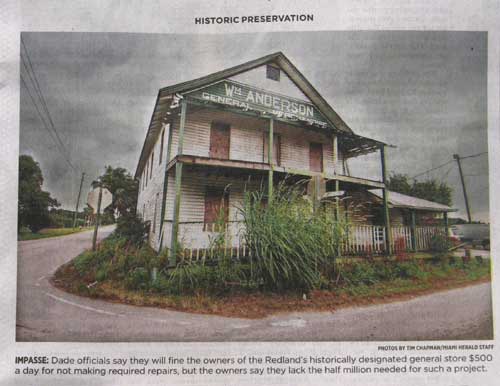
Anderson’s Corner, as photographed by Tim Chapman of the Miami Herald.
Miami-Dade officials have cracked down on the owners of the vacant, 100-year-old Anderson’s Corner general store in the Redland to prevent `demolition by neglect.’
BY ANDRES VIGLUCCI
aviglucci@MiamiHerald.com
The Anderson’s Corner general store, a modest, two-story wood-frame building on a corner in the rural Redland, doesn’t look like much. The white paint is peeling, porches sag, shattered windows are boarded up, and the Dade County pine siding is badly splintered where a hit-and-run motorist took out a chunk of wall last month.Yet the long-vacant country store, built around 1911 by a Redland pioneer, is one of Miami-Dade’s oldest and most resonant buildings — and also one of its most endangered.
And now it’s a test case in a county effort to boost enforcement of an ordinance meant to save historically designated buildings from what is happening to Anderson’s Corner, a phenomenon commonly described by preservationists as “demolition by neglect.”
“It’s sad to see these things happening, especially to a building that important,” said Kathleen Kauffman, Miami-Dade’s historic preservation officer. “And we don’t have that many wood-frame buildings left, period.”
Kauffman has cited the property’s longtime owners, Brian Simmons and his wife, Jessica Olsen, for failure to maintain a designated historic building. If the owners don’t make repairs sufficient to halt its deterioration, they will be fined $500 a day until the deficiencies are corrected.
Recently, the owners organized a cleanup, removing accumulated trash from the property and resealing boarded-up windows that had been forced open.
But Simmons said that he and his wife, small local farmers, lack the resources to do extensive repairs. They had planned a full renovation when they purchased it in 1997 but were unable to secure financing, he said. They have since had constant trouble keeping up with maintenance because vandals or homeless people regularly break in and damage the old building, Simmons said.
“It’s a money pit,” he said. “If I had the money, that place would be shining. It’s a piece of history, I know that. It makes us sick to know the condition it’s in. But my resources are tight.”
Subrata Basu, Miami-Dade’s assistant planning and zoning director, said he sympathizes with the owners’ difficulties but noted that they knew they were purchasing a protected building 12 years ago.
“It’s the owners’ responsibility to maintain the property — not just a historic property, but any property,” Basu said. “But it becomes a different issue when it’s a historic building.”
CITATION TRIGGER
County ordinances bar demolition or exterior alterations of buildings designated as historic. To address cases where owners allow historic buildings to slide into ruin — either deliberately or because of inability to properly maintain them — the ordinance gives the preservation officer the power to levy the $500-a-day fine.
But the ordinance had not been enforced, in part because the small office of three people lacked the resources to do so, Kauffman and Basu said. When the planning and zoning department last year absorbed the office, formerly housed at the county’s cultural affairs department, Basu had zoning inspectors undergo training to enforce the rules.
Complaints from neighbors over the worsening condition of Anderson’s Corner triggered the citation, the first under the new policy.
“I really resent that place falling apart,” said Peter Hoffman, one of the complainants, who lives catty-cornered from the old country store in an even older wood-frame building — the area’s original two-story 1904 schoolhouse, which is immaculately maintained.
“Locals and tourists knock the windows out,” he said. “They just kick those things out and they go in the building. It’s falling apart. The front porch is going to be in the street before the summer. And I’m worried about someone starting a fire.”
ABOUT ITS HISTORY
The store was the center of a settlement built by the first pioneers to claim homesteads in what was then, at the turn of the last century, a hardscrabble wilderness. Built by William Anderson, who worked for railroad magnate Henry Flagler, it provided living quarters for his family and served as a general store for what became a thriving farming community.
Editor and historian Howard Kleinberg called it “South Dade’s historic centerpiece.”
Designated a historic building by the county in 1981, Anderson’s Corner is part of a larger district made up of other surviving structures from the period, including the old schoolhouse. Anderson’s Corner is also on the National Register of Historic Places.
In the early 1990s, tropical fruit grower Joan Green and chef Mario Martinez transformed the old general store into a well-reviewed gourmet restaurant that used local produce in its dishes. It was just starting to gain popularity when Hurricane Andrew in 1992 took the building’s roof off and knocked the second story askew, putting an end to Anderson’s Corner’s brief-lived second incarnation.
The building has been vacant ever since.
Armed with $750,000 in grants, Green and Martinez gutted the building and began what was meant to be a complete restoration. Steel columns were installed to support the structure and a new roof put on. But the two had a falling-out amid what Green says were endless bureaucratic obstacles and financial disagreements.
The county pulled a $250,000 grant and, after lengthy litigation, the partners ended their involvement by selling to Simmons and Olsen, Green said, calling it “one of the greatest disappointments I have had in my life.”
“They had some idea about what they wanted to do there, but quite frankly it didn’t make any sense, economic or otherwise,” Green said in an e-mail from the Caribbean, where she now lives aboard a catamaran. “I have felt like crying every time I drive by the property because I have observed it deteriorating. I feel sad about all of the public money that went into the project that came to nothing.”
Dade Heritage Trust, a preservation group that loaned Green and Martinez money for the renovation, “never got a penny back,” said executive director Becky Roper Matkov.
“So much effort went into that, it’s such a shame,” Matkov said.
Simmons said he and his wife still dream about reopening Anderson’s Corner, but they were never able to secure financing for what he estimates would be a $500,000 restoration job. The couple, who live on a farm down the road, also had triplets since buying the historic property, limiting their time to focus on restoration or maintenance of the building.
Simmons said he would sell the property, but his wife, who grew up in South Miami-Dade, won’t hear of it.
“I had some great offers, but my wife said no,” Simmons said. “I would sell it today.”
BEHIND THE NEGLECT
Meanwhile, the building continues to deteriorate. Customers from a cantina next door litter the property with beer cans and bottles, Simmons complains. He believes cantina customers are responsible for some of the vandalism.
The cantina owner, for his part, says he believes the historic building is an eyesore and would like to see it gone.
“It has no value,” said the owner, Edelmiro Iglesias. “It has no floor and holes everywhere. It’s just going to fall down by itself.”
At least one neighbor thinks the vandalism may be deliberate, noting the historic property is one of a fewin the Redland with commercial zoning — thus potentially a target for someone hoping to cash in by building new retail.
“Piece by piece, it has been disappearing. Every day a piece goes missing. Almost as if it was being dismantled,” said John Green (no relation to the former owner), who has a small farm nearby. “It’s almost a sin to see this old edifice taken apart.”
Basu, the county planning official, said he believes there’s hope for saving Anderson’s Corner, which he believes would make a “wonderful” bed and breakfast. His agency is now drafting an ordinance to permit such lodging in the Redland.
But he concedes that the case underscores the difficulty in enforcing preservation laws. He hopes enforcement will stave off the building’s deterioration by ensuring that it is secured and, if necessary, shored up. But forcing actual renovation is well beyond the scope of the ordinance, and he acknowledges that the fine amount is “weak.”
“If someone is not cooperating, it can become a nightmare,” Basu said. “You can force them to do something immediate, but if they’re not into it, you eventually go back to where you started.”
© 2009 Miami Herald Media Company. All Rights Reserved.
Posted in agritourism, development, location, media | Tagged Anderson's Corner, historic preservation, zoning |
This summer, there was great concern among commercial avocado growers in Redland (including Bee Heaven Farm) about the apparent discovery of the redbay ambrosia beetle, which rapidly kills avocado trees, and has been located in North and Central Florida. At least one tree in Redland was suspected of infestation and was burned. UF/IFAS held a workshop (which was blogged) giving information about the beetle and laurel wilt, the lethal fungal infection that it causes.
If you have avocado trees on your property in town, don’t think you’re immune. Learn what the signs are and watch your trees carefully. There’s good information at Save The Guac and the UF/IFAS sites.
Farmer Margie told me in summer that she will take a wait and see attitiude with her grove. Both she and Gabriele Marewski of Paradise Farms (who also raises avocados) are cautiously optimistic that a healthy, unstressed tree may not get infested and die. So far so good, fingers crossed.
Here’s a good follow-up article about the situation, published in the Miami Herald on Dec 26th.
After enjoying a season of near record-high avocado prices, farmers of Florida’s second-largest tropical fruit crop are now worried about a potentially deadly invasive pest.
http://www.miamiherald.com/457/story/1398662.html
BY NIALA BOODHOO
nboodhoo@MiamiHerald.com
This year’s avocado season is making farmers happy: The 920,000-bushel crop, grown mostly in southern Miami-Dade County, is fetching prices that are almost 50 percent better than a few years ago. But as the season comes to a close, those in the Florida avocado industry are casting a wary eye to Martin County, where the redbay ambrosia beetle continues its march southward.
Growers, scientists, and the local, state and federal governments are in a race against the beetle as it makes its way south to the $30 million avocado industry.
The beetle, believed to be a native of Asia, is described by scientists as smaller than Lincoln’s nose on the penny. But it carries a fungus that has proved lethal to many trees in the laurel family, including redbays and avocados, from the Carolinas through Georgia, and now Florida. There is no method to cure the disease.
After citrus, avocados are Florida’s largest tropical-fruit industry. This year’s crop was more than 50 million pounds, virtually all of that grown on 7,500 acres in Miami-Dade.
“The avocado industry is very concentrated in one area,” said Craig Wheeling, president of Brooks Tropical in Homestead, one of the largest growers, packers and shippers of Florida avocados. “It’s kind of an all-or-nothing fight down here.”
Wheeling said his best avocados were getting about $16 a bushel — 45 percent better than the $11-a-bushel prices three years ago. He attributed the higher prices to not just a smaller crop, but to growing demand for Florida avocados. And he said that’s what makes it even more crucial that scientists find a way to combat the beetle and the fungus-causing disease it carries.
Females carry the fungus spores in a special pouch within their mouths. When the insects bore into a healthy tree to check if it would be suitable for nesting, the tree is inoculated with fungi that cause a disease called laurel wilt. As it spreads, the tree’s water system is disrupted, causing the leaves to wilt so quickly they don’t even fall off.
The larvae and adult females feed off the fungus — essentially, the beetle carries its farming system with it, said Jonathan Crane, a tropical-fruit plant specialist with the University of Florida’s Institute of Food and Agriculture Sciences in Homestead.
There are dozens of varieties of beetles that have a symbiotic relationship with a fungus it carries. The one beetle/fungus combination that has proved deadly to the redbay and Florida avocado tree is a specific variety with the scientific name raffaelea lauricola. It was first detected in Georgia in 2002.
It took a few years to spread through Georgia and was first found in Florida’s northern counties in 2005. On its own, the beetle can fly about 20 miles.
It has spread exponentially quicker the past two years to Central Florida, experts believe, because diseased trees have been cut down for firewood and brought south.
In late July, the local industry panicked after the state issued a press release saying a confirmed case of the beetle had been found in a Homestead grove.
Growers, including Brooks, spent hundreds of thousands of dollars to cut down and burn trees that looked weak or infected, and to spray groves with extra pesticides.
That initial test proved to be a false positive because the science behind tracking and typing the fungus is just developing, said University of Florida forest pathologist Jason Smith. The beetle and fungus have never been studied in Asia, where it is believed to come from, because trees there haven’t died.
“Nobody had ever looked at this,” Smith said.
It took weeks to confirm that the disease hadn’t reached Miami-Dade. Even so, the industry remains on guard.
“It’s still a threat,” said Miami-Dade County’s agricultural manager Charles LaPradd. “What I would love to say is that it will never get down here, but that’s fantasyland.”
Local growers say what happened this summer was a test.
The summer scare caused growers to start regular meetings with local, state and federal agriculture officials and scientists, who said they are close to a method that would confirm the disease in a day or so.
Most of the research is being spearheaded by the University of Florida, which received a $1.2 million USDA grant to find a way to beat the beetle.
One possible method might involve sterilizing the large equipment that is used within groves to prune trees, Smith said. Others are looking at the natural resistance that has been found in Asia and among some local varieties of trees. Additional research is going into fungicides that need to receive federal approval before being used.
In the meantime, the state agriculture department has also started a marketing campaign based on one of the fruit’s most popular uses, guacamole, at www.savetheguac.com. It’s designed to help educate the public about moving firewood and how to spot diseased trees.
“There are tens of thousands of backyard avocado trees in South Florida,” said state agriculture spokesman Mark Fagan.
“We can’t go into every backyard and inspect every avocado tree — we need the public’s help.”
© 2009 Miami Herald Media Company. All Rights Reserved. http://www.miamiherald.com
Posted in farm, fruits, location, media | Tagged avocados, laurel wilt, redbay ambrosia beetle, UF/IFAS |

Beekeeper Miguel Bode
You might have seen beekeeper Miguel Bode selling honey and beeswax candles at fairs and festivals and markets all around town. If you bought wildflower, avocado or lychee/longan honey from him (or Farmer Margie), those are the products of his bees kept at Bee Heaven Farm, among other farm locations. I caught up with him at Ramble, and noticed he had a sign saying he was looking for a bee yard in suburban Miami. Your reward? All the honey you can eat — and an opportunity to do something to help honey bees survive.
“A bee yard is a place where bees can be put and survive,” Miguel explained. The ideal location is secluded or isolated, in an area where people will not go often. It would be a place where the bees won’t be disturbed or disturb anyone else, and preferably close to a fence. When choosing a spot, consider the other side of the fence, so that bees coming and going from their hives don’t disturb the neighbor having a barbecue, for example.

A row of bee hives at Bee Heaven Farm
Specifically, Miguel is looking for a space big enough for multiple hives, at least 15-20 at the most. The hives are boxes stacked in a row 2 feet wide by 12 feet long. He would like to set up 3 rows, with an 8 foot buffer in between. That translates to a patch of yard that would be 12 feet by 22 feet in size, not including any space immediately around the hives.
Currently Miguel is keeping most of his bees in agricultural areas. He explained that bees produce less in Redland that in the suburbs. In spring when avocado, lychee and longans bloom there’s plenty of food for the bees, but during the rest of the year there’s not as much variety. Miguel would like to move his bees to the Pinecrest or Old Cutler Road areas where the yards are large and there’s plenty of different things blooming year round. The typical yards in the city are too small for so many hives, though. Special landscaping is not that important. Bees will fly to wherever they find flowers. They usually range about one mile, and will go as far as three miles.

Bee yard wanted, sweet reward!
Pets and kids are usually not a problem, and will quickly learn not to bother. Generally, honey bees are not aggressive and will not willfully attack you. Just don’t go up to the hive and start hitting it, then they will get upset! Bees only sting as a last resort. Open pools (not screened in) are a red flag because bees are attracted to water to drink, and might frighten or sting people in or around the pool. Yes, bees drink water (I have seen a bee sipping water from a puddle), and during the dry months of March, April and May they need lots of water.
If you like bees and honey and think your back yard is the perfect spot, contact Miguel Bode at beemyhoneymiami(at)yahoo.com .
Posted in farmer/grower, food, location, photo | Tagged bees, honey, Miguel Bode |


 Redland Rambles