Feeds:
Posts
Comments

At the Small Farms Conference, Nick and Margie Pikarsky of Bee Heaven Farm were part of a panel on solar power.
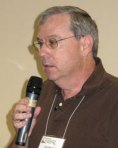
Nick Pikarsky

Nick Pikarsky

They gave a presentation on the two solar systems they have installed at their farm. One is a passive hot water collector, and the other system powers a water pump and freezer.

Water pump and freezer system

This system is used to pump water from the well for the bar, with extra power for the freezer. The pump provides water for everyday farm water uses. The system also does minor irrigation in a small area, consisting of a small mist house and a garden size drip system.

Solar panels mounted on roof of pump house

Solar panels mounted on roof of pump house

Two solar panels are mounted on top of the freezer shed, and were set at a compromise angle between summer and winter positions. Since the farm is so close to the equator in South Florida, the angle of the sun doesn’t change much through the seasons. They learned quickly that you can’t have anything obscuring the panels. A crawling vine once covered part of one panel and reduced the power output considerably. When nearby branches and a flowering bush grow too tall, they get cut back. After hurricanes Katrina and Wilma, the farm was without power two weeks and one week accordingly. The house didn’t have water, but the barn did, and the system was hooked up to supply for the house as well.
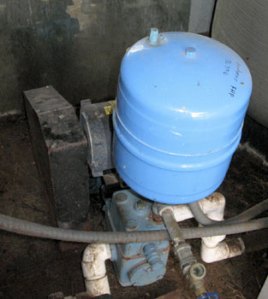
24V Dankoff Solar Force irrigation pump

24V Dankoff Solar Force irrigation pump

Nick researched the literature, spoke with suppliers and decided on a 24 volt DC system as a compromise between efficiency and economy. 12V systems are cheaper but more inefficient, and 48V systems were a bit too expensive. Choose the type of pump based on your needs — depth of water table, amount of water needed, and duty cycle — then size the solar system accordingly, Margie advised. The irrigation pump is a 24V Dankoff Solar Force (now sold under the Conergy brand). The pump system runs off 2 deep-cycle batteries charged by a small controller unit. It also powers a Sundanzer 8 cu. ft. 24V freezer chest, and a couple of emergency lights in the barn and pump house.

Inverter and breaker panel mounted on wall. Batteries, pump and freezer on the floor of the pump house.

Inverter and breaker panel mounted on wall. Batteries, pump and freezer on the floor of the pump house.

Passive water heater

Bee Heaven participated in Florida Keys GLEE a few years ago and learned about TCT Solar, which makes passive solar hot water collectors. This particular model is 50 gallons, and was mounted to serve as the roof of an outdoor shower stall. It provides plenty of scalding hot water for the shower, a washing machine, and the big sink in the barn. The passive system heats water only when there is sun, but the water stays hot! It requires no electricity and works really well.
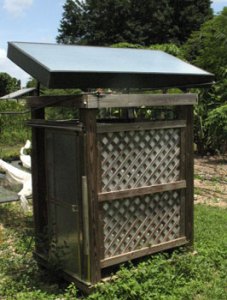
Passive collector mounted on top of outdoors shower.

Passive collector mounted on top of outdoors shower.

Barn system

There is a third system at Bee Heaven Farm that has not yet been fully implemented. It will someday serve all the power needs in the barn. The barn
has a Solar 5K 48V inverter which is designed to power the walk-in cooler, tools, lighting and standard 120V AC appliances. Nick and Margie calculate they need a total of 20 PV panels to power the barn, along with a complement of 40 batteries. It’s too expensive to do that all at once, so they’re hoping to implement in stages, and are excited about new government incentives to help with the purchases. There’s an A-B switch in the barn to go on or off the grid. Margie said their goal is to be completely free of the grid.
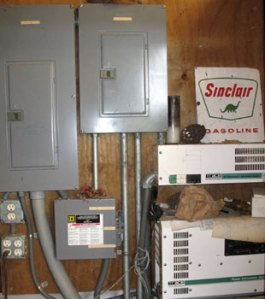
Barn breaker panels, A-B switch and inverter.

Barn breaker panels, A-B switch and inverter.

FPL has a net metering policy, but there’s a catch, Margie cautioned. They require you to be down when they are down, and you have to buy power from FPL at retail, yet they buy power from you at wholesale, and that’s a significant difference. FPL will give you credit if you generate more power
than you use, but at the end of the year, you lose any credit you’ve accumulated. Other speakers on the panel cautioned users to try to negotiate a contract with their utility that’s equitable.

Costs

These are the prices when the systems were built 5-7 years ago. Some things are now cheaper, and some things are more expensive.

Solar collector for hot water $1400 (copper piping and stand not included)

Pump and freezer system:
Batteries 400 x 2
Sharp modules (solar panels) 550 x 2
Rack for modules 200
Charge controller 140
Dankoff pump 2500
Pressure tank 200
Sundanzer freezer 1200
Total: 6200 + labor & shed

Download system diagrams for the solar water heater and for the solar pump.

Thanks to Margie for collaborating in the writing of this article, and Nick for the systems diagrams.

Florida avocados

Florida avocados

Take a good look at this season’s avocados, and savor the flavor. This season might be the last time you’ll see and taste Florida avocados, if the laurel wilt disease gets out of control in Miami-Dade County. It’s caused by the tiny redbay ambrosia beetle that carries a fungus which kills avocado trees fairly quickly. In Brevard County, where there are mostly neighborhood avocado trees, UF/IFAS researchers spotted the disease in October 2008, and by May 2009 the same trees were dead.

Last week the rumors were flying among growers that laurel wilt was spotted in a Miami-Dade grove. This Wednesday night it was confirmed by UF/IFAS scientists at an emergency meeting held at the Miami-Dade County Extension Service office. Over 120 concerned avocado growers packed into the meeting room to hear the grim news. This tiny beetle presents an enormous threat to their livelihood.

One tree suspected of laurel wilt came back positive for the disease using DNA testing, and four additional samples had been taken from three other groves for testing. This is the first time the fungus has been spotted in a commercial grove in Miami-Dade County, and it could severely harm a $12.7 million industry.

There are 892 growers and 6773 acres of avocado groves in the county, according to the USDA’s 2007 survey. If the disease cuts Florida’s commercial avocado crop in half, which could happen, it could cost the state $27 million in total economic impact and enough lost worker hours to equal 275 full-time jobs, according to UF/IFAS.

Plant inspectors and insect trappers from the Florida Dept. of Agriculture are surveying the ag production area from Goulds south — 140 commercial groves numbering 7000 acres, according to their calculations. They’re also setting sentinel traps to track the beetle, similar to what’s being done with fruit flies. Their survey should be 70-80 percent complete by this Friday Aug. 7. At the time of the meeting, they have not yet found signs of the beetle or laurel wilt.

If you’re a homeowner and you have an avocado tree in your yard, check it often for signs of beetle infestation or laurel wilt. If you see anything suspicious, call the Division of Plant Industry at 305-252-4360 or 888-397-1517 and an inspector will come take a sample for DNA testing. If the sample comes back positive, you’ll be instructed on how to treat or properly dispose of your tree. Do NOT cut it down and throw it on the street for pickup, because that could help spread the beetle and its fungal infection to other trees in the neighborhood.

State representatives Ileana Ros-Lehtinen and Mario Diaz-Balart were instrumental in pushing the USDA to give UF a $1.9 million grant to find a way to mitigate and manage laurel wilt. Other local politicians who are actively involved are County Mayor Carlos Alvarez and County Commissioner Katy Sorensen.

On the other hand, Mayor Carlos Alvarez recently drafted a new county budget that slashed Extension office funding to almost zero. The office also relies on matching funds from UF/IFAS to educate and support growers and homeowners about plant diseases and various agricultural issues. This drastic cut couldn’t come at a worse time. County commissioners are meeting on Sept. 3 and 17 (after their August vacation) to vote on the new budget. Please take the time to call or email your county commissioner and tell them not to cut funds for Extension and local growers! For locavores, doing that’s a no-brainer, right??

Miami-Dade County Mayor Carlos Alvarez http://www.miamidade.gov/mayor/
Miami-Dade County Commissioners http://www.miamidade.gov/commiss/
Representative Ileana Ros-Lehtinen http://ros-lehtinen.house.gov/
Representative Mario Diaz-Balart http://mariodiazbalart.house.gov/index.html

More info on redbay ambrosia beetle
http://www.doacs.state.fl.us/pi/enpp/ento/x.glabratus.html

More info on laurel wilt
http://trec.ifas.ufl.edu/RAB-LW/
http://www.doacs.state.fl.us/pi/enpp/pathology/laurel_wilt_disease.html

Miami-Dade County Extension Service http://miami-dade.ifas.ufl.edu
Miami-Dade DERM http://www.miamidade.gov/derm/
UF/IFAS Tropical Research & Education Center http://trec.ifas.ufl.edu/
Fla. Dept. of Agriculture and Consumer Services http://www.doacs.state.fl.us

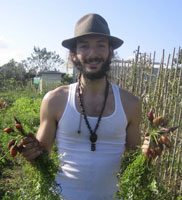
Zak H Stern

Zak H Stern

Well, not my prostate, but Zak’s. Former WWOOF-er Zak H Stern has been blogged by Budget Travel. Read the article here.

And what’s a WWOOF-er, you ask? That would be a volunteer apprentice who has registered through WWOOF (World Wide Opportunities on Organic Farms), and works on a chosen farm for room and board for an agreed period of time. For the volunteer, it’s a great way to learn about different crops, pick up various farm skills, and meet all kinds of people. Some volunteers already have experience from other farms, others are just starting out. For the farmer, it’s a great way to pass on knowledge, and get willing workers for a nominal cost.

Two seasons ago (2007-2008) Zak worked at Bee Heaven Farm for part of the season. He was cheerful and positive, and a delight to have on the farm and at market. His poem, While my Prostate is Small, was published in The COMmunity POST, the weekly Redland Organics CSA newsletter that goes out with the shares. I got his permission to reprint it. Enjoy!

While my prostate is small

By Zak H Stern

While my prostate is small….
I will travel the world,
Take long bus trips with no ac
And not stop fifty times to pee
While my prostate is small….
I will sleep through the night,
Drink a milkshake before bed
Without a hint of fright.
While my prostate is small….
I will enjoy my youth,
Smooth skin, sharp eyes,
A mind looking for truth.
While my prostate is small….
I will learn how to live,
How to love, how to listen,
How to take, how to give.
While my prostate is small….
I will withdraw from school,
Go live on a farm,
and learn how to live off the fat of the land.
While my prostate is small….
I will live my life to the fullest.

Published in The COMmunity POST, Week 15, March 8, 2008

real-dirt-book
The Real Dirt

The last presenter of the last session of the last day was not to be missed. Peter Burkard, farmer and published author, spoke on the panel “Local Food System Development.” I got his permission to post his speech it its entirely, and you can read it below. Although this blog’s focus is on Redland Organics’ growers and customers, what Peter has to say is extremely relevant in South Florida.

If you want to read more, his book is called The Real Dirt: An Organic Grower’s Journey and the Values that Inspired It, which sells for $15 a copy. You can get yours by contacting him at PMBORGANIC(at)aol.com. (Please remember to take out the (at) and put in the @ when you order your copy. Am doing this to ward off spam.) Peter is also a member of the Southwest Florida Small Farmers Network.


The Holy Land is Everywhere

You know those cars that are plastered with like 30 bumper stickers? I recently saw one of these at a small farmers’ market in the little town of Burnsville in the North Carolina mountains. Now usually I find myself in agreement with most sentiments on such cars and I knew this one would be no different, being at a farmers’ market and all. So I checked it out a little and among other incisive bits of wisdom like “JUST SAY NO TO SEX WITH PRO-LIFERS” was this one that I really liked: “THE HOLY LAND IS EVERYWHERE”. The idea being that we need to be worshiping the entirety of creation, not just some special place set aside.

As we go forth today, this is the vision and mind-set which it is our job to create amongst the majority of our fellow humans, an understanding and appreciation of the immense value of undegraded land. Undegraded land can either have massive value as wilderness, through free ecosystem services, or in its agricultural potential…and the best of farms will marry the two. We need the majority of the public to not only reject agribusiness but along with it reject the mechanistic, controlling, reductionist worldview upon which agribusiness is based. To do that, they need to both be informed about the reality of industrial agriculture and be able to experience our positive alternatives and the fabulous food that we provide.

Wendell Berry draws the distinction between industrialism and agrarianism, in which industrialism is a way of thought based upon monetary capital and technology, while agrarianism is a way of thought based on a sustainable relationship with the land, preferably land on which the farmer’s family lives. He sees this as the overarching theme of all our efforts…the replacement of the dominant destructive, unsustainable model which is destroying the prospects for life as we know it, with our culture of respect for our life-support system and each other.

This industrialism we fight against is easy to see every day throughout Florida in the destruction of excellent farmland under the developer’s bulldozers. Following this near-removal of food growing from areas most inhabited by people, industrial, chemicalized agriculture is given a quasi-monopoly over our food supply. Rural land is of course cheaper but is also conveniently out of sight, so the vast majority of the public has little if any direct contact with the production of their food.

It is up to us to change that, locating some of our attractive, sustainable alternatives in urban and suburban settings. By reversing the trend of the last hundred years of separating people from their food supply, we both provide the model for a more sustainable future and enlist more of the admiring public to our cause. For it is only after a sufficient number of voters and tax payers join our side that the policy makers will be forced to act or else be removed from office.

There are a great many successful alternatives to the industrial food system. We need to be those model alternatives, as well as unite with our like-minded brethren, be they fellow producers, consumers, or even competitors, so as to maximize our political clout. In our area of the Central and South Florida West coast, we’ve established a small farmer network to enable us to learn from each other and also acquire strength through numbers, so as to better move our agenda forward politically. I’d like to encourage other areas to create their own similar networks of growers.

Still, at the same time, I’d like to promote what I see as the best answer, one for which all you need is yourself. There is one food production method that stands out as clearly the most local, most fresh, most flavorful, most fun, most providing of exercise, and most reducing of our carbon footprint. That is growing as much of your own food as possible at home. Even though I’ve sold produce at a market for 30 years, I’ve never thought of this backyard grower as competition; instead, once one tastes the difference in truly fresh, organic produce, they will surely seek out what they aren’t able to grow themselves from us market gardeners. Besides, it is the right thing for the world. (If you’ve ever been to Europe, you’ve seen not only vastly better transportation and health-care systems but also a lot more–in some places almost universal–home food and flower gardens.) So grow as much as you can at home or in a community garden and buy the rest from other small farmers, local whenever possible.

Time for some policy specifics. These are specific elements of the food system that we need to be striving towards. I’ll call it my “John Lennon section”…Imagine these things being reality. But we need to do more than just imagine them and work towards making them a reality. So pick one or two you are most passionate about and get involved with making them happen.

–URBAN FRINGE AND EVEN URBAN LAND WHICH IS SET ASIDE IN PERPETUITY FOR AGRICULTURAL ACTIVITY, THROUGH THINGS LIKE CONSERVATION EASEMENTS AND SPECIAL TAX TREATMENT,
–MORE URBAN COMMUNITY GARDENS,
–THE TEARING DOWN OF URBAN LAWS WHICH PROHIBIT AGRICULTURAL ACTIVITIES,
–MORE SCHOOL GARDENS AND CHILD EDUCATION ABOUT FOOD PRODUCTION,
–MORE WIDESPREAD USE OF FARM-TO-SCHOOL PROGRAMS,
–MORE FARM TO CHEF CONNECTIONS,
–MORE ACCESS TO FRESH, LOCAL FOOD FOR THE URBAN POOR,
–CONTINUED EXPANSION OF FARMERS’ MARKETS AND CSA’S,
–MUNICIPAL AND EXTENSION EFFORTS TO ENCOURAGE MORE HOME FOOD PRODUCTION, MEANING TRADITIONAL AND ROOFTOP GARDENS, FRUIT TREES, SPROUTING, CHICKENS, BEES, RABBITS, TILAPIA, AND SO ON,
–MORE TOWN-TO-FARM NUTRIENT CYCLING,
–THE CONTINUATION AND/OR EXPANSION OF GOVERNMENT INCENTIVES FOR GREEN ENERGY AND WATER CONSERVATION MEASURES IN CONJUNCTION WITH FARMING,
–COUNTIES PROVIDING LAND FOR ESTABLISHING WORKING FARMS DESIGNED TO TRAIN NEW FARMERS,
–MATCHING PROPERTY OWNERS WITH POTENTIAL SHARECROPPING OR RENTING FARMERS AND GARDENERS,
–MANDATING WORKING FARMS OR COMMUNITY GARDENS BE INCORPORATED IN ALL HOUSING DEVELOPMENTS OVER A CERTAIN SIZE. (NEEDED TO BE DONE LONG AGO.)

This isn’t a world we need to create from scratch. Most of these ideas are already being turned into reality somewhere in this country…or they exist in a fledgling way and we just need to help them along.

There will always be battles with those seeking to preserve an obsolete and unsustainable status quo. These same Chamber of Commerce types either have fought in the past or still do fight for things like making toxic children’s toys, nuclear weapons, and gas guzzlers, destroying old growth forests, hunting and processing whales, and preserving the slave trade.

Just because an activity creates jobs–creates commerce–does NOT mean that is something we as a society should be encouraging…not an automatic good. As I give talks in support of my book, The Real Dirt, an Organic Grower’s Journey and the Values that Inspired it, this is one of the points I emphasize, the merging of a strong sense of ethical values with our livelihoods. It should be clear that we are on the right side. Just remember that what we envision is a far more just, peaceful, and sustainable world, and that fact alone should sufficiently inspire us.

written by Peter Burkard

800 strong

What do you get when you put a bunch of small farmers together in a large room? Spontaneous combustion of brain synapses! You’ll need to get a burn permit! On Saturday the official count was 800 participants (700 pre-registered and 100 walk-ups) from all corners of Florida. There was lots of good energy from all those people meeting and sharing information and ideas.

This was the first year for the Small Farms Conference, and word is the UF/IFAS organizers want to do it again. Commissioner Bronson said in his speech that he’s budgeted $15K for the conference next year.

Also, if you weren’t able to attend and feel bad about missing out, speakers’ handouts and recordings or transcripts of presentations will be posted on the conference website in a week or so. Will keep you posted.

Thanks to Gabriele, Margie, Hani and Nick for collaborating on this post.