Feeds:
Posts
Comments

Posts Tagged ‘Margie Pikarsky’

Happy Thankgiving to all my readers out there! When you sit down to your holiday feast, don’t forget to give thanks for all the farmers who worked hard to bring you those fresh, local organic green beans, maybe the heritage turkey, and the other delicious things on your table.

Thanks to Margie Pikarsky of Bee Heaven Farm, and her family and helpers for providing me with some of the freshest and healthiest food I’ve eaten, and for extending their friendship, kindness and generosity. Thanks also (in no particular order) to Chris and Eva Worden, Robert Barnum, Dan Howard, Hani and Mary Lee Khouri, Cliff Middleton, Gabrielle Marewski, Steven Green, Muriel Olivares, Miguel Bode and Mario Yanez.

This blog wouldn’t exist without their cooperation. Their farms wouldn’t exist without your support. Eat local!

Read Full Post »

You haven’t heard much from me these last few months because I’ve been feeling de-pleated by condo board responsibilities. Small problems were looking big, and bigger problems looked overwhelming. Time to hit the reset button, so I headed down to Bee Heaven a couple weeks ago to get some much needed farm therapy.

Fall is planting time down in Redland. Summer is just too hot, too buggy and too rainy to grow much of anything. Planting starts in the fall near the start of the dry season, and harvest is in the spring. The growing seasons here are completely upside down compared to the temperate climate Up North.

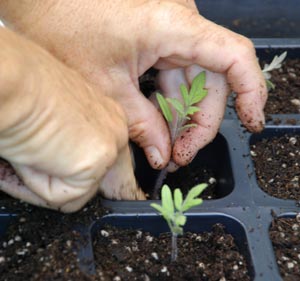
Jane transplanted starts into their first pot.

It was a sunny, breezy Saturday afternoon when I visited Bee Heaven. Margie and her manager Jane Cameron were puttering in the potting shed, transplanting starts, or baby vegetable plants, from the seed beds to small pots. A bit of soil went into the bottom of each pot. Then, one by one, Jane carefully lifted each start out of its bed and placed it into its new home. She set the plant down with one hand, put more soil around it with her other hand, and pressed the soil down gently. The work had a gentle rhythm. Repeat it a hundred more times or so, and that was the afternoon’s task.

Growers will tell you there’s something hopeful about working with baby plants. “It’s so exciting to see them grow from seed,” Jane said. “It’s empowering. It feels exciting to see the plant first poking out of the ground, to see the energy. You don’t get that with a plant already started that you buy from the store.”

You’re not thinking of bugs, or disease or freeze — although those risks are there, even at that stage. Some starts’ leaves had evidence of bugs munching along the edges. Another start revealed a small black caterpillar near its roots, as it was gently lifted out of the seed bed. The caterpillar would grow up to be a butterfly of some kind, Margie explained, but in the meantime, it was chomping on little roots. A note was made in the input log, and the plants and seed tray would be treated with BT for the caterpillars.

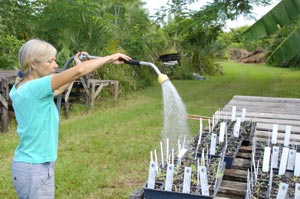
Jane watered the starts after transplanting.

Labels were placed into the pots, so you knew what kind of plant it was. Trays of pots were taken to an outside table made from old wooden pallets, where the starts soaked up sunshine and would grow and grow. Jane watered them lightly, holding the spray nozzle high above, so water fell gently like rain. Smaller starts were waiting on other outside tables nearby, still too young for transplant, maybe in a few more days. “They aren’t finished sprouting,” Margie said. When the little plants show four true leaves, then they are ready to pot up.

Most of the starts I saw that day were heirloom tomatoes with exotic names like Black From Tula, Red Calabash, and Zapotec Pleated. “ZAP-otec. That sounds like the name of a pharmaceutical,” Jane remarked. “Feeling de-pleated? Try Zapotec,” Margie chimed in. “It will pleat you back in no time!” Now there’s an idea — plant (and eat) heirloom tomatoes to be re-plete with energy.

Work done, I ambled around Bee Heaven to see how other things were going. Bright sunshine and clear blue sky were good medicine in itself, and soon I was feeling less de-pleated. A light breeze ruffled leaves, and mockingbirds twittered background music from a nearby big tree and from the hedges further over. Roosters living in nearby chicken tractors got a call and response chorus going. “Ur-ur-ER-ah,” one rooster called, and another responded an similar way, and another, and suddenly I was in the midst of poultry opera. “Here I am, how are you,” they seemed to be calling. “I am here,” I told them. (Yes, I talk to chickens.) I am here, I am fine, pleated and replete. Farm therapy works!

Read Full Post »

Hey there Redland Ramblers! This is guest blogger Melissa Contreras, founder of Urban Oasis Project. Last night, a group of Redland and Miami farmers and I returned home after a weekend at the 2nd Small Farms/Alternative Enterprises Conference in Kissimmee.  I have always been a farmer wannabe, and as such, I grow food for my family, my pet bunnies,  and a few friends on my 1/4 acre “urban homestead” in Kendall.  I was happy to learn at the conference that this small scale of growing is now being officially considered as part of our local food system, as it should be! The University of Florida/IFAS Extension isn’t just for big farmers and agribusiness, we little people count too!

Cast of characters on this road trip included Bee Heaven Farmer Margie, husband Nick, their new farm manager Jane;  Muriel of Little River Market Garden, Mario of Guara Ki Farm, and me.  Meeting up at Bee Heaven Farm, we shared a ride in Margie’s van, and took the scenic route around the shores of Lake Okeechobee on US 27. It was beautiful! Cows and egrets mingled in green pastures, Nick spotted a sandhill crane, and tri-color herons searched for underwater snacks near the water’s edge. Along the way, through what was once a river of grass, we saw fields of sugarcane (some organic), and picturesque views which reminded me that while South Florida is often thought of as a metropolitan built environment,  it still belongs to Mother Nature, though altered. Hopefully Everglades restoration will return the river of grass to its rightful owner.

After 4 hours on the road, we arrived  and checked into our hotel, the posh and sophisticated Super 8. Hey, we’re on a budget, OK?  I shared a suite with Margie, Nick, and Jane.  After repeated promises to Jane that I would not confuse her with my husband in the middle of the night, she decided to sleep on the couch.  But, I digress.  We had a nice lunch in restored historic downtown Kissimmee, an old cowboy town with a lovely lakefront, unique and colorful wooden homes with gingerbread mill work, unusual eateries and watering holes like ” The Wicked Stepsister,” a nice antique shop,  and so much more. Next time you’re in the neighborhood, take a break from the Orlando area tourist traps and visit this authentic town.

After lunch, we proceeded to the Osceola Heritage Center, site of the next day’s convention, for meetings of the Greater Everglades Foodshed Alliance, the Florida Food Policy Council, and a pre-conference pow-wow with Extension agents from all over Florida. The Greater Everglades Foodshed Alliance meeting was a recap of the Food Summit for interested parties.  The Florida Food Policy Council will “bring together stakeholders from diverse food-related sectors to examine how the food system is operating and to develop recommendations on how to improve it. FPCs may take many forms, but are typically either commissioned by state or local government, or predominately a grassroots effort. Food policy councils have been successful at educating officials and the public, shaping public policy, improving coordination between existing programs, and starting new programs.” (definition from foodsecurity.org). We are forming a soon-to-be Miami food policy council. (Contact Mario if you have a stake in our local food system and want to participate in this new effort.)

Those who attended the informal Friday meetings were also invited to sit in on the pre-conference event for UF/IFAS Extension agents, in which  Dr. Danielle Treadwell, Dr. Mickey Swisher, and Sarasota Extension’s new Director and doctoral candidate Evangeline “Van” Linkous  talked about our changing food system from their different points of view and varying expertise.  Dr. Treadwell champions UF research in organic and sustainable farming, and feels that “educating consumers is an important part of what we do.”  Dr. Swisher said she was surprised to discover the “30 mile problem” in which  “disadvantaged communities in Florida’s urban areas often live 30-40 miles from areas where fresh produce is grown.”  Van’s background is in planning and she was a member of the Delaware Valley Regional Planning Council before coming back to Florida from Philadelphia and the University of Pennsylvania. She feels that much urban zoning could be converted to mixed-use, which could mean urban farms and farm stands could be located within high-density urban populations, giving urbanites more access to local, fresh food. A kindred spirit! We are quite lucky to have these three women in Extension.

So, if you’re catching on to a theme here, the conference tagline was “Sustaining Small Farms…Strengthening Florida’s Communities.”  There was much excitement among attendees on that Friday before the conference, seeing our major research institutions catching onto interests of so many people in local food,  and food justice as a paradigm shift from our current system. Further illustrating this point is the choice of keynote speaker for the conference: my personal hero, Will Allen, founder of  Growing Power, Inc.

I will write more about Saturday of the conference in the next post:  keynote speaker Will Allen, the three Florida Innovative Farmer Award winners, conference workshops, amazing local foods lunch and more! Come back  for more, including pictures!

Read Full Post »
The Miami Herald has a nice long article about farmer Margie Pikarsky and the Redland Organics CSA. You can find it in today’s Tropical Life section.

Bee Heaven owner: Organic farming is good for the foodie — and the land

BY ANA VECIANA-SUAREZ
aveciana@MiamiHerald.com

On a muggy summer day, as bruised clouds gather overhead, Margie Pikarsky wends her way through her five-acre farm pointing proudly at strips of cultivated land and a growing compost pile. A blue jay swoops across the field, then another. In the distance a cardinal trills.

“I feel very connected to nature,” Pikarsky, 57, says, and then adds with a wry laugh. “I have this Mother Earth thing going.”

Indeed. Pikarsky has been running Bee Heaven, an organic farm in South Dade’s Redland area, since 1995, when pesticide-free farming was more a boutique niche than thriving business. She harvests honey, collects organic eggs and grows familiar fruits and vegetables as well as exotics — mostly Asian greens — that do well in South Florida soil.

She sells them at farmer’s markets and through Redland Organics, a community-supported agriculture (CSA) initiative that allows people to buy “shares” upfront in return for weekly selections of organic produce during the growing season.

Read more: http://www.miamiherald.com/2010/07/22/1740121/mother-earth.html

Read Full Post »

It was a great weekend for the Fairchild Farm & Garden Festival, sunny and warm but not yet excruciatingly hot. A lot was going on, and I was running from presentations in the Garden Room to various tents and back trying to keep up with interesting events.

Margie Pikarsky

On Saturday morning, I dropped in at the start of Farmer Margie Pikarsky’s presentation on preserving the harvest. As usual, she gave a well-researched lecture on different kinds of food preservation — freezing, fermentation, dehydration, brining, pickling, and canning. The handout was chock full of info, and if you didn’t make it to the lecture, you can download it here.

As for following recipes and instructions that one finds published in books and elsewhere, Margie cautioned that “all publications are geared for the temperate zone. You can’t listen to them. We have to modify. It’s warmer here and chemical reactions happen faster. You have to be aware of that. Sauerkraut can take two weeks instead of two months. There’s potential for vegetables to go bad in the heat when fermenting. Start with organic produce which has less mold and contaminants.” Margie recommended the book Wild Fermentation if you want more detailed instructions for pickling and fermenting.

Stopped by the Cooking Demo tent to say hi to Laura Lafata aka La Diva Cucina. She was getting ready to give a presentation on preparing radishes with vermouth. The radishes looked happy to be in her hands, and vermouth is an ingredient I hadn’t thought of using. (The recipe is at the bottom of this post.)

Laura Lafata aka La Diva Cucina

Talk about food makes me hungry, so I prowled around looking for something good to eat. Found Margie standing in line at the bright green Native Conch stand, and we got the last of the conch salad. Thanks to Jason for taking care of us!

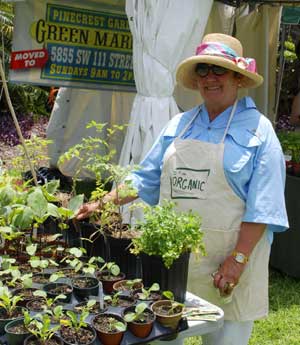
Claire Tomlin with potted herbs for sale.

Came across Claire Tomlin of The Market Company showing off her latest venture. She has ready-to-grow raised garden beds made of cedar that you can use in your yard. The beds come in a package that includes a cedar frame, soil blend, vegetable and herb starter plants, organic fertilizer and mulch. All you need to add is water and sunlight. It’s too late to plant almost all vegetables now (remember, we’re in the sub-tropical growing zone), but there’s more than enough time to get ready for fall planting. If you’re interested, contact Dylan Terry at dylanjterry(at)gmail.com or call 786-436-7703 for more information.

Pure beeswax candles available from Miguel Bode the beekeeper.

Said hi to Miguel Bode the beekeeper on the way out, and he revealed that he has the largest display of pure beeswax candles anywhere (well, at least at the festival). He uses 35 different molds to shape wax extracted from his hives.

My name was on the schedule for the food bloggers panel Saturday afternoon, but I couldn’t stay due to a schedule conflict. Thanks to Melissa Contreras and Annie Stamps of Fairchild for inviting me to participate in the Festival. You ladies rock!

Sauteed Radishes and Tops over Bow Tie Pasta with Apple Chicken Sausage

Serves four main dinners or six starter plates


Ingredients:

1 lb. box of bow tie pasta
1 bunch of radishes with tops attached
1 pkg. organic apple chicken sausage
dash white vermouth
good quality extra virgin olive oil
kosher salt and pepper

Method:

Put on pasta water to boil and once boiling, add a dash of salt. Cook pasta al dente in salted water for a minute or two less than suggested When pasta is cooked, drain into colander, saving 1/2 cup of pasta water. Set aside.

While pasta is cooking, fill sink with cool water. Chop radish tops and wash thoroughly in water, let green tops drain and then blot dry with paper towels. Wash radishes and thinly slice, set aside.

Heat large fry pan on stove and slice sausages into quarter inch slices. Add olive oil to pan and when heated, add sausages, lower heat to medium high and saute until brown on both sides, being careful not to burn. Put cooked sausage on plate, set aside.

Heat fry pan again and add more olive oil if needd. Once hot, add radishes, lightly salt and cook over medium heat until light brown on both sides. Turn up heat and add a dash of vermouth to deglaze pan, continue cooking radishes for another 30 seconds or until soft. Add to the plate of cooked sausage.

Heat fry pan and use more oil if necessary. Lightly saute greens until just wilted, add pasta to pan along with sausages and radishes and thoroughly combine all ingredients. Cook over medium high heat for another minute, adding a bit of pasta water to make a light sauce. Season with salt and freshly ground black pepper and serve immediately. Drizzle extra virgin olive oil over each serving.

Copyright (c) La Diva Cucina Inc.

Read Full Post »

« Newer Posts - Older Posts »