Feeds:
Posts
Comments

Archive for the ‘vegetables’ Category

You haven’t heard much from me these last few months because I’ve been feeling de-pleated by condo board responsibilities. Small problems were looking big, and bigger problems looked overwhelming. Time to hit the reset button, so I headed down to Bee Heaven a couple weeks ago to get some much needed farm therapy.

Fall is planting time down in Redland. Summer is just too hot, too buggy and too rainy to grow much of anything. Planting starts in the fall near the start of the dry season, and harvest is in the spring. The growing seasons here are completely upside down compared to the temperate climate Up North.
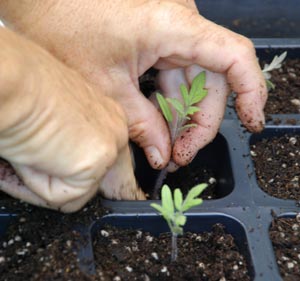
Jane transplanted starts into their first pot.

It was a sunny, breezy Saturday afternoon when I visited Bee Heaven. Margie and her manager Jane Cameron were puttering in the potting shed, transplanting starts, or baby vegetable plants, from the seed beds to small pots. A bit of soil went into the bottom of each pot. Then, one by one, Jane carefully lifted each start out of its bed and placed it into its new home. She set the plant down with one hand, put more soil around it with her other hand, and pressed the soil down gently. The work had a gentle rhythm. Repeat it a hundred more times or so, and that was the afternoon’s task.

Growers will tell you there’s something hopeful about working with baby plants. “It’s so exciting to see them grow from seed,” Jane said. “It’s empowering. It feels exciting to see the plant first poking out of the ground, to see the energy. You don’t get that with a plant already started that you buy from the store.”

You’re not thinking of bugs, or disease or freeze — although those risks are there, even at that stage. Some starts’ leaves had evidence of bugs munching along the edges. Another start revealed a small black caterpillar near its roots, as it was gently lifted out of the seed bed. The caterpillar would grow up to be a butterfly of some kind, Margie explained, but in the meantime, it was chomping on little roots. A note was made in the input log, and the plants and seed tray would be treated with BT for the caterpillars.
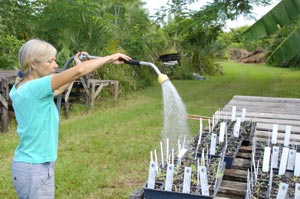
Jane watered the starts after transplanting.

Labels were placed into the pots, so you knew what kind of plant it was. Trays of pots were taken to an outside table made from old wooden pallets, where the starts soaked up sunshine and would grow and grow. Jane watered them lightly, holding the spray nozzle high above, so water fell gently like rain. Smaller starts were waiting on other outside tables nearby, still too young for transplant, maybe in a few more days. “They aren’t finished sprouting,” Margie said. When the little plants show four true leaves, then they are ready to pot up.

Most of the starts I saw that day were heirloom tomatoes with exotic names like Black From Tula, Red Calabash, and Zapotec Pleated. “ZAP-otec. That sounds like the name of a pharmaceutical,” Jane remarked. “Feeling de-pleated? Try Zapotec,” Margie chimed in. “It will pleat you back in no time!” Now there’s an idea — plant (and eat) heirloom tomatoes to be re-plete with energy.

Work done, I ambled around Bee Heaven to see how other things were going. Bright sunshine and clear blue sky were good medicine in itself, and soon I was feeling less de-pleated. A light breeze ruffled leaves, and mockingbirds twittered background music from a nearby big tree and from the hedges further over. Roosters living in nearby chicken tractors got a call and response chorus going. “Ur-ur-ER-ah,” one rooster called, and another responded an similar way, and another, and suddenly I was in the midst of poultry opera. “Here I am, how are you,” they seemed to be calling. “I am here,” I told them. (Yes, I talk to chickens.) I am here, I am fine, pleated and replete. Farm therapy works!
Read Full Post »

Crazy carrots

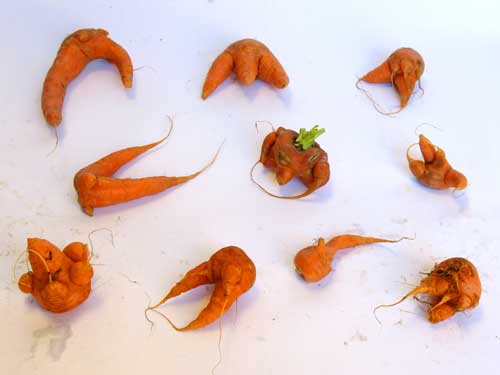
These are carrots from last week's share. Some look like teeth, others like udders.

Read Full Post »

Hope springs forth

The heirloom tomatoes available at market are winding down. They will be very scarce for weeks, assuming there won’t be patchy frost tonight, which still has potential to damage weakened plants.

Weeks later, you can still see signs of freeze damage at Bee Heaven Farm — and signs of recovery.

Tomatoes blooming after the freeze

The heirloom tomatoes vary in damage. Some varieties are all but destroyed by the freeze. The ones with blackened, shriveled leaves are not coming back. A few varieties are re-growing leaves and still have fruit ripening on the vines. And some look positively fluffy with their green leaves and are blooming again. The quantity and quality of the second bloom tomatoes remains to be seen. If they’re just as nice as the ones we’ve had so far, expect more heirloom tomatoes at market, just not right away, perhaps in a couple months. “Hope springs forth!” Margie said.

Purple Pod heirloom beans blooming after the freeze.

The heirloom beans have been all but decimated. One variety with purplish stems, known as Purple Pod, re-grew leaves and looks a lot better than a week or two after the freeze. It’s even putting out a few, shy blooms. The question is, will those blooms set and grow beans. And if they grow, how big and what shape are they going to be in? All of that is doubtful because they have a big problem with mildew. “The leaves are all frozen out and the plants are more vulnerable to everything,” Margie explained to me.

This is the lasting, almost hidden freeze damage that takes weeks to emerge. The Gold of Bacau beans aren’t coming back very well at all, and the few pods that have grown since the freeze are small and misshapen, nothing you would want to buy at the market or find in your CSA box.

Freeze damaged Gold of Bacau beans.

Read Full Post »

Potato heaven

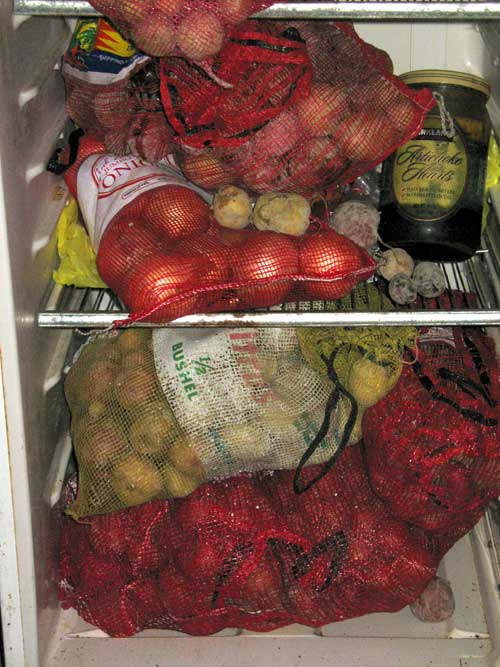
Robert Barnum called the other day to tell me about his preps for the upcoming Potato Pandemonium dinner. He has two refrigerators bulging with potatoes, both the one in the kitchen and the one on the front porch. Not everybody has a frig on the front porch brimming with spuds, so this I had to see for myself. Yup, the porch frig held at least four onion sacks stuffed with spuds, and the kitchen frig held another two full sacks.

The kitchen table held an overflow of potatoes in several buckets, which were sorted by shape and color — dark skinned that look purplish-blue-black inside, red skinned that are red inside, golden ones, and delicate fingerling potatoes. Not sure how many pounds that adds up to, but it looks like it should be enough for 30 guests. Robert explained the spuds were gleaned from a nearby field. There’s nothing wrong with the tubers; they’re perfectly good to eat, and would otherwise be plowed under.

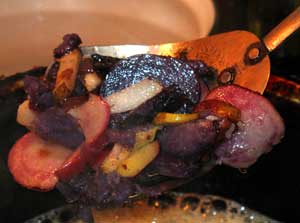
Multicolor chips just out of the fry pot

Robert mentioned he browsed through his extensive collection of cook books for inspiration, but the actual dish will be his version. “All these recipes come out of my head,” he explained. “Some of these have never been done, or done the way I plan to do it.” He offered a test batch of Potato Salad with Carambola Relish, which had a tropical and tangy dressing, no typical mayo here. Bubbling in a pot of oil were Multicolored Chips, and sure enough some potatoes are really red inside, looked like small chioggia beets. Ultimately each dish will be interpreted with his signature flair — tropical ingredients straight from his grove, and food cooked over a wood fired grill.

If you’ve never been out to Possum Trot Tropical Fruit Nursery, it’s a unique corner of Redland, not to be missed. Intrigued? Here’s the link to register for the Pandemonium.

Read Full Post »

In a pickle

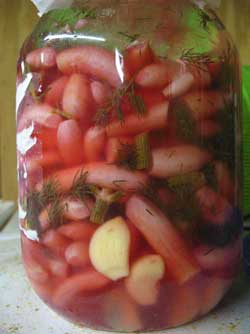
French breakfast radishes pickling in brine.

Overwhelmed by the amount of radishes that you’ve been seeing in your CSA box? Couldn’t possibly eat them all right away? Pickle them! I didn’t know you could make brine pickles with radishes until I saw a giant jar on top of the barn refrigerator. Thanks to farm intern Jamie for telling me how the pickles were made. Haven’t tried the recipe yet but it looks simple enough. These radishes would be a tasty addition to a meat and cheese sandwich.

Brine-cured pickled radishes

Brine is 1 tbsp. pickling salt to 1 qt. water
cut up or whole radishes
several whole cloves of peeled garlic
several branches of dill

Wash and trim radishes. Wash and chop dill. Put them in a jar along with peeled garlic. Mix up brine and pour over radish mix until just covered. Fill any air space at the top with a plastic bag full of water. It also acts as a weight to hold the radishes down. Cover mouth of the jar with a coffee filter kept in place with string or elastic. Let the pickles sit undisturbed for at least 3 to 5 days. Test the pickles after 5 days, may want to ferment them longer. When they are to your liking, move the jar to chill in the refrigerator. The pickles will keep for several months.

Read Full Post »

« Newer Posts - Older Posts »