Feeds:
Posts
Comments

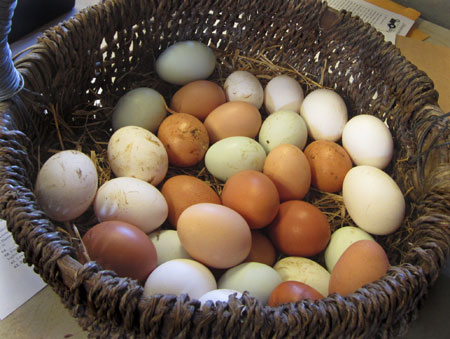
White chickens lay white eggs, and brown chickens lay brown eggs.
Not true! The color of the egg is determined by the color of the hen’s ear lobe. White ear lobes indicate white eggs, and red or pink earlobes indicate brown, blue or green eggs, depending on the breed. Some brown breeds, like Rhode Island Red, will lay brown eggs, but other varieties of brown hens don’t. Cuckoo maran hens, which have black and white speckled feathers, lay dark brown eggs, with shells so dark in color they are called “chocolate” eggs.

So does that mean that green chickens lay green eggs?
Sort of. Araucana hens will lay green, blue, and pinkish beige eggs. They do not have green, blue or pink feathers. Look at their feet! Instead of white, yellow or gray, their feet are blue or green, ranging from pale to deep in color.

Speckled eggshells mean the hen was stressed.
Maybe. Certain breeds consistently lay speckled eggs. Or the dark brown speckles could be tiny flecks of blood that were deposited on the egg as it traveled through the oviduct. It just happens sometimes, no worries. The hen is ok and the egg is good to eat. If a hen is stressed, such as when she is moulting (seasonally shedding feathers) or getting henpecked (ever hear of pecking order? it’s real), she will stop laying eggs for a while.
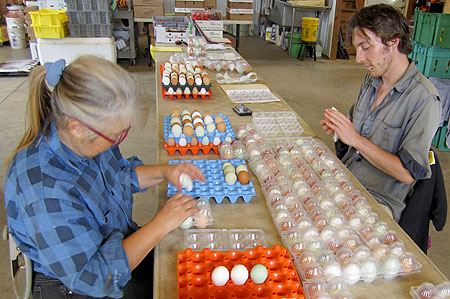
Farm interns Donna and Jon pack eggs.

A blood speck next to the yolk of an egg means that the egg is fertilized.
Not true! It means that a little bit of blood got inside the shell as the yolk was developing. You can tell if an egg is fertilized only if you hold up the egg to light (candling) to see if an embryo is forming. The egg needs to be incubated in warmth (under the hen in a nest, or in an incubator) for the embryo to develop.

An orange yolk is more nutritious than a yellow yolk.
Mostly true. But, some breeds, like the araucana, lay eggs with a light colored yolk. A deep yellow or orange yolk egg generally comes from a pastured or free range hen, which has a chance to eat a variety of nutritious things, including plants and bugs. Marigolds have carotenoids which make egg yolk color darker. An orange yolked egg is not necessarily fresher than a lighter yolked egg.

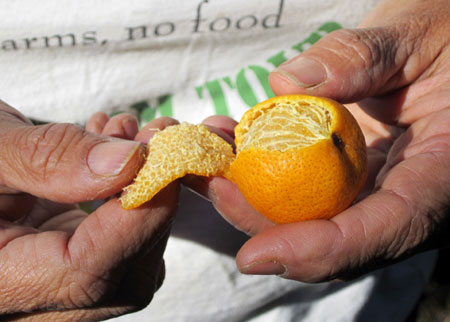
Cleopatra tangerines

Tangy indeed! Pop one of the little segments into your mouth and you’re in for a sweet-sour surprise. The Cleopatra variety of tangerine is not shy about expressing its citrusy flavor, but it’s downright sour if you pick it too early. The best fruits are the ones that have just fallen off the tree, their tartness mixing with sun-ripened sweetness.

Farmer Margie peels a tangerine.

Cleopatras are a mandarin orange characterized by loose skin and small segments. (This is a variety that’s usually canned, not sold fresh, because of its tartness.) The fruit itself is small, no more than two inches across. The skin is edible, and has a high oil content, making it very aromatic and quite tasty. You can eat the skin fresh, or use it in cooking, like for for orange beef, to flavor oil for the dish.

The Cleopatra tree is usually used as rootstock, to graft another variety of citrus onto it, because it can tolerate cold and resists most diseases. It has been around for a long time, introduced from Jamaica to Florida before 1888.

During the winter season (January and February), the tree will be loaded down with fruit. The season for Cleopatras is starting to wind down, so get them while you can!

Slow Love

A special Dinner in Paradise
to benefit Slow Food Miami
Edible School Gardens.

Saturday Feb. 11, 2012
5:00 pm – Reception
5:30 pm – Farm Tour
6:00 pm – Five Course Dinner

Featuring fresh local seafood and fresh harvest from the farm
prepared by Chef Kira Volz of Broadwings Catering, along with Chefs Christopher Siragusa and Rebecca Kleinman.

Purchase farm dinner tickets here.

If you prefer not to drive to the farm yourself, Park Ride and Sip on a luxury coach, while the Square One Organic Vodka mixologist prepares seasonal cocktails to sip on the way to the farm. $30 roundtrip ticket includes parking. Coach departs at 4:00 pm from St. Stephens parking lot in Coconut Grove.

Purchase Slow Love bus tickets here.

Survival cooking skills

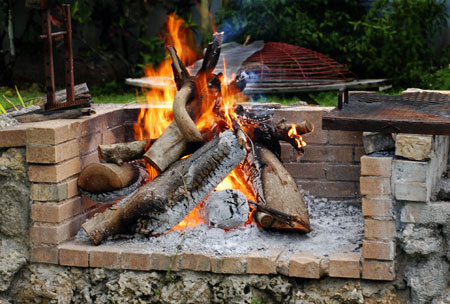
Cooking with fire!

Saturday, Feb 4, 2012
9:30 am – 3:00 pm

Possum Trot Tropical Fruit Nursery
14955 SW 214th St.
Miami, FL 33187-4602
305-235-1768

Convert your gas grill to burn wood. That’s the first of a series of survival workshops that grower/chef Robert Barnum is teaching. “I teach long lost trades, arts, and skills that can be quite useful if the situation becomes less than what it is today,” he said. Robert has teamed up with Jason Long, who started the Re-skill Florida school “where anyone can teach and learn honorable useful skills,” according to their web site.

Bring your gas grill to the workshop and Robert will show you how to safely modify it. Instead of expensive gas, burn wood, and use your own. Being able to cook with wood can save money, and teach you how to be more frugal and self-reliant. Robert has plenty of experience when it comes to being self-reliant. Over the years, he has experimented with which woods are better for cooking, and which are to be avoided. “Don’t use Brazilian pepper, oleander or mango,” he suggested, “as the smoke can be irritating to some people.” He should know — he has 40 acres of trees on his Possum Trot Tropical Fruit Nursery.

There’s room for 35 people, but hurry as the class is selling out. The cost if the workshop is $50. It includes the registration fee, instructor fee, grill modification fee, and lunch. You could try to register online at the Re-skill Florida web site, but when I checked on Wednesday night, the registration button was still not working.

Instead, call Robert at 305-235-1768 to let him know you’re coming, and bring cash to pay at the door. If you haven’t been to Possum Trot before, you will need directions, as the entrance is a bit tricky to find, and the address doesn’t show up on some GPSs.

The gas-to-wood grill workshop is the first of a series of Saturday classes. Coming up:

Feb. 11th — Rope making with Agave
How to make rope from agave plants. Optional: Learn preparation, and camp out the night before.

Feb. 18th — Introduction to economic botany
Learn which trees and plants to grow in your yard for food and other useful purposes.

Feb. 25th — Kitchen frugality
What to do with all the food in your CSA box, and how to shop in bulk and store food.

Mango Cafe at the Fruit and Spice Park

Recently, farmer Margie Pikarsky and her husband Nick, daughter Rachel and my friend John DeFaro joined me for lunch at the Mango Cafe, located at the Fruit and Spice Park. The Cafe is by the park’s main entrance, inside a rustic wooden house. We were there for the fruit sampler, made fresh daily from whatever fruits are ripe that day in the park. Talk about extreme locavore! But the sampler was sold out so we had to console ourselves with other fresh, local delicacies like Florida lobster roll, shrimp tacos, and mango-passionfruit shakes.

John DeFaro and Margie Pikarsky dig in to lunch. On the wall behind is a picture of the Redland District Band of 1913, and a Redland District tour guide from the 1930s.

The wooden house is not as old as it looks. It’s a reproduction. The original was built in 1902 by pioneer settler John Bauer, and got destroyed by Hurricane Andrew in 1992. The replica was rebuilt with FEMA funds and completed in 2002. Inside the house (where the original living and dining rooms would have been), framed old photos and maps lined the walls. Over by the front door was a map with charred edges. It’s the original planting guide that had been saved from a fire. By our table was a series of pictures of the first land survey for the park in 1944, the year the park opened. Sixty eight years ago the land was almost completely barren, except for a scattering of royal palms and Australian pines. Big difference between then and now!

Now the 37 acre county park is lush with over 500 varieties of fruits, vegetables, spices, herbs and nuts, some you may have heard of, and many you might not have. Tram tours will take you around, and the guide will fill you in about the plants and the history of the park. Where else in Miami would you find 150 varieties of mangos, 75 varieties of bananas, crimson gak fruit, sensitive cacao growing sheltered in a heated greenhouse, or annatto to stain your fingertips bright orange?

Park manager Chris Rollins

Fruit and Spice Park is also the site for many events and festivals throughout the year. Coming up this month is the Redland Heritage Festival, which will feature historical exhibits, local arts and crafts, and an Everglades reptile show. At one Heritage Festival a few years ago, I remember admiring a collection of vintage tractors, and at another sampling a variety of mangoes. Coming up later in the year, the park will also host the Asian Culture festival, the Redland International Orchid Show, and summer’s Mango Mania.

If you haven’t been to the park, go! It’s nothing you’ve seen before. If you haven’t gone in a while, go again. They’ve added an herb garden and a large pond edged with many varieties of bamboo. The place changes as different plants bloom and bear at different times of the year. Word to the curious — please don’t pick fruits off trees, but you may taste what has fallen to the ground. Most plants or fruits are safe to nibble, unless a sign warns otherwise.

37th Annual Redland Heritage Festival
January 21 and 22, 2012 10 a.m. to 5 p.m.
Admission $8 (children 11 and under are free)

Fruit and Spice Park
24801 SW 187 Ave. Homestead FL
305-247-5727